
Home » SAF vs Renewable Diesel: Who Wins the HEFA Capacity?
SAF vs Renewable Diesel: Who Wins the HEFA Capacity?
10 min read · Nov 2, 2026 · By Alex
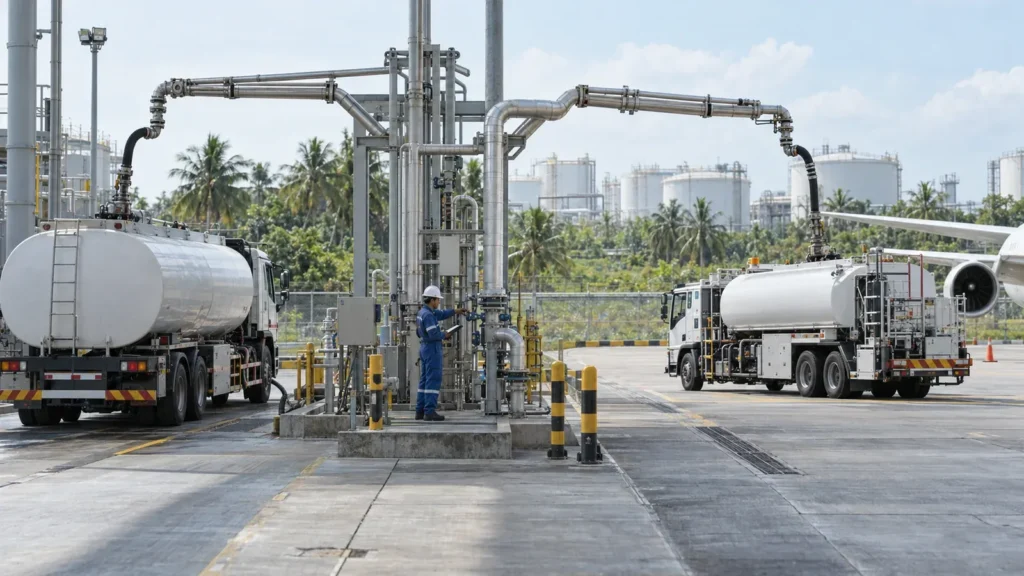
Sustainable aviation fuel is the headline product of every airline decarbonization plan, yet the barrel behind it is fought over by two destinations. Renewable diesel, a fuel chemically equivalent to petroleum-based distillate fuel, usually wins that barrel on pure economics today. It sells into a far larger pool and its policy value is bankable now. Aviation keeps two levers: a jet engine needs liquid fuel, and a mandate reserves a sub-share for the jet pool. SAF vs renewable diesel is therefore a contract and mandate question before it is a chemistry question.
Two refineries can grow from one HEFA (Hydroprocessed Esters and Fatty Acids) unit. Also, the same used cooking oil can land in either finished pool. What separates them is who buys the barrel, under which mandate, and for how many years. That is the frame I use when I read a feasibility study in Southeast Asia.
In short
- Duty: Renewable diesel runs at any concentration in diesel engines; SAF is certified only up to a 50% blend.
- Maturity: HEFA carries Technology Readiness Level 9 and costs 2 to 2.5 times conventional aviation fuel, the lowest of the SAF routes.
- Cost driver: Feedstock is the lion’s share of HEFA production cost, so both products price off the same lipid pool.
- Scale: SAF reached 1.9 Mt in 2025, only 0.6% of jet fuel consumption, while the diesel pools remain far larger.
- Contract: An offtake agreement (a contract committing a buyer to take the output) must be binding and cover the 8 to 14 year tenor to reach a final investment decision (FID).
In this article
The short answer: diesel wins the barrel today
Renewable diesel is chemically equivalent to petroleum-based distillate fuel, so it runs in diesel engines in any concentration. SAF is a drop-in fuel. It replaces conventional jet fuel without changes to engines or airport infrastructure. Blenders can use SAF up to a 50% share in certified blends. On the production side, HEFA carries a Technology Readiness Level of 9, has long served renewable diesel production. It also offers the lowest levelized cost of the SAF routes. That sits at 2 to 2.5 times the cost of conventional aviation fuel, with feedstock taking for the lion’s share of total production costs. Renewable diesel and biodiesel are biomass-based diesel fuels used to comply with renewable volume obligations in the Renewable Fuel Standard administered by the U.S. Environmental Protection Agency.
What this means for you: the chemistry is not the constraint, the destination contract is. I would ask which pool the binding offtake targets. That single clause decides whether your barrel sells as jet fuel or as road diesel.
The chemistry is the same, the destination is not
HEFA sits on one lipid stream and yields several finished products. Therefore, you choose the destination after conversion rather than during it. Biodiesel, a distinct product, typically blends at concentrations of 20% or less. Meanwhile, renewable diesel runs at any concentration. On the aviation side, as of July 2023, ASTM International had approved eleven conversion processes for SAF production. Eleven others sat under strict evaluation. Eight of the eleven approved processes sit under ASTM D7566. That specification covers aviation turbine fuels containing synthesised hydrocarbons. The remaining three follow ASTM D1655 because of co-processing. Co-processing feeds the bio-based material into an existing refinery alongside conventional fossil jet fuel. Mandates and specifications set the split, not the reactor. This is why I read low-carbon fuel mandates before I open any plant model.
What this means for you: I would map every mandate that touches your buyer . I would size the jet line only after that. A co-processing unit and a standalone unit carry different certification work and different offtake expectations.
One feedstock pool, two claimants
Waste fats, oils and greases form the second generation feedstock: high emission reduction potential, relatively limited availability. The category includes used cooking oil, animal fat, industrial grease and residues such as palm oil mill effluent. That pool is finite at the collection end. The six major Asian used cooking oil exporters collect an estimated 3,700 to 5,000 kilotonnes a year. Malaysia, the regional hub, exports 321 kilotonnes against only 48 to 71 kilotonnes collected at home. Looking forward, IATA estimates 189 Mt of oil-based feedstock available for bioenergy and biofuels in 2050. SAF production could use 82 Mt of that. That leaves a theoretical maximum of 63 Mt for oil-based HEFA SAF, just over 15% of SAF in 2050. I map that pool against SAF feedstock availability in Southeast Asia before I accept any capacity claim.
What this means for you: I would price both products off the same delivered feedstock cost. Diesel and jet compete for identical litres, and the side that signs the longer contract usually takes them.
What the barrel earns: price and policy
At current price levels, the SAF premium added USD 3.6 billion in fuel costs for the industry in 2025. SAF prices exceed fossil-based jet fuel by a factor of two. In mandated markets that gap reaches a factor of five. Meanwhile SAF was only 0.6% of total jet fuel consumption.
Renewable diesel in the United States averaged about 170,000 barrels per day in the first quarter of 2025, down 12% from a year earlier. Over the same period production capacity rose nearly 20%, and major producers reported operating losses. The flat blender’s tax credit was due to give way to a carbon intensity credit. The value of that credit depends on the carbon intensity of the feedstocks. ReFuelEU aviation sets a 2% SAF share at EU airports from 2025 and 1.2% synthetic aviation fuels from 2030.
I compare those stacks in sustainable aviation fuel price terms before I underwrite.
What this means for you: I would model realized margin per tonne under both regimes. Diesel can post operating losses while capacity grows. Aviation can pay five times the conventional price without any guarantee of supply.
What the plant looks like: one asset, two slates
Producers can process HEFA feedstocks in two ways. Standalone SAF plants typically take 3 to 5 years to build and start production. Alternatively producers co-process in existing refineries with modest modifications. Capital profiles then diverge by route: HEFA is the most mature and cost-effective and faces feedstock constraints. Alcohol-to-Jet carries higher capital costs from on-site ethanol processing. Gasification-Fischer Tropsch is capital-intensive and needs solid feedstock handling. Power-to-Liquid has the highest capital requirements because it relies on renewable electricity, electrolysis and CO2 capture. A multi-product plant can switch its slate within those constraints. This is how I read advanced biofuels multi-product plants: as optionality rather than as a fixed jet asset. The counterweight is physical, since air transport requires a liquid fuel as long as aircraft propulsion involves jet engines.
What this means for you: I would underwrite the plant as one asset with two saleable slates. Then I would price the option to send each tonne to jet or to diesel. That avoids assuming either destination by default.
Three ways the aviation side loses the capacity
First, the offtake stays a non-binding memorandum. A project needs contractually binding agreements to reach FID. Investors often require offtake agreements covering at least 70 to 80 percent of annual capacity. Some lenders want reliable offtake for 100 percent of the SAF. That cover must run across the full loan tenor of 8 to 14 years. Second, lenders finance total capacity rather than the sub-share the plant can actually sell as SAF. Installed SAF capacity globally reached 4.4 Mt by end 2024, and developers planned 6.9 Mt of expansion. Meeting 2030 demand needs an additional 5.8 Mt of final investment decisions by 2026. Third, the margin depends on a credit whose rules move, since U.S. renewable diesel production fell while capacity grew over the same period.
What this means for you: I would treat capacity headlines as unaudited until the binding offtake, the financed sub-share and the credit assumptions all sit in the same model.
The order I would run the work in
I would fix the destination of the barrel before I fix the equity story. The sequence I use is simple. First comes buyer mandate exposure, then the offtake that covers the loan tenor. After that comes the feedstock contract shared with the diesel side, then the product slate clause, then the credit exposure. The SAF refinery lifecycle runs through five phases: conceptualization, pre-feasibility, FID, construction and commissioning. Also, each phase raises the cost of changing the destination. Feedstock supply is where I spend the most time, because it is the line both slates draw on. Also, the line where price volatility enters the model. My feedstock supply work starts at the collection point, not at the gate.
What this means for you: I would not write an equity story early. The mandate, offtake, feedstock, slate and credit questions all need answers, in that order. A change at any earlier step resets every number after it.
How I would run this if it were my file
First, I would model the SAF line with published volumes. Global SAF production was 1.9 Mt in 2025, 0.6% of jet fuel consumption. Projections put 2.4 Mt in 2026. I would then stress the capacity claim against the forecast. That forecast puts global SAF production capacity at around 20 Mt by 2030, with the project success factor applied. HEFA refineries account for about 95% of total volume. I would check demand against the 17 million tonnes per annum expected by 2030. That is approximately 4 to 5 percent of total jet fuel consumption. Finally I would keep the policy lever in view, because ReFuelEU aviation reaches 70% SAF from 2050. Switzerland adopted the same regulation from 1 January 2026.
What this means for you: I would present the SAF case as a mandated sub-share. It grows inside a diesel pool that stays larger for years. Then I would let the binding offtake decide how much of my barrel actually follows it.
Sources
- IATA, September 2025.
- IATA, 9 December 2025.
- World Economic Forum with Kearney, February 2025.
- ICCT, February 2022.
- U.S. Energy Information Administration, 4 June 2025.
- European Commission, 15 November 2026.
Frequently asked questions
Is renewable diesel the same thing as SAF?
No. They share the same lipid feedstock pool, but renewable diesel is chemically equivalent to petroleum-based distillate fuel and can be used in diesel engines in any concentration, while SAF must meet aviation specifications. Eight of the eleven conversion processes approved as of July 2023 sit under ASTM D7566, and blended aviation fuels are certified to reach a SAF blend of up to 50% (U.S. Energy Information Administration, IRENA, European Commission).
Why do HEFA plants usually make diesel instead of jet fuel?
Because feedstock is the lion’s share of production cost, diesel sells into a much bigger pool with credits tied to the carbon intensity of the feedstocks, and the aviation sub-share starts small: 2% SAF at EU airports from 2025, rising to 70% only in 2050 (IATA, September 2025; U.S. Energy Information Administration; European Commission).
How much oil-based feedstock can realistically go to aviation by 2050?
Of an estimated 189 Mt of oil-based feedstock available for bioenergy and biofuels in 2050, 82 Mt could be used for SAF production and the theoretical maximum of oil-based HEFA SAF is 63 Mt, which is just over 15% of the SAF in 2050 (IATA, September 2025).
What decides whether my project receives a HEFA barrel at all?
The contract. Investors often require at least 70 to 80 percent of annual capacity to be covered by offtake agreements, some lenders require 100 percent of the SAF produced for the full tenor of 8 to 14 years, and binding agreements are what carries a project to a final investment decision (World Economic Forum with Kearney).
Not sure your project would survive a credit conversation?
A short call is usually enough to see where your project stands.
If you are weighing a HEFA project in Southeast Asia at feasibility stage, I run the mandate, offtake and feedstock questions in that order before any equity story is written, and investor introductions come after the file holds together rather than before.
I do not provide investment advice or arrange investments. I act as a strategic advisor and facilitator.

Alex, Founder of WeConnect Asia
I help low-carbon fuel and carbon removal project developers in Southeast Asia secure the commercial and financial partners needed to reach FID.
Related articles

Pitching a Climate Tech Company to Strategic Investors: What the Corporate Has to Believe Before It Writes a Cheque
How to pitch a climate tech company to strategic investors: the metric cluster, the readiness evidence and the ask that corporates fund.

Biomethane: What It Is, How It Is Made and Who Buys It
Biomethane is biogas cleaned to pipeline quality. I explain how it is made, how it differs from biogas and who buys it in Southeast Asia.

CO2 Sourcing for e-SAF Projects: What the Rules Allow and What the Contract Must Say
Biogenic CO2, direct air capture or industrial flue gas: which sources an e-SAF plant may use, what they cost and which contract terms make the fuel certifiable.

Operating Performance Guarantees for SAF Plants: What Lenders Ask For
Minimum guarantees, performance damages, retesting and who stands behind them: the operating guarantees a SAF plant needs to keep debt and offtake intact.

EPC and Construction Risk in SAF Plants: What a Lender Actually Tests
FEED scope, convertible EPC, performance guarantees and damages caps: the construction risk questions a SAF project must answer before financial close.

Matching Feedstock and Offtake Risk Back-to-Back in a SAF Project: How Lenders Read the Chain
Lenders do not buy a feedstock plan and an offtake plan separately. They buy the link between the two, and the link is where most SAF files break.