
Home » UCO Collection in Southeast Asia: How the Oil Actually Reaches a Plant
UCO Collection in Southeast Asia: How the Oil Actually Reaches a Plant
10 min read · Nov 2, 2026 · By Alex
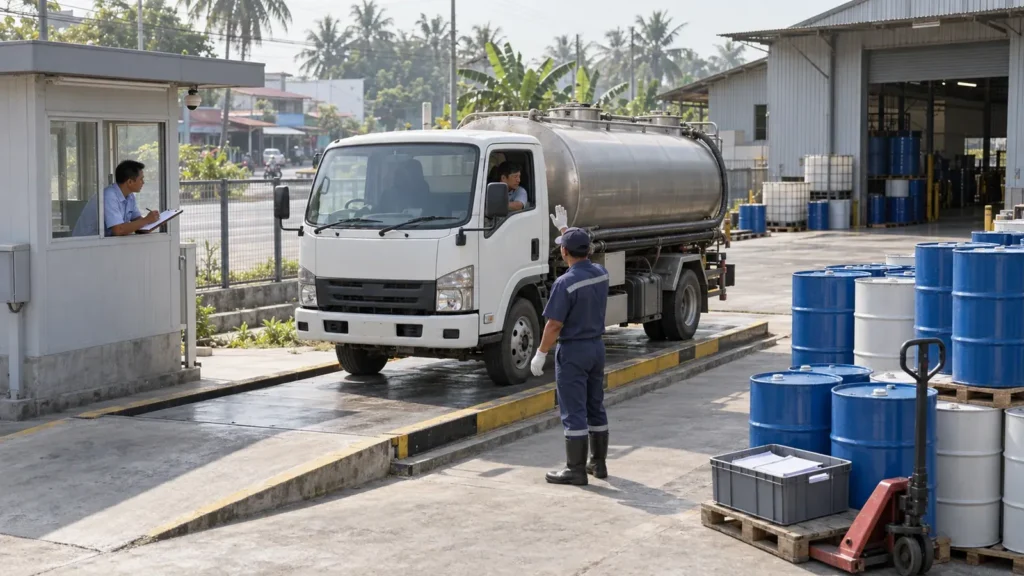
The oil moves from restaurants, hotels and food processors to a local collector, then to an aggregator (a consolidator holding one depot volume) at a depot, then to a renderer or exporter, and only at the depot is it weighed. That weighbridge record is the first volume you can prove, and it is where a supply contract can attach. Everything upstream of it is a chain of custody (the documented trail from a collecting point to a plant) problem rather than a logistics problem. The sustainable aviation fuel feedstock availability page for Southeast Asia sets the wider frame. I narrow it to used cooking oil and one question: at which hand does UCO collection become contractable?
I write from the supplier side: I am looking at a used cooking oil business that already has volume on the ground and needs a buyer that will accept the paperwork. The five hands below are not a theory, they are the sequence that a lender, a certifier and a plant will each ask you to evidence.
In short
- Chain: five hands from kitchen to plant, with a single weighbridge in the middle.
- Measurement: the depot records the weight, the kitchen only declares it.
- Cost: feedstock carries the lion’s share of conversion cost.
- Proof: accounting records stand in for physical segregation.
- Contract: offtake covering 70 to 80 percent of annual capacity for 8 to 14 years.
In this article
The short answer: five hands before the plant
A point of origin is any site where cooking oil is used and discarded: a household kitchen, a restaurant fryer, a hotel kitchen, a food processing line. An aggregator is the party that buys from several local collectors, holds the oil at a depot, and sells one consolidated volume onward.
The estimate starts from urban households, urban restaurants and food processing, the sectors and regions from which it is easiest to collect. A collector takes the oil from those points of origin and hands it to an aggregator. The aggregator holds the depot volume, and that is where a weighbridge record starts to exist, with a date, a weight and a counterparty attached. Transport & Environment describes the same structure as points of origin feeding collecting points. Nothing in that sequence measures the oil before it reaches the depot.
What this means for you: a supply agreement cannot attach to a restaurant, so I would draw the collection radius around aggregators and depots rather than around kitchens.
The five hands, one by one
(a) The cooking site: restaurants, hotels, food processors and household kitchens, where volume is estimated rather than measured. (b) The local collector, who usually works from a self-declaration rather than a visit: most UCO sources do not need to be visited or audited, they provide a self-declaration to their collecting point. (c) The aggregator and depot, where volumes from many collectors are combined into a single lot. (d) The renderer or HEFA plant, where waste oils become fuel (HEFA is hydroprocessed esters and fatty acids, the dominant pathway). (e) The exporter or regional buyer that moves the lot onward.
An audit of a point of origin is only required if it supplies more than 5 tonnes of UCO per month, which for a restaurant would mean cooking more than 50 tonnes of fries a month, the average monthly production of 18 fast food restaurants.
The buyers at hands (c) and (e) are named: sustainable aviation fuel in Southeast Asia lists Pertamina, EcoCeres and FatHopes Energy among planned plants that take UCO.
What this means for you: only hands (b) and (c) can sign, and only hand (c) gives you a weight you can measure.
What the volumes are, and what they cost to collect
The ICCT estimates current collection across six Asian exporters in kilotonnes (a kilotonne is a thousand tonnes): China 3,086 to 4,097, India 224 to 326, Indonesia 182 to 266, Japan 70 to 122, Malaysia 48 to 71, and the Republic of Korea 88 to 107, giving 3,700 to 5,000 kilotonnes across the six countries.
Those are national totals rather than contractable volumes. Collecting UCO in Asia is around 30% cheaper than in Europe, which is one reason the material moves instead of staying where it was cooked. I read that gap as the reason Asian material reaches distant markets at all.
The cost line at the plant follows the same logic. Feedstock accounts for the lion’s share of total HEFA production costs, and the price of the feedstock can vary significantly with market supply and demand dynamics. That volatility is the background to what sustainable aviation fuel costs.
What this means for you: I would price my volume against a published reference rather than a spot conversation, because the plant’s own cost line moves with the same feedstock.
What the buyer's certificate has to cover
Voluntary schemes certify through mass balance: physical segregation is not required, accounting documents track the product, and those documents are what an auditor checks. The chain of custody you will be asked to produce is therefore a paperwork chain rather than a physical one.
The largest scheme certifying UCO biofuels is ISCC, with at least 1,275 valid UCO certificates registered on its database. Certificate count is not audit depth. Based on an analysis of ISCC-certified collectors in China, Malaysia and Indonesia, only 9% of certified collecting points had a sample of their points of origin audited, and for the remaining 91% no audits were conducted.
The failure mode is straightforward: UCO fraud means unsustainable feedstock, such as palm oil, reported as UCO, and laboratory analysis is limited in practice because of the physical and chemical similarity of the two.
The criteria a buyer applies before it accepts the certificate are set out in sustainable aviation fuel sustainability criteria.
What this means for you: I would write audit and sampling rights into the supply agreement before any volume is declared, because the certificate alone does not establish where the oil came from.
What a lender needs before it funds the chain
Investors often require at least 70 to 80 percent of annual capacity to be covered by offtake agreements, and some lenders require 100 percent of the fuel produced to have reliable offtake covering the full loan tenor, which typically runs 8 to 14 years. Spreading default risk across several parties matters to them, because airline credit ratings are on average lower.
Offtake contracts are often non-binding memoranda of understanding, and contractually binding agreements are needed for a project to reach a final investment decision. A data room full of memoranda does not close. Those requirements are settled before construction begins, because the financing decision comes first.
That is where a collection chain either survives or fails. A chain that cannot be evidenced at the depot rarely survives the test, because the lender is buying an evidence trail as much as a fuel stream. The financing sequence is set out in how to finance a SAF project.
What this means for you: I would treat the depot record as the unit of credit and draft the offtake around it before a lender asks for it.
Three ways the chain breaks
First, exports that exceed collection. Malaysia exports 3 times more UCO than is collected in the country, and Malaysia exports 321 kilotonnes against 48 to 71 kilotonnes collected at home, while the country also imports large quantities as a regional hub.
Second, tracing. Intra-Asia trade makes it difficult to trace the origins of UCO, and gutter oil, illicit cooking oil recycled from waste collected from fryers, sewer drains and grease traps, competes for the same material inside the region. The material is chemically usable either way, so only paperwork separates the two streams.
Third, demand. Global airlines are set to triple demand for UCO by 2030, and the 2030 SAF targets would require at least twice the UCO that can be collected in the United States, Europe and China combined.
What this means for you: all three push in the same direction, so a buyer that accepts a declared volume without a weighbridge record is paying for a gap it cannot see.
The order I would run the work in
I would map the collection radius first, then contract the aggregators, then reconcile weighbridge records against declared points of origin, then fix sampling rights, then set the price reference, and only then offer the volume to a plant.
The plants that consume that volume are already in the region. A facility in Tuas, Singapore processes UCO and animal fats at 1,000,000 tonnes a year and is operating, and planned plants in Johor Bahru, Sabah, Sei Mangkei, Cilacap and Phra Khanong run on UCO or UCO with POME. POME is palm oil mill effluent, a residue generated by the palm oil mills that are dense across Indonesia and Malaysia. Those are the counterparties a supply agreement has to fit, and feedstock supply work is organised around that fit. I would also confirm which pathway each plant runs, because HEFA standalone plants take 3 to 5 years to build and start production.
What this means for you: I would not approach a plant before the reconciliation step, because a radius without reconciled weighbridge records is a forecast rather than a supply.
How I would run this if it were my file
I would check my collection plan against published baselines before writing any offtake draft: 3,700 to 5,000 kilotonnes collected a year across the six major Asian exporters, Europe consuming 130,000 barrels a day, 8 times its own collection, more than 80% of current SAF volumes produced from UCO, ASEAN led by Indonesia and Malaysia producing over 80% of the world’s palm oil as of 2023, and demand cover of 70 to 80 percent of annual capacity expected by investors.
The palm oil baseline matters for a second reason: the ICCT notes that the physical and chemical nature of waste oil makes it possible to disguise virgin palm oil as waste oil.
A plan that sits inside those ranges is discussable. A plan that claims a share of the 3,700 to 5,000 kilotonnes without naming its depots is not.
What this means for you: I would bring the radius, the depots, the weighbridge records and the draft offtake to the first meeting, and let the gaps show early.
Sources
- ICCT, February 2022.
- Transport & Environment, 18 June 2024.
- Transport & Environment, 15 November 2026.
- IRENA, December 2024.
- IATA, September 2025.
- World Economic Forum, February 2025.
Frequently asked questions
Where is used cooking oil actually collected in Southeast Asia?
From urban households, urban restaurants and food processing, gathered by local collectors who pass the oil to aggregators and depots, and from those depots to renderers, exporters or regional biofuel plants. The ICCT builds its estimate on exactly those sectors, and Transport & Environment describes points of origin feeding collecting points. In Southeast Asia the same sequence applies, with the depot as the first point where a weight is recorded rather than declared.
How much can a collection network realistically deliver?
The published estimates put Indonesia at 182 to 266 kilotonnes a year and Malaysia at 48 to 71 kilotonnes, against 3,086 to 4,097 kilotonnes in China, with 3,700 to 5,000 kilotonnes across the six major exporting countries. A single network should be sized from its own named depots inside one of those ranges, because the national figure includes material that never reaches an exporter cleanly.
What should a UCO collection agreement contain?
A list of points of origin with monthly tonnage, the mass balance records behind them, audit rights above the 5 tonne monthly threshold, a price reference, and offtake coverage of at least 70 to 80 percent of annual capacity for 8 to 14 years. Those are the documents a certifier and a lender will each ask for, and they have to describe the same oil.
Why do exports from a country sometimes exceed what it collects?
Because the country acts as a trading hub rather than only a producer. Malaysia both imports and exports large quantities of UCO, and its exports run at 3 times its collection, so the export number is a trade balance rather than a domestic total. The same pattern is what makes intra-Asia tracing harder.
Not sure your project would survive a credit conversation?
A short call is usually enough to see where your project stands.
If you want to know whether your own network can carry an agreement at plant scale, I would walk the chain with you before any draft goes out, starting from the list of depots you can actually name. Investor introductions is the conversation to have next.
I do not provide investment advice or arrange investments. I act as a strategic advisor and facilitator.

Alex, Founder of WeConnect Asia
I help low-carbon fuel and carbon removal project developers in Southeast Asia secure the commercial and financial partners needed to reach FID.
Related articles

Pitching a Climate Tech Company to Strategic Investors: What the Corporate Has to Believe Before It Writes a Cheque
How to pitch a climate tech company to strategic investors: the metric cluster, the readiness evidence and the ask that corporates fund.

Biomethane: What It Is, How It Is Made and Who Buys It
Biomethane is biogas cleaned to pipeline quality. I explain how it is made, how it differs from biogas and who buys it in Southeast Asia.

CO2 Sourcing for e-SAF Projects: What the Rules Allow and What the Contract Must Say
Biogenic CO2, direct air capture or industrial flue gas: which sources an e-SAF plant may use, what they cost and which contract terms make the fuel certifiable.

Operating Performance Guarantees for SAF Plants: What Lenders Ask For
Minimum guarantees, performance damages, retesting and who stands behind them: the operating guarantees a SAF plant needs to keep debt and offtake intact.

EPC and Construction Risk in SAF Plants: What a Lender Actually Tests
FEED scope, convertible EPC, performance guarantees and damages caps: the construction risk questions a SAF project must answer before financial close.

Matching Feedstock and Offtake Risk Back-to-Back in a SAF Project: How Lenders Read the Chain
Lenders do not buy a feedstock plan and an offtake plan separately. They buy the link between the two, and the link is where most SAF files break.