
Home » UCO for SAF: Is Used Cooking Oil a Reliable Feedstock?
UCO for SAF: Is Used Cooking Oil a Reliable Feedstock?
10 min read · Nov 2, 2026 · By Alex
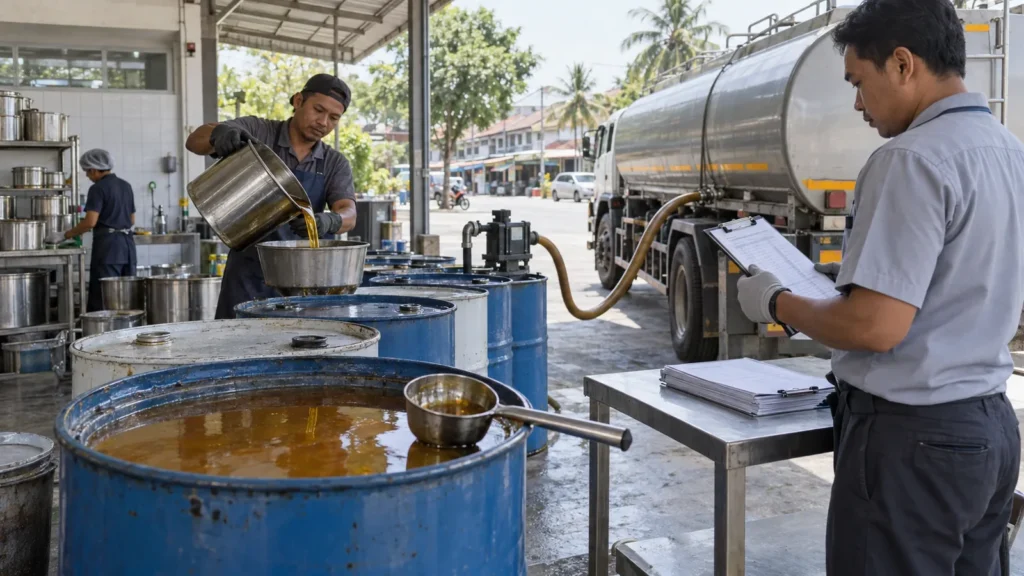
Yes as a physical base, because more than 80% of current sustainable aviation fuel (SAF) volumes start from used cooking oil (UCO). In addition, no as a financing base until one contract writes in collected volume, proof of origin and price. That stays the honest answer before I argue anything else. I set it against the wider SAF feedstock availability in Southeast Asia, then work through the detail below. The UCO SAF feedstock decision then turns on three conditions. Also, the volume I can evidence, the origin proof the buyer accepts. In addition, a price mechanism that survives the contract.
Below I work through what makes a tonne count, where the volumes actually sit, what the base costs, and how the three failure modes appear in a signed agreement. The order matters, because a supplier who can answer all three is the supplier a producer can put into a bank model.
In short
- Base: More than 80% of current SAF volumes start from UCO, so the material works at scale.
- Constraint: Waste fats, oils and greases carry high emission reduction potential but availability stays relatively limited.
- Volume: Six major Asian exporters collect an estimated 3,700 to 5,000 kilotonnes a year between them.
- Origin: Verification rests on auditing paperwork and records, because laboratory analysis cannot split UCO from palm oil.
- Price: Feedstock takes the lion’s share of HEFA cost. In addition, SAF sells at a factor of two, up to five in mandated markets.
In this article
The short answer: reliable on three conditions
Producers make more than 80% of current SAF volumes from UCO. Therefore, the industry has already proven the material base. Also, the industry already runs on it at scale (Transport & Environment, 18 June 2024). IATA places waste fats, oils and greases. This means UCO, animal fat, industrial grease and residues such as palm oil mill effluent (POME), among second generation feedstocks: high emission reduction potential, but relatively limited in availability.
A supply is therefore reliable on three conditions only. The collected volume I can evidence, month by month and point by point. The origin proof the buyer accepts, in the shape an auditor accepts rather than the shape I usually produce. Also, a price mechanism that holds for the length of the contract instead of resetting with each market swing. Any two of the three leave a gap.
What this means for you: I test my file against those three conditions before I quote a volume. Two met and one open is still an open file. This happens because the open one is the question a lender asks first.
What UCO is, and why a jet engine accepts it
The ICCT defines UCO as a kind of waste oil used to produce biodiesel, hydroprocessed vegetable oil (HVO), or hydroprocessed esters and fatty acids (HEFA). Through HEFA the plant hydrogenates the oil rather than blending it. Therefore, the output is a drop-in fuel: chemically interchangeable with conventional jet fuel once it meets the specification, with no change to aircraft or fuelling equipment.
As of July 2023, organisations such as ASTM International had approved 11 conversion processes for SAF production. Meanwhile, 11 others sat under strict evaluation. Eight of the approved processes sit under ASTM D7566, the specification for aviation turbine fuels containing synthesised hydrocarbons, while three follow ASTM D1655 because of co-processing with conventional fossil jet (IRENA, December 2024). The three most mature pathways are HEFA-SPK, FT-SPK and ATJ-SPK.
Two words govern tracking. Chain of custody is the documented route from the collection point to the refinery gate. Mass balance is the accounting method behind it: no one needs physical segregation, documents track the product. Also, an auditor checks those documents. The sustainability criteria set what those documents must show.
What this means for you: I sell on paper as much as on oil, so my chain of custody and mass balance records have to survive an audit before I promise a refinery anything.
The rules that decide which tonnes count
ReFuelEU aviation defines SAF to cover synthetic aviation fuels from renewable hydrogen and captured carbon, advanced biofuels from feedstock listed in part A of annex IX, biofuels produced from oils and fats listed in part B of annex IX, and recycled carbon aviation fuels (European Commission, 15 November 2026). Annex IX is the feedstock list inside the renewable energy directive, and waste oils such as UCO sit in part B.
The same regulation fixes the shares: a 2% SAF share at EU airports from 2025. This rises to 70% from 2050, and a 1.2% share of synthetic aviation fuels from 2030. Also, this rises to 35% from 2050. It replaces national SAF mandates in Member States.
There is a ceiling behind the definition. In RED II, waste oils such as UCO in annex IX part B cap at 1.7% of road and rail energy. In addition, the proposed revision would extend that cap to all transport energy, including marine and aviation. I set the rule text against ReFuelEU aviation whenever a buyer quotes a percentage back to me.
What this means for you: a tonne is worth only the category it falls into, so I confirm part B eligibility before I quote and before I count a volume as SAF.
Where the volume actually comes from
The six major Asian UCO exporters collect an estimated 3,700 to 5,000 kilotonnes a year between them. China 3,086 to 4,097 kilotonnes, India 224 to 326, Indonesia 182 to 266, Japan 70 to 122, Malaysia 48 to 71, and the Republic of Korea 88 to 107. Those figures count collected volumes, not export offers, and that gap breaks most supply promises.
Mandates are what pull those tonnes out of the region. Singapore targets 1% SAF for all departing flights from 2026. This rises to 3 to 5% by 2030 with a levy for SAF purchases. South Korea and Indonesia have announced roadmaps requiring 1% SAF from 2027. Japan has set a 10% SAF blending target for domestic airlines by 2030. I read those obligations against SAF mandates before I promise a tonne to anyone.
Europe already consumes 130,000 barrels of UCO a day, 8 times more than it collects.
What this means for you: regulation writes demand near my collection points into law. So I place a regional offtake first and treat export as the balance rather than the plan.
What the base costs, and how it is priced
Feedstock accounts for the lion’s share of total HEFA production costs. In addition, the price of the feedstock can vary significantly with market supply and demand dynamics (IATA, September 2025). That single line is why a supply agreement cannot leave price open.
At the product end, SAF prices exceed fossil-based jet fuel by a factor of two, and by up to a factor of five in mandated markets. In addition, the SAF premium translated into an additional USD 3.6 billion in fuel costs for the industry in 2025. The spread is where the room sits, and I watch it on sustainable aviation fuel price references. Collecting UCO in Asia is around 30% cheaper than in Europe, which is one reason producers look at this region at all.
A price clause I would sign references a published index, states the collection or delivery basis, and sets a review date instead of a fixed number.
What this means for you: I quote a reference. Also, a mechanism rather than a spot number, because feedstock price moves with supply and demand every month.
Three ways the base fails the contract
First, origin. UCO fraud means biofuels from unsustainable feedstocks, such as palm oil, that someone reports as UCO. In addition, the physical and chemical nature of waste oil and drop-in hydrotreated fuels makes it possible to disguise virgin vegetable oil as waste oil. Laboratory analysis therefore stays limited, and verification relies on auditing paperwork and records. Suppliers usually self-declare a point of origin, meaning the restaurant, fryer or collection site where the oil arises.
Second, tracing. Intra-Asia trade makes it difficult to trace the origins of UCO: Malaysia acts as a hub. In addition, both imports and exports large quantities of UCO.
Third, volume. Global airlines will triple demand for UCO by 2030. Moreover, global SAF targets for 2030 would require at least twice the UCO the United States, Europe and China collect combined.
What this means for you: I write the three as separate warranties in the contract. This happens because strength in one area cannot repair a failure in another.
The order I would run the work in
I start from the collection points, not from the export offer. Map the points of origin and their monthly tonnage, fix the audit rights, agree how the team stores the mass balance records. Agree how the team produces those records, set the price against a published index, then match volume to a plant.
Two facts anchor that sequence. An auditor visits a point of origin only if it supplies more than 5 tonnes of UCO per month. Moreover, audits cover only 9% of ISCC-certified UCO collecting points in China, Malaysia. Also, Indonesia had a sample of their points of origin audited.
The buyers at the end of that chain are already there. A plant in Tuas, Singapore processes UCO and animal fats at 1,000,000 tonnes a year and is operating. Meanwhile, developers plan plants in Johor Bahru, Sabah and Phra Khanong on UCO (IRENA, December 2024). I set my own package out at feedstock supply.
What this means for you: I bring audited collection data to the first meeting, because volume without a paper trail is not a supply offer.
How I would run this if it were my file
I check my own numbers against the published ones before anyone else does it for me. Six-country collection of 3,700 to 5,000 kilotonnes a year. More than 80% of current SAF volumes starting from UCO. 1.9 Mt of SAF produced in 2025 at 0.6% of jet fuel consumption. HEFA at over 90% of current or upcoming SAF capabilities.
Where my collected tonnage sits inside those figures tells me which of the three conditions is weakest, and I fix that one first instead of polishing the two that already hold. I keep the evidence for each condition in one file, so nothing goes to a producer until all three have a document behind them.
What this means for you: I take my own tonnage to the published ranges first. In addition, I go to a buyer only when my number sits inside them with room to spare.
Sources
- ICCT, February 2022.
- IATA, September 2025.
- IRENA, December 2024.
- European Commission, 15 November 2026.
- IATA, 9 December 2025.
- Transport & Environment, 15 November 2026.
- Transport & Environment, 18 June 2024.
Frequently asked questions
Is used cooking oil enough to build a SAF project on?
As a physical base, yes, since more than 80% of current SAF volumes are produced from UCO (Transport & Environment, 18 June 2024). As a financing base, only if volume, origin proof and price sit in the same contract. Availability is relatively limited (IATA, September 2025) and global airlines are set to triple demand for UCO by 2030 (Transport & Environment, 18 June 2024), so material that looks abundant in a spreadsheet is contested in the market.
How much used cooking oil is realistically available in Asia?
The six major Asian exporters collect an estimated 3,700 to 5,000 kilotonnes a year in total: China 3,086 to 4,097 kilotonnes, India 224 to 326, Indonesia 182 to 266, Japan 70 to 122, Malaysia 48 to 71, and the Republic of Korea 88 to 107 (ICCT, February 2022). Collecting UCO in Asia is around 30% cheaper than in Europe, which is one reason buyers look here (Transport & Environment, 18 June 2024).
What makes UCO eligible under the EU rules?
The tonnes must be waste oils listed in part B of annex IX of the renewable energy directive and meet the sustainability criteria of that directive, since ReFuelEU aviation takes its SAF definition from those categories (European Commission, 15 November 2026). Under RED II those same waste oils are capped at 1.7% of road and rail energy, and the proposed revision would extend that cap to all transport energy, including marine and aviation (ICCT, February 2022).
What should my supply agreement contain before I sign it?
The volume per point of origin, the mass balance records, the audit rights and the price reference. Verification of UCO relies on auditing paperwork and records rather than laboratory testing, and points of origin are usually self-declared (Transport & Environment, 15 November 2026). Since an audit is only required above 5 tonnes of UCO per month, I would contract for audits below that threshold as well.
Not sure your project would survive a credit conversation?
A short call is usually enough to see where your project stands.
If you are at feasibility stage and want your collected volume tested against a real buyer, I work through the three conditions with you, prepare the origin evidence, and then make the introduction on investor introductions.
I do not provide investment advice or arrange investments. I act as a strategic advisor and facilitator.

Alex, Founder of WeConnect Asia
I help low-carbon fuel and carbon removal project developers in Southeast Asia secure the commercial and financial partners needed to reach FID.
Related articles

Pitching a Climate Tech Company to Strategic Investors: What the Corporate Has to Believe Before It Writes a Cheque
How to pitch a climate tech company to strategic investors: the metric cluster, the readiness evidence and the ask that corporates fund.

Biomethane: What It Is, How It Is Made and Who Buys It
Biomethane is biogas cleaned to pipeline quality. I explain how it is made, how it differs from biogas and who buys it in Southeast Asia.

CO2 Sourcing for e-SAF Projects: What the Rules Allow and What the Contract Must Say
Biogenic CO2, direct air capture or industrial flue gas: which sources an e-SAF plant may use, what they cost and which contract terms make the fuel certifiable.

Operating Performance Guarantees for SAF Plants: What Lenders Ask For
Minimum guarantees, performance damages, retesting and who stands behind them: the operating guarantees a SAF plant needs to keep debt and offtake intact.

EPC and Construction Risk in SAF Plants: What a Lender Actually Tests
FEED scope, convertible EPC, performance guarantees and damages caps: the construction risk questions a SAF project must answer before financial close.

Matching Feedstock and Offtake Risk Back-to-Back in a SAF Project: How Lenders Read the Chain
Lenders do not buy a feedstock plan and an offtake plan separately. They buy the link between the two, and the link is where most SAF files break.