
Home » Alcohol-to-Jet SAF: What the Alcohol Choice Does to the Project
Alcohol-to-Jet SAF: What the Alcohol Choice Does to the Project
10 min read · Nov 2, 2026 · By Alex
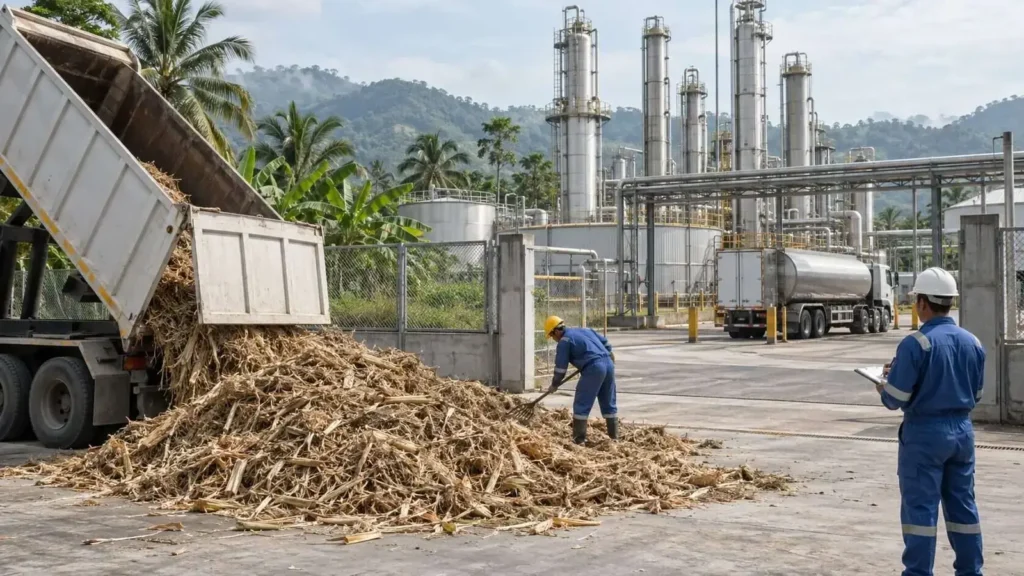
A jet fuel plant built on fermentation lives or dies on the carbon source it buys. Fermentation turns plant sugars into alcohol, so the carbon source decides the plant’s economics. ASTM International certified that route for isobutanol in 2016 and for ethanol in 2018. In addition, it carries approval up to 50 percent blending. The carbon source is a carbohydrate, meaning a sugar, starch or fibre molecule. That molecule decides the scale, the capital cost and the carbon score of the plant. In addition, Sustainable aviation fuel carries many conversion routes. Alcohol-to-jet, the route that converts fermented alcohol into jet range hydrocarbons, sits among the 12 pathways approved by ASTM International. I write for an equity investor at feasibility stage in Asia.
My work sits at the feasibility stage, where the reaction chemistry is clear and the commercial structure is not.
What decides an alcohol-to-jet project
Three questions carry the file. The first is which carbohydrate enters the fermenter. Next comes what the alcohol choice costs at the first step. The third is the price the finished fuel has to clear.
In short
- Certification: ASTM D7566 Annex A5, the specification section for this family of synthesized hydrocarbon fuel, covers the route, certified for isobutanol in 2016 and ethanol in 2018, capped at 50 percent blending.
- Feedstock: The carbohydrate choice drives scalability, capital cost, operating cost, carbon score and sustainability.
- Capital: On-site ethanol processing lifts capital cost, while power-to-liquid carries the highest capital requirements of the four families.
- Price: 2025 output reached 1.9 million tonnes, 0.6 percent of jet fuel, sold at two times the fossil price.
- Timing: An extra 5.8 Mt needs a final investment decision (FID) by 2026 to meet the 17 million tonnes expected in 2030.
In this article
The short answer: the alcohol decides the project
ASTM D7566 Annex A5 lists the alcohol-to-jet synthetic paraffinic kerosene route. Ethanol, isobutanol and isobutene from biomass serve as feedstock, with a maximum blend ratio of 50 percent. The ICAO ACT-SAF technical session describes the pathway as ASTM certified in 2016 for isobutanol. For ethanol, certification came in 2018. ASTM International currently approves 12 sustainable aviation fuel production pathways, including three for co-processing. This route is one of them. What decides whether a project works is not the three reaction steps. Those steps are commercial processes operating today with high carbon yields. Instead, the source of the alcohol decides, because that choice drives scalability, economics, sustainability and carbon footprint. The reaction sequence is a checkpoint rather than a differentiator for an Asian file.
What this means for you: I would treat the chemistry as closed. Instead, I would put the feasibility budget against the carbohydrate contract and the choice of alcohol. Those two items move the plant’s scale and margin more than any equipment choice.
What the alcohol has to be made from
A variety of feedstocks can make the alcohol, but the choice significantly impacts scalability, economics, sustainability and carbon footprint. Moreover, carbohydrates as the feedstock for alcohol production enable a meaningful SAF solution through fermentation of plants and organic waste. The route takes residual starch, sugar, molasses, agricultural residue or grasses, bagasse and wood. It also takes biogenic municipal solid waste without plastics or synthetics. Other feedstocks for alcohol are possible but will not reach the same scale and impact. The selection of the carbohydrate can significantly impact scalability, capital cost, operating cost, carbon score and sustainability. On the aviation side the approved route takes sugar, starch crops and lignocellulosic biomass. For an Asian file I read that list against what the region can actually deliver at volume. In fact, the regional feedstock picture is the first document I open.
What this means for you: I would not sign a site before I can name the carbohydrate. The carbohydrate must hold for the life of the plant. Every other number in the model inherits from that choice.
Who supplies the alcohol, and what that contract costs
Alcohol-to-jet carries higher capital costs from on-site ethanol processing, while HEFA is the most mature and cost-effective pathway. By contrast, power-to-liquid has the highest capital requirements. Ethanol dehydration removes a water molecule to turn the alcohol into an olefin. That step takes much more energy and cost than isobutanol dehydration. Even so, biobased ethanol is more common today than biobased isobutanol. A project has to price that trade-off before it picks the alcohol. Oligomerization then connects small olefins together to give a larger olefin fit for SAF. Moreover, hydrogenation converts that olefin into a paraffin fit for SAF use. Steps two and three are commercial processes operating today with high carbon yields.
In addition, they use very little hydrogen. Example providers for the dehydration step are Axens, Lummus-Braskem, Technip, KBR-Petron and UOP. For steps two and three, the examples are Axens, UOP and Lummus.
What this means for you: I would price the alcohol supply arrangement together with the dehydration unit. The energy and cost of that first step are set by which alcohol arrives at the gate.
What the fuel has to clear in price
SAF production in 2025 reached 1.9 million tonnes, only 0.6 percent of total jet fuel consumption. Moreover, 2026 projections point to 2.4 million tonnes and 0.8 percent. SAF prices exceed fossil-based jet fuel by a factor of two. In mandated markets the factor can reach five. At current price levels, the premium adds an extra USD 3.6 billion in fuel costs for the industry in 2025. Demand for global SAF should reach 17 million tonnes per annum by 2030. That equals approximately 4 to 5 percent of total jet fuel consumption. In addition, the industry may need between 19 billion and 45 billion US dollars of capital expenditure by 2030.
The exact figure depends on the technology mix. Also, the revenue line of an alcohol to jet plant sits inside those three numbers. Specifically, the way the premium is priced decides whether the model clears.
What this means for you: I would model the fuel at two times fossil jet fuel first. Then I would stress it at up to five times in a mandated market. The revenue line decides whether the plant clears its hurdle.
Where the route sits against the other approved pathways
Of the approved conversion processes, eight sit under ASTM D7566. The remaining three follow ASTM D1655 because they co-process with conventional fossil jet. As of July 2023 there were 11 approved processes with 11 others under evaluation. The IRENA study of Southeast Asia focuses on three pathways, HEFA-SPK, FT-SPK and ATJ-SPK, the most mature technologies to date. On blend limits, the alcohol to jet route carries approval up to 50 percent alongside the Fischer-Tropsch and HEFA routes. By contrast, the direct sugars route carries approval up to 10 percent. Co-processing routes carry 5 or 10 percent. IEA Bioenergy Task 39 records that alcohol-to-jet is nearing commercial status.
Meanwhile, the lipid-derived HEFA pathway will continue to supply the majority of SAF volumes up to 2030. For a project at feasibility the grouping matters. A 50 percent cap places this route beside Fischer-Tropsch and HEFA in any procurement discussion. By contrast, routes capped at 5 or 10 percent need a larger conventional fuel stream around them.
What this means for you: I would not build a mandate case on being the only route. Instead, I would place the alcohol route in the mature group at 50 percent blending. HEFA still carries the volume up to 2030.
What the route implies for cost and carbon next to power-to-liquid
Power-to-liquid has the highest capital requirements of the four families, because it relies on renewable electricity, electrolysis and CO2 capture. In addition, it sits at a lower technology readiness level. The reverse water gas shift reaction still needs full resolution. Also, e-SAF faces a much higher cost base, potentially up to 12 times that of conventional jet fuel. The alcohol route answers that comparison differently. Fermentation of the carbohydrates releases biogenic CO2 in a high purity stream. Operators can sequester that stream or convert it into fuels and chemicals. Moreover, an energy balance for the route using corn shows an input of 45,000 BTU including growing plants.
Against that, the output is about 120,000 BTU per gallon of SAF, plus coproducts and captured CO2. Carbon intensity, the lifecycle emissions attached to each unit of fuel energy, is where the carbohydrate choice shows up again. By contrast, the power-to-liquid route answers it with renewable electricity.
What this means for you: I would carry the capital line and the carbon line in the same table. An Asian project that buys the wrong carbohydrate can lose the carbon score even when the reaction runs well.
The order I would run the alcohol-to-jet file in
I would fix the carbohydrate source first, because it drives scalability, capital cost and operating cost. In addition, it sets the carbon score and sustainability. Then I would price the dehydration step, since ethanol dehydration takes much more energy and cost than isobutanol dehydration. After that I would confirm the approval and blend position under ASTM D7566 Annex A5 at 50 percent. Then I would check the lifecycle value the pathway can carry. ICAO publishes CORSIA default life cycle emission values for FT, HEFA, SIP and ATJ. Then I would write the offtake agreement, meaning a contract to buy a share of the plant’s output.
That contract should cover the debt tenor. Investors often require buyers to commit to 70 to 80 percent of annual capacity. The contract should also match the tenure of debt financing, for example 8 to 14 years. Then I would walk the five critical phases of the SAF refinery lifecycle: conceptualization, pre-feasibility, FID, construction and commissioning. In fact, the route into that decision is where files stall.
What this means for you: I would run these six checks in this order. A final investment decision on an unfixed carbohydrate source rests on the wrong model.
How I would run this if it were my file
I would take the carbohydrate contract as the first condition precedent. Feedstock selection affects scale, investment hurdle and the selling price of SAF. I would use the reference plant as a sizing and financing caution rather than a promise. The session gives an example at Lake Preston, South Dakota, with a targeted start-up of 2026. That date depends on the timing of construction financing, and the plant was still in engineering optimization. It produces 65 million gallons per year and 4,450 bbl/d of hydrocarbons. Biogenic CO2 capture and sequestration comes to about 290,000 mt/y. For Southeast Asia I would check the reference list first. Neste at Tuas in Singapore runs 1,000,000 tonnes from Q3 2023.
\n
Petronas and Idemitsu plan 650,000 tonnes at Pengerang for 2026. NEXTCHEM at Sei Mangkei plans 60,000 tonnes. Indonesia released a national road map and action plan for the industrial development of SAF in September 2024. Malaysia launched its Aviation Decarbonisation Blueprint in the same month. That plan treats SAF as a lever to cut sectoral emissions by up to 46.2 percent.
What this means for you: I would treat the South Dakota plant as a caution on financing timing. In addition, I would take the Southeast Asian list as a benchmark on scale. Then I would price my own file against both.
Sources
\n
- \n
- ICAO, 15 November 2026
- ICAO Aviation Benefits, 15 November 2026
- ICAO ACT-SAF, 2023
- IEA Bioenergy Task 39, January 2024
- World Economic Forum with Kearney, February 2025
- IRENA, December 2024
\n
\n
\n
\n
\n
\n
Frequently asked questions
Which alcohols can be converted into SAF?
Ethanol, isobutanol and isobutene from biomass are the feedstocks listed for the approved alcohol-to-jet route, and the pathway was ASTM certified in 2016 for isobutanol and in 2018 for ethanol. ICAO lists them under ASTM D7566 Annex A5 with a maximum blend ratio of 50 percent, so the alcohol choice is made before any equipment is ordered.
What blend limit does alcohol-to-jet have?
The alcohol-to-jet synthetic paraffinic kerosene route under ASTM D7566 Annex A5 has a maximum blend ratio of 50 percent. SAF must also have the same chemical qualities and characteristics as conventional jet fuel, so manufacturers do not have to redesign engines or aircraft, and once the fuel demonstrates compliance it is blended with conventional jet fuel and re-tested.
Is alcohol-to-jet more capital intensive than HEFA?
It carries higher capital costs from on-site ethanol processing, while HEFA is the most mature and cost-effective pathway and power-to-liquid has the highest capital requirements of the four families. The line I would price hardest is the first step, because ethanol dehydration takes much more energy and cost than isobutanol dehydration, even though biobased ethanol is the more common product today.
What feedstock is the right starting point for an Asian alcohol-to-jet project?
The approved route takes sugar, starch crops and lignocellulosic biomass, and the practical list is residual starch, sugar, molasses, agricultural residue or grasses, biogenic municipal solid waste without plastics or synthetics, bagasse and wood. The selection of the carbohydrate significantly impacts scalability, capital cost, operating cost, carbon score and sustainability, so I would start from what the region can deliver at volume rather than from the process design.
Not sure your project would survive a credit conversation?
A short call is usually enough to see where your project stands.
If you are at feasibility stage and want the file read against these six checks, investor introductions is where I start the conversation. First, I map the carbohydrate, the dehydration cost, the blend position, the lifecycle value and the offtake tenor. Then I map the five phases and put the project in front of the equity that fits it.
I do not provide investment advice or arrange investments. I act as a strategic advisor and facilitator.

Alex, Founder of WeConnect Asia
I help low-carbon fuel and carbon removal project developers in Southeast Asia secure the commercial and financial partners needed to reach FID.
Related articles

Pitching a Climate Tech Company to Strategic Investors: What the Corporate Has to Believe Before It Writes a Cheque
How to pitch a climate tech company to strategic investors: the metric cluster, the readiness evidence and the ask that corporates fund.

Biomethane: What It Is, How It Is Made and Who Buys It
Biomethane is biogas cleaned to pipeline quality. I explain how it is made, how it differs from biogas and who buys it in Southeast Asia.

CO2 Sourcing for e-SAF Projects: What the Rules Allow and What the Contract Must Say
Biogenic CO2, direct air capture or industrial flue gas: which sources an e-SAF plant may use, what they cost and which contract terms make the fuel certifiable.

Operating Performance Guarantees for SAF Plants: What Lenders Ask For
Minimum guarantees, performance damages, retesting and who stands behind them: the operating guarantees a SAF plant needs to keep debt and offtake intact.

EPC and Construction Risk in SAF Plants: What a Lender Actually Tests
FEED scope, convertible EPC, performance guarantees and damages caps: the construction risk questions a SAF project must answer before financial close.

Matching Feedstock and Offtake Risk Back-to-Back in a SAF Project: How Lenders Read the Chain
Lenders do not buy a feedstock plan and an offtake plan separately. They buy the link between the two, and the link is where most SAF files break.