
Home » Fischer-Tropsch SAF: What Is Proven and What Is Not
Fischer-Tropsch SAF: What Is Proven and What Is Not
10 min read · Nov 2, 2026 · By Alex
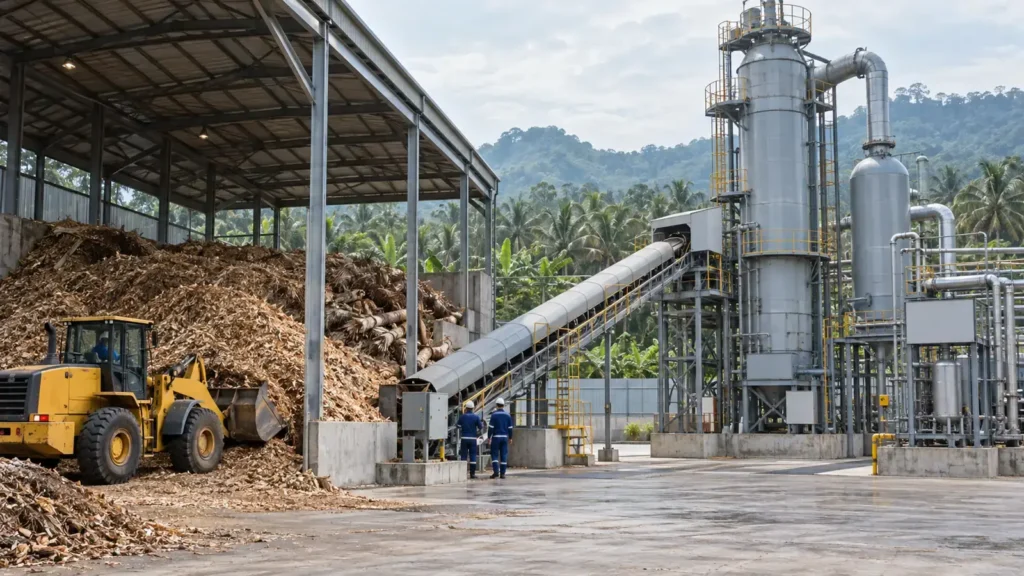
The Fischer-Tropsch reaction itself is commercial and has run in gas-to-liquids plants for decades. Meanwhile, three parts are not yet fully commercial (IEA Bioenergy Task 39). First comes the gasification front end, which heats biomass without burning it. Second comes syngas cleanup, which removes poisons from the carbon monoxide and hydrogen mixture. Third comes the integration around both. Sustainable aviation fuel projects sit or fall on that split, and a lender reads the two halves very differently. I wrote this page for an equity investor at feasibility stage in Southeast Asia. That investor wants to know exactly where the proof stops. So the honest read on Fischer-Tropsch SAF is: proven chemistry, unproven front end. Also, a case you build part by part rather than declare finished.
This matters because the pathway sits at an awkward point in the market. It is approved for use and technically understood. However, it still lacks a clean operating reference at gasification scale. Everything below separates what an operating plant already proves from what a first project would still have to demonstrate. I keep the chemistry, the approval and the credit questions in separate buckets. That way none borrows credibility from another.
In short
- Reaction: The synthesis step itself is commercial, with gas-to-liquids plants running for decades and the reactor technology not in question.
- Front end: Gasification, cleanup and site integration carry the least operating history.
- Approval: ASTM approves the route for blending up to 50 percent under its specification.
- Yield: Straight-run jet output sits near 40 percent unless you add extra units at cost.
- Financing: Solid feedstock handling, capital intensity and long sales contracts decide bankability.
In this article
The short answer: the reaction is proven, the front end is not
The Fischer-Tropsch synthesis has run in commercial gas-to-liquids plants for decades, using iron or cobalt catalysts (ICAO ACT-SAF). It is a catalytic route that converts carbon monoxide and hydrogen into liquid hydrocarbons. A catalyst speeds a reaction without consuming itself. The Fischer-Tropsch process is fully commercial. By contrast, the preceding processing steps are not yet fully commercial. The same holds for the overall integration of the gasification route (IEA Bioenergy Task 39). ASTM D7566 Annex A1 approves the route with a maximum blend ratio of 50 percent (ICAO). That annex is the specification for aviation turbine fuels containing synthesised hydrocarbons. The route takes coal, natural gas and biomass as possible feedstocks. The question a finance person has to answer is therefore narrower than the technology question. Specifically, which parts of the chain have operating references? Also, which parts still sit around a first project (IEA Bioenergy Task 39)?
What this means for you: I treat the reaction and the integration as two separate underwriting questions. Only one of them has a long record.
What goes into the gasifier
Gasification of biomass produces syngas. That syngas can feed Fischer-Tropsch synthesis or a methanol intermediate for methanol-to-jet. In addition, it can feed fermentation to ethanol followed by alcohol-to-jet (IEA Bioenergy Task 39). Syngas cleanup remains a critical component of the pathway to prevent downstream catalyst deactivation (IEA Bioenergy Task 39). Engineers design the gasification process around the specific feedstock. That choice drives feedstock preparation, the type of gasification reactor and the syngas cleanup process (IEA Bioenergy Task 39). The route takes energy crops, lignocellulosic biomass and solid waste (ICAO Aviation Benefits). Also, municipal solid waste and farm and forest residues are usable, but their supply chains remain weak (IEA Bioenergy Task 39).
The low energy density of forest residues limits the economical transportation distance from a refinery and therefore impacts the scale of refineries, so feedstock availability in Southeast Asia needs densification such as pellets or bio-oils before large-scale facilities can be established (IEA Bioenergy Task 39).
What this means for you: I price the feedstock radius before I price the reactor.
What the reaction actually gives you
The Fischer-Tropsch reaction releases a lot of heat, about 165 kJ/mol of CO converted. Also, the product spectrum depends on catalyst, temperature, pressure and gas composition (ICAO ACT-SAF). Low temperature Fischer-Tropsch runs at 200 to 250 degrees Celsius with iron or cobalt catalysts. It targets distillate and waxes with fewer oxygenates; waxes are a heavy fraction that congeals as it cools. Meanwhile, high temperature Fischer-Tropsch runs at 350 degrees Celsius with an iron catalyst. It targets gasoline and light olefins with more oxygenates (ICAO ACT-SAF). The product slate follows the Anderson-Schulz-Flory distribution, a statistical model of chain growth. Also, a typical alpha for cobalt based low temperature operation is 0.85 to 0.95, with higher alpha better (ICAO ACT-SAF). The maximum straight-run jet fraction sits near 40 percent. Also, extra hydrocracking and alkylation units raise it at added cost (IEA Bioenergy Task 39).
New catalyst research needs independent ASTM approval, since ASTM limits approved SAF to iron and cobalt catalysts (IEA Bioenergy Task 39).
What this means for you: I read yield and selectivity as revenue risk.
What the fuel has to clear in price
SAF production in 2025 reached 1.9 million tonnes, only 0.6 percent of total jet fuel consumption. Also, forecasters project 2.4 million tonnes and 0.8 percent for 2026 (IATA). SAF prices exceed fossil-based jet fuel by a factor of two. In mandated markets the factor reaches five. At current price levels, the SAF premium adds USD 3.6 billion in fuel costs for the industry in 2025 (IATA). Demand for global SAF should reach 17 million tonnes per annum by 2030. That is approximately 4 to 5 percent of total jet fuel consumption (World Economic Forum with Kearney). Those are the volumes the whole industry has to place, and they remain a fraction of demand. A Fischer-Tropsch project therefore has to clear the price spread in this market.
This already runs two to five times the fossil reference, depending on where it sells.
What this means for you: I test the revenue line against that premium before I test the capital plan.
What is proven and what is still being assembled
The gas-to-liquids and low temperature Fischer-Tropsch pathway has commercial proof. Installed plants run at 2,500 and 7,500 bbl/day in South Africa and about 14,700 bbl/day in Malaysia. In addition, Qatar runs about 33,500 and 140,000 bbl/day, Nigeria about 34,000 and Uzbekistan 38,000 (ICAO ACT-SAF). Kerosene range material from this route meets the Annex A1 specification. It blends up to 50 percent with crude derived Jet A-1. Also, it burns with lower NOx and SOx and less soot, which lowers contrail propensity (ICAO ACT-SAF). The first small-scale commercial gasification facility came online in 2022 on municipal solid waste. However, its Fischer-Tropsch liquids went to a refinery for co-processing under ASTM D1655, at a maximum of 5 percent blends. It is not clear whether it produced substantial SAF volumes (IEA Bioenergy Task 39).
Other gasification-based facilities are planned or under construction in North America and Europe. However, high investment and long construction mean a slow ramp-up of commercial volumes (IEA Bioenergy Task 39).
What this means for you: I need references on the front end, not on the reaction.
What the project costs and who carries it
Gasification-Fischer Tropsch is capital-intensive and needs solid feedstock handling. Meanwhile, HEFA is the most mature and cost-effective pathway. Power-to-liquid carries the highest capital requirements (World Economic Forum with Kearney). The industry may require between 19 billion and 45 billion US dollars of capital expenditure by 2030. The range depends on the technology mix (World Economic Forum with Kearney). An offtake agreement is the sales contract that covers the fuel output. Investors often require offtake cover for at least 70 to 80 percent of annual capacity. In addition, some lenders require reliable offtake on 100 percent of the SAF produced, covering the full loan tenor. Also, the contract needs to cover the tenure of debt financing. For example, that means 8 to 14 years (World Economic Forum with Kearney).
The comparison a credit committee will run against this route is power-to-liquid, where e-SAF carries a much higher cost base, potentially up to 12 times that of conventional jet fuel (IATA).
What this means for you: contract coverage and tenor decide whether the capital plan closes.
The order I would run the gasification file in
I would start with the feedstock. Engineers design the process around it, and supply chains for waste and residues stay weak (IEA Bioenergy Task 39). Then I would size the plant against the transport radius. Low energy density limits the economical transportation distance from a refinery (IEA Bioenergy Task 39). Then I would price the cleanup and the wax handling. Syngas cleanup prevents downstream catalyst deactivation, and the waxy product needs hydroprocessing for cold flow. In addition, congealing lines need heat tracing (ICAO ACT-SAF). Then I would confirm ASTM D7566 Annex A1 at 50 percent. ASTM limits the catalyst list to iron and cobalt (ICAO, IEA Bioenergy Task 39). Then I would write the offtake to cover the debt tenor (World Economic Forum with Kearney).
Then comes the SAF refinery lifecycle: conceptualization, pre-feasibility, final investment decision (FID), construction and commissioning (World Economic Forum with Kearney).
What this means for you: I run these moves in order before I plan how to finance the SAF project.
How I would run this if it were my file
I would ask for two operating references rather than one technology slide. The reaction has a long record, and the integration does not (IEA Bioenergy Task 39). I would treat temperature control and catalyst protection as credit issues. An overheated catalyst can fail, and high temperature lowers alpha (ICAO ACT-SAF). I would check catalyst poisons including sulfur, halides, metals and nitrogenous species. Also, the water treatment line. Process water carries oxygenates and hydrocarbons, so it needs treatment before it leaves the site (ICAO ACT-SAF). I would track the announced Northern Sweden project starting in April 2028. It targets about 45 kt/a of advanced biofuel at 14 g CO2/MJ. In addition, it targets about 45 kt/a of renewable fuel of non-biological origin at 0.2 g CO2/MJ (ICAO ACT-SAF).
For Southeast Asia I would check announced plants first. These include the Manila municipal solid waste project at 91,000 tonnes planned for 2025. Also, Indonesia’s September 2024 national road map for SAF matters (IRENA).
What this means for you: I need operating references and a treated water line before I model returns.
Sources
- ICAO, 15 November 2026
- ICAO Aviation Benefits, 15 November 2026
- ICAO ACT-SAF, 2023
- IEA Bioenergy Task 39, January 2024
- World Economic Forum with Kearney, February 2025
- IATA, 9 December 2025
Frequently asked questions
Is Fischer-Tropsch SAF commercially proven today?
The reaction itself is, with gas-to-liquids plants installed at 2,500 and 7,500 bbl/day in South Africa, about 14,700 bbl/day in Malaysia, about 33,500 bbl/day and 140,000 bbl/day in Qatar, about 34,000 bbl/day in Nigeria and 38,000 bbl/day in Uzbekistan (ICAO ACT-SAF). The first small-scale commercial gasification facility started in 2022 on municipal solid waste, but the preceding processing steps and the overall integration of the gasification route have yet to be fully commercialized (IEA Bioenergy Task 39).
What feedstocks can a Fischer-Tropsch plant actually use?
Energy crops, lignocellulosic biomass and solid waste are listed for the approved route (ICAO Aviation Benefits), and municipal solid waste and forest and agricultural residues can be used even though their supply chains are not well-established (IEA Bioenergy Task 39).
What blend limit applies to Fischer-Tropsch SAF?
The route under ASTM D7566 Annex A1 has a maximum blend ratio of 50 percent, the aromatics variant under Annex A4 is also approved up to 50 percent, and co-processing of Fischer-Tropsch hydrocarbons in a conventional petroleum refinery is approved at 5 percent under ASTM D1655 (ICAO).
Why does the jet fraction matter for the financing of the project?
In the conventional process the maximum straight-run jet fraction is limited to about 40 percent by the Anderson-Schulz-Flory distribution, and additional process units that raise the SAF fraction cost money, so the yield assumption is a direct input to the revenue model (IEA Bioenergy Task 39).
Not sure your project would survive a credit conversation?
A short call is usually enough to see where your project stands.
If you are weighing this route against HEFA or power-to-liquid for a Southeast Asia site, I can walk the file with you: project finance support for sustainable aviation fuel developments, from feedstock radius to contract coverage and debt tenor. The output is a short list of what has to be proved before the numbers hold.
I do not provide investment advice or arrange investments. I act as a strategic advisor and facilitator.

Alex, Founder of WeConnect Asia
I help low-carbon fuel and carbon removal project developers in Southeast Asia secure the commercial and financial partners needed to reach FID.
Related articles

Pitching a Climate Tech Company to Strategic Investors: What the Corporate Has to Believe Before It Writes a Cheque
How to pitch a climate tech company to strategic investors: the metric cluster, the readiness evidence and the ask that corporates fund.

Biomethane: What It Is, How It Is Made and Who Buys It
Biomethane is biogas cleaned to pipeline quality. I explain how it is made, how it differs from biogas and who buys it in Southeast Asia.

CO2 Sourcing for e-SAF Projects: What the Rules Allow and What the Contract Must Say
Biogenic CO2, direct air capture or industrial flue gas: which sources an e-SAF plant may use, what they cost and which contract terms make the fuel certifiable.

Operating Performance Guarantees for SAF Plants: What Lenders Ask For
Minimum guarantees, performance damages, retesting and who stands behind them: the operating guarantees a SAF plant needs to keep debt and offtake intact.

EPC and Construction Risk in SAF Plants: What a Lender Actually Tests
FEED scope, convertible EPC, performance guarantees and damages caps: the construction risk questions a SAF project must answer before financial close.

Matching Feedstock and Offtake Risk Back-to-Back in a SAF Project: How Lenders Read the Chain
Lenders do not buy a feedstock plan and an offtake plan separately. They buy the link between the two, and the link is where most SAF files break.