
Home » Feedstock Certification for Lenders: What the Credit File Has to Show
Feedstock Certification for Lenders: What the Credit File Has to Show
10 min read · Nov 2, 2026 · By Alex
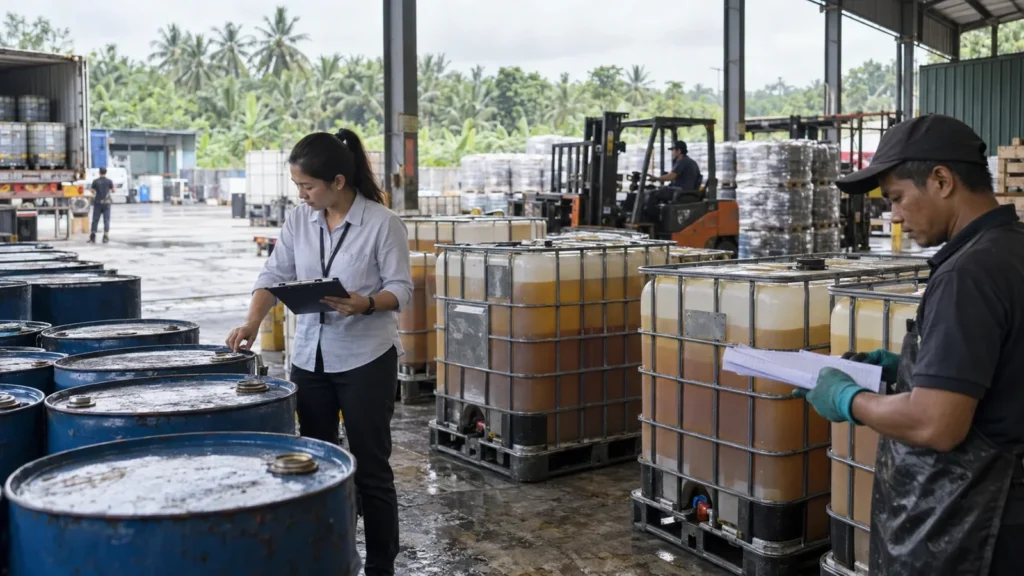
Which proof of feedstock sustainability holds in the credit file? Three proofs, not one certificate: a sustainability certification scheme approved by the ICAO Council, a mass balance trail. This means meane documents rather than physical segregation follow the product, that survives an audit of the point of origin, the collecting site, and figures that satisfy both the renewable energy directive and CORSIA, where SAF has to cut net greenhouse gas emissions by at least 10% against baseline life cycle values under an approved scheme valid for 365 days. The evidence of failure is public: 9% of ISCC certified UCO collecting points in China, Malaysia and Indonesia had their points of origin audited. The feedstock certification lenders ask for is that standard. Also, I begin from the regional feedstock picture in Southeast Asia.
Lenders do not take a certificate at face value. They read the file behind it line by line and test whether each entry holds up. In this piece I set out what sits in that file, which filters the material has to pass, and exactly where the trail breaks.
In short
- Three proofs: an approved scheme, an audit trail that reaches the collecting point, and figures that clear both the directive and CORSIA.
- CORSIA: eligible fuels come from producers certified by a scheme approved by the ICAO Council, valid for 365 days.
- Europe: part A and part B of annex IX decide the share, and the ISCC material list decides the column.
- Failure point: mass balance runs on documents, and only 9% of sampled certified collecting points were audited.
- My sequence: scheme, material line, audit trail, expiry, then the supply contract and only then the price.
In this article
The short answer: three proofs, not one certificate
The first proof is the scheme. A sustainability certification scheme approved by the ICAO Council has to certify the producer. Also, that approval is what makes a batch count internationally. The second proof is the trail. Mass balance means no one separates the physical product: the documents follow it instead. Also, those documents are what an auditor tests. The point of origin is the site that collected the material: the restaurant, the grease trap or the rendering plant. It is also the site an audit has to reach. The third proof is the numbers. CORSIA SAF has to cut net greenhouse gas emissions by at least 10% against the baseline for aviation fuel on a life cycle basis, and compliance with the greenhouse gas and carbon stock themes rests on independent attestation by an approved scheme.
What this means for you: I never ask whether a certificate exists. I ask which scheme approved it, whether the trail reaches the collecting point, and whether the calculation clears 10%.
What the certificate is actually doing in the credit file
One certificate gives the lender a single input into the diligence exercise. It never provides the conclusion. Lenders perform detailed due diligence and greenhouse gas modelling to confirm that the sustainable aviation fuel will meet the EU regulatory requirements, and the carbon and biogenic feedstock supply has to comply with the greenhouse gas reduction and sustainability criteria under RED III and the delegated acts. That modelling runs on life cycle emissions values. Engineers use these benchmark figures for aviation fuel to measure a batch from production through to combustion. ICF identifies the largest barrier to financing as uncertainty about technology maturity, and states that beyond technology, securing long-term regulatory certainty is a key requirement.
It also records that the lack of technical due diligence or transparency, together with the dominance of small companies that have no track record, makes it hard to judge which feedstock supply and pricing assumptions will actually hold at scale.
What this means for you: I treat the certificate as evidence that feeds the model, and I expect the lender’s own greenhouse gas model, not the cover page, to be the document that sizes the debt.
The CORSIA filter
I start with the CORSIA filter because it is the cleanest test of whether a batch will be accepted internationally. A CORSIA eligible fuel is a renewable or waste-derived aviation fuel that meets the CORSIA Sustainability Criteria. Also, such fuels have to come from fuel producers certified by a sustainability certification scheme approved by the ICAO Council. The CORSIA certified fuels website publishes information on certified batches and economic operators. Also, the feedstocks for eligible fuel production fall into five categories. Nine sustainability themes apply to CORSIA SAF from 1 January 2024. Schemes on the ICAO approved list grant compliance with the greenhouse gas and carbon stock themes through independent attestation. A fuel producer can make batches for 365 calendar days after certification. The scheme then has to certify the producer again.
What this means for you: I check the expiry before I check anything else, because a certificate that has passed 365 days tells me nothing about the batch in front of me.
The European filter
The European test runs alongside EU compliance and carbon intensity work. Also, Article 3(7) of ReFuelEU Aviation comes first: the rules define SAF there. That definition covers synthetic aviation fuels made from renewable hydrogen and captured carbon, advanced biofuels from waste and residues whose feedstock sits in part A of annex IX, biofuels produced from oils and fats whose feedstock sits in part B, and recycled carbon aviation fuels. Part A lists the feedstocks whose contribution to the minimum counts as twice their energy content. The rules count that energy twice towards a target on purpose. Part B holds exactly two entries: used cooking oil, and animal fats classified as categories 1 and 2. The shares are 2% at EU airports from 2025, rising to 70% from 2050.
The ISCC EU material list then states, material by material, whether the entry is classified as waste or residue in a given member state and whether it carries the ReFuelEU Aviation mark or only the FuelEU Maritime mark. It also warns that the rules cannot list POME oil under the material entry of POME.
What this means for you: I read the column before I read the certificate, because a material that only carries the FuelEU Maritime mark cannot support a ReFuelEU Aviation obligation.
Where mass balance breaks
The weakness is structural rather than accidental. Voluntary schemes use a mass balance approach. Therefore, no one has to segregate the product physically: accounting documents track it and auditors test those documents. Transport and Environment states that the approach is susceptible to falsified documents and to multiple claiming. Two parties count the same material twice. The audit threshold is where it shows. Auditors only have to audit a point of origin if that point supplies more than 5 tonnes of UCO a month. An ISCC analysis in China, Malaysia and Indonesia found a gap. Only 9% of certified collecting points had an auditor sample their points of origin; the remaining 91% had none.
The producer-side failure is just as simple: a producer receiving 50 tonnes a month can be certified twice through two audits, report 100 tonnes across the two certificates, and conceal 50 tonnes of unsustainable feedstock entering production. All of this sits underneath the sustainability criteria a SAF batch has to satisfy.
What this means for you: I do not read the certificate cover, I read the audit file behind it, and if the collecting points were never visited I treat the reported volume as unproven.
Four checks I run before the credit committee
First, the scheme and its approval status: I confirm the scheme is approved by the ICAO Council when the batch has to meet CORSIA obligations, and that it is recognised for the European rules that apply to that batch. Second, the material line in the eligible list and the columns it carries, because the same material can be eligible in one regime and excluded in another. Third, the audit trail at the point of origin rather than the certificate cover, because the certificate states compliance while the trail is what an auditor tests. Fourth, the expiry: certification runs for 365 calendar days, and the scheme then renews it. I put all four on a single page before the meeting. Therefore, the committee sees the gaps in the same order I found them rather than in the order that flatters the file.
What this means for you: if any of the four is missing, I would rather delay the credit paper than present a file that a reviewer can break with one question.
The order I would ask for the documents in
I ask for the scheme certificate and the approved list entry first, then the chain of custody for the period under review, then the greenhouse gas calculation behind each batch, then the supplier contract that keeps the material coming, and only after those four the pricing discussion. That order matters because two anchors sit underneath it. Dentons states that lenders will expect a long-term feedstock supply arrangement from a credible and reliable source that meets the EU eligibility criteria, plus a back-up plan if feedstock becomes critically unavailable, and that lenders will perform detailed due diligence and greenhouse gas modelling on the result. ICF places feedstock availability and commodity pricing inside the financing requirements of the HEFA phase. This is mature but sensitive to both. Feedstock supply work therefore belongs in the file before any conversation about price starts.
What this means for you: I put the supply contract ahead of the price, because a price without a contract is a forecast, and a contract without a greenhouse gas result is a liability.
How I would run this if it were my file
I would assemble the evidence in the order a reviewer reads it. First the approved scheme and its 365 day validity, because that is the gate on the batch itself. Second the material entry and the columns it carries in the ISCC EU material list. Third the part A and part B split of annex IX, which decides whether the feedstock counts at all and at what weight. Fourth the audit rate at the point of origin, quoted openly rather than buried, because a reviewer will find it anyway. Fifth the due diligence the lender will run in any case: the greenhouse gas modelling under RED III. Also, the delegated acts, and the technology maturity questions that ICF records as the largest barrier to financing. I would then state plainly what the file does not prove.
It does not prove that supply will arrive, and it does not prove a price.
What this means for you: a credit file that shows its own limits early survives the committee; one that hides them does not.
Sources
- ICAO, June 2025.
- ICAO, 16 November 2026.
- ISCC, February 2026.
- European Commission, 16 November 2026.
- Transport and Environment, 15 November 2026.
- Dentons, 15 April 2025.
- ICF, 3 October 2023.
Frequently asked questions
Which certification schemes do lenders accept?
They accept schemes approved by the ICAO Council when the batch has to meet CORSIA obligations, since CORSIA eligible fuels have to come from fuel producers certified by such a scheme, and they also accept the schemes recognised for the European rules that apply to that particular batch.
What is the difference between a certificate and a chain of custody?
The certificate states compliance with the standard. The chain of custody is the document trail that follows the material from the collecting point through to the batch. Under mass balance the physical product is not segregated, so those documents are what the auditor tests, and Transport and Environment records that this makes the approach susceptible to falsified documents and to multiple claiming.
What does the auditor check in a feedstock file?
The point of origin, its volumes, and its classification as waste or residue in the relevant member state. An audit of a point of origin is only required above 5 tonnes a month, and in the sampled population of ISCC certified collectors in China, Malaysia and Indonesia only 9% of collecting points had their origins audited. The material line in the ISCC EU material list supplies the classification itself.
Does certification remove the feedstock supply risk?
No. It evidences compliance with a standard, while lenders still expect a long-term feedstock supply arrangement from a credible and reliable source and a back-up plan in case of critical feedstock unavailability. Certification tells me the material was eligible; it does not tell me the material will arrive.
Not sure your project would survive a credit conversation?
A short call is usually enough to see where your project stands.
If you are assembling this file before a credit committee and want a second read on the order of the evidence, I can introduce the project to lenders and investors who already work with this material.
I do not provide investment advice or arrange investments. I act as a strategic advisor and facilitator.

Alex, Founder of WeConnect Asia
I help low-carbon fuel and carbon removal project developers in Southeast Asia secure the commercial and financial partners needed to reach FID.
Related articles

Pitching a Climate Tech Company to Strategic Investors: What the Corporate Has to Believe Before It Writes a Cheque
How to pitch a climate tech company to strategic investors: the metric cluster, the readiness evidence and the ask that corporates fund.

Biomethane: What It Is, How It Is Made and Who Buys It
Biomethane is biogas cleaned to pipeline quality. I explain how it is made, how it differs from biogas and who buys it in Southeast Asia.

CO2 Sourcing for e-SAF Projects: What the Rules Allow and What the Contract Must Say
Biogenic CO2, direct air capture or industrial flue gas: which sources an e-SAF plant may use, what they cost and which contract terms make the fuel certifiable.

Operating Performance Guarantees for SAF Plants: What Lenders Ask For
Minimum guarantees, performance damages, retesting and who stands behind them: the operating guarantees a SAF plant needs to keep debt and offtake intact.

EPC and Construction Risk in SAF Plants: What a Lender Actually Tests
FEED scope, convertible EPC, performance guarantees and damages caps: the construction risk questions a SAF project must answer before financial close.

Matching Feedstock and Offtake Risk Back-to-Back in a SAF Project: How Lenders Read the Chain
Lenders do not buy a feedstock plan and an offtake plan separately. They buy the link between the two, and the link is where most SAF files break.