
Home » Selling SAF into Japan and South Korea
Selling SAF into Japan and South Korea
10 min read · Nov 2, 2026 · By Alex
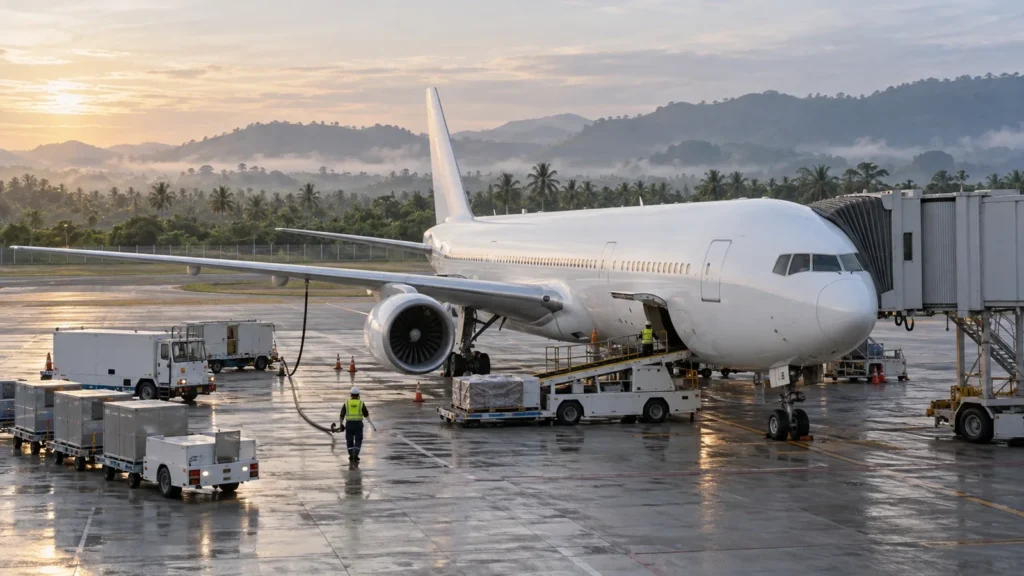
Sustainable aviation fuel sales split into two doors in North East Asia, and I read both here. Japan aims to replace 10% of the fuel consumed by its airlines with SAF by 2030, through supply targets in current legislation and a decarbonization promotion plan, the plan each airline files to cut its emissions. South Korea opens a blending obligation, a duty to blend SAF into the jet fuel it sells, on fuel suppliers for international departures from 2027, rising to 3 to 5% by 2030. So the export saf japan korea decision turns on one thing: the party that carries the obligation, not the flag on the fuel, decides what you can sell.
Both markets sit inside ICAO frameworks, and neither is a price story alone. I read them as contractual horizons: a published ratio, a published bearer, a published first year. Everything I use below comes from documents a government or an industry body has actually released.
In short
- Japan: a 10% replacement target for the fuel its airlines consume by 2030, carried inside each airline’s decarbonization promotion plan.
- Korea: a blending obligation on fuel suppliers, 1% for international departures from 2027, rising to 3 to 5% by 2030.
- Eligibility: CORSIA aligned SAF with at least a 10% net emissions reduction against conventional jet fuel is the gate.
- Price: a conventional jet fuel index plus an SAF premium near term, cost-of-production or cost-plus for an offtake.
- Contract: the offtaker and the tenor decide how much volatility I keep and how much I pass on.
In this article
The short answer
I start from the bearer of the duty, because that is where an offtake conversation actually happens. On the Japanese side, the route is a consumption target carried by the airlines: replace 10% of the fuel consumed by Japanese airlines with SAF by 2030. Held in a decarbonization promotion plan submitted by the airline itself and backed by supply targets for 2030 established on current legislation (ICAO). On the Korean side, the route is a blending obligation carried by fuel suppliers: from 2027 every international flight departing South Korea must use jet fuel with a 1% SAF blend, rising to 3 to 5% by 2030 and 7 to 10% by 2035 (Argus Media, InfluenceMap).
Two documents, two counterparties, two sales motions. Neither route lets me sell on the flag of the fuel. In addition, neither route lets me quote a volume before I know who is obliged to buy it.
What this means for you: I decide which door I am knocking on before I prepare a single volume, because the Japanese plan leads me to an airline and the Korean ratio leads me to a fuel supplier.
What each government has actually published
Japan published its quantified target through the public-private council that groups airlines, airports, oil companies and the ministries, and the 2030 SAF use target sits inside each airline’s decarbonization promotion plan (ICAO). South Korea published a SAF blending mandate roadmap in September 2025 through the Ministry of Land, Infrastructure and Transport (MOLIT) and the Ministry of Trade, Industry and Energy (MOTIE), with the first binding ratio in 2027. In addition, the later ratios confirmed in 2026 and 2029 against domestic capacity and global market conditions (InfluenceMap, Argus Media).
Both are dated policy documents. Therefore, I read them as contractual horizons rather than ambitions, and I treat any change to them as a policy risk on the offtake, the exposure I follow on policy risk. The demand signal behind them comes from IATA’s published figures rather than from the roadmap itself.
What this means for you: I put the publication date and the next review date in the first line of the term sheet. Therefore, a change in the ratio shows up as a re-open rather than a surprise.
Eligibility decides the sale
Korean authorities recognise SAF that meets CORSIA requirements towards the mandate, which means a minimum 10% reduction in net greenhouse gas emissions compared with conventional jet fuel, and they plan to weigh reductions above that level more favourably after 2030 (Argus Media). Japan supports the registration and certification of SAF as CORSIA eligible fuel, proposed a new feedstock through ICAO in FY2023 with the agreement reflected in March 2024, and is developing an ASEAN-Japan certification guidebook by FY2026 to spread the certification process across the region (ICAO).
For the physical fuel the rule is simpler. In addition, harder: SAF is only approved for use blended with conventional aviation fuel, up to a 50% blend under current certification. In addition, once it is co-mingled the molecules can no longer be traced independently (IATA). The claim therefore travels on documents rather than on the molecule, which makes the certificate chain part of the product I sell.
What this means for you: I check the CORSIA reduction threshold and the certificate chain before I quote a volume. That is because a compliant certificate is what converts a shipment into a sale in either market.
The price basis a buyer will recognize
The way a sustainable aviation fuel price reaches my quote is direct: near-term purchases price off a conventional jet fuel index with an SAF premium applied, or off an SAF price index from a price reporting agency for markets such as the US West Coast, Northwest Europe and Singapore (IATA). A worked regional formula is a prior-period average of Argus FOB Singapore plus an agreed percentage of that average plus add-ons, or that same average plus a fixed number of US cents per gallon plus add-ons (IATA).
The add-ons are not decorative: on top of production cost sits a market premium. Logistics, certification, transaction-related costs and markups along the supply chain, and in 2024 that premium in Europe reached as high as around 1000 USD per tonne of HEFA SAF (IATA). Current market levels frame the negotiation: SAF prices exceed fossil-based jet fuel by a factor of two, and by up to a factor of five in mandated markets (IATA).
What this means for you: I quote index, premium. In addition, add-ons as separate lines, so the buyer can see which part of the number I control and which part the market sets.
The contract that fits each door
A one-off or annual contract prices off an index, an offtake agreement prices off cost-of-production or cost-plus, and an equity stake leaves pricing unspecified (IATA). Published offtake agreements run two to ten years or longer against one to three years for traditional jet fuel contracts. In addition, the longer agreement is what lets the neat SAF supplier obtain finance. The room a producer needs to reach final investment decision, the point where the board commits capital (IATA).
Cost-plus passes feedstock and hydrogen volatility to the buyer and is growing more popular with suppliers because the risk profile favors the seller, so I negotiate transparency provisions on those two items (IATA). Joint purchasing, where airlines pool volume to give suppliers demand certainty, is the fourth structure. In addition, matters when a single offtaker cannot carry the whole volume (IATA).
What this means for you: I present the offtake structure with the tenor the buyer can sign, and I name which volatility line moves with feedstock. Therefore, the offtake does not restart at the price annex.
Where a Southeast Asian producer fits
The Asia-Pacific region should hold the greatest demand for SAF. In addition, Japanese authorities are building certification guidance for the ASEAN region because knowledge of the process is uneven (ICAO). The regional cost reference is built on hydrotreated vegetable oil and palm fatty acid distillates for Southeast Asia, while used cooking oil is the basis for European and North Asian references, and that is the comparison a buyer makes against my quote (IATA).
Demand remains tight worldwide: output reached 1.9 Mt in 2025, 0.6% of total jet fuel consumption, is projected at 2.4 Mt and 0.8% in 2026, and airlines that committed to 10% SAF by 2030 will have to re-evaluate because supply is insufficient (IATA). Certification capability, not production capacity alone, is what turns a shipment into a compliant sale.
What this means for you: I place my quote next to the reference the buyer already uses. In addition, I show the certificate path before I compete on price. That is where Southeast Asian supply wins or loses the file.
How I run the approach
I open with the obligation and its bearer, because a target inside an airline’s plan and a duty on fuel suppliers lead to two different counterparties. I check eligibility against the CORSIA reduction threshold before I quote a volume, and I log the confirmation dates of the Korean ratios as milestones in the same file as the price, since the 2026 confirmation is a dated event rather than a present fact (InfluenceMap).
Also, I date every published figure I use. That is because some of these numbers are confirmed in later years rather than fixed today, and a ratio that is re-based later changes the volume I can underwrite. I keep the source beside each number so a buyer’s team can trace it without asking me twice.
What this means for you: I send one page per market with the bearer, the first binding year, the eligibility rule and the price basis, and I refresh the page when a confirmation date passes rather than when a target slips.
The decision rule I apply
I proceed when I can name the obligation, its bearer, its first binding year, the eligibility rule and the price basis in one page. In addition, I hold the approach when one of the five is only a stated ambition. That rule stops me underwriting a percentage with no supplier attached to it.
I present the offtake structure with the tenor the buyer can sign. In addition, I keep the compliance evidence in the contract annex rather than in the correspondence, so the certificate, the transfer document. In addition, the verification sit where an auditor will look for them. I keep policy review dates next to the price. That is because a mandate that is re-based changes the volume before it changes the margin.
What this means for you: I go ahead when the five items sit on one page. In addition, I wait when one of them is still an ambition. That is the only test I apply before I open the approach.
Sources
- IATA, 12 May 2024.
- Also, IATA, May 2024.
- IATA, 9 December 2025.
- ICAO, 7 August 2024.
- Argus Media, consulted 16 November 2026.
- InfluenceMap, consulted 16 November 2026.
Frequently asked questions
What volume does a Japanese airline have to use by 2030?
The published target is to replace 10% of the fuel consumed by Japanese airlines with SAF by 2030, set in a decarbonization promotion plan that the airline submits and supported by supply targets for 2030 established on current legislation (ICAO). That target sits with the airline rather than with the fuel supplier, so the volume reaches me through a plan, not through a duty at the pump.
When does the Korean obligation start, and who carries it?
It starts in 2027 for international departures at a 1% blend, and the duty sits with fuel suppliers under the roadmap released by MOLIT and MOTIE in September 2025 (InfluenceMap, Argus Media). Penalties are deferred for a period, and up to 20% of the annual obligation can be carried over for up to three years.
What SAF does a Korean departure have to burn at first?
SAF that meets CORSIA requirements, which means at least a 10% reduction in net greenhouse gas emissions compared with conventional jet fuel, with higher reductions expected to count more favourably after 2030 (Argus Media). Nine domestic airlines already operate some short-haul routes on a 1% blend, so the certificate path is being exercised before the ratio rises.
What price basis should I quote to a buyer in either market?
For near-term volumes, a conventional jet fuel index plus an agreed SAF premium, or an SAF price index from a price reporting agency for markets such as Singapore. For an offtake, cost-of-production or cost-plus, with add-ons for logistics, certification, transaction costs and supplier margin stated separately (IATA).
Not sure your project would survive a credit conversation?
A short call is usually enough to see where your project stands.
If you are weighing these two doors before your final investment decision. I work the obligation, the eligibility rule and the price basis through with you. In addition, I can open the counterparty conversation through investor introductions when the structure is ready to be presented.
I do not provide investment advice or arrange investments. I act as a strategic advisor and facilitator.

Alex, Founder of WeConnect Asia
I help low-carbon fuel and carbon removal project developers in Southeast Asia secure the commercial. In addition, financial partners needed to reach FID.
Related articles

Pitching a Climate Tech Company to Strategic Investors: What the Corporate Has to Believe Before It Writes a Cheque
How to pitch a climate tech company to strategic investors: the metric cluster, the readiness evidence and the ask that corporates fund.

Biomethane: What It Is, How It Is Made and Who Buys It
Biomethane is biogas cleaned to pipeline quality. I explain how it is made, how it differs from biogas and who buys it in Southeast Asia.

CO2 Sourcing for e-SAF Projects: What the Rules Allow and What the Contract Must Say
Biogenic CO2, direct air capture or industrial flue gas: which sources an e-SAF plant may use, what they cost and which contract terms make the fuel certifiable.

Operating Performance Guarantees for SAF Plants: What Lenders Ask For
Minimum guarantees, performance damages, retesting and who stands behind them: the operating guarantees a SAF plant needs to keep debt and offtake intact.

EPC and Construction Risk in SAF Plants: What a Lender Actually Tests
FEED scope, convertible EPC, performance guarantees and damages caps: the construction risk questions a SAF project must answer before financial close.

Matching Feedstock and Offtake Risk Back-to-Back in a SAF Project: How Lenders Read the Chain
Lenders do not buy a feedstock plan and an offtake plan separately. They buy the link between the two, and the link is where most SAF files break.