
Home » Thailand SAF Policy: A Standard in Force, an Obligation Still Soft
Thailand SAF Policy: A Standard in Force, an Obligation Still Soft
10 min read · Nov 2, 2026 · By Alex
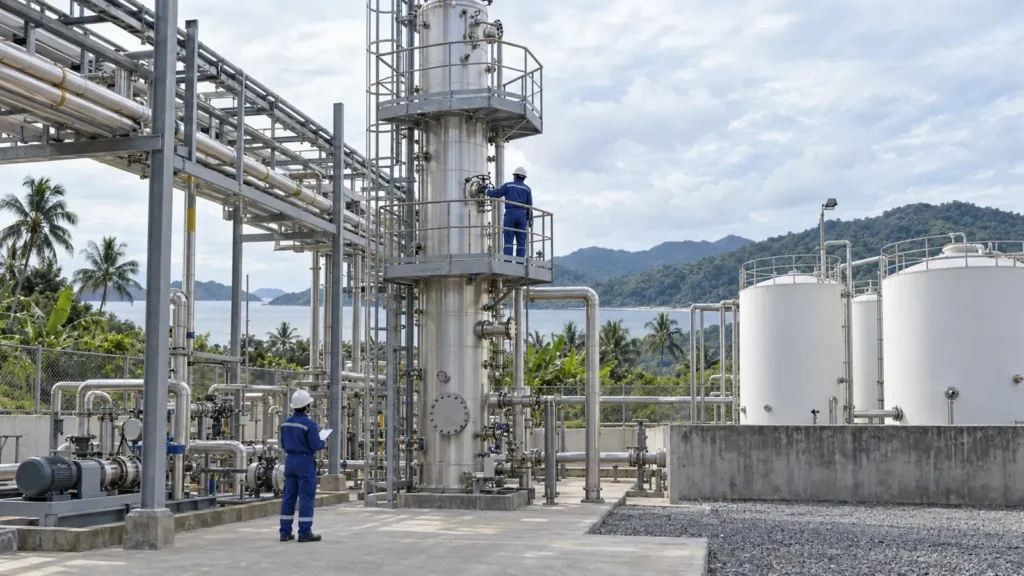
Thailand has required sustainable aviation fuel blending since 1 January 2026; the Southeast Asia picture frames what follows. National fuel standards, meaning published specifications for what may be sold and burned, make the blend mandatory through the Department of Energy Business. Eight Thai airlines signed a memorandum of understanding. A signed intent without a penalty, holding SAF at 1% of fuel on international flights between CORSIA states for 2026 and 2027. The Thailand SAF policy runs to 8% by 2036, domestic capacity is about 370 million litres a year by 2026. In addition, no instrument carries a written penalty. Therefore, I read a standard and a commitment rather than an enforceable obligation.
I read this file the way a lender would: which instrument is in force, which line is only a published plan. In addition, which volumes are already under contract. Two published readings of the same start date sit side by side, and I keep both rather than averaging them.
In short
- In force: Fuel standards made blending mandatory on 1 January 2026, with Jet A-1 in three specifications under ASTM D7566.
- Committed: Eight Thai airlines signed a memorandum of understanding to hold SAF at 1% of fuel on international flights between CORSIA states for 2026 and 2027.
- Planned: The Department of Alternative Energy Development and Efficiency maps a rise from 1% to 8% by 2036.
- Supply: Estimated domestic capacity is about 370 million litres a year by 2026, across HEFA and co-processing HEFA.
- Gap: Neither instrument carries a written penalty, and no compliance test is published.
In this article
What Thailand has actually put in force
Since 1 January 2026, blending SAF into jet fuel is mandatory in Thailand under regulations implemented by the Department of Energy Business, which says the rules support carbon neutrality and net-zero goals and categorizes Jet A-1 into three types: conventional Jet A-1, fuel produced via co-hydroprocessing, and a blend of conventional Jet A-1 with pure SAF. Feedstocks, the raw material the fuel is made from, and production processes must meet ASTM D7566 norms, with current focus on HEFA technology. Norton Rose Fulbright states that from 2026, airlines in Thailand will be required to use at least 1% SAF blended with conventional jet fuel, increasing gradually in line with ICAO’s net-zero aviation goals by 2050.
The Civil Aviation Authority of Thailand initiated a memorandum of understanding with eight major Thai operators. Under it, all signatories commit to keeping SAF at 1% of fuel consumed on international flights between states participating in CORSIA, for both 2026 and 2027: Bangkok Airways, K-Mile Air, Nok Air, Thai AirAsia, Thai AirAsia X, Thai Airways, Thai Lion Air and Thai VietJet.
What this means for you: what I can point at today is a fuel specification plus a signed airline commitment, not a rule with a published penalty. I label them separately in the model.
The dates the government has published
The Department of Alternative Energy Development and Efficiency is preparing to mandate the use of SAF, starting at 1% on 1 January 2026 and increasing to 8% by 2036. That ramp is a blending requirement, meaning a minimum share that must be mixed into jet fuel. In addition, it sits inside the National Energy Plan 2024, the country’s 2050 Carbon Neutrality goal and its 2065 Net Zero target. The transport sector accounts for the largest share of final energy consumption at 40.5%. For the mandates other governments have published. Sustainable Aviation Futures records that Thailand is among several Southeast Asian nations that have introduced SAF blending roadmaps beginning around 2027. Read the two dates together: a fuel standard already in force since 1 January 2026. In addition, a ramp that remains a published intention.
What this means for you: I do not average these readings. The standard in force is one row with its source, the ramp is a second row with its source. In addition, the lender sees which line is binding today and which is a forecast.
What is already being produced
Thai producers run two conversion processes today, HEFA. In addition, Co-processing HEFA, using used cooking oil as feedstock, and total estimated production capacity is approximately 370 million litres per year by 2026. Bangchak Corporation is constructing a HEFA plant using used cooking oil as feedstock, capable of producing one million litres daily. In addition, PTT Global Chemical is producing SAF via co-processing HEFA with an existing capacity of over 16,000 litres per day. Airlines and domestic fuel producers work together to strengthen the SAF supply chain. In addition, ICAO notes that Thai aeroplane operators can now access SAF through available local supply channels. Because the airline commitment covers flights between states participating in CORSIA, those volumes must also meet its eligibility rules.
Norton Rose Fulbright records Bangchak’s fry to fly campaign, which encourages the public to sell used cooking oil at its petrol stations. A loan equivalent to USD 190 million from UOB backed by carbon credits, an offtake agreement with Shell International Eastern Trading in Singapore, and a 10-year agreement with Japan’s Cosmo Oil from December 2023.
What this means for you: the capacity line mixes a national annual figure with plant level daily figures. Therefore, I keep them on separate rows. The signed contracts matter more than any of those numbers when I test whether the plant can sell what it makes.
Feedstock, and the ethanol that is looking for a home
Thailand has 28 ethanol plants with a total capacity of 6.92 MLPD while road consumption in 2024 was around 3.43 MLPD, leaving an ethanol surplus of over 50%. Alcohol-to-Jet technology allows ethanol to be converted into SAF, requiring approximately 1.7 tonnes of ethanol per 1 tonne of SAF. Therefore, the Department of Alternative Energy Development and Efficiency has a policy to promote value-added uses for the available ethanol. Older fuel types such as Gasohol 91, Gasohol 95 and E85 will be gradually phased out, with full discontinuation expected by 2027, while Gasohol E20. In addition, Biodiesel B7 become the new primary options. By 2030, SAF production through Alcohol-to-Jet using molasses and sugarcane as feedstocks is being explored.
However, the life cycle emissions factor for molasses is relatively high under ICAO’s CORSIA default values because it is classified as a co-product, and Thailand plans to propose a study on a country-specific life cycle emissions factor for Thai molasses. I also check feedstock availability across Southeast Asia before I credit any of these volumes.
What this means for you: the surplus feedstock and the emissions factor are two separate underwriting questions. One tells me whether a plant can be fed. The other tells me whether the output still qualifies once it is booked.
What a finance plan has to survive
IATA states that any SAF mandates should be introduced only where the necessary market conditions, production capacity, infrastructure readiness and supportive policy measures are sufficiently in place, in order to avoid unintended economic impacts. Supply constraints or disproportionate cost burdens. In a separate release, IATA asks for policy support through effective sequencing of production incentives and investment frameworks that provide certainty and reduce risk before any mandates are imposed. Norton Rose Fulbright notes that feedstock-rich countries such as Indonesia, Malaysia and Thailand have the natural potential to become major SAF producers but currently lack the infrastructure or support mechanisms necessary to develop SAF projects at scale.
In addition, that obtaining bankable, long-term offtake agreements with airlines is critical, albeit challenging. Bankable, in plain words, means structured. Therefore, a lender can count the revenue, which Norton Rose Fulbright ties to long-term, stable offtake terms from airlines and jet fuel providers.
What this means for you: in the way I approach financing a SAF project. A finance plan here needs the name of the instrument, the authority that issues it. In addition, the authority that enforces it, and I need those three before the debt tenor starts.
Where the risk sits today
SAF currently represents less than 1% of global aviation fuel use and is several times more expensive than conventional aviation fuel. In a separate IATA release, global SAF production is expected to reach around 2.4 million tonnes in 2026, representing just 0.8% of aviation fuel use, at a cost to airlines of $4.3 billion. Sustainable Aviation Futures reports that SAF produced in Asia has tended to flow to Europe where mandates create a price premium, raising concerns that Asia-Pacific might face local shortages or higher costs if it lags behind in policy. In addition, that IATA reports most SAF supply in 2025 is headed to Europe with Europe’s approach having driven SAF prices to five times that of conventional jet fuel.
What this means for you: the way I read policy risk starts with this distinction. The risk I watch is not that Thailand drops its target. It is that a signed commitment. In addition, a fuel standard carry the revenue line while the compliance test an underwriter would use has not been published.
What I would ask before signing
I ask four questions in writing. First, does the blending requirement sit in a legal instrument with a penalty, or in a fuel standard plus a memorandum. Second, which authority issues the rule and which one enforces it, because the department that publishes a standard and the civil aviation authority that runs the memorandum are not the same office. Third, what the current compliance date is, and I record it with the date it was published. This is because this file has two published readings: a standard in force since 1 January 2026 and roadmaps that Sustainable Aviation Futures places around 2027. Fourth, what volume the plant can sell if the obligation slips. In addition, I take that answer from signed contracts rather than from the trajectory. I do not average the two readings; I keep both, each with its source.
What this means for you: these four answers decide whether the revenue line is contracted or assumed. In addition, I will not write a debt case until each one has a written reply. In addition, a date attached to it.
How I would model it if it were my file
I put the capacity line and the obligation line on separate rows and I date every entry. The capacity row carries approximately 370 million litres per year by 2026 as the national figure, with the Bangchak plant at one million litres daily. In addition, the PTT Global Chemical co-processing capacity of over 16,000 litres per day recorded as separate line items. The obligation row carries 1% from 1 January 2026. Also, the memorandum covering 2026 and 2027, and 8% by 2036 as the stated endpoint. I run the model twice, once with the obligation enforced and once with it slipping. In addition, I show the lender the difference in one line. My last row is the contracted volume, because that is the only row a lender will count.<\/p>
What this means for you: both runs start from the same published dates. Therefore, the gap between them comes from enforcement rather than arithmetic. In addition, that gap is what I ask the lender to price. If the obligation slips, the contracted row still has to cover debt service.<\/p>
Sources<\/strong><\/p>\n
- \n
- IATA<\/a>, June 2026.<\/li>\n
- IATA<\/a>, 6 June 2026.<\/li>\n
- ICAO<\/a>, July 2025.<\/li>\n
- The Nation<\/a>, 22 October 2025.<\/li>\n
- World Bio Market Insights<\/a>, consulted 16 November 2026.<\/li>\n
- Sustainable Aviation Futures<\/a>, 2025.<\/li>\n
- Norton Rose Fulbright<\/a>, October 2025.<\/li>\n<\/ul>
- IATA<\/a>, 6 June 2026.<\/li>\n
Frequently asked questions
What is Thailand's SAF mandate?
It arrives through national fuel standards in force since 1 January 2026 that require blending SAF into jet fuel and set Jet A-1 specifications in three types under ASTM D7566 with a focus on HEFA. It is supported by a memorandum of understanding in which eight Thai airlines commit to 1% of fuel burned on international flights between CORSIA states for 2026 and 2027, with a published path to 8% by 2036 (World Bio Market Insights; ICAO; The Nation).
When did the 1% SAF blending requirement start?
The fuel standards took effect on 1 January 2026, and the airline commitment covers 2026 and 2027 (World Bio Market Insights; ICAO). The roadmap from the Department of Alternative Energy Development and Efficiency also starts at 1% on that same date, while Sustainable Aviation Futures places several Southeast Asian roadmaps around 2027, so I keep both readings with their sources instead of merging them.
How much SAF can Thailand produce?
Total estimated production capacity is approximately 370 million litres per year by 2026, with Bangchak building a HEFA plant capable of producing one million litres daily and PTT Global Chemical already producing above 16,000 litres per day through co-processing (ICAO; World Bio Market Insights). I keep the national annual figure and the plant daily figures on separate lines when I compare them.
Does Thailand's SAF policy make a project bankable?
It helps demand and it has produced signed commercial contracts, including a loan equivalent to USD 190 million from UOB, an offtake with Shell International Eastern Trading and a 10-year agreement with Cosmo Oil, but a finance plan still needs an instrument with a published compliance test before it can treat the obligation as contracted revenue (Norton Rose Fulbright).
Not sure your project would survive a credit conversation?
A short call is usually enough to see where your project stands.
If you are building a Thai SAF file. In addition, the offtake question is what holds the model together, I can structure that conversation with airlines, fuel traders. In addition, buyers before the numbers are fixed. See how I work on offtake agreements.
I do not provide investment advice or arrange investments. I act as a strategic advisor and facilitator.

Alex, Founder of WeConnect Asia
I help low-carbon fuel and carbon removal project developers in Southeast Asia secure the commercial and financial partners needed to reach FID.
Related articles

Pitching a Climate Tech Company to Strategic Investors: What the Corporate Has to Believe Before It Writes a Cheque
How to pitch a climate tech company to strategic investors: the metric cluster, the readiness evidence and the ask that corporates fund.

Biomethane: What It Is, How It Is Made and Who Buys It
Biomethane is biogas cleaned to pipeline quality. I explain how it is made, how it differs from biogas and who buys it in Southeast Asia.

CO2 Sourcing for e-SAF Projects: What the Rules Allow and What the Contract Must Say
Biogenic CO2, direct air capture or industrial flue gas: which sources an e-SAF plant may use, what they cost and which contract terms make the fuel certifiable.

Operating Performance Guarantees for SAF Plants: What Lenders Ask For
Minimum guarantees, performance damages, retesting and who stands behind them: the operating guarantees a SAF plant needs to keep debt and offtake intact.

EPC and Construction Risk in SAF Plants: What a Lender Actually Tests
FEED scope, convertible EPC, performance guarantees and damages caps: the construction risk questions a SAF project must answer before financial close.

Matching Feedstock and Offtake Risk Back-to-Back in a SAF Project: How Lenders Read the Chain
Lenders do not buy a feedstock plan and an offtake plan separately. They buy the link between the two, and the link is where most SAF files break.