
Home » EPC and Construction Risk in Methanol Plants: What a Lender Actually Signs
EPC and Construction Risk in Methanol Plants: What a Lender Actually Signs
10 min read · Nov 2, 2025 · By Alex
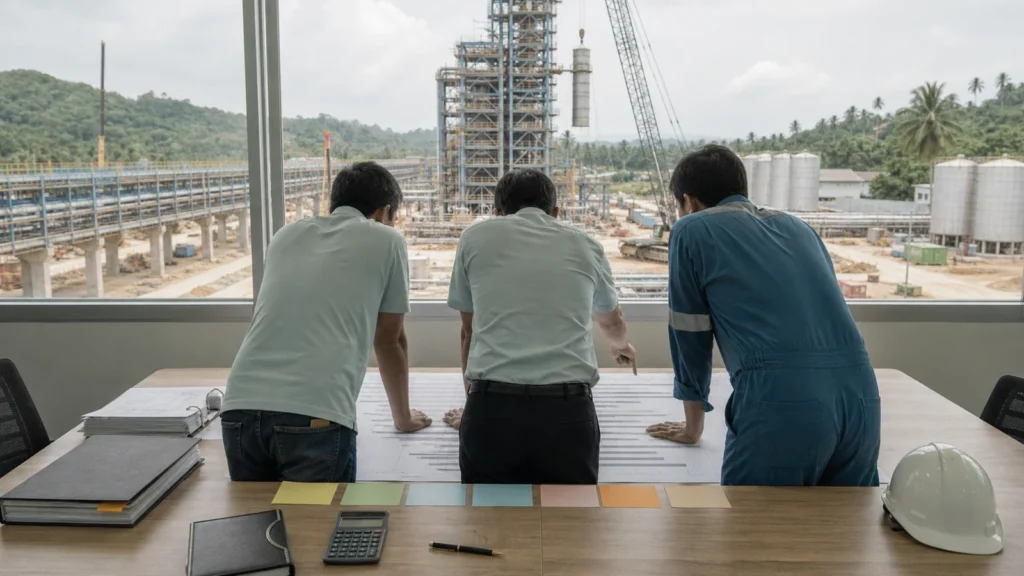
Building a methanol plant is a chain of commitments, and the construction contract carries most of them. I read that contract as a document about failure, not about price. For a lender, a development finance institution or an export credit agency in a pre-FID file on green methanol, the test is contractual. A bankable answer on methanol plant EPC risk is six written requirements: a fixed completion date, a fixed completion price, no or limited technology risk, output guarantees, liquidated damages for delay and performance, and security from the contractor or its parent; plus two restrictions: large liability caps, and limits on the contractor’s right to claim extensions of time and extra cost.
Front-end engineering design, the engineering package that fixes the design before construction, takes at least 24 months and can take 36 months, in an estimate published in November 2025. Everything below is read against that clock. I describe what a construction contract has to say, not what any project has signed.
In short
- Requirements: six written items: a fixed date, a fixed price, no or limited technology risk, output guarantees, damages for delay and performance, contractor security.
- Restrictions: large liability caps, plus tight limits on claims for extra time and extra cost.
- Estimate: contingency of 20 percent in a November 2025 estimate, against a class 5 range of 20 to 40 percent.
- Schedule: at least 24 months of front-end engineering design, up to 36, and about six years to commissioning, in November 2025.
- Demand: renewable methanol sold in 2024 was 400,000 to 500,000 tonnes, far below the announced pipeline.
In this article
What the contract has to decide
An EPC contract, meaning engineering, procurement and construction and also called turnkey, is where a methanol project stops being a plan and becomes a delivery obligation. It fixes who carries the cost of delay, who carries a performance shortfall, and who pays when the design misses the guaranteed output. Before completion, that allocation is the entire credit story, because a late plant earns nothing.
The contract is one document in a suite: it works only if it matches the offtake that gives the plant a customer, the feedstock supply that keeps it running, and the loan that funds it. That offtake is usually take-or-pay, meaning the buyer pays for the volume it commits to whether or not it lifts it; without a locked-in client, lenders do not lend and boards do not approve. Project finance, meaning funding repaid from the cash the project itself generates, makes that alignment a condition.
What this means for you: I open the EPC section first, then I test whether the offtake, the feedstock supply and the loan document say the same thing about dates, output and liability.
The six requirements, in writing
In January 2016, PricewaterhouseCoopers described an EPC contract as delivery of a complete facility the developer only has to turn the key on, at a guaranteed price, by a guaranteed date, at a specified performance level, with failure normally triggering monetary liabilities to the contractor. It defined bankability as a risk allocation between the contractor and the project company that satisfies the lenders, who look at how easily the contractor can claim extra cost or time and at the security it provides.
What I then want in writing: a fixed completion date, a fixed completion price, no or limited technology risk, output guarantees, meaning a promised quantity of product, liquidated damages for delay and for performance, security from the contractor or its parent, liability caps that ideally would not exist, and limits on the contractor’s right to claim an extension of time, meaning extra days, or extra cost. The page on securing offtake agreements covers the contract that triggers the loan.
Liquidated damages, agreed sums payable for lateness or underperformance, only work if they are enforceable and set high enough to bite. Single point of responsibility is the form’s main advantage, and the January 2016 paper also records heavy contractor losses, refusals in some jurisdictions and costlier construction insurance. It requires the contract to match the suite, feedstock supply included, which for a methanol plant is a natural gas agreement with a local supplier.
What this means for you: I tick each requirement against the draft and test the liability cap against my delay model before price enters the conversation.
The price the plant has to beat
BloombergNEF and the Climate Technology Coalition report, in a study dated 18 June 2024, that low-carbon methanol production costs can run from 1.2 to 12 times those of fossil methanol depending on the feedstock. In that June 2024 analysis, above 500 USD a tonne a shipping company may find it cheaper to pay the carbon price on its own emissions than to buy green fuel, at least until 2030. Close to 70 percent of grey methanol supply comes from China, and in the same analysis planned low-carbon methanol capacity worldwide could consume 1.65 million tonnes of clean hydrogen a year.
Once producers have signed long-term offtakes or won investment from maritime buyers, they approach port infrastructure operators for storage capacity, so the offtake contract feeds straight back into the construction schedule. The e-methanol project finance page is where that price has to hold.
What this means for you: I ask what price the offtake actually fixes and I test it against the carbon price the buyer would otherwise pay before I treat the revenue line as stable.
What the estimate and the schedule carry
The Oceans North and Arup study of November 2025 puts a 50,000 tonnes a year phase at about 182 million USD in 2025 dollars, four phases at about 731 million USD, or 3,653 USD a tonne of installed capacity including contingency, above the 3,330 USD a tonne reference for e-methanol from direct air capture.
In that November 2025 estimate, direct costs are capture 138 million USD, electrolysis 206 million USD, the methanol synthesis loop 111 million USD, balance of plant 26 million USD and storage 38 million USD, for 519 million USD; contingency, the allowance for estimate error, is 20 percent, or 103 million USD, against AACE International class 5 guidelines that put the range at 20 to 40 percent; development expenses are 83 million USD, or 10 to 15 percent of capital cost before contingency.
In that same estimate the schedule gives about six years from the start of first phase engineering to commissioning, with front-end engineering design taking at least 24 months and possibly 36, permitting typically taking two years, later phases three years apart, and full operation 15 years after development starts. In that same November 2025 estimate, operating cost at full capacity is about 300 million USD a year, of which about 150 million USD is electricity, against a levelised cost of about 1,860 USD a tonne of e-methanol versus 383 USD for marine gas oil, 357 USD for very low sulphur fuel oil and 234 USD for heavy fuel oil at equivalent energy. The infrastructure project finance page is where contingency and schedule are read together.
What this means for you: I read the contingency line and the schedule line together, then I ask what happens to the estimate if commissioning slips.
The two risks no price removes
The European Investment Bank and Roland Berger study of May 2024 rests on a consultation of 34 companies drawn from a long list of more than 100. It reports that investors worry about weak returns and high initial capital for first-of-a-kind industrial deployments, which are the most expensive, and that the undecided future marine fuel, ammonia, methanol or bio-based liquefied natural gas, creates an obsolescence risk for a plant that picks the wrong option.
Inflation, higher interest rates and higher electricity prices have already reduced project returns, and the cost gap between sustainable and conventional fuels is expected to persist. The May 2024 study recommends selective de-risking of first-of-a-kind projects, public risk mitigation instruments, development bank financing products and a coordinated financing ecosystem.
An obsolescence risk is not a construction delay: no damages clause pays for a plant that runs on time and makes a fuel the market has stopped wanting. The green methanol production page shows how that choice lands on the plant itself.
What this means for you: I keep the fuel choice and the construction schedule on separate lines of the file, because a clean EPC section covers neither.
What the demand side does to the decision
The Methanol Institute’s 2025 milestones record 50 dual-fuel methanol ships in service at the start of 2025, an orderbook of 350 newbuilds able to run on methanol plus close to 700 methanol-ready ships, and more than 1,000 methanol-classed ships expected in service within five years. Total methanol supply in 2024 was 94 million tonnes, of which only 400,000 to 500,000 tonnes of renewable product were sold.
In those 2025 milestones, more than 200 renewable and low-carbon methanol projects have been announced worldwide, with a potential 45.8 million tonnes by 2030 of which only 20 to 40 percent may materialise, that is 7 to 14 million tonnes within five years. About 4 million tonnes of low-carbon, blue, bio-methanol and e-methanol capacity was operational or under construction in February 2025, and China holds half the global pipeline of bio-methanol and e-methanol projects.
Delivery is a separate line: methanol dual-fuel ships delivered at 59 in 2025 and 38 in the first half of 2026, recorded in November 2026. The methanol bunkering page is where those ships take delivery.
What this means for you: I separate ordered ships from delivered ships and announced capacity from tonnes actually sold, then I ask how much of my plant’s demand sits on the delivered side.
The six questions I ask before I sign
The construction contract cannot answer these alone, so I ask them across the whole methanol plant EPC risk file, in this order, and I expect a written answer to each. None of them is about price, and that is deliberate.
- Which of the six requirements does the draft contract already contain, and which are still open?
- How big is the liability cap, measured against the delay model I am using?
- What contingency does the estimate carry, and against which published class guideline?
- What does the front-end engineering design schedule allow for permitting before construction starts?
- What happens to the plant if the fuel choice turns out to be wrong?
- How much of the demand behind the plant is ordered rather than merely announced?
What this means for you: I write the six answers into the credit memo with a date against each, and I leave blank anything I cannot answer with one.
How I would redline the EPC section of my own file
I redline that section with four dated rows, and any row I cannot date does not go into the file. Nothing else survives my first pass unless it carries a date and a source.
- Requirement row, dated January 2016: fixed date, fixed price, output guarantees, damages, security from the contractor or its parent, and limits on claims for extra time and extra cost.
- Contingency row, dated November 2025: 20 percent of direct costs, or 103 million USD, against a class 5 range of 20 to 40 percent.
- Schedule row, dated November 2025: front-end engineering design of 24 to 36 months, and about six years from engineering start to commissioning.
- Demand row, dated 2024: 400,000 to 500,000 tonnes of renewable methanol sold, set against the announced pipeline.
What this means for you: I keep those four rows visible at the top of the file, because they are the dated facts a committee will test first.
Sources
- PwC EPC Contracts in the process plant sector, January 2016.
- Oceans North and Arup Port of Vancouver e-methanol study, November 2025.
- European Investment Bank and Roland Berger, May 2024.
- BloombergNEF and Climate Technology Coalition, June 2024.
- Methanol Institute 2025 Milestones, 2025.
Frequently asked questions
What makes an EPC contract bankable?
A contract whose allocation of risk between the contractor and the project company satisfies the lenders: a fixed completion date, a fixed completion price, no or limited technology risk, output guarantees, liquidated damages for delay and for performance, security from the contractor or its parent, large liability caps, and restrictions on the contractor’s right to claim extensions of time and extra cost. Bankability is about that allocation, not about the headline price of construction.
Why does the lender care about the contingency?
Because contingency is what absorbs estimate error. In the November 2025 estimate, contingency was 20 percent of direct costs, or 103 million USD, while the published class 5 guidelines put that range at 20 to 40 percent; development expenses were 83 million USD, or 10 to 15 percent of capital cost before contingency.
What schedule should the debt drawdown assume?
One that matches the engineering rather than a marketing date: front-end engineering design takes at least 24 months and can take 36, a permitting process typically takes two years, and about six years separate the start of first phase engineering from commissioning of that phase, in an estimate published in November 2025. I draw against those durations.
Does a big orderbook remove construction risk?
No. Announced projects and ordered ships are not delivered capacity. In the 2025 milestones, of more than 200 announced low-carbon methanol projects with a potential 45.8 million tonnes by 2030 only 20 to 40 percent may materialise, that is 7 to 14 million tonnes within five years, and renewable methanol actually sold in 2024 was 400,000 to 500,000 tonnes.
Not sure your project would survive a credit conversation?
A short call is usually enough to see where your project stands.
If you want the EPC section of your file read against these six requirements, the contingency and the schedule, I do that with you at contracting and risk management.
I do not provide investment advice or arrange investments. I act as a strategic advisor and facilitator.

Alex, Founder of WeConnect Asia
I help low-carbon fuel and carbon removal project developers in Southeast Asia secure the commercial and financial partners needed to reach FID.
Related articles

Pitching a Climate Tech Company to Strategic Investors: What the Corporate Has to Believe Before It Writes a Cheque
How to pitch a climate tech company to strategic investors: the metric cluster, the readiness evidence and the ask that corporates fund.

Biomethane: What It Is, How It Is Made and Who Buys It
Biomethane is biogas cleaned to pipeline quality. I explain how it is made, how it differs from biogas and who buys it in Southeast Asia.

CO2 Sourcing for e-SAF Projects: What the Rules Allow and What the Contract Must Say
Biogenic CO2, direct air capture or industrial flue gas: which sources an e-SAF plant may use, what they cost and which contract terms make the fuel certifiable.

Operating Performance Guarantees for SAF Plants: What Lenders Ask For
Minimum guarantees, performance damages, retesting and who stands behind them: the operating guarantees a SAF plant needs to keep debt and offtake intact.

EPC and Construction Risk in SAF Plants: What a Lender Actually Tests
FEED scope, convertible EPC, performance guarantees and damages caps: the construction risk questions a SAF project must answer before financial close.

Matching Feedstock and Offtake Risk Back-to-Back in a SAF Project: How Lenders Read the Chain
Lenders do not buy a feedstock plan and an offtake plan separately. They buy the link between the two, and the link is where most SAF files break.