
Home » Biogas and Biomethane Offtake Agreements: What the Contract Has to Fix
Biogas and Biomethane Offtake Agreements: What the Contract Has to Fix
10 min read · Sep 12, 2025 · By Alex
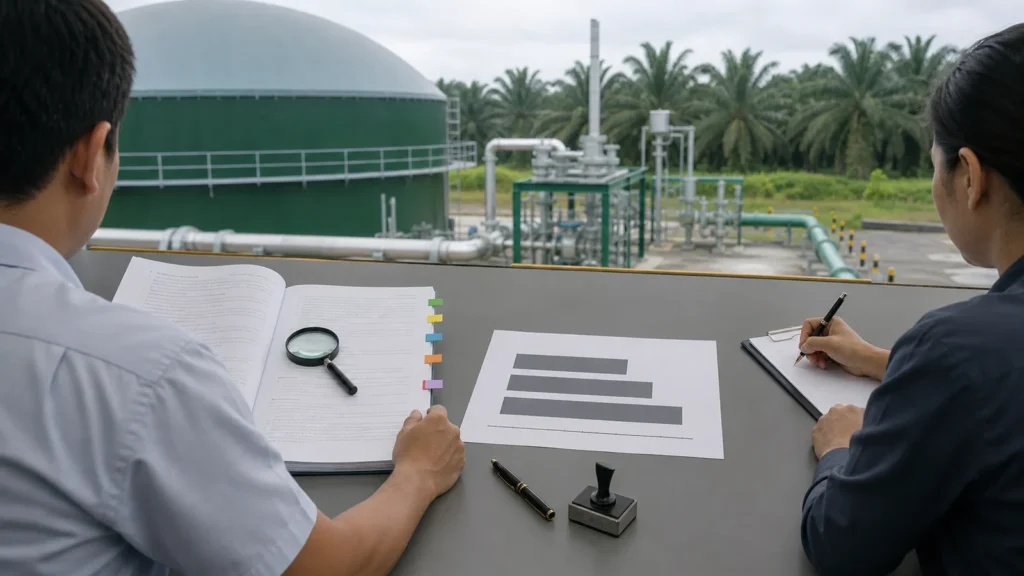
Six things decide whether a biogas or biomethane sale can be financed: the product sold (electricity, gas, or a certificate), the volume, the tenor (how long the contract runs), the price formula and its index, the delivery point, and the credit of the buyer. Everything else in the draft protects one of those six, and a contract that leaves any one of them open is not bankable, meaning a lender will not lend against it. A biogas offtake agreement fixes those six, and the market gives the frame: Southeast Asia produced almost 80 PJ of biogases in 2025 against a potential of almost 65 bcme (billion cubic metres equivalent) estimated in 2026, while the United Kingdom paid an indexed tariff over 15 years in three tiers at the end of 2022. I work in the biogas, biomethane and biofuels industry and prepare these negotiations before final investment decision (FID).
I take the six clauses in the order a lender reads them, from what is sold to who buys and where certificates sit. Each section closes with the move I would make next.
In short
- Six clauses: product, volume, tenor, price index, delivery point, buyer credit.
- Tariff model: the United Kingdom pays an indexed tariff over 15 years in three volume tiers.
- Regional frame: almost 80 PJ produced in 2025 against potential of almost 65 bcme.
- Carbon lesson: revenue that depends on a carbon market stopped working in this region in 2012.
- Buyer base: power utilities, gas networks, industrial users and, new, bunker suppliers.
In this article
What an offtake agreement has to fix
An offtake agreement is the contract in which a buyer commits to take a defined product from a defined plant, for a defined period, at a defined price. Biogas is the gas microorganisms produce when they break down organic material without oxygen, a process called anaerobic digestion; biomethane is that gas cleaned of carbon dioxide and other impurities until it can enter a gas grid.
The six clauses rank in this order: product, volume, tenor, price formula and index, delivery point, buyer credit. A draft that leaves any one open is not bankable, because the lender, a commercial bank or a development finance institution (DFI), must price the gap or refuse it.
The negotiation is not about price alone. It is about who carries the volume risk when the feedstock, the organic material fed into the digester, does not arrive, who carries the quality risk when the gas misses specification, and who carries the policy risk when the tariff moves. I put those three risks on the table before any number.
What this means for you: write the six clauses on one page in that order and mark the line your buyer has not answered. That line is the negotiation.
Three products, three contracts
Three products leave the same digester: electricity, gas, and a certificate, and each needs a different contract.
In 2020 worldwide biogas production cost sat between USD 2/MBtu and USD 20/MBtu, with 70 percent to 95 percent of that total inside the digester and the rest covering collection and treatment of the feedstock. Feedstock can also carry a gate fee, the payment an operator receives for accepting a waste. Those figures come from the IEA biogas and biomethane outlook published in 2020.
Adding a cogeneration unit, the grid connection and the distribution of recovered heat can add 70 percent to an integrated project in 2020. Upgrading to biomethane costs more: around USD 19/MBtu on average in 2020 once cleaned, of which the upgrading step alone is USD 2/MBtu to USD 4/MBtu at a plant cleaning about 3.5 million m3 of biogas a year, plus around USD 3/MBtu to reach the grid.
The extra capital of upgrading only pays if the offtake is a gas contract sold at a gas price. Sell electricity instead and you pay for upgrading while earning on a power price. Digestate, the residue left after digestion, and pure CO2 brought modest revenue in 2020 and did not close the gap to natural gas. I set those numbers beside offtake agreements for waste-to-energy and biogas before choosing.
What this means for you: decide the product first, because the digester cost is paid either way and only a gas contract can pay for the upgrading step.
Volume and tenor, and what the buyer will accept
Volume and tenor are one negotiation: a buyer who takes less for longer buys a different risk than one who takes more for a short time.
At the end of 2022 the United Kingdom paid 5.51 p/kWh on the first 60 GWh injected, 3.53 p/kWh on the next 40 GWh and 1.56 p/kWh beyond, under an indexed tariff running 15 years. Those figures are recorded in the IEA Bioenergy Task 37 country report of September 2024.
The same 2024 report describes Switzerland financing a plant over a 20-year repayment period, with compensation covering 50 percent of the costs directly linked to energy production. The tier rewards the first tranche and flattens the tail: the plant is paid well while it amortises the digester and paid less once it runs.
A 15-year support schedule also lets the project sign a shorter commercial offtake with a merchant tail: the scheme carries the early years and the market the later ones. I use that shape when I secure offtake agreements, because a buyer accepts a lower tail if the head of the curve is protected.
What this means for you: ask for the tier structure before you argue about the average price, then set the tenor to cover the years the digester is still being paid off.
Price and indexation
A price clause has two parts: the number, and the index that moves it. The index decides who carries feedstock risk for the whole tenor.
In 2024 the levelised cost of bioenergy electricity was USD 0.087/kWh, 19 percent above the USD 0.073/kWh of 2023, on feedstock price volatility and logistics costs. Installed cost was USD 3 242/kW in 2024, 16 percent above the 2023 average of USD 2 795/kW, and variable operation and maintenance ran at around USD 0.004/kWh. These 2024 figures come from the IRENA cost review published in 2025.
The installed cost is capex, the capital spending that happens once; the maintenance line is opex, the operating cost that repeats; and only the second moves during the contract. A fixed price for 15 years transfers feedstock risk to the seller, an index transfers it to the buyer. The choice decides which counterparty needs a hedge, and it must be written before the volume is agreed.
A feed-in tariff, a fixed price a state or utility pays for renewable electricity, is one form of that index, and the Malaysian biogas feed-in tariff shows how a national rate can be revised mid-term.
What this means for you: pick the index before the price, then write a floor and a cap around it so neither side funds a move it cannot afford.
Who the buyer is
Four buyer types sit at the end of a biogas chain, and each buys something different.
In 2025 Southeast Asia produced almost 80 PJ of biogases against a feedstock potential of almost 65 bcme, with Thailand, Indonesia and Malaysia the most relevant markets, as recorded in the IEA renewables report published in 2026. The same 2026 report describes a new wave of liquefied biomethane and bio-LNG projects driven by maritime fuel demand, export to Singapore and import substitution, and says growth will depend on supportive policies.
A power utility needs a dispatchable volume and asks for minimum availability. A gas network needs a specification: methane content, moisture, pressure and a test method at the delivery point. An industrial user needs a delivered price and asks who pays for compression and grid entry. A bunker supplier needs a port and a certificate.
I map the buyer before I draft and read the biomethane market in Southeast Asia to see which of the four is actually buying.
What this means for you: name the buyer type first, because the four ask for four different contracts and only one fits your plant.
Where certificates and carbon revenue sit
Certificates and carbon revenue are real money, and the most fragile line in the model.
The 2020 policy brief from the Energy Studies Institute at the National University of Singapore records that the collapse of carbon prices in 2012 stopped the Southeast Asian biogas projects that depended on carbon revenue, with many companies ending in serious financial difficulty, after that mechanism had been the main stimulus between 2008 and 2012. The same brief puts regional biogas projects at 53 percent of the global registered count and 3 percent of all registered projects, and records a Singapore carbon tax set in 2019 at S$5/tCO2.
The placement rule follows from that history: certificates and carbon revenue belong in a separate schedule with a separate counterparty, never inside the core offtake, so their disappearance does not reopen the price.
I keep that schedule apart and point counterparties to the Singapore biomethane sandbox when they ask where a certificate can be sold.
What this means for you: write carbon and certificate income in a schedule that can be deleted on its own, then check the base case still works without it.
The clauses I check first
Once a draft arrives, I read seven lines before anything else.
- The product specification and the test method: what is sold, at what purity, and how a quality dispute is settled.
- The minimum and maximum volume with the take-or-pay level, so a shortfall has a price.
- The tenor against the debt schedule, so the contract outlives the borrowing.
- The price formula and the index, with a floor and a cap on both.
- The delivery point and who pays for compression or grid entry.
- The credit support from the buyer: a guarantee, a parent guarantee, or a deposit.
- The change of law clause, because a tariff revision has already moved a national rate in this region: in 2014 Malaysia raised its purchase tariff from RM 0.32/kWh to RM 0.40/kWh.
What this means for you: run these seven lines in order and stop at the first blank, because that blank is where the risk sits and no price adjustment moves it.
How I would write the offtake row into the credit paper
The credit paper is what a lender reads to decide, and the offtake row answers the revenue question. I write four rows and nothing more.
- The product and the specification.
- The volume and the take-or-pay level.
- The tenor against the loan life.
- The price formula with its index.
The row is finished only when the buyer’s credit is documented: accounts, a rating if there is one, and the support behind the signature. A signed term sheet with an investment grade buyer is worth more than a letter of intent from a better payer, because the first is enforceable and the second is not.
What this means for you: fill the four rows, attach the buyer’s credit file, and only then send the paper; a row without a documented buyer is read as an assumption.
Sources
- IEA, Outlook for biogas and biomethane, 2020.
- IRENA, Renewable power generation costs in 2024, 2025.
- Energy Studies Institute, Producing Biogas from Palm Oil Mill Effluent in Southeast Asia, 2020.
- IEA Bioenergy Task 37, A perspective on the state of the biogas industry in 12 member countries, 2024.
- IEA, Renewables 2026, chapter Biogases, 2026.
Frequently asked questions
What must a biogas offtake agreement contain?
The product and its specification, the volume including a take-or-pay level, the tenor, the price formula and its index, the delivery point, and the credit support of the buyer. A contract missing any of the six leaves a risk that the lender will price or refuse.
How long should the offtake run?
Long enough to cover the debt and to let the plant amortise the digester, which carries 70 percent to 95 percent of total cost on 2020 data. Support schemes give a reference: the United Kingdom pays an indexed tariff over 15 years and Switzerland finances plants over a 20-year repayment period.
Should carbon revenue sit inside the offtake?
No. It belongs in a separate schedule with its own counterparty, because it has already disappeared once in this region: the carbon price collapse of 2012 stopped Southeast Asian biogas projects that depended on it.
How is the price usually indexed?
Either to a feedstock cost index, which protects the seller, or to the competing fuel price, which protects the buyer, with a floor and a cap. The choice decides which side needs a hedge, and it has to be written before the volume is agreed.
Not sure your project would survive a credit conversation?
A short call is usually enough to see where your project stands.
If you are heading into a negotiation and want the draft read against these six clauses, my offtake agreement work covers exactly this stage, from the first term sheet to the row that goes into the credit paper.
I do not provide investment advice or arrange investments. I act as a strategic advisor and facilitator.

Alex, Founder of WeConnect Asia
I help low-carbon fuel and carbon removal project developers in Southeast Asia secure the commercial and financial partners needed to reach FID.
Related articles

Pitching a Climate Tech Company to Strategic Investors: What the Corporate Has to Believe Before It Writes a Cheque
How to pitch a climate tech company to strategic investors: the metric cluster, the readiness evidence and the ask that corporates fund.

Biomethane: What It Is, How It Is Made and Who Buys It
Biomethane is biogas cleaned to pipeline quality. I explain how it is made, how it differs from biogas and who buys it in Southeast Asia.

CO2 Sourcing for e-SAF Projects: What the Rules Allow and What the Contract Must Say
Biogenic CO2, direct air capture or industrial flue gas: which sources an e-SAF plant may use, what they cost and which contract terms make the fuel certifiable.

Operating Performance Guarantees for SAF Plants: What Lenders Ask For
Minimum guarantees, performance damages, retesting and who stands behind them: the operating guarantees a SAF plant needs to keep debt and offtake intact.

EPC and Construction Risk in SAF Plants: What a Lender Actually Tests
FEED scope, convertible EPC, performance guarantees and damages caps: the construction risk questions a SAF project must answer before financial close.

Matching Feedstock and Offtake Risk Back-to-Back in a SAF Project: How Lenders Read the Chain
Lenders do not buy a feedstock plan and an offtake plan separately. They buy the link between the two, and the link is where most SAF files break.