
Home » Biogas Supply for Methanol Plants: Five Clauses to Read Before You Sign
Biogas Supply for Methanol Plants: Five Clauses to Read Before You Sign
10 min read · Sep 13, 2025 · By Alex
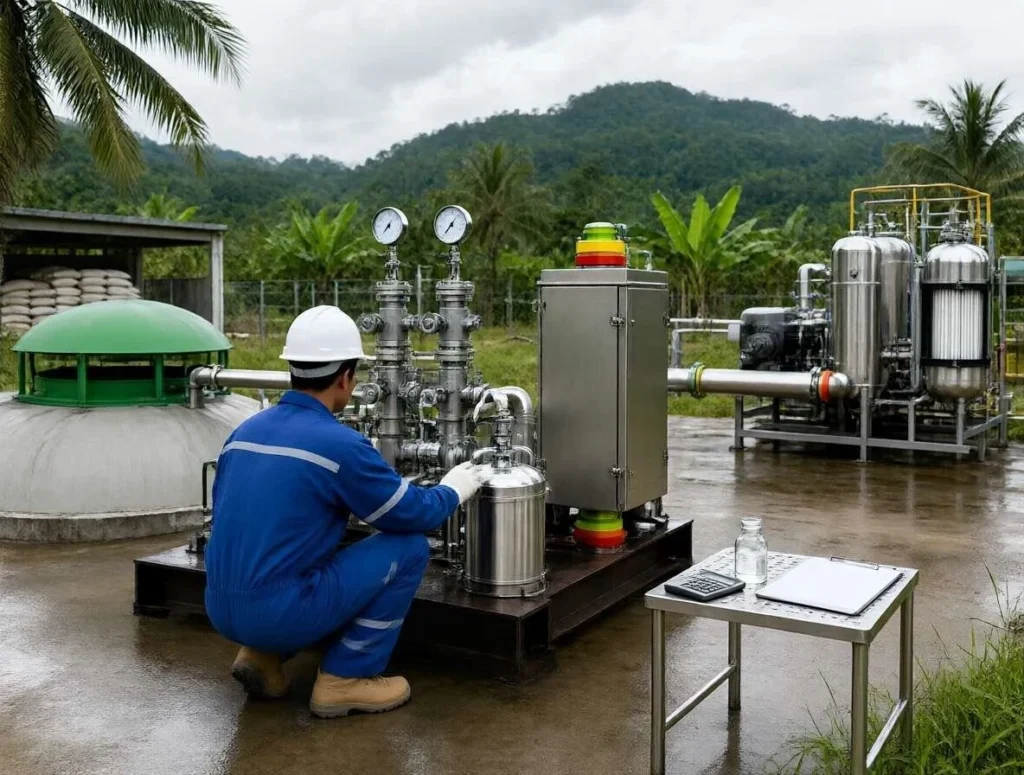
Five clauses answer what the contract must actually say: a delivery term of 10, 15 or 20 years as written in the published biogas purchase and sale agreement, biogas being gas produced from organic matter (NAESB, December 2006); a maximum contract quantity, in that same agreement the lesser of a designated volume and 8,000 MMBtu a day, MMBtu being a unit of gas energy; a gas quality specification the seller must meet; a termination right if the seller delivers less than 25 percent of the maximum quantity for 120 consecutive days; and a clean split between the gas and its environmental attributes. I read every draft against those five lines first. The NAESB agreement of December 2006 is a published model, not a signed contract. A biogas supply methanol file also belongs to the wider feedstock picture, and the green methanol industry page carries that frame.
I write from the structuration side of a green methanol file, where the supply contract is drafted while the lenders are still forming a view. Everything below comes from the published sources listed at the end of this article, and every figure carries its publisher and its date.
In short
- Duration: the NAESB agreement of December 2006 writes the delivery term as 10, 15 or 20 years and executes the example at 10 years.
- Volume: under that same NAESB December 2006 agreement the seller delivers up to the lesser of a designated volume and 8,000 MMBtu a day.
- Quality: the specifications sit in the buyer’s tariffs, and first delivery follows regulatory approval or waiver (NAESB, December 2006).
- Termination: below 25 percent of the maximum quantity for 120 consecutive days, the buyer may exit that site on 30 days written notice (NAESB, December 2006).
- Attributes: the environmental attributes are defined separately from the gas, with a 45 days right of first refusal for the buyer (NAESB, December 2006).
In this article
Five clauses, one contract
Those five clauses are the whole agenda before financial close: duration, maximum quantity, quality, termination, attributes. I put them into one paragraph of the term sheet so that nothing gets negotiated twice later.
The frame comes from IRENA and the Methanol Institute in 2021: bio-methanol, the methanol made from organic feedstocks instead of fossil carbon, is produced from forest and agricultural residues, biogas from landfill, sewage and municipal solid waste, and black liquor, the residual stream of the paper industry. The same IRENA and Methanol Institute 2021 report records that biogas can also be fed into a methanol plant based on natural gas. A methanol project can therefore buy this gas either as a carbon source or as fuel, and the contract has to state which job it covers.
What this means for you: I do not open a price discussion until the document says which job the gas has, because a contract written for fuel delivery and a contract written for a carbon source are not the same document.
What the contract is really buying
I start from the definition. The published NAESB agreement of December 2006 defines biogas as methane, carbon dioxide and associated non-combustible gases, in a gaseous state, produced by anaerobic digestion, the breakdown of organic matter without oxygen, by fermentation, or by gasification of organic matter. The same agreement obliges the seller to build and operate the production facilities, pipelines and equipment needed to deliver to the delivery point.
Composition decides what the plant can do. GIZ and NIRAS recorded in 2024 that a green methanol pre-feasibility design assumes biogas at 60 percent biomethane and 40 percent carbon dioxide, with the carbon dioxide used as the carbon source combined with green hydrogen. Biomethane is what remains after upgrading, the cleaning step that separates methane from carbon dioxide, and Ecohz wrote in 2026 that it is chemically identical to fossil methane. The plant explainer shows the machinery behind those molecules.
What this means for you: I check that the delivery point, the composition and the quality specification sit in the same paragraph, because the plant design and the meter cannot disagree at commissioning.
Duration, volume and quality
Three clauses are mechanical. Duration: the NAESB template of December 2006 writes the term as 10, 15 or 20 years, allows a non-standard term with regulatory justification, and executes the example for 10 years. Volume: under that same NAESB December 2006 template the seller delivers all biogas produced at the site up to the lesser of a designated volume and 8,000 MMBtu a day, a million British thermal units of energy. Quality: the seller must meet the gas quality specifications in the buyer’s tariffs, and the first delivery date only arrives after the regulator has approved or waived approval.
The volume side needs a design behind it. GIZ and NIRAS recorded in 2024 that their design assumes a total biogas capacity of 50,000 Nm3 an hour, which forces an expansion of existing biogas production, and identifies biomass supplier cooperatives in the region. The process stages page is where that volume curve comes from.
What this means for you: I match the NAESB December 2006 term against the loan tenor first, then check that its 8,000 MMBtu a day cap and the GIZ and NIRAS 2024 design of 50,000 Nm3 an hour describe the same stream.
Termination, attributes and the certificates
The fourth clause is the one lenders read first. Under the NAESB agreement of December 2006, if the seller cannot deliver at least 25 percent of the maximum quantity from a site for 120 consecutive days, other than through force majeure, an event outside either party’s control, the buyer may terminate for that site with 30 days written notice. Under that same NAESB agreement of December 2006, the buyer also holds a 45 days right of first refusal over additional environmental attributes.
The fifth clause separates the meter from the claim. Ecohz, in a page last updated in January 2026, wrote that the contract delivers two things: the physical molecules, untraceable once injected into the grid, and the documentation, where a guarantee of origin certifies a given amount, typically one megawatt hour, and a proof of sustainability carries the feedstock and carbon intensity. The biomethane page holds that split in plain words.
What this means for you: I read the shortfall test and the certificate assignment together, because a buyer who survives the termination right but loses the guarantees of origin has bought gas and lost the sustainability claim.
Who else is buying this gas
The counterparty risk sits in the market, not in the clause. The European Biogas Association recorded in September 2025 that Europe’s conventional carbon dioxide demand was 13.9 million tonnes a year in 2024, with the merchant market at 56 percent, that emerging markets are projected at 344 million tonnes by 2040, and that e-fuels alone will need more than 13 times today’s merchant volumes within 15 years, which is the stream that upgrading separates from biomethane.
The European Biogas Association reported in September 2025 that direct air capture is estimated at 300 to 500 EUR a tonne by 2050, and records that a missing premium for biogenic CO2 over fossil CO2 plus low-cost carbon dioxide from bioethanol brings competition and market saturation. Zero Carbon Shipping 2024 puts the suitable world supply at 320 to 370 million tonnes a year, at most 43 percent of the current world fleet, and names competition with carbon storage as a major barrier, the frame the biogas and biomass industry page carries.
What this means for you: I never treat the biogenic carbon stream as unlimited or unclaimed, so I ask who is contractually ahead of the plant for the same molecules.
What the gas becomes in the methanol plant
The purchase has to survive the synthesis step. IRENA and the Methanol Institute recorded in 2021 that for methanol synthesis the optimal hydrogen to carbon monoxide ratio is close to 2, while biomass gasification produces a syngas with a low ratio that must be adjusted, and that co-feeding biogas into a methanol plant based on natural gas is possible in the short term.
I hold the contract against the same IRENA and Methanol Institute 2021 economics: feedstock costs of 0 to 17 USD per gigajoule for biomass and municipal solid waste, bio-methanol at 320 to 770 USD a tonne with feedstock up to 6 USD per gigajoule, and e-methanol, made from captured carbon dioxide and green hydrogen, at 800 to 1600 USD a tonne with carbon dioxide from BECCS, capture with bioenergy, at 10 to 50 USD a tonne. The production page carries the chemistry.
What this means for you: I check the hydrogen to carbon monoxide balance in the plant design before I sign, because the gas I buy has to arrive in the ratio the synthesis loop can actually use.
What I would ask before signing anything
I ask five questions in writing before I read the price. What is the delivery term, 10, 15 or 20 years as the NAESB model of December 2006 writes it, and does it reach past the loan tenor the lenders will propose? What is the maximum contract quantity, and what happens on the days above it, given that the NAESB agreement of December 2006 caps delivery at the lesser of a designated volume and 8,000 MMBtu a day? Which gas quality specification applies, and who pays if the gas drifts out of it? What is the shortfall test, given that the NAESB agreement of December 2006 terminates for a site below 25 percent of the maximum quantity for 120 consecutive days? Are the guarantees of origin and proofs of sustainability assigned to this contract, with feedstock and carbon intensity carried through, as Ecohz described in January 2026?
What this means for you: I send all five in one email, because a supplier who answers only the price question has not answered anything I can take to a lender.
How I would structure it if it were my own file
I keep four dated rows in the term sheet, and every row carries its publisher and its date. The volume row carries the 50,000 Nm3 an hour design and the 60 percent to 40 percent split of GIZ and NIRAS in 2024. The duration row carries the 10, 15 and 20 year options of the NAESB agreement of December 2006. The risk row carries the 25 percent for 120 days termination test and the 30 days written notice, both from that same December 2006 agreement. The certificate row carries the guarantee of origin and proof of sustainability language of Ecohz, last updated in January 2026.
Nothing in these four rows is a contracted volume: the 50,000 Nm3 an hour figure is a design assumption in the GIZ and NIRAS pre-feasibility summary of 2024, and the NAESB figures come from a published model of December 2006, not from a contract signed by anyone in this file.
What this means for you: I hand over a single sheet where each row names its source and its date, so a lender or a buyer can check every figure without coming back to me.
Sources
- NAESB biogas purchase and sale agreement, December 2006.
- Ecohz, 2026.
- GIZ and NIRAS, 2024.
- European Biogas Association, September 2025.
- IRENA and Methanol Institute, 2021.
- Zero Carbon Shipping, 2024.
Frequently asked questions
What is biogas used for in a methanol project?
Two jobs, depending on the route: IRENA and the Methanol Institute recorded in 2021 that biogas from landfill, sewage and municipal solid waste is a bio-methanol feedstock and that biogas can be fed into a natural-gas-based methanol plant, while GIZ and NIRAS recorded in 2024 that a green methanol design uses biogas at 60 percent biomethane and 40 percent carbon dioxide, with the carbon dioxide as the carbon source and green hydrogen as the other input (IRENA and Methanol Institute 2021; GIZ and NIRAS 2024).
How long should a biogas supply contract run?
Long enough to sit next to the debt: the published NAESB agreement of December 2006 offers delivery terms of 10, 15 or 20 years and executes the example at 10 years, with a non-standard term requiring regulatory justification. I treat that set of three published options as the starting point for any negotiation (NAESB 2006).
What happens if the supplier underdelivers?
The published agreement of December 2006 lets the buyer terminate for the affected site with 30 days written notice if the seller delivers less than 25 percent of the maximum quantity for 120 consecutive days for reasons other than force majeure, meaning an event outside either party’s control (NAESB 2006).
Who owns the environmental attributes?
They travel with the molecules as documents: Ecohz wrote, in a page last updated in January 2026, that a guarantee of origin certifies a given amount, typically one megawatt hour, and a proof of sustainability carries feedstock and carbon intensity, because the molecules themselves cannot be tracked once injected into the grid (Ecohz 2026).
Not sure your project would survive a credit conversation?
A short call is usually enough to see where your project stands.
If you are drafting this contract now, I can help you structure the feedstock and supply side of the file, from the five clause list to the data room, with every figure carrying its source and its date before counsel sees the draft.
I do not provide investment advice or arrange investments. I act as a strategic advisor and facilitator.

Alex, Founder of WeConnect Asia
I help low-carbon fuel and carbon removal project developers in Southeast Asia secure the commercial and financial partners needed to reach FID.
Related articles

Pitching a Climate Tech Company to Strategic Investors: What the Corporate Has to Believe Before It Writes a Cheque
How to pitch a climate tech company to strategic investors: the metric cluster, the readiness evidence and the ask that corporates fund.

Biomethane: What It Is, How It Is Made and Who Buys It
Biomethane is biogas cleaned to pipeline quality. I explain how it is made, how it differs from biogas and who buys it in Southeast Asia.

CO2 Sourcing for e-SAF Projects: What the Rules Allow and What the Contract Must Say
Biogenic CO2, direct air capture or industrial flue gas: which sources an e-SAF plant may use, what they cost and which contract terms make the fuel certifiable.

Operating Performance Guarantees for SAF Plants: What Lenders Ask For
Minimum guarantees, performance damages, retesting and who stands behind them: the operating guarantees a SAF plant needs to keep debt and offtake intact.

EPC and Construction Risk in SAF Plants: What a Lender Actually Tests
FEED scope, convertible EPC, performance guarantees and damages caps: the construction risk questions a SAF project must answer before financial close.

Matching Feedstock and Offtake Risk Back-to-Back in a SAF Project: How Lenders Read the Chain
Lenders do not buy a feedstock plan and an offtake plan separately. They buy the link between the two, and the link is where most SAF files break.