
Home » Biomethane Grid Injection: Requirements, Costs and Who Pays
Biomethane Grid Injection: Requirements, Costs and Who Pays
10 min read · Nov 2, 2025 · By Alex
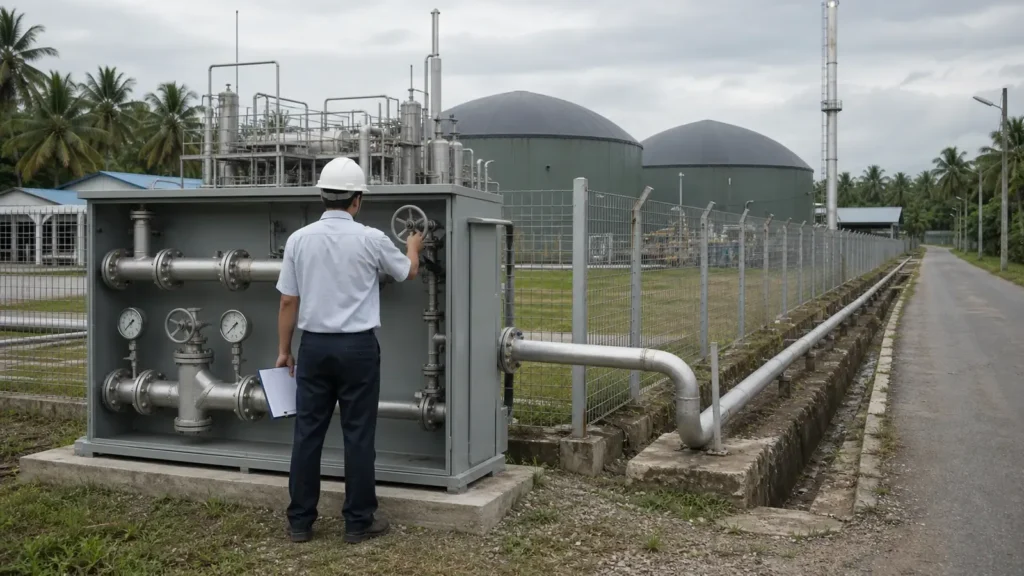
A digester has two outlets for its gas. One is a private pipe to one industrial buyer. Another option is the shared gas network that already runs through the district. The second route is a connection project before it is a gas project. Biomethane grid injection delivers cleaned gas into the network. The route passes through five cost items: the injection station, pressure regulation and metering. In addition, the list covers odourisation and the last mile of pipe. Across the European markets studied in 2025, the station alone cost 200 000 to 1 800 000 euros. That figure excludes compression and the last mile. In addition, who pays for it changes from one country to the next.
What biomethane grid injection means
Upgrading produces biomethane, the methane-rich gas. The step strips carbon dioxide and contaminants from raw biogas, the mixture that leaves the digester. If the vocabulary is new, how biomethane is produced and sold covers the basics before the connection detail.
The article follows the order of a feasibility file. First the five items and the money across national rules. Then gas quality and contaminants. Finally compression and the checks I would complete before FID. That final investment decision releases construction capital.
In short
- Five cost items: injection station, pressure regulation, quality control and metering, odourisation, last mile of pipe.
- Station cost: 200 000 to 1 800 000 euros in the European markets studied, excluding compression and the last mile.
- Compression: about 30 percent of the cost of a transmission grid connection, usually carried by the producer.
- Who pays: Germany covers 75 percent of the total within 10 km of the grid, France lets the producer pay everything except the last mile.
- Quality: oxygen limits run from 0.001 percent mol in France to 0.5 percent mol in Denmark, so the connection agreement decides.
In this article
Injection is a connection project
The five items deserve precise names, because each has a different owner and a different price. Also, the injection point is the flange where ownership of the gas passes from producer to operator. In addition, the injection station carries all the equipment around it. Pressure regulation matches the outlet pressure of the plant to the pressure the network demands. Metering proves continuously that the gas stays inside specification. In addition, it proves that every billed volume reaches the buyer. Odourisation adds the smell that makes a leak detectable in a network built for odorised gas. The last mile of pipe joins the plant fence to the operator’s asset.
In addition, the gas is the easy part. A digester that produces a stable stream has solved its chemistry. The connection is a construction and permitting sequence owned by someone else. Moreover, the network is a shared asset with quality rules that apply to every user. Therefore, the producer does not negotiate with a buyer but with an operator. That operator runs its own capacity, hydraulic and quality reviews, and the calendar follows those studies rather than the digester.
What this means for you: I would schedule commissioning around the operator’s study, not the other way round. I would treat the connection date as an external constraint on day one.
The five cost items, and what they actually cost
The 2025 study on the cost of grid connections surveyed 22 member states. It comes from the European Biogas Association, which priced the connection item by item. Also, the figures in this section are European, and I do not transpose them to Southeast Asia.
The injection station alone costs 200 000 to 1 800 000 euros, excluding compression and the last mile of pipe. In addition, the range holds for distribution grids and transmission grids alike. The size of the station drives the price and economies of scale exist. Therefore, a large plant pays less per unit of capacity than a small one. Compression can represent about 30 percent of the cost of a transmission grid connection. Producers carry most of that item.
The normal case is a distribution connection. About 58 percent of European plants connect to a distribution grid. The European distribution network exceeds 2 000 000 km, against 260 000 km of transmission. A distribution main is closer, shorter and cheaper to reach, and it is where most projects belong. The transmission route makes sense only for a large plant, and even then the geography is narrow. More than 90 percent of transmission-connected plants sit in Germany, France and Italy.
The biomethane market in Southeast Asia is a different map, with different distances between the feedstock and the pipe.
What this means for you: I would establish whether the nearest pipe is distribution or transmission before fixing the plant capacity, because that single fact decides whether the connection is affordable at all.
Who pays, and how that changes the negotiation
Instead, the same 2025 survey shows that cost sharing is a national rule. It is not a project term. In Germany the grid operator covers 75 percent of the total cost. The rule applies to a plant within 10 km of the grid. Also, in France the producer pays everything except the last mile of pipe, which both sides share according to length. In some countries the operator pays for the injection station. It then rents that station to the producer for up to 60 000 euros a year. Meanwhile, an injection fee recovers the network costs. In emerging markets the producer often carries the full connection cost.
The lesson is arithmetic before it is legal. In addition, the same physical connection can cost the developer nothing or its whole capex. The capital cost of building it. In addition, national regulation states the difference. A developer who budgets from a neighbouring country’s experience will be wrong in both directions.
Support schemes carry the same national signature. The feed-in tariff framework in Malaysia is one example of a national instrument, rather than the pipe itself, deciding what a project can earn.
What this means for you: I read the cost-sharing rule before I size the plant. I carry the assumed split in the financial model as a named line item, not a footnote.
Gas quality is national, not universal
The European Biogas Association note of March 2024 on biomethane standards is clear on one point: the standard is voluntary. EN 16723-1 covers biomethane for injection, and EN 16726 defines natural gas quality. Each country may keep its own specification, and most do.
Oxygen causes the most difficulty, alongside the Wobbe index, the calorific value and the relative density. The Wobbe index describes how a gas behaves at a burner for a given pressure. That index ties the delivered composition to the appliances at the far end. Oxygen limits run from 0.001 percent mol in France on an hourly basis. Denmark allows 0.5 percent mol at entry and transit points. In addition, storage points allow 0.1 percent mol, and Italy sits up to 0.6 percent mol.
Controlling oxygen is not a formality. Oxygen corrodes steel and, in high pressure grids, feeds the black powder that fouls valves and filters. A plant that follows the wrong national limit needs a redesign. No contract fixes that. In addition, the whole upgrading route may have to change. The wider biogas, biomass and biofuels sector treats these limits as design inputs for exactly that reason.
What this means for you: I would obtain the national oxygen limit in writing. I would do that before anyone chooses the upgrading technology, and treat it as a hard design constraint.
The contaminants that stop a project
The European standard EN 16723-1 dates from 2016 and sets the biomethane-specific limits. EN 16726 carries the parameters common with natural gas. The total volatile silicon limit is 0.3 to 1 mgSi/m3. In addition, the producer and the operator agree the value actually applied. They set it in the grid entry agreement. That contract fixes quality, pressure, metering and liability at the injection point. The national limit caps carbon monoxide at 0.1 percent mol, ammonia at 10 mg/m3 and amines at 10 mg/m3. Chlorinated and fluorinated compounds, compressor oil and dust must stay at trace levels.
Siloxanes catch developers first. They are silicon-bearing compounds carried in from the feedstock, and they burn into an abrasive dust that damages equipment downstream. Removing them before the membrane or the amine column is a design choice with a known cost. After the gas leaves the upgrading unit, the same removal is a repair. Because the assessment depends on the feedstock and on the upgrading process, each country sets its own limits.
Checking a project against EU compliance rules usually starts with this table, not with the carbon numbers.
What this means for you: I would test the feedstock for silicon before signing for the upgrading unit. The grid entry agreement turns the laboratory number into a contractual one.
Compression, pressure and the energy bill
In 2020, the IEA biogas and biomethane outlook put grid connection at about USD 3/MBtu. An upgrading step costs about USD 2/MBtu to USD 4/MBtu. That estimate assumes a plant cleaning about 3.5 million m3 of biogas a year. Average biomethane sat around USD 19/MBtu. The report expects about USD 14/MBtu by 2040, roughly 25 percent less. It adds that room for further decline is limited because the technologies are mature.
The same outlook keeps the capital question in proportion. Between 70 and 95 percent of the cost of biogas sits in the digesters. In addition, the report uses a 20 year life for that capital in centralised plants. Compression sits on the other side of the ledger. It is a permanent opex item, part of the running cost of the plant for its whole life. The network pressure sets that cost, not the preference of the plant.
That asymmetry matters at design stage. A connection to a higher pressure grid buys capacity and access. The price is a compressor and its electricity bill for 20 years.
What this means for you: I would ask the operator for the minimum delivery pressure it will accept. I would then price the compressor against that number, because the network pressure is a fixed input.
What has to be in place before FID
The IEA Bioenergy Task 37 country report of September 2024 shows how much of this is already operating. Also, the United Kingdom had 723 plants at the end of 2022 and 103 174 m3/h of biomethane capacity. In addition, its support scheme pays an indexed tariff over 15 years. It pays 5,51 p/kWh on the first 60 GWh injected and 3,53 p/kWh on the next 40 GWh. Beyond that, the rate falls to 1,56 p/kWh. Switzerland usually finances a plant over a 20-year repayment period. It also compensates 50 percent of the costs directly linked to energy production. France declared 364 upgrading units.
Those figures describe support, not a market. What a lender asks for is narrower. A signed connection offer with a firm capacity and a firm price. In addition, a quality specification with the test method named. A metering and allocation rule both sides accept. Moreover, a revenue line that survives the end of any support scheme matters. It needs a tenor, the length of the repayment schedule the lender expects, and it must fit the asset. The Singapore biomethane sandbox is one place where developers test that last point before committing capital.
What this means for you: I would not order long lead equipment on a feasibility letter. The file a lender reads begins with a signed offer. It ends with a contract that pays after the subsidy stops.
How I would size a connection
Five checks, in this order. The distance and the pressure of the nearest pipe, because those two facts decide the compressor and the pipe cost. Also, the free capacity the operator declares, because a main that looks close can be hydraulically full. The tightest quality limit in the entry agreement, because that limit selects the upgrading route. In addition, the cost split between producer and operator written in national regulation, because it changes the return before any gas flows. And the fallback offtake if the connection is refused, because a project with no second outlet has a single point of failure.
I would request the operator’s feasibility study before ordering the upgrading unit. The specification of the unit follows the connection and never the reverse: oxygen, sulphur, silicon and delivery pressure all come out of the network. In addition, a skid ordered against assumptions has to be rebuilt against the agreement.
What this means for you: I would sequence the file as connection study, then connection offer, then upgrading specification, then FID, and hold the equipment order until the third step is signed.
Sources\n
- \n
- European Biogas Association and Common Futures, How costs to connect biomethane to gas grids are paid for, 2025.
- European Biogas Association, Biomethane standards: facilitating renewable gas uptake, 2024.
- CEN, EN 16723-1:2016, Specifications for biomethane for injection in the natural gas network, 2016.
- IEA, Outlook for biogas and biomethane, 2020.
- IEA Bioenergy Task 37, A perspective on the state of the biogas industry in 12 member countries, 2024.
\n
\n
\n
\n
\n
Frequently asked questions
How much does a biomethane grid connection cost?
The injection unit alone costs 200 000 to 1 800 000 euros in the European markets studied in 2025, excluding compression and the last mile of pipe. Compression can add about 30 percent of the cost of a transmission connection.
Who pays for the connection, the producer or the grid operator?
It depends on national regulation. Germany has the operator cover 75 percent of the total cost within 10 km of the grid, France makes the producer pay everything except the last mile, and in emerging markets the producer often carries the full cost.
What gas quality is required for injection?
The national limit, not a universal one. Oxygen limits run from 0.001 percent mol in France to 0.5 percent mol in Denmark, the silicon limit set in 2016 is 0.3 to 1 mgSi/m3, and carbon monoxide is capped at 0.1 percent mol.
Can a plant inject without a compression step?
Only when the network pressure and the upgrading route allow it. An amine unit delivers gas at low pressure and needs compression, while a membrane skid runs at a higher pressure and can feed a high pressure grid more directly.
Not sure your project would survive a credit conversation?
A short call is usually enough to see where your project stands.
If you want the connection sequence reviewed before capital is committed, the technology maturity and scale-up review is where I start with developers. Send the operator’s study, the draft entry agreement and the cost split you have been quoted, and I will tell you which of the five checks is still open.
I do not provide investment advice or arrange investments. I act as a strategic advisor and facilitator.

Alex, Founder of WeConnect Asia
I help low-carbon fuel and carbon removal project developers in Southeast Asia secure the commercial and financial partners needed to reach FID.
Related articles

Pitching a Climate Tech Company to Strategic Investors: What the Corporate Has to Believe Before It Writes a Cheque
How to pitch a climate tech company to strategic investors: the metric cluster, the readiness evidence and the ask that corporates fund.

Biomethane: What It Is, How It Is Made and Who Buys It
Biomethane is biogas cleaned to pipeline quality. I explain how it is made, how it differs from biogas and who buys it in Southeast Asia.

CO2 Sourcing for e-SAF Projects: What the Rules Allow and What the Contract Must Say
Biogenic CO2, direct air capture or industrial flue gas: which sources an e-SAF plant may use, what they cost and which contract terms make the fuel certifiable.

Operating Performance Guarantees for SAF Plants: What Lenders Ask For
Minimum guarantees, performance damages, retesting and who stands behind them: the operating guarantees a SAF plant needs to keep debt and offtake intact.

EPC and Construction Risk in SAF Plants: What a Lender Actually Tests
FEED scope, convertible EPC, performance guarantees and damages caps: the construction risk questions a SAF project must answer before financial close.

Matching Feedstock and Offtake Risk Back-to-Back in a SAF Project: How Lenders Read the Chain
Lenders do not buy a feedstock plan and an offtake plan separately. They buy the link between the two, and the link is where most SAF files break.