
Home » Biomethane Quality Standards: What a Grid Operator Will Test
Biomethane Quality Standards: What a Grid Operator Will Test
9 min read · Jan 22, 2026 · By Alex
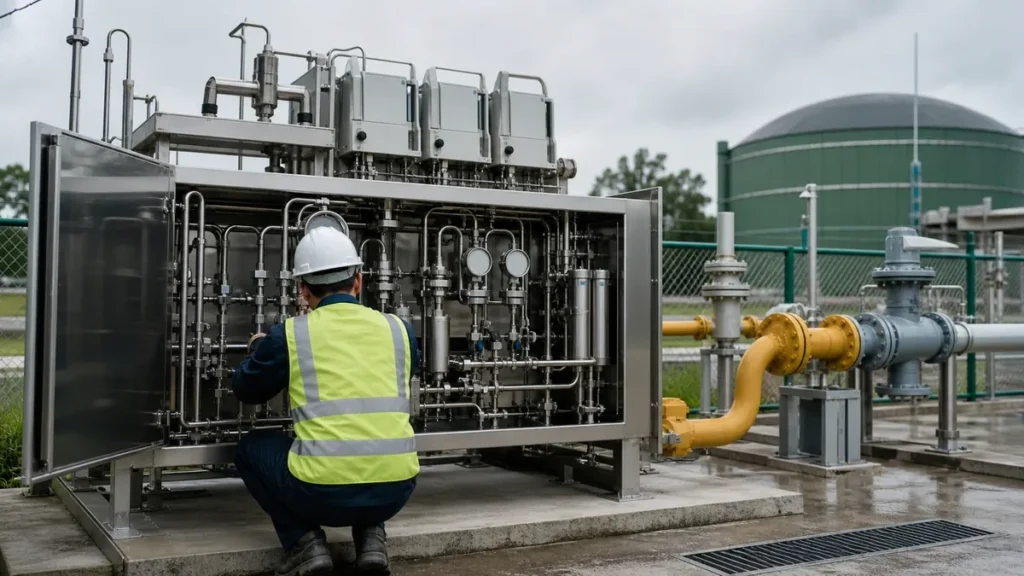
A gas network accepts upgraded biogas on one condition: every parameter sits inside its limit, or the gas does not enter the grid. The test is binary, and one failure stops the whole delivery whatever the other readings say. The biomethane quality standards behind that test split into a part for grid injection and a part for vehicle fuel, they follow around a dozen parameters, and the readings that decide a plant are the Wobbe index, carbon dioxide, oxygen, sulphur compounds and siloxanes. The Wobbe index is one number for how much energy a burner receives at a given pressure; siloxanes are silicon compounds that burn into abrasive silica inside customer equipment. I work across the biogas, biomethane and biofuels industry, and the question I get before feasibility sign off is always the same: which parameter will stop my injection, and what does it cost to meet it?
Biogas is the raw gas from anaerobic digestion, the breakdown of organic matter without oxygen, and biomethane is that gas after upgrading, the step that removes carbon dioxide and contaminants so it can behave like natural gas. I take the article in that order: framework, parameters, regional anchor, then the checks I run and the words I put in the contract.
In short
- One gate: every parameter is tested, and one failure stops the injection.
- Reference range: the Wobbe index runs from 13.403 to 16.058 kWh/m3 in the 2025 table.
- Carbon dioxide: limited to 2.5 mol percent for injection under the same table.
- Siloxanes: 0.3 to 1 mg Si/m3, and production processes cannot guarantee below 0.5 mg Si/m3.
- Regional frame: Southeast Asian feedstock potential is almost 65 bcm against barely 80 PJ produced in 2025.
In this article
Why a specification decides the plant
The specification is a gate, not a target: either each parameter sits inside its limit or there is no injection. I settle the limits before the upgrading line is ordered, because the polishing train, the sampling regime and the acceptance test all follow from those numbers. Biomethane has to behave like natural gas in the grid: the same combustion behaviour at the burner, no damage to pipes, no damage to customer equipment. The cheapest way to meet the limits is upstream, in the digester, because every milligram of hydrogen sulphide or siloxane that never forms is a milligram the polishing stage does not have to remove.
What this means for you: put the injection limits into the feasibility study before you approve it. An offer that does not name its limits describes a machine, not a compliant gas.
The framework behind the numbers
I take the structure from the EN 16723 grid injection specification as summarised by Smallops. It has two parts: part 1, published in 2016, covers injection into the natural gas network, and part 2, published in 2017, is the automotive fuel specification. Part 1 adds limits specific to biomethane, including siloxanes, carbon monoxide, ammonia and amines, and refers to EN 16726 for the rest. The background on the gas itself sits in how biomethane is explained.
The 2025 table in Spain refers back to part 1 for siloxanes and reads: a Wobbe index between 13.403 and 16.058 kWh/m3, carbon dioxide at or below 2.5 mol percent, oxygen at or below 0.01 mol percent, hydrogen sulphide and carbonyl sulphide at or below 15 mg/m3, total sulphur at or below 50 mg/m3, siloxanes between 0.3 and 1 mg Si/m3, a water dew point of plus 2 degrees C at 70 bar, ammonia at or below 10 mg/m3, mercaptans at or below 17 mg/m3, hydrogen at or below 2 mol percent.
The specification follows around a dozen parameters beyond methane, and the rule is binary: each one is respected, or there is no injection. The same 2025 table carries two extended limits, 4 percent carbon dioxide and 1 percent oxygen, and they apply only inside networks at or below 16 bar with no reverse flow to the transmission grid.
What this means for you: take this table to your counterparty before you order equipment, and write into the offer which limit set applies at your connection point.
The parameters that stop a plant
I take the list from the GERG and CEN TC 408 standardisation update of October 2021: carbon monoxide at or below 0.1 percent under the first part of the specification, total silicon between 0.3 and 1 mg Si/m3, ammonia and amines at 10 mg/m3 when water is present, a methane number at a minimum of 65 under EN 16726 against a minimum of 80 for the automotive part, and a hydrocarbon dew point at or below minus 2 degrees C. The methane number is an index of how far the gas sits from pure methane in its resistance to knocking.
Siloxanes are where the arithmetic turns awkward. Studies of continuous exposure to 100 percent biomethane over 15 years would suggest a limit as low as 0.1 mg Si/m3, yet analytical quantification limits sit at best at 0.10 mg Si/m3, which is why the written range is 0.3 to 1 mg Si/m3. Current production processes cannot guarantee a level below 0.5 mg Si/m3, and 0.1 mg Si/m3 can severely damage switching type oxygen sensors in vehicles.
Those numbers are fixed long before the meter, at the stages of the biogas production process, which is where I look first when an offer quotes a polishing price.
What this means for you: ask which reading has the smallest margin in the offer, and price the polishing stage against that reading, not against the average.
Why the specification is still moving
The regulation of 2024 on internal markets for renewable gas, natural gas and hydrogen requires the European network operator association to publish a gas quality monitoring report every two years, and the first edition is the ENTSOG gas quality monitoring report of December 2024.
EN 16726 sets the parameters for group H gases and its first edition was published in 2015 under the Commission mandate M/400, but no consensus on the Wobbe index was reached that year, so work ran from 2016 and a revision started in 2022.
The committee working on biomethane quality also considers merging the two parts of EN 16723. On the international side, a working group has published eight standards on contaminants, covering volatile organic compounds, ammonia, compressor oil, siloxanes, terpenes, amines, hydrogen chloride and hydrogen fluoride, with a standard on calculating the methane number expected in 2025.
A window can move, and a plant contracted against one fixed number can end up outside it. That is the exposure I watch in the biomethane market in Southeast Asia.
What this means for you: write the specification version and its revision path into the contract, so a future change of limit triggers a retest.
What the vehicle fuel specification adds
The automotive route is covered by the EN 16723-2 automotive fuel specification of June 2017, approved on 10 April 2017 under the Commission mandate M/475.
That specification records a gap: automotive use needs sulphur at 10 mgS/m3 including odorisation, while the gas industry can supply 30 mg/m3 including odorisation, and the difference sits in an annex that may be taken up in a national preface. The methane number depends on the composition of the distributed gas, and only a small fraction of distributed gas falls below 70. On siloxanes the pattern repeats: 0.1 mg Si/m3 can severely damage switching type oxygen sensors, and current production cannot guarantee below 0.5 mg Si/m3.
Liquefied supply adds its own handling rule: fuelling stations must keep particle contamination to 10 mg per litre, with a filter at 5 micrometres nominal and 10 micrometres absolute at 90 percent efficiency.
That second destination matters most where volume comes from several sources at once, the case I discuss in scaling biomethane by clustering mills.
What this means for you: decide the destination before you size the plant, because the sulphur and siloxane limits you must hit are not the same for injection and for fuel.
Where a Southeast Asian project anchors its specification
The regional numbers come from the IEA renewables report published in 2026: Southeast Asian feedstock potential is estimated at almost 65 bcm, around 2 300 PJ, against combined production barely at 80 PJ in 2025, and one bcm equals 36 PJ.
The same 2026 report describes a wave of liquefied biomethane and bio liquefied natural gas projects driven by maritime demand, export to Singapore and import substitution, and it says scale up depends on supportive policies. It names feedstock supply chains, meaning collection, aggregation and storage, as the main challenge.
A European specification is a reference, not an obligation in Southeast Asia: the local requirement is the one agreed with the operator of the injection point. Where no national rule applies, the anchor is the specification written into the network entry agreement or the offtake agreement, a contract for the sale of the gas, checked at the point of injection. For the receiving side I read the Singapore biomethane sandbox.
What this means for you: get the limit set in writing from the counterparty at the injection point before feasibility sign off, because that document, not a European standard, is what your plant will be tested against.
The checks I run on an upgrading offer
Six checks, in the order I run them:
- Incoming gas: is the biogas measured at all? The specification is only as cheap as the digester is clean, and the 2016 standard family puts the cost of every contaminant at the source.
- Polishing capacity: is it sized for siloxanes at 0.3 to 1 mg Si/m3 on 2021 data, and for ammonia at 10 mg/m3?
- Upgrading family: which of the four is offered, pressure swing adsorption, water or amine scrubbing, membranes, or cryogenic? Membranes are the most common family in new installations.
- Sampling regime: is it written, with siloxanes measured by gas chromatography and mass spectrometry after capture in a cartridge rather than by a field sensor?
- Acceptance window: is the Wobbe window of 13.403 to 16.058 kWh/m3 from the 2025 table part of the acceptance test?
- Penalty clause: is it written against the parameter, not against the average?
What this means for you: run the six checks against the offer letter, not the brochure, and treat silence on any one as a no.
How I would write the quality section of the contracts
The quality section I draft has four rows:
- The specification, with its test method and its sampling frequency.
- The acceptance test at the injection point.
- Responsibility for polishing consumables between two samples.
- The remedy when a single parameter fails.
I consider that section finished when a reader can answer, for every limit, three questions: who measures it, how often, and who pays when it is missed.
What this means for you: write those three answers next to every number in the specification.
Sources
- Smallops, Biomethane EN 16723: quality for grid injection, n.d..
- GERG and CEN TC 408, Standardization of Biomethane, update of the activities of CEN TC 408, October 2021.
- ENTSOG, Gas Quality Monitoring Report, First Edition, December 2024.
- CEN, EN 16723-2:2017, biomethane as automotive fuel specification, June 2017.
- IEA, Renewables 2026, chapter Biogases, 2026.
Frequently asked questions
What does a biomethane grid injection specification check?
Around a dozen parameters. Under the 2025 table, the decisive ones are a Wobbe index between 13.403 and 16.058 kWh/m3, carbon dioxide at or below 2.5 mol percent, oxygen at or below 0.01 mol percent, sulphur compounds at or below 15 mg/m3, siloxanes between 0.3 and 1 mg Si/m3 and hydrogen at or below 2 mol percent.
Why are siloxanes such a problem?
They form abrasive silica in customer equipment, the written limit is between 0.3 and 1 mg Si/m3 because measurement itself is difficult at lower levels, and current production processes cannot guarantee below 0.5 mg Si/m3 on 2021 data. They are removed in the polishing stage and measured by laboratory analysis, not by a field sensor.
Do Southeast Asian projects have to follow the European standard?
No standard is imposed by that reference alone. Where a national rule exists it governs, and where none applies the practical anchor is the network entry or offtake contract signed with the counterparty, checked at the injection point.
What happens if one parameter fails?
The gas is not accepted for that period. This is why the specification, its test method, its sampling frequency and the responsibility for polishing consumables belong in the contract before the upgrading line is ordered.
1
A short call is usually enough to see where your project stands.
If you are looking for a second pair of eyes on an upgrading offer or a draft quality section, see my compliance and carbon intensity work. Send the offer together with the counterparty limit set, and I will mark which parameter is the binding one.
I do not provide investment advice or arrange investments. I act as a strategic advisor and facilitator.

Alex, Founder of WeConnect Asia
I help low-carbon fuel and carbon removal project developers in Southeast Asia secure the commercial and financial partners needed to reach FID.
Related articles

Pitching a Climate Tech Company to Strategic Investors: What the Corporate Has to Believe Before It Writes a Cheque
How to pitch a climate tech company to strategic investors: the metric cluster, the readiness evidence and the ask that corporates fund.

Biomethane: What It Is, How It Is Made and Who Buys It
Biomethane is biogas cleaned to pipeline quality. I explain how it is made, how it differs from biogas and who buys it in Southeast Asia.

CO2 Sourcing for e-SAF Projects: What the Rules Allow and What the Contract Must Say
Biogenic CO2, direct air capture or industrial flue gas: which sources an e-SAF plant may use, what they cost and which contract terms make the fuel certifiable.

Operating Performance Guarantees for SAF Plants: What Lenders Ask For
Minimum guarantees, performance damages, retesting and who stands behind them: the operating guarantees a SAF plant needs to keep debt and offtake intact.

EPC and Construction Risk in SAF Plants: What a Lender Actually Tests
FEED scope, convertible EPC, performance guarantees and damages caps: the construction risk questions a SAF project must answer before financial close.

Matching Feedstock and Offtake Risk Back-to-Back in a SAF Project: How Lenders Read the Chain
Lenders do not buy a feedstock plan and an offtake plan separately. They buy the link between the two, and the link is where most SAF files break.