
Home » China SAF Policy: A Target That Is Not an Obligation and a Pilot That Is Widening
China SAF Policy: A Target That Is Not an Obligation and a Pilot That Is Widening
10 min read · Nov 2, 2026 · By Alex
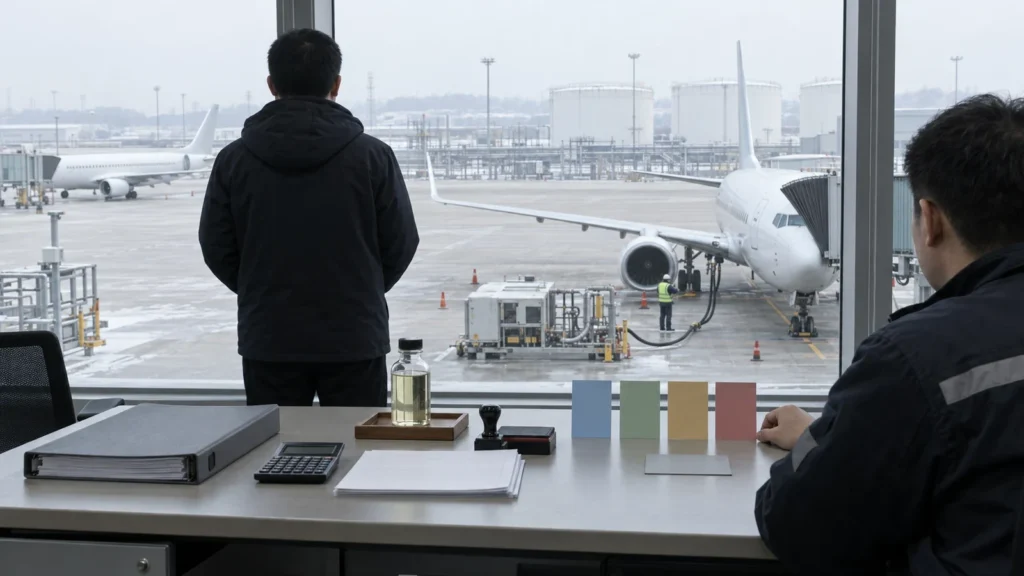
China has published no blending obligation. It means no rule requires fuel suppliers to mix a share of sustainable aviation fuel into jet fuel. Its only quantitative target sits in the 14th Five-Year Plan for Green Civil Aviation Development of 2022. For example, a five-year plan sets national goals for a span of years. Its SAF goal is non-mandatory: consume 20,000 tonnes annually by 2025, for a cumulative 50,000 tonnes. The national pilot programme, a trial that puts the fuel on real flights, launched on 19 September 2024. Also, its second phase, from 19 March 2025, refuels all domestic flights of domestic airlines departing from four airports under a book and refuelling pattern, where a few airports supply the fuel and airlines buy and claim the volume.
Announced production capacity of 3.32 million tonnes a year sits far above the 870,000 tonnes a year that six companies were producing. That is the China SAF policy a lender meets first.
The published record reads as a chain of plans, standards work and a two-phase pilot rather than a purchase duty. Sustainable Aviation Futures records the same headline: the government set a 50,000-tonne SAF production target by 2025. I see a market being built before a market is ordered.
What the China SAF policy covers at a glance
In short
- Mandatory: No blending mandate exists. The 2022 goal of 20,000 tonnes a year by 2025, cumulative 50,000 tonnes, is a non-mandatory plan goal.
- Pilot: Launched 19 September 2024; the second phase from 19 March 2025 covers all domestic flights from four airports.
- Output: 870,000 tonnes a year from six companies, against operational and planned capacity of 3.32 million tonnes per year.
- Certification: Four of the six producers hold airworthiness certification; ASTM D7566 plus an approved scheme is the international test.
- Demand: Three 2030 readings of 3 million, 4 million and 7.2 million tonnes, against 38.2 million tonnes used in 2024.
In this article
What has actually been published
The 14th Five-Year Plan for Green Civil Aviation Development came in 2022. It set a non-mandatory goal: 20,000 tonnes of SAF each year by 2025, for a cumulative 50,000 tonnes. As a result, that plan carries China’s first quantitative target for SAF. In July 2023 the Civil Aviation Administration of China released its draft Sustainability Requirements for Alternative Aviation Fuels. It opened the draft for public consultation. In August 2023, the government added SAF to the Green Low-Carbon Advanced Technology Demonstration Programme. The National Development and Reform Commission and the Civil Aviation Administration of China launched it. Also, eight other central government agencies joined them.
In October 2023, the Green Aviation Manufacturing Development Outline called for SAF demonstration flights by 2025. Specifically, it was to use domestically produced aircraft, with phased trials of blending ratios. A blending ratio is the share of SAF that refiners blend into jet fuel. The outline also called for SAF standards, certification frameworks and airworthiness validation. In July 2024, the Civil Aviation Administration of China created the Sustainable Aviation Fuel Research Centre. In addition, the centre sits under its second research institute and builds China’s independent SAF certification system.
What this means for you: I read this sequence as policy work rather than a purchase order, so no revenue line in this file comes from a document until a counterparty signs against it.
The target that carries no obligation
Transport & Environment counts eight SAF mandates worldwide: the EU, the UK, India and Brazil are among them. Specifically, it puts China among seven countries where proposals are still on the table. Others include South Korea, the United Arab Emirates and Turkey. By contrast, the same source says the main approach sets a target: a minimum percentage of SAF. Meanwhile, canada and the US have adopted an incentive-based approach. In fact, the Chinese document on file is a plan goal, and officials describe it as non-mandatory. The working paper China presented to the ICAO Assembly describes the current stage as research. For example, it proposes supportive policies such as fiscal and tax incentives, cost relief and import-export trade. It also sets out a goal of blending ratios suitable for China’s conditions. Meanwhile, a SAF policy system is gradually taking shape.
What this means for you: under the mandates published elsewhere, China still sits in the discussion column, so I can book no compliance date from a proposal.
The pilot, and what book and refuelling means
China launched the SAF application pilot on 19 September 2024, carried out in two phases. In the first phase, 12 flights from Air China, China Eastern Airlines and China Southern Airlines used SAF. They departed from Beijing Daxing, Chengdu Shuangliu, Zhengzhou Xinzheng and Ningbo Lishe airports. In addition, crews focused on supply systems, fuel quality monitoring and flight data monitoring. The phase ended on 28 February 2025 and confirmed safety, coordination and process effectiveness. From 19 March 2025, the second phase covers every domestic flight of domestic airlines leaving those four airports. It runs on the book and refuelling pattern. Specifically, a limited number of airports provide physical SAF supply. Instead, airlines purchase SAF without taking physical delivery and claim the related emission reductions. China is also promoting total quantity control for SAF nationwide and developing a centralized registration system to keep data traceable and verifiable.
What this means for you: this is book and claim written into a national pilot, and it is the part of the programme I would read first as a foreign supplier.
What is produced, and what is certified
China’s SAF production capacity reaches 3.32 million tonnes per year across operational and planned facilities. In fact, the HEFA pathway covers most of it. Six companies have commenced production, for a total output of 870,000 tonnes annually. Sinopec Zhenhai Refining produces 100,000 tonnes per year and Junheng Group 200,000. Ecotech Environmental produces 50,000, Haixin Energy 50,000, Jia’ao Lianyungang 370,000 and Pengyao Environmental 100,000. Four of these companies hold airworthiness certification from the Civil Aviation Administration of China. The certification is the approval that lets the fuel fly on a certified aircraft. In addition, a further 2.45 million tonnes per year sit in construction or planning. In addition, officials issued product carbon footprint standards for aviation fuel as MH/T 6138.1-2025 and MH/T 6138.2-2025.
Norton Rose Fulbright sets the international test: certification under ASTM D7566 before blending, an ISCC or RSB scheme, and for CORSIA an ICAO-approved scheme with at least a 10% lifecycle reduction and no feedstock from converted ecosystems or protected areas.
What this means for you: I keep announced capacity, actual output and certified output on three separate lines, because only the certified volume is sellable to a buyer with a compliance test.
What a finance plan has to survive
GreenAir News writes that achieving price parity is essential to commercialise SAF in China. As a result, the strategy needs supply chain optimisation, financial incentives and policy interventions to ensure long-term feasibility. It must extend beyond HEFA into power-to-liquids, carbon capture utilisation and storage and hydrogen integration. The ICAO working paper shows the common challenges. Specifically, they are high application costs and lack of diversity in raw materials and production technologies. It argues that a technical roadmap and industrial ecosystem must avoid systemic risks from promoting a single solution. Norton Rose Fulbright states that no established wholesale market for SAF exists yet with a predictable and discoverable price. As a result, bankable, long-term offtake agreements with airlines are critical. Airlines can sign them directly or sleeve them through jet fuel providers.
Furthermore, IATA argues that any SAF mandate should arrive only where market conditions are in place. In addition, production capacity, infrastructure readiness and supportive policy measures must be there too.
What this means for you: in the way I approach financing a SAF project, I need a price mechanism, a certified volume and an offtake before I write a revenue line.
Where the risk sits today
SAF currently represents less than 1% of global aviation fuel use and is several times more expensive than conventional aviation fuel because of feedstock cost, developing production technology, missing infrastructure and high upfront investment (IATA, June 2026). A separate IATA release expects global SAF production to reach around 2.4 million tonnes in 2026. In fact, IATA puts that at just 0.8% of aviation fuel use. The cost to airlines would be $4.3 billion (IATA, 6 June 2026). Transport & Environment reports that only a few frameworks actively promote e-kerosene. No Asian airline holds a firm e-kerosene offtake agreement. In fact, e-kerosene counts for around 15% of European SAF volumes and 5% of North American ones. Sustainable Aviation Futures adds that SAF produced in Asia has tended to flow to Europe. As a result, mandates there create a price premium. Consequently, local shortages or higher costs follow if policy lags.
What this means for you: the risk I watch is the gap between announced capacity and certified output, because the way I read policy risk starts with which number is contractible today rather than which number was announced.
What I would ask before signing
I ask four questions in writing. First, is the demand side a published obligation or a plan goal, and I record which document and which date. Second, which phase of the pilot my volume would feed, since the first phase verified 12 flights. Also, the second covers all domestic flights departing from four airports under a defined pattern. Third, what share of the announced capacity holds airworthiness certification, because four of the six producing companies have it and the rest of the announced volume does not. Fourth, what price mechanism applies, and I take it from a signed contract rather than from research on an autonomous pricing mechanism. I do not average announced capacity with certified output.
What this means for you: those four written answers tell me what I am contracting into. The choice is a regulated obligation or a voluntary programme that can be paused.
How I would model it if it were my file
I keep four dated rows. The target row carries 20,000 tonnes annually by 2025 and the accumulated 50,000 tonnes, both labelled non-mandatory. The output row carries 870,000 tonnes a year across six companies, with the four certified producers marked. The capacity row carries 3.32 million tonnes per year operational and planned, with the 2.45 million tonnes per year under construction or planning kept separate. The demand row carries the three 2030 readings of 3 million, 4 million and 7.2 million tonnes, each with its author: Deloitte, the Civil Aviation University of China, and SkyNRG and ICF, set against 38.2 million tonnes of aviation fuel consumed in 2024. My last row names the contracted volume, because that is the only row a lender will count.
What this means for you: I never merge those rows into a single headline number, and I date every row so that a lender can see which figure moved and when.
Sources
- GreenAir News, 13 June 2025.
- ICAO, 13 September 2025.
- IATA, June 2026.
- IATA, 6 June 2026.
- Transport & Environment, consulted 16 November 2026.
- Sustainable Aviation Futures, 2025.
- Norton Rose Fulbright, October 2025.
Frequently asked questions
What is China's SAF policy?
It is a sequence of plans and programmes rather than an obligation: the 2022 five-year plan set a non-mandatory goal of 20,000 tonnes annually by 2025 for a cumulative 50,000 tonnes, followed by a certification draft in July 2023, a demonstration programme in August 2023, a manufacturing outline in October 2023 and a dedicated research centre in July 2024 (GreenAir News). Each step builds certification and policy machinery before any purchase duty appears.
Does China have a SAF blending mandate?
No blending mandate has been adopted: Transport & Environment counts eight mandates worldwide and places China among seven countries where proposals are being discussed, while China’s own working paper describes blending ratio goals as proposed research (Transport & Environment; ICAO). Until a mandate exists, I treat Chinese demand as voluntary and contract-based, with no compliance date to plan against.
How much SAF does China produce today?
Six companies have commenced production with a total output of 870,000 tonnes annually against operational and planned capacity of 3.32 million tonnes per year, and four of the six hold airworthiness certification (GreenAir News). The balance of the announced capacity is under construction or planning rather than producing.
Is the Chinese SAF market open to a foreign supplier?
Access runs through contracts and certification: international cooperation on trade, infrastructure and mutual recognition of standards is a stated task of the pilot, and buyers will require ASTM D7566 plus an approved sustainability scheme for CORSIA eligibility (ICAO; Norton Rose Fulbright). A centralized registration system for traceable and verifiable data is also being developed, so a foreign volume has to enter through a documented, verifiable channel.
Not sure your project would survive a credit conversation?
A short call is usually enough to see where your project stands.
If you are looking at a Chinese volume and want the contract side examined before you model revenue, I work through the terms, the pilot phase your volume would feed and the certification path in my offtake agreements work.
I do not provide investment advice or arrange investments. In addition, I work as a strategic advisor and facilitator.

Alex, Founder of WeConnect Asia
I help low-carbon fuel and carbon removal project developers in Southeast Asia secure the commercial and financial partners needed to reach FID.
Related articles

Pitching a Climate Tech Company to Strategic Investors: What the Corporate Has to Believe Before It Writes a Cheque
How to pitch a climate tech company to strategic investors: the metric cluster, the readiness evidence and the ask that corporates fund.

Biomethane: What It Is, How It Is Made and Who Buys It
Biomethane is biogas cleaned to pipeline quality. I explain how it is made, how it differs from biogas and who buys it in Southeast Asia.

CO2 Sourcing for e-SAF Projects: What the Rules Allow and What the Contract Must Say
Biogenic CO2, direct air capture or industrial flue gas: which sources an e-SAF plant may use, what they cost and which contract terms make the fuel certifiable.

Operating Performance Guarantees for SAF Plants: What Lenders Ask For
Minimum guarantees, performance damages, retesting and who stands behind them: the operating guarantees a SAF plant needs to keep debt and offtake intact.

EPC and Construction Risk in SAF Plants: What a Lender Actually Tests
FEED scope, convertible EPC, performance guarantees and damages caps: the construction risk questions a SAF project must answer before financial close.

Matching Feedstock and Offtake Risk Back-to-Back in a SAF Project: How Lenders Read the Chain
Lenders do not buy a feedstock plan and an offtake plan separately. They buy the link between the two, and the link is where most SAF files break.