
Home » Scaling a Climate Tech Company in Southeast Asia: The Four Moves
Scaling a Climate Tech Company in Southeast Asia: The Four Moves
9 min read · Apr 2, 2026 · By Alex
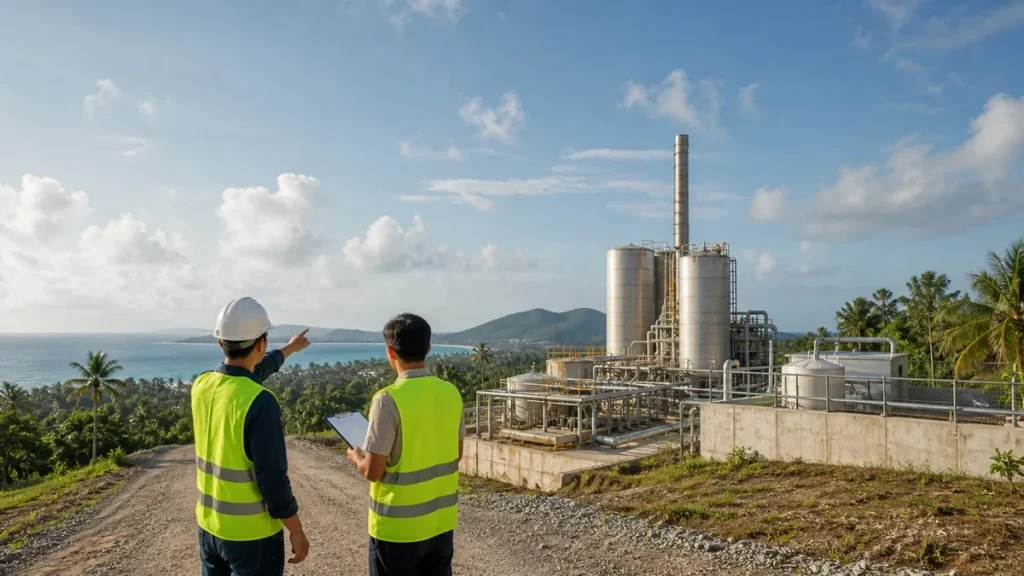
Scaling a climate tech company in Southeast Asia is not a bigger version of your home market. It is four moves in order, and the order decides who funds you. A climate tech scale up asia plan that respects the order wins one local project with a named developer, turns that project into a reference, builds the second country on the back of the reference, and only then raises on the regional story. The money follows the reference, not the plan. I keep the published head of this branch at the climate tech and green tech hub.
I take you through a fixed order: the region, the money, the value map, the first project, the second country, the moments when scaling is the wrong answer, and the way I run the four moves with a founder. Every section closes with one instruction you can act on.
In short
- Order: one local project, one reference, one second country, then capital.
- Reference: the money follows the reference project, not the business plan.
- Partners: a named local developer carries site, permits and local contracts.
- Capital: regional funds are mostly early stage, so the ask must match the stage.
- Systems: grids, bioeconomy and EVs are where the region puts its money.
In this article
What scaling means here
The four moves in order: one local project, one reference, one second country, then capital. Scaling starts when your product has to survive a second regulator, a second grid and a second contract set, not when your home pipeline gets longer.
I define the words I use. A scale-up is a company whose product already works at home and is now being repeated for a second customer in a second market. A reference project is the first installation you can show a stranger with real operating data attached to it. A regional playbook is the written sequence of site selection, permitting, contracting and financing that you can run again in a second country. A developer is the party that owns the site, the permits and the local contracts. An offtake is a contract in which a buyer commits to take the output of the project for a set period.
I do not open with the pitch. I open with the project that can be permitted on a real timetable, because a project that cannot be permitted cannot be financed and cannot be copied.
What this means for you: write the four moves on one page, put a date against each move, and do not start the second line until the first line has a named local partner.
Why the region is worth the move
The regional case rests on the Openspace analysis of venture climate investment in Southeast Asia published in June 2024.
The share of climate tech in Southeast Asia venture funding grew from 3.2 percent in 2019 to 9.5 percent in 2023, and deal volume grew at a compound annual growth rate of over 15 percent from 2019 to 2023. Almost 30 climate-specific funds have emerged since 2020, raising over US$830 million. Generalist funds, which invest across sectors rather than in climate alone, joined over 80 percent of regional climate tech equity deals in 2023 by deal count. Singapore and Indonesia took over 90 percent of total climate deal value in the region in the first 11 months of 2023.
That is a concentrated region. Capital, track record and repeat buyers sit in two markets, so the choice of your second country carries more weight than the next item on your product roadmap. A plan that names a country without naming who holds the site there is a wish.
What this means for you: before you write any roadmap, decide the second country from where deals actually cleared in 2023, and confirm that a named developer can hold the site there.
Who funds the move
I keep the list of climate tech investors next to me when I read a raise, and the reading comes from the Net Zero Insights State of Climate Tech 2025 report.
In 2025, venture investors took 34.1 percent of deals by investor type, governments 19.5 percent, strategics 13.8 percent and growth equity investors 13.2 percent. A strategic is a corporate investor, and its venture arm is the investment team it runs inside.
The funnel tightened in 2025: nearly 50 percent fewer companies reached Seed to Series A and 80 percent fewer made it from Series A to Series B compared with 2022, despite needing six extra months to progress. Capital shifted from climate ambition to commercial performance. Winning technologies meet real demand, demonstrate manufacturing readiness, secure offtake and align with market signals. Mitigation still captured over 70 percent of climate tech funding in 2025.
A regional story travels only when it shows demand. Ambition is now the entry ticket, not the argument.
What this means for you: walk into the room with one named buyer, one manufacturing readiness date and one operating number, then describe the region only after those three land.
Where the regional value sits
I set this beside the regional ecosystem map, and the value map comes from the Bain and Company Southeast Asia’s Green Economy 2025 report.
Published May 2025, with just five years left until 2030, the region is not on track to meet its climate pledges. Three high-impact solutions are named: scaling the sustainable bioeconomy, modernizing domestic and regional grids, and accelerating the electric vehicle ecosystem. The global bioeconomy is projected to reach US$30 trillion by 2050. Modernizing and expanding the power grid would generate approximately 200,000 jobs in 2030 and $25 billion in GDP contributions. Prioritizing the three solutions could create $120 billion in new economic value and up to 900,000 jobs in 2030. The enabling layer named is access to climate and transition finance, carbon markets and green artificial intelligence.
No company can serve all of that at once. I pick one system, then one country inside that system, because a firm selling into grids, farms and fleets together has no reference anyone can inspect.
What this means for you: choose the one system where your first project can be permitted, built and measured, and treat the other two as later chapters.
What the first project must prove
I read this next to the note on venture capital in low carbon fuels, and the framing comes from the Stanford Guidebook for Early Climate Infrastructure published in April 2024.
In the International Energy Agency Net Zero Roadmap updated in 2023, 35 percent of the emissions reductions necessary will come from technologies not yet on the market. In that 2024 guidance, for low-carbon infrastructure projects often more than half of the cost of the output is driven by the cost of financing, and roughly 40 percent of the cost of renewable energy projects can be attributed to costs of financing.
Founders of breakthrough technology companies rarely set out to become project developers. Without a natural development partner, an early team has to build the permitting, contracting, financing and operating capability that bridges technology provider and project developer. A pilot is a small unit built to prove the process before the commercial plant. A first-of-a-kind plant is the first commercial installation of its technology, with no identical unit behind it to point at.
Small industrial bolt-ons or modular installations into an existing facility avoid risks around land and permitting and let the developer recoup asset value if there is a customer issue, but they can fall below a minimum size that makes them difficult to finance. One developer raised US$300M of equity financing in 2022 from climate-focused funds to fund its pilot and first commercial plant.
What this means for you: treat the first project as proof of execution rather than as a revenue line, and size it so it can be permitted, financed and repeated.
What the second country changes
I check this against the note on infrastructure project finance, and the evidence comes from the First Citizens Bank Future of Climate Tech report published in April 2026. Project finance is funding lent against the cash flows of a single project rather than against the company as a whole.
United States venture capital investment in climate tech reached US$29 billion in 2025, the third-highest year on record behind 2021 and 2022. In 2025, capital was concentrated: 10 late-stage deals captured 28 percent of all investment. A record 52 percent of venture-backed climate tech companies reduced their net burn year on year in 2025 as gross margins improved. Over 50 federal actions since 2024 raised headwinds through pullbacks in funding, research, permitting and staffing.
Concentration and policy shocks land hardest on a company that has one country. The second country is a hedge built from a reference: same product, same playbook, new counterparty. Building it from scratch before the first project has data doubles the exposure instead of reducing it.
What this means for you: draft the second country while the first project is being built, and open it only when the first project can hand over operating numbers.
When scaling is the wrong answer
I test readiness against bankability, which means the quality that makes a project acceptable to infrastructure funds and banks.
Fewer than 15 percent of regional climate funds had raised more than US$100 million as at end-2023. In the same regional data as at end-2023, early-stage rounds prior to Series B consistently comprise an average of 85 percent of climate tech equity deal volume. Generalist funds prioritize return profiles within fund lives rather than abatement potential. Infrastructure funds and banks are typically only willing to back new technologies after a demonstrated history of strong operational performance and revenue generation.
Three refusals:
- 1. No second country while the first project is not in commissioning.
- 2. No regional raise without a named offtake buyer.
- 3. No scale talk while the team cannot permit, contract and finance.
What this means for you: when any refusal holds, the answer is not a smaller round, it is more months on the first project and fewer slides about the region.
How I run the four moves
Four steps, in this order:
- Write the four moves on one page with dates against each one.
- Pick the first system and the first country from the value map.
- Price the second country on the back of the first project’s data.
- Set the capital question last.
A data room is the folder of documents a funder asks to see before committing, and a memorandum of understanding is a short statement of intent that binds nobody. I keep both ready from the first project, so a regional conversation starts with documents instead of slides.
The plan is finished only when the reference project has field data and the second country has a named counterpart. Until both exist, every figure you present is a forecast, and forecasts do not pour concrete.
What this means for you: run the four moves as a dated sequence, and write the capital line last, once the reference project can show what the second country will cost.
Sources
- Openspace, June 2024.
- Net Zero Insights, December 2025.
- Bain & Company, May 2025.
- Guidebook for Early Climate Infrastructure, 2024.
- First Citizens Bank, April 2026.
Frequently asked questions
What does scaling a climate tech company mean in Southeast Asia?
It means four moves in order: one local project with a named developer, one reference project built from that project, a second country entered on the back of the reference, and only then a regional raise. The order is not decoration. In 2023 the region’s climate deal value concentrated in two markets, and in 2025 capital followed commercial performance, offtake and manufacturing readiness rather than ambition. A plan that skips a step usually fails at the second country.
Which country should come second?
Choose it from where the value sits, not from where you happen to know people. In the first 11 months of 2023, Singapore and Indonesia took over 90 percent of total climate deal value in the region, so a country outside them has to justify itself on the map. The value map published in 2025 sets out its figures for 2030 across three systems: the sustainable bioeconomy, domestic and regional grids, and the electric vehicle ecosystem. Pick the system first, then the country inside it that has a site and a named counterpart.
Do I need a local developer for the first project?
Yes. The developer owns the site, the permits and the local contracts, and those three decide whether the first project gets built at all. Guidance published in 2024 for early climate infrastructure noted that founders of breakthrough technology companies rarely set out to become project developers, so an early team has to build permitting, contracting, financing and operating capability or partner with someone who already holds it. Modular installations into an existing facility reduce land and permitting risk, but they can fall below a minimum size that makes them difficult to finance.
When should I raise regional capital?
After the reference project has field data. In 2025 nearly 50 percent fewer companies reached Seed to Series A and 80 percent fewer moved from Series A to Series B compared with 2022, and in the same year a record 52 percent of venture-backed climate tech companies reduced their net burn. Regional data as at end-2023 shows early-stage rounds before Series B averaging 85 percent of climate tech equity deal volume, so the ask has to match the stage you can document.
Want the four moves sequenced against your own roadmap?
A short call is usually enough to see where your project stands.
When you want the four moves turned into a dated plan, start with the strategic partnerships work. Before the first meeting I ask for your home market numbers, your permitting status and any signed offtake, and I come back with the four moves written on one page in your order.
I do not provide investment advice or arrange investments. I act as a strategic advisor and facilitator.

Alex, Founder of WeConnect Asia
I help low-carbon fuel and carbon removal project developers in Southeast Asia secure the commercial and financial partners needed to reach FID.
Related articles

Pitching a Climate Tech Company to Strategic Investors: What the Corporate Has to Believe Before It Writes a Cheque
How to pitch a climate tech company to strategic investors: the metric cluster, the readiness evidence and the ask that corporates fund.

Biomethane: What It Is, How It Is Made and Who Buys It
Biomethane is biogas cleaned to pipeline quality. I explain how it is made, how it differs from biogas and who buys it in Southeast Asia.

CO2 Sourcing for e-SAF Projects: What the Rules Allow and What the Contract Must Say
Biogenic CO2, direct air capture or industrial flue gas: which sources an e-SAF plant may use, what they cost and which contract terms make the fuel certifiable.

Operating Performance Guarantees for SAF Plants: What Lenders Ask For
Minimum guarantees, performance damages, retesting and who stands behind them: the operating guarantees a SAF plant needs to keep debt and offtake intact.

EPC and Construction Risk in SAF Plants: What a Lender Actually Tests
FEED scope, convertible EPC, performance guarantees and damages caps: the construction risk questions a SAF project must answer before financial close.

Matching Feedstock and Offtake Risk Back-to-Back in a SAF Project: How Lenders Read the Chain
Lenders do not buy a feedstock plan and an offtake plan separately. They buy the link between the two, and the link is where most SAF files break.