
Home » E-fuels Policy in Singapore, Japan and South Korea: What Public Demand Actually Exists
E-fuels Policy in Singapore, Japan and South Korea: What Public Demand Actually Exists
10 min read · Oct 14, 2025 · By Alex
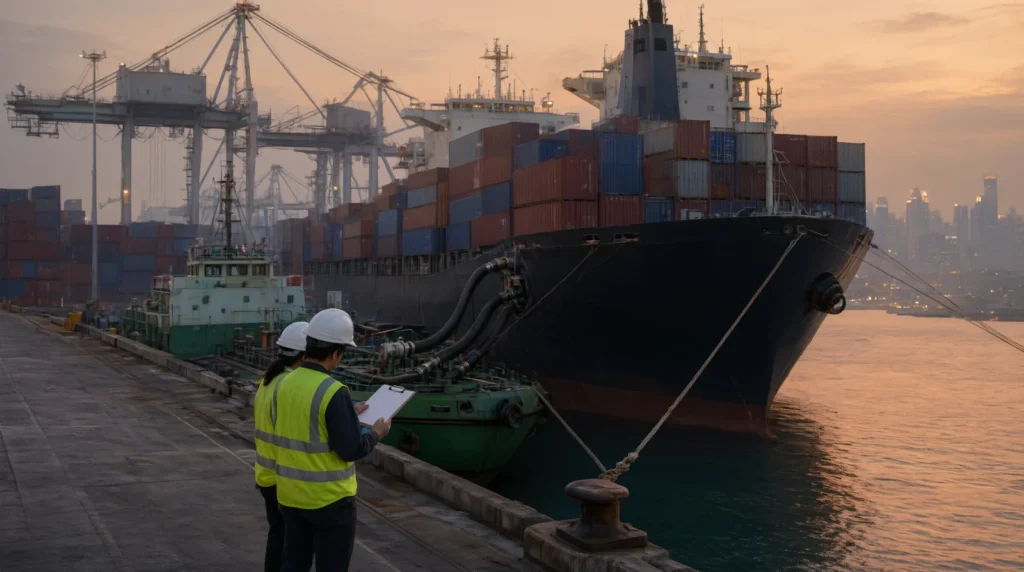
Singapore will license methanol as a marine fuel for five years from 1 January 2026 and scores the sustainability certification of the fuel when awarding those licences. Japan has targets rather than a blending mandate: 1 per cent e-methane in city gas by 2030 and 10 per cent of Japanese airlines’ fuel replaced by SAF in 2030. Korea commits its new ships to engines that can burn e-methanol by 2030, and a global fuel standard approved in April 2025 will apply to ships over 5,000 gross tonnage, which emit 85 per cent of international shipping CO2. That is what public demand actually sits behind an e-fuels policy in these three markets, and I work it out below from the hydrogen, PtX and e-fuels hub.
I first define what counts as an e-fuel, then take each market in turn: what Singapore licenses, what Japan targets, what Korea orders for its ships, and what the global fuel standard covers. I close with the checks I run before I call any of it demand.
In short
- Singapore: a licensing window from 1 January 2026 to 31 December 2030 for methanol as marine fuel, with sustainability certification scored at award.
- Japan: targets rather than a mandate: 1 per cent e-methane in city gas by 2030, 10 per cent SAF for its airlines in 2030.
- Korea: new ships able to burn e-methanol by 2030, 388 public vessels converted by 2030.
- Global standard: a well-to-wake fuel intensity rule for ships over 5,000 gross tonnage, approved 11 April 2025 for an announced 2027 entry into force.
- My reading: a licence and a vessel rule carry a date, a target carries only a forecast.
In this article
What these policies are actually buying
An e-fuel is a synthetic fuel made by combining captured carbon dioxide with green hydrogen, and the family covers e-gasoline, e-jet, e-diesel and e-methanol (2023). e-methanol is that synthesis routed into methanol so a ship engine can burn it, and SAF, sustainable aviation fuel, is the e-jet fraction an airline takes.
I rank instruments by how hard they bind. A licence is permission to sell a named fuel in a named port, and it carries dates. A target is a number a government wants, with no purchase attached. A trajectory is a path across a sector with milestone years. A mandate is a legal obligation to put a volume of fuel into use, and no such mandate for liquid e-fuels exists in the three markets below. An Asian e-fuels policy here is one of those three instruments. Singapore is building methanol and ammonia value chains for international shipping (2026).
What this means for you: name the instrument before you model demand, because only a licence and a vessel rule tell you who must buy, and by when.
Singapore: a licence with a certification condition
Singapore licenses a fuel rather than a technology. The licensing window, meaning the period in which a supplier may sell, runs from 1 January 2026 to 31 December 2030. The methanol bunkering licences announced for Singapore in November 2025 went to three suppliers selected from 13 applicants, after an application window that opened in March 2025. Sustainability certification means documented proof that the fuel was made without fossil feedstock, and certifying that a molecule comes from renewable electricity is the part a producer must show. The evaluation criteria include the sustainability certification of the methanol supplied, so certification is scored at award rather than assumed (2025).
A licensing window with a certification condition is the closest thing to contracted demand on this list (2026).
What this means for you: if your molecule clears that certification, you are qualifying for a window that is open, not chasing a forecast.
Singapore: the demand behind the licence
The licence sits on top of wider demand. Nine green and digital shipping corridors pair these port waters with partners across Asia, Europe and North America, as recorded in the Singapore transport ministry page on maritime sustainability updated in August 2026. The Maritime Singapore Green Initiative launched in 2011 with SGD 100 million was refreshed in 2024 with SGD 50 million for early adoption of zero and near-zero fuels. The fleet rule carries the volume: from 2030 every new harbour craft in port waters must be fully electric, capable of using B100 biofuels, or compatible with net-zero fuels, with the sector targeting net zero by 2050. Two terminal operators target a 60 per cent cut in total port operations emissions by 2030 against a 2005 baseline, then net zero by 2050, and Tuas Port becomes fully operational in the 2040s with electric container handling in 2050.
What this means for you: a rule that applies to every new harbour craft from 2030 tells you which buyers must act, and when, which is demand you can plan a plant against.
Japan: targets instead of a mandate
Japan publishes targets rather than a blending obligation, unlike fuel mandates that set volumes rather than roadmaps. The Japanese e-fuels policy document of December 2023 defines e-fuels as synthetic fuels produced from captured carbon dioxide and green hydrogen, then prints: 1 per cent e-methane in city gas by 2030 and 90 per cent by 2050; 10 per cent of Japanese airlines’ fuel replaced by SAF in 2030; a roadmap from 1 barrel per day in 2025 through 300 barrels per day of demonstration to commercialisation by the early 2030s and a commercial plant of 10,000 barrels per day; a liquid fuel yield of 80 per cent at pilot scale of about 300 barrels per day by 2030; alcohol-to-jet yield at or above 50 per cent at 100 to 200 yen per litre with aircraft use by 2030. The frame: national emissions 46 per cent below fiscal 2013 by fiscal 2030, an emissions trading system in heavy industry from fiscal 2026, a carbon levy on fossil fuel importers from fiscal 2028, 20,000 billion yen of transition bonds over 10 years and a green innovation fund of 2,000 billion yen (2023).
A target without an obligation to buy is a forecast, not a contract (2023).
What this means for you: treat those Japanese numbers as a yield and cost roadmap you can be measured against, not as a purchase order you can invoice.
Korea: a shipping trajectory with e-methanol in it
Korea writes the fuel choice into ship orders and into bank credit (2023). The Korean national action plan on green shipping submitted in 2023 rests on a Carbon Neutrality Act promulgated in September 2021 and in force from March 2022, which made the country the 14th with a 2050 net-zero framework. Its international shipping trajectory, announced in February 2023, is 60 per cent by 2030, 80 per cent by 2040 and 100 per cent by 2050. Domestic shipping targets 307,000 tonnes of CO2 equivalent by 2050, a 70 per cent cut from 1,019 thousand tonnes of CO2 equivalent in 2018, across 867 ocean-going ships of 5,000 gross tonnage and above under international rules. New ships must become dual-fuel vessels able to burn green fuels such as e-methanol and LNG by 2030, which fixes the fuels these ships are ordered to burn; 388 public vessels convert by 2030, and 14 hydrogen ports are planned by 2040 with import demonstration from 2026. A transition fund of up to 1,000 billion Korean won supports small and medium shipping companies, while a green ship rating of 3 or above is required before a public bank finances a vessel as green finance.
When the public bank conditions its loan on a rating, the fuel choice stops being voluntary (2023).
What this means for you: a financing gate that tests the fuel, not the balance sheet, is the strongest demand signal on this list after the Singapore licence.
The global price signal
The layer that covers every large ship is the global fuel standard inside the net-zero framework approved in April 2025. It was approved on 11 April 2025 at the marine environment protection committee session held from 7 to 11 April 2025, amending Annex VI of MARPOL with a new chapter, and it applies to ships over 5,000 gross tonnage, which emit 85 per cent of the CO2 from international shipping. It has two pillars: a fuel standard that cuts the greenhouse gas fuel intensity of the fuel, meaning greenhouse gases across the whole life of that fuel, calculated well-to-wake from production to combustion on board; and a global economic measure that charges remedial units above thresholds and rewards zero and near-zero ships. Base and direct compliance targets let ships bank or transfer units and pay into a dedicated net-zero fund. Entry into force is announced for 2027, 16 months after adoption, across 108 Parties covering 97 per cent of world tonnage by weight (2025).
The standard prices a fuel gap for the largest ships, whatever fuel a project sells into it (2025).
What this means for you: you are selling into a measured fuel intensity, so the buyer’s question is whether your molecule lowers their intensity, not what your tonne costs.
What I check before I call a policy demand
I run four checks. First, licence against target, because a licence window runs five years from 1 January 2026 to 31 December 2030 while other markets publish roadmaps. Second, certification condition against claim, because the award criteria name the sustainability certification of the fuel (2025). Third, vessel rule against budget, because new harbour craft must be net-zero compatible from 2030 and 388 public vessels convert by 2030 (2026). Fourth, timeline against money, because the fuel standard was approved in April 2025 for an announced entry into force in 2027. What turns policy into revenue is the contract behind the policy: an offtake is a commitment to buy a stated volume, and bankability is the point at which a lender will finance the plant against that commitment.
What this means for you: run the four checks in order, and if one fails, the number in front of you is a dated forecast rather than demand.
The four checks I run on an Asian e-fuels policy
I write down which instrument it is: licence, target or trajectory. I date the deadline the policy itself prints, never a date I infer. I look for the entity that must pay, because a fuel rule with no payer behind it is a study. I look for the certification scheme that decides whether the fuel counts, because that is where a producer wins or loses.
What this means for you: an Asian e-fuels policy earns a line in your model only when you can name the instrument, the deadline, the payer and the scheme; anything less stays on a watchlist.
Sources
- Maritime and Port Authority of Singapore, Singapore to Award Licences for Methanol Bunkering https://www.mpa.gov.sg/media-centre/details/singapore-to-award-licences-for-methanol-bunkering, 2025.
- Ministry of Transport Singapore, An environmentally sustainable maritime Singapore https://www.mot.gov.sg/what-we-do/green-transport/maritime-environment-responsibility, 2026.
- Agency for Natural Resources and Energy, Japan’s e-fuels policy, APEC EGEDA https://www.egeda.ewg.apec.org/egeda/meeting/21WSpresentations/S2-7.pdf, 2023.
- Ministry of Oceans and Fisheries, Republic of Korea, Toward Green Shipping by 2050: 2023 National Action Plan https://wwwcdn.imo.org/localresources/en/OurWork/Environment/Documents/NAP/R.O.K%20National%20Action%20Plan%20-%20Toward%20Green%20Shipping%20by%202050.pdf, 2023.
- International Maritime Organization, IMO approves net-zero regulations for global shipping https://www.imo.org/en/mediacentre/pressbriefings/pages/imo-approves-netzero-regulations.aspx, 2025.
Frequently asked questions
What counts as an e-fuel under these policies?
A synthetic fuel made by combining captured carbon dioxide with green hydrogen, covering e-gasoline, e-jet, e-diesel and e-methanol (2023). SAF is the e-jet share that airlines take, and e-methanol is the version a ship engine can burn.
Does Singapore have a mandate for e-methanol?
No: it licenses suppliers of methanol as marine fuel from 1 January 2026 for five years, to 31 December 2030, and requires sustainability certification of the methanol supplied (2025).
What has Japan actually committed to for e-fuels?
Targets rather than an obligation: 1 per cent e-methane in city gas by 2030 and 90 per cent by 2050, 10 per cent of Japanese airlines’ fuel replaced by SAF in 2030, and a roadmap from 1 barrel per day in 2025 to a commercial plant of 10,000 barrels per day by the early 2030s (2023).
What does the global shipping fuel standard change for a buyer?
It applies to ships over 5,000 gross tonnage, which emit 85 per cent of international shipping CO2, measures fuel intensity well-to-wake and was approved on 11 April 2025 for an announced entry into force in 2027, so a buyer is selling into a fuel standard rather than a price (2025).
Not sure your project would survive a credit conversation?
A short call is usually enough to see where your project stands.
If you are sizing a plant or a supply deal against one of these instruments, I map the certification path, the fuel intensity maths and the compliance calendar through compliance and carbon intensity support.
I do not provide investment advice or arrange investments. I act as a strategic advisor and facilitator.

Alex, Founder of WeConnect Asia
I help low-carbon fuel and carbon removal project developers in Southeast Asia secure the commercial and financial partners needed to reach FID.
Related articles

Pitching a Climate Tech Company to Strategic Investors: What the Corporate Has to Believe Before It Writes a Cheque
How to pitch a climate tech company to strategic investors: the metric cluster, the readiness evidence and the ask that corporates fund.

Biomethane: What It Is, How It Is Made and Who Buys It
Biomethane is biogas cleaned to pipeline quality. I explain how it is made, how it differs from biogas and who buys it in Southeast Asia.

CO2 Sourcing for e-SAF Projects: What the Rules Allow and What the Contract Must Say
Biogenic CO2, direct air capture or industrial flue gas: which sources an e-SAF plant may use, what they cost and which contract terms make the fuel certifiable.

Operating Performance Guarantees for SAF Plants: What Lenders Ask For
Minimum guarantees, performance damages, retesting and who stands behind them: the operating guarantees a SAF plant needs to keep debt and offtake intact.

EPC and Construction Risk in SAF Plants: What a Lender Actually Tests
FEED scope, convertible EPC, performance guarantees and damages caps: the construction risk questions a SAF project must answer before financial close.

Matching Feedstock and Offtake Risk Back-to-Back in a SAF Project: How Lenders Read the Chain
Lenders do not buy a feedstock plan and an offtake plan separately. They buy the link between the two, and the link is where most SAF files break.