
Home » First-of-a-Kind Risk in e-SAF Finance: How a First Plant Actually Gets Funded
First-of-a-Kind Risk in e-SAF Finance: How a First Plant Actually Gets Funded
9 min read · Aug 2, 2026 · By Alex
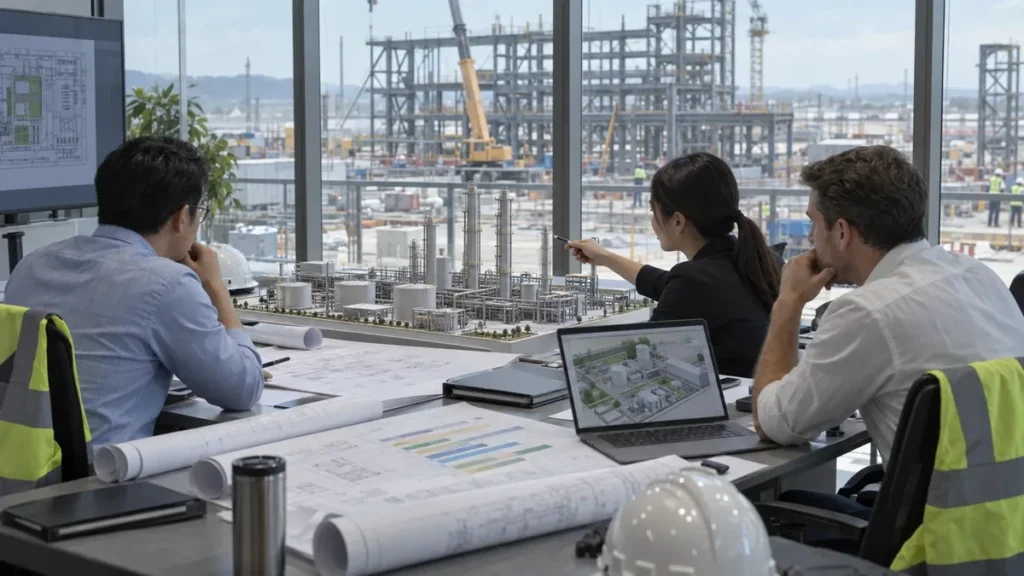
A first-of-a-kind plant has no operating twin to price against, so it is underwritten on contracts and instruments rather than on history. I would write the risk allocation table before the financial model, and I would treat revenue as the gating item. That is the short answer to how the first unit of a sustainable aviation fuel line actually gets funded, and the wider framing sits in e-SAF project finance. For a project debt banker or developer in Southeast Asia weighing a first of a kind e saf unit, the real question is who carries integration complexity, construction risk and the challenge of translating promising engineering into bankable cash flows.
That distinction matters because every precedent a lender normally leans on is missing. I therefore read a first unit as a question of risk allocation first and a question of technology second.
In short
- Answer: No operating twin exists, so the first unit is underwritten on contracts and instruments rather than history.
- Contract: A single turnkey construction contract is unlikely to be available, so scopes get bundled and penalties sit with the strongest supplier in each package.
- Public money: Five instruments are proposed for the early slice, and all of them are meant to be targeted and temporary.
- Gating item: Revenue visibility, not the construction contract, is what decides the final investment decision.
- Sequence: Fund the early engineering study first, then ask debt for a priceable scope.
In this article
What "first of a kind" means inside a credit file
FOAK (first of a kind) inside a credit file means there is no operating twin to price against, and the first plant of an e-SAF line is financed on contracts and instruments rather than on history. The first commercial facilities face the familiar headwinds of any first-of-a-kind technology: integration complexity, construction risk, and the challenge of translating promising engineering into bankable cash flows. I read those three headwinds as the whole of the underwriting problem.
IATA Economics puts the maturity picture in front of me: no commercial-scale e-SAF facilities are currently in operation, no commercial-scale project in Europe has reached FID (final investment decision), and globally only one project has reached FID to date and is under construction in the US. The same source notes that production costs can be up to 12 times higher than conventional aviation fuel, so the first unit cannot be priced off a comparable.
I also fix my terms. An offtake is the contract under which a buyer takes the plant’s output, and in this market binding airline commitments are scarce, so the offtake is usually where a first plant stalls.
What this means for you: treat the missing operating twin as the core credit fact, and ask which contract is standing in for the history you do not have.
Why the standard construction contract does not survive contact with the first plant
Project finance lenders traditionally insist on a lump sum turnkey contract under which a capable, financially strong contractor guarantees both completion and operational performance, with liquidated damages (LD) available if it fails. EPC (engineering, procurement and construction) contractors are unlikely to provide that structure for e-SAF projects because the facilities integrate multiple new technologies in a first-of-a-kind setting, combining interdependent units that have yet to demonstrate commercial-scale compatibility.
Where the single contract breaks, the pattern that has worked elsewhere is early offshore wind: multi-contracting structures with licensors, OEMs and construction contractors taking discrete scopes, work packages bundled as far as possible, and penalty obligations placed with the most creditworthy supplier in each package. Bundling only works as far as the package is strong. Licensor and OEM warranties are typically limited in coverage, and many licensors are firms with limited credit strength, so every bundle you sign moves risk back onto the project company.
Construction contractors favour cost-reimbursable or target-price models, and the resulting risk transfer is generally unacceptable within project finance frameworks. That gap is why supplemental instruments such as technology performance insurance, contingent equity or public-backed financing enter the conversation at all. The rest of the funding stack is set out in how to finance a SAF project.
What this means for you: do not wait for a full-wrap turnkey offer that will not come, and instead design the contract map around the strongest supplier in each package.
Where public money is expected to step in
The Project SkyPower and Green Finance Institute report proposes five instruments: direct lending to anchor project debt, enhancements to technology performance insurance, contingent credit facilities to manage overruns after contingencies are exhausted, matched funding for comprehensive FEED (front-end engineering design) studies, and targeted backstops where supplier guarantees are insufficient.
The report is explicit that support should be targeted and temporary, designed to complement or share rather than replace private sector accountability, because public financial institutions are not best placed to carry project delivery risk. I read that as a deliberate limit. Public money is asked to absorb the early, unpriceable slice, not to stand behind the whole file.
The size of that slice is concrete. A FEED study is estimated to cost around 1.5 to 3 percent of total installed cost, so for projects ranging from 1 to 1.5 billion euros a FEED study could cost between 15 million and 45 million euros, an amount that presents a real challenge for developers with early-stage funding constraints. Where that maturity work sits in my own service line is technology maturity and scale-up.
What this means for you: ask which of the five instruments you actually need, fund the FEED study before you ask anyone for debt, and check that any public support carries a stated taper.
The risk that actually stops the deal
The same report states that offtake risk is the greatest challenge for financing e-SAF projects, while its own scope stays on delivery risk on the assumption that the other risks are handled through commercial contracts or a market mechanism. European Business Magazine describes the resulting mismatch: an eSAF developer financing a first commercial plant needs long-duration revenue visibility, while airlines face the opposite incentive because a first-generation price may lock them into an uneconomic position as costs fall.
Transport and Environment adds the supply-side picture: more than 40 large-scale e-SAF projects were under development in Europe as of May 2025, none had reached FID, and meeting the 2030 target depends on more FIDs within the next 12 to 18 months. The same report notes that start-ups have taken the lead in project development, and combined with the lack of binding offtake agreements from airlines this makes the projects appear high-risk to banks and other potential investors.
European Business Magazine also records that early projects absorb first-of-a-kind engineering, expensive equipment, immature supply chains, commissioning risk and limited operating history, so a first project competes not only against fossil jet fuel and HEFA SAF but against the expectation that the next e-SAF plant may be cheaper.
What this means for you: treat delivery instruments as the second half of the file, because no amount of construction risk transfer repairs a missing revenue contract.
What the money expects in return
Transport and Environment puts the financing hurdle plainly, with each plant requiring 1 to 2 billion euros in capital, a CapEx (capital expenditure) figure that sets the equity cheque long before anyone discusses returns. IATA adds the cost side of the same problem: progress is hindered by high capital investments and production costs, which can be up to 12 times higher than conventional aviation fuel.
On the returns side, RMI reports what a project finance roundtable heard: a private equity backed energy transition fund may want around 15 percent levered equity internal rate of return for operating projects and over 20 percent where there is development risk, while venture capitalists may want north of 40 percent for pre-offtake projects with novel technology configurations, and there is no juicy 20-year investment grade offtake in this market.
RMI’s note is dated 22 March 2024, which makes it older than two years. I use it as evidence of the return gap, not as a current pricing sheet. The technology that consumes this capital is set out in power-to-liquid explained.
What this means for you: reconcile the return you are being asked for against the revenue you can actually contract, and treat any gap as a structure problem rather than a pricing argument.
The sequence that turns a first plant into a bankable file
The disciplined route described by PTQ in Decarbonisation Technology (November 2025 issue) is a conceptual phase before detailed engineering: technology readiness levels checked, integration complexity assessed for operability, safety and cost, structured scoring to compare options, and then bankable delivery pathways such as staged financing, modular scale-up or risk sharing, so that later stages run on stronger assumptions.
Project SkyPower sets the same logic on contracts: engage contractors early, aligned with technology provider selection before FEED, then run a disciplined FEED and detailed design phase so contractors can identify and price delivery risks. PTQ adds that spreadsheets alone do not convince investors, who want to know whether it is real and whether it can be delivered, and that for first-of-a-kind projects the feasibility phase is decisive because it transforms complexity into clarity.
The readiness checklist that governs this sequence is how to reach FID for a SAF project, and the certification chain your fuel must satisfy is renewable fuels of non-biological origin.
What this means for you: buy the feasibility work before you buy the equipment, because the delivery pathway you choose here is the one lenders will underwrite later.
The three questions I would expect in the room
RMI’s account of what investors ask gives me the agenda. The first is which feedstock and therefore which technology, with feedstock contracts that need to be as airtight, maybe even more solid, than offtake so that both debt and equity investors can participate.
The second is whether to seek a government loan guarantee, where the review process can take 6 to 12 months or more and approval is uncertain, leaving three financing archetypes: a government loan with a government guarantee, a commercial loan with a government guarantee, and a commercial loan with no government guarantee.
The third is how to assemble insurance, construction guarantees and equipment warranties in a way that gets past a bank’s credit committee, where EPCs may not be able to provide full-wrap construction contracts, OEM warranties may not be long or strong enough for lenders, and getting insurance to cover all project risks may be too expensive.
What this means for you: arrive with feedstock contracts as tight as the offtake, a stated position on the guarantee route, and an insurance stack you can defend line by line.
How I would run the file if it were mine
I would write the risk allocation table before the model, naming who carries integration, commissioning and performance risk; I would fund FEED early because that study is what turns a concept into a priceable scope; I would keep public instruments as a bridge with a stated taper rather than a permanent subsidy; and I would treat the offtake as the gating item, because delivery instruments do not fix missing revenue.
What this means for you: allocate each first-of-a-kind risk to the party that can actually manage it, fund the FEED study before you ask for debt, and treat offtake as the item that decides FID, not the construction contract.
Sources
- Green Finance Institute, October 2025.
- PTQ, November 2025.
- RMI, 22 March 2024, older than two years.
- IATA, 20 February 2026.
- Transport and Environment, June 2025.
- European Business Magazine, updated 28 August 2026.
Frequently asked questions
What makes a project first of a kind in the eyes of a lender?
The absence of operating history. The first commercial facilities face integration complexity, construction risk and the challenge of translating engineering into bankable cash flows, no commercial-scale e-SAF facilities are currently in operation, and only one project globally has reached FID.
Will an EPC contractor sign a fixed-price turnkey contract for an e-SAF plant?
Unlikely. Project finance lenders traditionally insist on a lump sum turnkey contract, but EPC contractors are unlikely to provide it for e-SAF projects because multiple new technologies are integrated in a first-of-a-kind setting, which pushes developers towards multi-contracting with liquidated damages placed with the most creditworthy supplier in each package.
What public support is realistically available for a first e-SAF plant?
The instrument set proposed by Project SkyPower and the Green Finance Institute is direct lending to anchor project debt, enhancements to technology performance insurance, contingent credit facilities for overruns, matched funding for FEED studies, and backstops where supplier guarantees are insufficient, all targeted and temporary.
How long does it take to reach FID after the power and feedstock are secured?
The published targets are FID within the next 18 months to meet typical construction and ramp-up timelines under ReFuelEU, and more FIDs within the next 12 to 18 months for the European pipeline to meet its 2030 target; one disclosed project has targeted FID for 2028 with power supply now secured.
Want that first-of-a-kind risk tested against your own line?
A short call is usually enough to see where your project stands.
If you are building the first unit of an e-SAF line and you want the risk allocation, the FEED scope and the revenue contract tested before the file goes to a credit committee, the test that file has to pass is bankability.
I do not provide investment advice or arrange investments. I act as a strategic advisor and facilitator.

Alex, Founder of WeConnect Asia
I help low-carbon fuel and carbon removal project developers in Southeast Asia secure the commercial and financial partners needed to reach FID.
Related articles

Pitching a Climate Tech Company to Strategic Investors: What the Corporate Has to Believe Before It Writes a Cheque
How to pitch a climate tech company to strategic investors: the metric cluster, the readiness evidence and the ask that corporates fund.

Biomethane: What It Is, How It Is Made and Who Buys It
Biomethane is biogas cleaned to pipeline quality. I explain how it is made, how it differs from biogas and who buys it in Southeast Asia.

CO2 Sourcing for e-SAF Projects: What the Rules Allow and What the Contract Must Say
Biogenic CO2, direct air capture or industrial flue gas: which sources an e-SAF plant may use, what they cost and which contract terms make the fuel certifiable.

Operating Performance Guarantees for SAF Plants: What Lenders Ask For
Minimum guarantees, performance damages, retesting and who stands behind them: the operating guarantees a SAF plant needs to keep debt and offtake intact.

EPC and Construction Risk in SAF Plants: What a Lender Actually Tests
FEED scope, convertible EPC, performance guarantees and damages caps: the construction risk questions a SAF project must answer before financial close.

Matching Feedstock and Offtake Risk Back-to-Back in a SAF Project: How Lenders Read the Chain
Lenders do not buy a feedstock plan and an offtake plan separately. They buy the link between the two, and the link is where most SAF files break.