
Home » Selling SAF into the Middle East: Demand Without a Mandate
Selling SAF into the Middle East: Demand Without a Mandate
10 min read · Nov 2, 2026 · By Alex
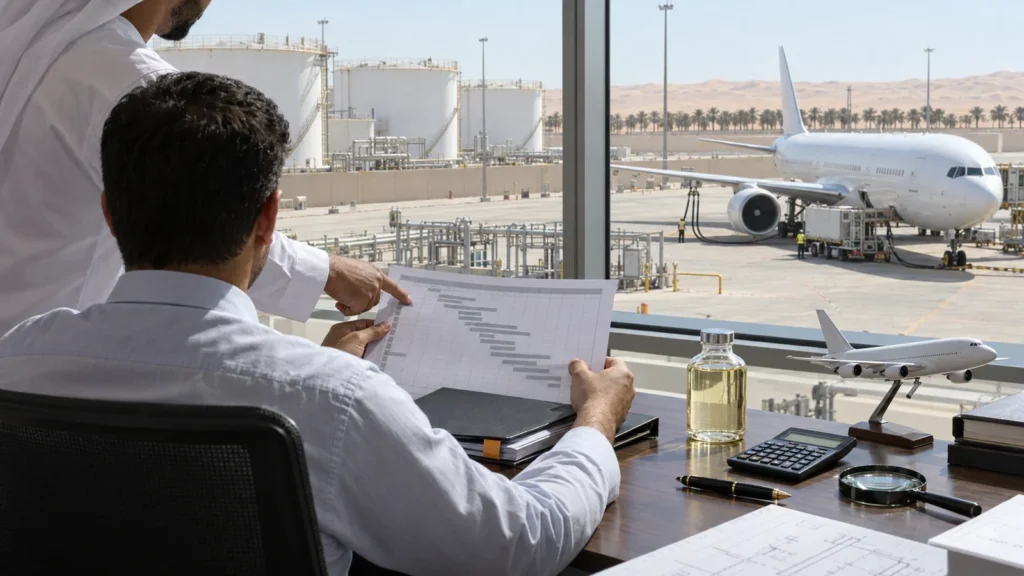
There is no binding blending mandate anywhere in the Gulf today. The UAE has published a General Policy for Sustainable Aviation Fuel. In addition, its headline figure is a voluntary target. This percentage carries no penalty if a supplier misses it. Supply 1 per cent of fuel to national airlines at UAE airports using locally produced SAF by 2031. It also carries a national aim of 700 million litres of SAF a year. Gulf refineries already produce and certify SAF, so an exporter reaches this market through a supply or offtake contract. That contract fixes volume, price and term before delivery, with a regional producer or fuel supplier, not a compliance obligation. That is the shape of the export SAF Middle East trade I underwrite. Start with the SAF export overview for the wider region.
What follows is the buyer map I use when a developer asks where Gulf demand really comes from. I separate published intention from signed contract, then check certification, delivered cost and the policy risk sitting behind each line.
In short
- No mandate: No Gulf state has adopted a blending obligation. Transport & Environment lists the United Arab Emirates among seven countries where proposals are being discussed.
- UAE policy: A voluntary target of 1 per cent locally produced SAF for national airlines by 2031. It also names 700 million litres of annual capacity as an aim.
- Certification: ISCC EU/CORSIA PLUS covers supply at Abu Dhabi Airport and ISCC+ covers the Jubail plant.
- Existing supply: Regional refineries already convert used cooking oil into certified SAF.
- My route: I enter through a supply or offtake contract with a refinery or fuel supplier.
In this article
What the region has actually adopted
The UAE General Policy for Sustainable Aviation Fuel carries two published intentions. It aims to decarbonise the aviation sector and position the UAE as a regional hub for low-carbon aviation fuel. In addition, it sets a target of 1 per cent of fuel for national airlines by 2031. That SAF must be locally produced at UAE airports. The same policy states an intent to develop local capacity enabling the production of 700 million litres of SAF annually and to establish a national regulatory framework, including exploring policies to support the long-term economic operation of SAF facilities in the UAE. It also sets standards for SAF production and use. In addition, it aligns with the UAE Energy Strategy 2050 and the UAE Net Zero by 2050 Strategic Initiative.
GreenAir News reports that the guideline was confirmed after a post-COP28 cabinet meeting. The Ministry of Energy and Infrastructure describes it as the first of its kind in the Middle East. It did not specify whether UAE-based airlines or others would be obliged to use the SAF.
What this means for you: no blending obligation has been published anywhere in the region. Therefore, I read this as a published intention with a date attached, not as demand I can contract against.
Who buys, and on which basis
Transport & Environment counts eight SAF mandates adopted worldwide, including in the EU, the UK, India and Brazil. In addition, records that proposals are being discussed in seven countries including China, South Korea. The United Arab Emirates and Turkey. Also, the mandate list puts the UAE in the discussion column, not the obligation column. Demand sits with six international airlines and eight international airports. In addition, the roadmap to 2050 describes production at up to five facilities using three pathways: oils from saltwater-tolerant plants grown in Abu Dhabi, municipal solid waste converted to low emission fuel, and power-to-liquid fuels using solar-generated electricity. GreenAir News also records that Emirates established a $200 million fund to support sustainable aviation innovation. It also ran two test flights with aircraft engines powered by 100% SAF. It also announced multiple deals to procure imported SAF.
What this means for you: the buying decisions here are corporate procurement decisions. Therefore, each one needs its own contract rather than a compliance schedule I can lean on.
What the buyer will ask you to prove
ADNOC was the first company in the Middle East to receive International Sustainability and Carbon Certification for SAF production. In addition, its ISCC EU/CORSIA PLUS co-processing certification lets it supply SAF at Abu Dhabi Airport. That fuel comes from used cooking oil blended with jet fuel. Co-processing means running waste feedstock through an existing refinery unit beside conventional jet fuel. A certification scheme means an audited feedstock and emissions rulebook labelled on each volume. SATORP, a joint venture between Aramco and TotalEnergies at Jubail, produces SAF from used cooking oil, is certified under ISCC+. In addition, aims at 1.5 million tons per annum by 2030.
Norton Rose Fulbright states that SAF must be tested against ASTM D7566 before blending, that aircraft operators may also certify under ISCC or RSB, and that CORSIA eligibility requires an ICAO-approved scheme. No feedstock from converted ecosystems or protected areas. It also requires at least a 10% reduction in lifecycle greenhouse gas emissions against conventional jet fuel. It adds that schemes differ, that RSB CORSIA bars palm oil derivative feedstocks without prior approval. In addition, periodic re-recertification is a quasi change-in-law risk.
What this means for you: certification decides whether a volume can be sold twice in two markets. Therefore, I confirm the scheme and the destination rules before I quote.
What is already made, and where an export fits
The Masdar, TotalEnergies and Siemens Energy collaboration signed at Abu Dhabi Sustainability Week 2022 covers a demonstrator plant at Masdar City for green hydrogen production to convert carbon dioxide into SAF. Sustainable Aviation Futures describes a regional trend of using existing infrastructure and expertise. This streamlines production and helps drive down costs. In addition, positions the Middle East between Asia, Europe and Africa as a possible export and transit hub. Norton Rose Fulbright records that exporting SAF across borders from feedstock-rich countries to those with strong airline sectors is expensive and logistically complex and can also reduce the net carbon benefit. The UAE roadmap, reported by GreenAir News, says some production could be exported to more mature policy regimes such as the European Union. In addition, allocating half of this supply to exports could give a cumulative $1.7 billion of export revenue by 2030.
For volumes that cannot move physically, book and claim is the alternative I check first. The buyer pays for the environmental attributes while the fuel stays at the plant.
What this means for you: I price both routes, physical shipment with freight and emissions counted. In addition, a book and claim payment, then let delivered cost decide.
What a finance plan has to survive
With no obligation in force, I cannot book revenue here until a buyer signs. Norton Rose Fulbright records that there is not yet an established wholesale market for SAF with a predictable and discoverable market price, so bankable, long-term offtake agreements with airlines, directly or sleeved through jet fuel providers, are critical; the same source notes that mandatory carbon schemes across Asia remain nascent, leaving reliance on voluntary markets. The UAE policy says the country is exploring policies to support the long-term economic operation of SAF facilities. That is the missing piece a lender asks for. GreenAir News reports that producing 700 million litres of SAF by 2030 would cost between $7 billion and $9 billion. It would cut cumulative CO2 by an estimated 4.8 million tonnes and would create up to 18,000 jobs across the value chain.
IATA’s fact sheet says any SAF mandate should come only where market conditions, production capacity, infrastructure readiness and supportive policy measures are in place. In the way I approach financing a SAF project, I price this market on the contract in front of me, never on the published target.
What this means for you: the capacity aim stays in a separate note from the revenue line, because a lender funds the signed offtake only.
Where the risk sits today
SAF currently represents less than 1% of global aviation fuel use and is several times more expensive than conventional aviation fuel. In addition, IATA lists the reasons as more expensive feedstocks, still developing production technologies, lack of physical and market infrastructure, and high upfront investment needs. In a separate IATA release, global SAF production is expected to reach around 2.4 million tonnes in 2026. That represents just 0.8% of aviation fuel use, at a cost to airlines of $4.3 billion. Transport & Environment notes that most frameworks currently incentivise biofuels. Those include crop-based ones such as soy or palm oil, that the EU. In addition, the UK have excluded them for sustainability reasons, and that only a few frameworks actively promote e-kerosene. The exposure I watch is set out in my note on SAF policy risk.
What this means for you: the risk is not that the target disappears. It is that a voluntary target carries no penalty. Therefore, the revenue line depends entirely on which buyer signs and which certification scheme the destination market accepts.
What I would ask before signing
I ask four questions in writing. First, who is the buyer, a national airline, a fuel supplier or a refinery, and which entity holds the offtake obligation if one appears. Second, which certification scheme the volume carries today, ISCC EU/CORSIA PLUS or ISCC+, and whether the destination market accepts it. Third, what the delivered cost is once freight. In addition, I count the emissions from moving feedstock, because cross-border movement can reduce the net carbon benefit. Fourth, what changes if the voluntary target becomes an obligation, and who carries that cost, including who pays if periodic re-recertification alters the rules. I keep the published target and the signed contract on separate lines.
What this means for you: four written answers give me a file I can price. In addition, anything unanswered becomes a condition rather than an assumption.
How I would model it if it were my file
I use three rows. The first row carries the published intention: 1 per cent by 2031 and 700 million litres of annual capacity. Both are dated to the instruments that published them. Also, the second row carries what is operating today. Certified co-processing at Abu Dhabi Airport and the Jubail plant with its 1.5 million tons per annum aim for 2030. The third row carries my contracted volume, priced against freight and certification cost. I run the model twice, once with the voluntary target still voluntary and once with it converted into an obligation. In addition, I show the lender the difference in one line. Nothing in row one earns anything until row three fills.
What this means for you: the file stays honest because every row cites an instrument or a contract. Therefore, a reader can see which numbers are intention and which carry a signature.
Sources
- UAE Government portal, updated 22 October 2026.
- Sustainable Aviation Futures (Middle East), consulted 16 November 2026.
- GreenAir News, 20 December 2023.
- IATA, June 2026.
- IATA, 6 June 2026.
- Transport & Environment, consulted 16 November 2026.
- Norton Rose Fulbright, October 2025.
Frequently asked questions
Is there a SAF mandate in the Middle East?
No blending obligation has been adopted in the region: Transport & Environment counts eight mandates adopted worldwide, including the EU, the UK, India and Brazil, with the United Arab Emirates among seven countries where proposals are being discussed. What exists in the Gulf today is a published general policy with a voluntary target, so a sales forecast here should not assume a compliance buyer.
What is the UAE SAF target?
The UAE General Policy for Sustainable Aviation Fuel sets a voluntary target to supply 1 per cent of fuel to national airlines at UAE airports using locally produced SAF by 2031, alongside an intent to enable production of 700 million litres of SAF annually. GreenAir News reports the same 700 million litres a year figure by 2030 in the announcement cycle that followed a post-COP28 cabinet meeting, and the policy page links to the National Sustainable Aviation Fuel Roadmap to 2050.
What certification does a Gulf buyer require?
SAF must meet ASTM D7566 before blending, with ISCC or RSB certification used by operators, and CORSIA eligibility requires an ICAO-approved scheme, no feedstock from converted ecosystems or protected areas and at least a 10% lifecycle reduction. ADNOC already holds ISCC EU/CORSIA PLUS co-processing certification for SAF supplied at Abu Dhabi Airport, and the Jubail plant carries ISCC+, so a regional buyer starts from a certifiable position.
Can an Asian producer export SAF to the region?
Yes, but through contracts. Cross-border export is expensive and logistically complex and can reduce the net carbon benefit, and the UAE roadmap itself points to exporting part of its production to more mature policy regimes such as the European Union. For an Asian producer the practical route is a supply or offtake agreement with a regional producer or fuel supplier, with freight and certification cost priced in from the start.
Not sure your project would survive a credit conversation?
A short call is usually enough to see where your project stands.
If you want a second read on a draft contract before it goes to a counterparty, my offtake agreement work covers volume, price mechanics, certification obligations and take-or-pay language, and I tell you where the risk actually sits.
I do not provide investment advice or arrange investments. I act as a strategic advisor and facilitator.

Alex, Founder of WeConnect Asia
I help low-carbon fuel and carbon removal project developers in Southeast Asia secure the commercial and financial partners needed to reach FID.
Related articles

Pitching a Climate Tech Company to Strategic Investors: What the Corporate Has to Believe Before It Writes a Cheque
How to pitch a climate tech company to strategic investors: the metric cluster, the readiness evidence and the ask that corporates fund.

Biomethane: What It Is, How It Is Made and Who Buys It
Biomethane is biogas cleaned to pipeline quality. I explain how it is made, how it differs from biogas and who buys it in Southeast Asia.

CO2 Sourcing for e-SAF Projects: What the Rules Allow and What the Contract Must Say
Biogenic CO2, direct air capture or industrial flue gas: which sources an e-SAF plant may use, what they cost and which contract terms make the fuel certifiable.

Operating Performance Guarantees for SAF Plants: What Lenders Ask For
Minimum guarantees, performance damages, retesting and who stands behind them: the operating guarantees a SAF plant needs to keep debt and offtake intact.

EPC and Construction Risk in SAF Plants: What a Lender Actually Tests
FEED scope, convertible EPC, performance guarantees and damages caps: the construction risk questions a SAF project must answer before financial close.

Matching Feedstock and Offtake Risk Back-to-Back in a SAF Project: How Lenders Read the Chain
Lenders do not buy a feedstock plan and an offtake plan separately. They buy the link between the two, and the link is where most SAF files break.