
Home » Haber-Bosch Flexibility with Variable Power: What a Cycling Ammonia Plant Actually Costs
Haber-Bosch Flexibility with Variable Power: What a Cycling Ammonia Plant Actually Costs
10 min read · Oct 19, 2025 · By Alex
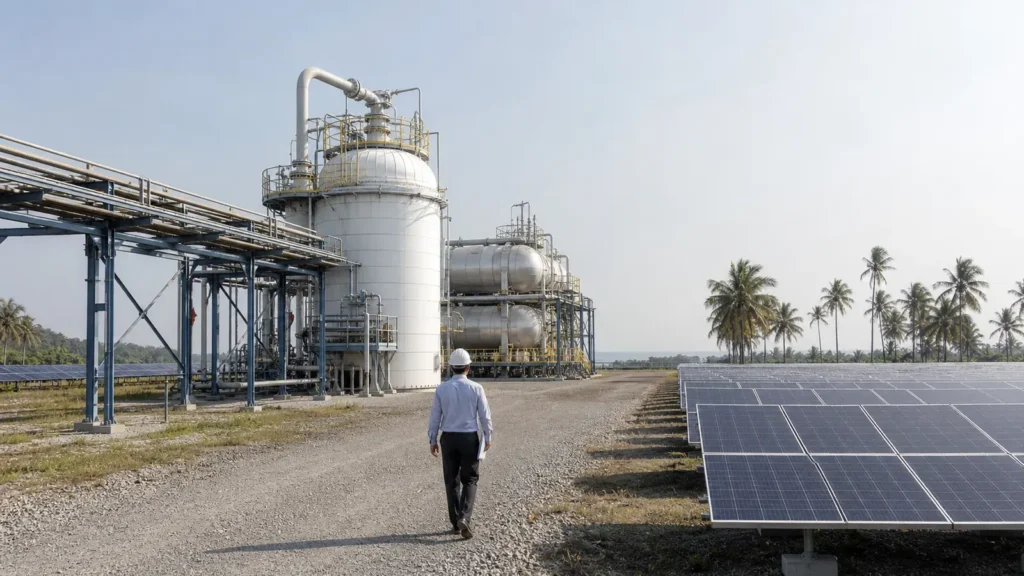
Yes, a Haber-Bosch synthesis loop, the process that makes ammonia from hydrogen and nitrogen under pressure and heat, can follow variable renewable power, but only with thermal storage and buffers around it. A published design reaches a turn-down ratio of 20, meaning operation at 5 per cent of nominal power, reheats its reactor tubes from ambient in 15 minutes and still holds enough heat after 55 hours to restart, while commercial reactors are built for long steady hot runs and cycling raises reliability problems from thermal cycling. The phrase haber bosch flexibility is a specification question rather than a slogan, and I start from the green ammonia page when I frame it for a pre-FID developer in Southeast Asia at feasibility stage.
In this article I order the question in seven parts: what the loop is being asked to do, where the inertia sits, what the operating envelope allows, what the flexible design costs, what the market pays, what a buyer will accept, and the checks I run. Each part answers one question a developer puts to me at feasibility stage.
In short
- Turn-down: A published design runs down to 5 per cent of nominal power, a turn-down ratio of 20 in 2022-2023.
- Inertia: Reactor tubes reheat from ambient in 15 minutes and the heat store still works after 55 hours in 2022-2023.
- Envelope: The reactor accepts up to a 73 per cent reduction and a 24 per cent enhancement in production in 2018.
- Cost: The flexible reactor design is 956 GBP per tonne against 2,330 GBP per tonne for a battery option in 2022-2023.
- Market: Renewable ammonia costs about 720 USD per tonne on the best sites in 2022.
In this article
What a flexible ammonia plant is being asked to do
The Haber-Bosch process makes ammonia from hydrogen and nitrogen under pressure and heat. A turn-down ratio is the lowest share of nominal output a plant can run at, and per-pass conversion is how much of the feed becomes ammonia in one pass. What the plant is now asked to do is absorb a power profile that moves every hour instead of holding one set point.
My starting point is the technology roadmap on sustainable nitrogen fertiliser production published in October 2021: it records that ammonia plants have lifetimes of up to 50 years and that the installed fleet averages about 25 years, around 40 years in Europe against 12 years in China. Ammonia production accounts for about 2 per cent of final energy consumption in 2021, around 40 per cent of it as feedstock.
A plant ordered today is expected to run for decades, which is why its operating profile is a financing question in 2021.
What this means for you: you are buying an operating profile as much as a reactor, so I test the profile first and the price second.
Why steady state was the default
Nothing in the chemistry rewards movement. Per-pass conversion runs at 25 to 35 per cent in 2018, which forces a recycle stream several times the feed rate, and every start has to be reconciled with that loop. That is why the synthesis loop and its steady-state design grew up around a single set point.
More than 90 per cent of the process energy goes into producing hydrogen in 2018, which makes hydrogen the limiting reagent in a renewable trough: when the sun drops, the nitrogen side waits. Three catalyst beds in series are the configuration that works best for ammonia synthesis in 2018, and three beds held at temperature are expensive to take down and expensive to bring back.
Steady state was therefore a design choice with a cost attached in 2018, not a law of the process.
What this means for you: the equipment you are pricing was engineered for long hot runs, so every flexibility claim has to be measured against that baseline.
What the operating envelope actually allows
The starting point is the 2018 operating envelope study of the Haber-Bosch process, which puts the usual envelope at 150 to 300 bar and 623 to 773 K with a hydrogen to nitrogen molar ratio of 2:1 to 3:1 and inert gas content from 0 to 15 mol per cent in 2018.
Inside that box the reactor accepts up to a 73 per cent reduction and a 24 per cent enhancement in ammonia production in 2018, while flexibility on hydrogen admission reaches 51 to 67 per cent depending on the variable considered in 2018. Power-to-ammonia, meaning electricity converted to hydrogen and nitrogen and then to ammonia, is estimated at 50 to 60 per cent against 60 to 64 per cent for the best conventional plants in 2018, and the approach had reached technology readiness level 6 by 2018, which is where the plant equipment whose envelope is at stake actually sits.
The envelope is wide on paper in 2018 and every point has to be bought in the design.
What this means for you: you pay for the whole envelope, so I ask which points are demonstrated.
Where the inertia actually sits
In the feasibility report on an ammonia synthesis plant running on intermittent renewable energy, published in 2022 and 2023, the reactor tubes can be reheated from ambient temperature to operating temperature in 15 minutes thanks to thermal storage, meaning heat held for later release. After 55 hours the gravel bed still holds enough heat to bring the modules back to about 350 degrees C, the catalyst activation temperature at which the catalyst starts working.
The rest moves quickly in 2022-2023: the inert gas leaves the reactor at about 500 degrees C, and the electrolyser starts in under 5 minutes and runs below 100 degrees C. Equipment is sized on peak power rather than average power with about 30 minutes of battery storage as a buffer, so the hydrogen feed that carries most of the process energy sets the plant size. Flexible operation can lead to reliability issues from thermal cycling in 2022-2023.
The inertia sits in the heat store, not in the molecule, in 2022-2023.
What this means for you: you are buying a restart sequence as much as a reactor, so I ask for store size and hold time.
What flexibility does to the number
The levelised cost of ammonia, meaning the lifetime cost of the plant divided by the tonnes it delivers, is where a flexible design survives or dies. For the 10 MW reference plant built from two 5 MW electrolysers in 2022-2023, the flexible reactor design comes out at 956 GBP per tonne against 2,330 GBP per tonne for the battery option and 1,640 GBP per tonne for the hydrogen storage option.
Electricity at up to 50 GBP per megawatt hour puts that design inside the 570 to 1,100 GBP per tonne range predicted for green ammonia in 2022-2023, and projected 2050 prices of 245 to 282 GBP per tonne show where that range heads. The same assessment puts life-cycle emissions at 0.18 kg of CO2 per kg of ammonia against a low-carbon threshold of 0.42 kg in 2022-2023.
The cycling premium is visible in the number rather than hidden inside it in 2022-2023.
What this means for you: the flexible reactor is not the cheapest line, but it is cheaper than buying the same uptime with batteries.
What the market pays for the molecule
My benchmark is the renewable ammonia innovation outlook of May 2022: about 183 million tonnes of ammonia are produced each year, 72 per cent from natural gas and 22 per cent from coal. Ammonia absorbs about 45 per cent of world hydrogen demand, around 33 million tonnes of hydrogen in 2020.
That outlook puts renewable ammonia at about 720 USD per tonne on the best solar and wind sites in 2022, with 480 USD per tonne expected in 2030 and 310 USD per tonne in 2050. Parity with fossil ammonia needs about 150 USD per tonne of CO2 or electricity below 20 USD per megawatt hour in 2022.
Announced capacity reaches 15 million tonnes a year by 2030 across 54 projects, about 8 per cent of the current market, against less than 0.02 million tonnes produced in 2021. Announcements are not operating plants. The cost curve of the molecule sets the price a flexible plant must beat in 2022.
Bankability, meaning whether a lender will advance money against the project, follows that curve, and what the cost does to financing is where I go next.
What this means for you: the price you can get is set by a molecule whose cost keeps falling, so I test against the curve.
What a buyer will accept from a cycling plant
My reference is the 2024 techno-economic study of ammonia cracking for power generation: gaseous hydrogen stays the cheapest way to move hydrogen on land up to 3,500 km, and beyond that distance ammonia becomes the more economic carrier. Liquid ammonia stores 121 kg of hydrogen per cubic metre against 71 kg per cubic metre for liquid hydrogen in 2024.
Storage is where the choice bites: storing hydrogen reactant in bulk over a day can cost up to three times as much as storing ammonia in 2018, and an ammonia tank is the cheapest large-scale storage beyond 100 GWh.
A buyer signs for the molecule delivered, so the carrier choice is part of the offtake in 2024, where an offtake is the contract under which the output is sold and take-or-pay means the buyer pays for the contracted volume whether it lifts it or not. That is why proving the design before FID belongs in the case.
What this means for you: the carrier you choose fixes your delivery profile and your tank, so I settle it with the buyer first.
The four checks I run on a flexible ammonia design
The design is published, but the guarantee has to come from the supplier. Four questions, in order. First, the turn-down the supplier guarantees in writing, because a published design runs down to 5 per cent of nominal power in 2022-2023. Second, the restart time, because a design reheats its reactor tubes in 15 minutes and holds enough heat to restart after 55 hours in 2022-2023. Third, the efficiency penalty against the 50 to 60 per cent range for power-to-ammonia in 2018. Fourth, the cycling warranty on the catalyst, because reliability issues from thermal cycling are the known cost of that profile in 2022-2023.
A guarantee that is not in the contract is not a guarantee, and a warranty that excludes thermal cycling is a warranty against the very duty you are buying.
What this means for you: I ask for these four numbers in writing before I look at the price, because they decide whether the plant you commission is the plant you modelled.
Sources
- IEA, Ammonia Technology Roadmap: Towards more sustainable nitrogen fertiliser production https://www.iea.org/reports/ammonia-technology-roadmap/executive-summary, 2021.
- IRENA and Ammonia Energy Association, Innovation Outlook: Renewable Ammonia https://www.irena.org/-/media/Files/IRENA/Agency/Publication/2022/May/IRENA_Innovation_Outlook_Ammonia_2022.pdf, 2022.
- STFC and Frazer-Nash Consultancy, ASPIRE: Ammonia Synthesis Plant from Intermittent Renewable Energy, feasibility report https://assets.publishing.service.gov.uk/media/6467910a628371000c3a8921/HYS2169_STFC_Final_Feasibility_Report__Confidential___Public_.pdf, 2022-2023.
- Cheema and Krewer, Operating envelope of Haber-Bosch process design for power-to-ammonia, RSC Advances 8(61):34926-34936 https://pmc.ncbi.nlm.nih.gov/articles/PMC9087324, 2018.
- Richard, Ramirez Santos, Olivier and Gallucci, Techno-economic analysis of ammonia cracking for large scale power generation, International Journal of Hydrogen Energy 71:571-587 https://pure.tue.nl/ws/files/331613543/1-s2.0-S0360319924020056-main.pdf, 2024.
Frequently asked questions
What does turn-down ratio mean for an ammonia plant?
It is the lowest share of nominal output at which the plant can keep running. A published flexible design reaches a turn-down ratio of 20, that is 5 per cent of nominal power in 2022-2023, while a conventional reactor is specified for steady output.
Can a Haber-Bosch plant follow hourly renewable power?
It can follow variable power with thermal storage and buffers around it: reactor tubes reheat from ambient in 15 minutes, the heat store still holds enough for about 350 degrees C after 55 hours, and about 30 minutes of battery storage buffers the peaks in 2022-2023. Long steady hot runs remain what commercial reactors are built for.
What does flexible operation do to the cost of ammonia?
It changes the levelised cost rather than destroying it: 956 GBP per tonne for the flexible reactor against 2,330 GBP per tonne for a battery option and 1,640 GBP per tonne for hydrogen storage in 2022-2023. The choice between those three routes decides whether flexibility is affordable.
What should a developer ask an equipment supplier before FID?
Ask for the guaranteed turn-down, the restart time from ambient, the efficiency at part load, the warranty covering thermal cycling, and the offtake terms that accept a variable delivery profile. Get those five answers in writing before the front-end engineering package is signed, because they tell you more than a datasheet will.
Not sure your project would survive a credit conversation?
A short call is usually enough to see where your project stands.
If you are at feasibility stage and you need to know whether a flexible ammonia design will hold up in your conditions, I offer technology maturity and scale-up support and I run the four checks above against the supplier’s own numbers before you commit.
I do not provide investment advice or arrange investments. I act as a strategic advisor and facilitator.

Alex, Founder of WeConnect Asia
I help low-carbon fuel and carbon removal project developers in Southeast Asia secure the commercial and financial partners needed to reach FID.
Related articles

Pitching a Climate Tech Company to Strategic Investors: What the Corporate Has to Believe Before It Writes a Cheque
How to pitch a climate tech company to strategic investors: the metric cluster, the readiness evidence and the ask that corporates fund.

Biomethane: What It Is, How It Is Made and Who Buys It
Biomethane is biogas cleaned to pipeline quality. I explain how it is made, how it differs from biogas and who buys it in Southeast Asia.

CO2 Sourcing for e-SAF Projects: What the Rules Allow and What the Contract Must Say
Biogenic CO2, direct air capture or industrial flue gas: which sources an e-SAF plant may use, what they cost and which contract terms make the fuel certifiable.

Operating Performance Guarantees for SAF Plants: What Lenders Ask For
Minimum guarantees, performance damages, retesting and who stands behind them: the operating guarantees a SAF plant needs to keep debt and offtake intact.

EPC and Construction Risk in SAF Plants: What a Lender Actually Tests
FEED scope, convertible EPC, performance guarantees and damages caps: the construction risk questions a SAF project must answer before financial close.

Matching Feedstock and Offtake Risk Back-to-Back in a SAF Project: How Lenders Read the Chain
Lenders do not buy a feedstock plan and an offtake plan separately. They buy the link between the two, and the link is where most SAF files break.