
Home » How to Finance a Green Methanol Project: From Equity to Contracted Revenue
How to Finance a Green Methanol Project: From Equity to Contracted Revenue
10 min read · Jan 2, 2026 · By Alex
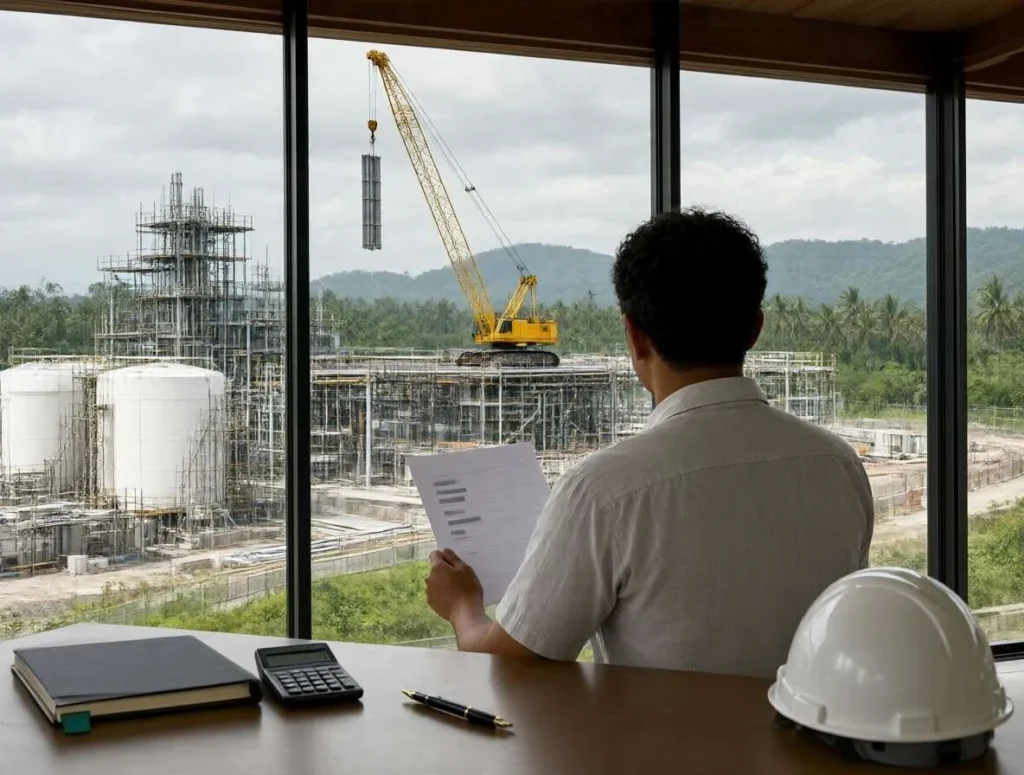
A green methanol plant is financed in four steps, in this order: equity of around 30 percent sitting in the special purpose vehicle, the project company, before the debt file opens (GIZ and NIRAS, 2024); senior debt, money lent to the project and repaid first from its cash flows, closing only against contracted revenue because buyers stop at two to three years while the construction loan is longer (European Investment Bank, May 2024); public risk cover for the first-of-a-kind tranche, the first unit of its kind; and revenue contracts, price floors or contracts for difference where a payment closes the gap between an agreed price and the market price, which the Global Biofuels Alliance names as the conditions for relaxing tighter equity and debt terms (January 2026). The green methanol industry page carries the same picture of where the money sits.
The order matters more than the amount. Each tranche is released because the one before it is already in place, and a pre-feasibility file lives or dies on that sequence. Below I take the same sequence apart, dating every figure to the publisher that released it.
In short
- Equity: Around 30 percent sits in the vehicle before any lender opens the file (GIZ and NIRAS, 2024).
- Senior debt: It closes against signed revenue, not against a forecast (European Investment Bank, May 2024).
- Revenue: The contract must outlive the loan and carry the cost gap.
- Public cover: Guarantees and concessional capital take the first-of-a-kind tranche (Global Biofuels Alliance, January 2026).
- Separation: Announced capacity is not sold volume (Methanol Institute, 2025).
In this article
Four steps, in order
I do not treat how to finance a methanol project as a hunt for one lender. It is a sequence: capital enters the vehicle, debt follows the revenue, public money absorbs what private money refuses to carry, and the revenue contract holds the rest up.
The frame around that sequence is set by how small the market still is. The Global Biofuels Alliance recorded in January 2026 that biofuels account for less than 2 percent of global fuel consumption at nearly 198 Mtpa, that demand should grow 2 to 2.5 times by 2035, and that cumulative investment needs to reach 420 to 500 billion USD in a base case and 630 to 740 billion USD in an accelerated case by 2035, a 4 to 7 times increase in annual capital flows against historical levels.
What this means for you: I size each step of my file against that capital requirement, because the market level says the money exists while my plant still has to earn its tranche one step at a time.
Why the revenue story comes first
The European Investment Bank recorded in May 2024, on the basis of a consultation of 34 companies selected from a longlist of more than 100, that promoters struggle to secure offtake volumes, meaning production committed to a buyer, at prices that reassure lenders the project can repay its financing. The same report records a maturity mismatch: buyers hesitate to commit beyond two to three years while the construction loan is considerably longer, because buyers are used to trading on standardised spot markets and expect production costs to fall with scale.
It also records that even with long-term agreements, some early-stage buyers such as airlines are not considered sufficiently creditworthy by lenders. Cost is why a short contract cannot simply be stretched: IRENA and the Methanol Institute recorded in 2021 that e-methanol, methanol made from renewable electricity and captured carbon dioxide, runs at 800 to 1600 USD a tonne against 100 to 250 USD a tonne for fossil methanol. The contract has to carry that gap.
Project finance is lending repaid from the cash flows of a single asset, and the e-methanol project finance page applies that definition to these same numbers.
What this means for you: I write the offtake terms before the debt terms, because the second document is only an answer to the first.
Step one and two: equity in the vehicle, then senior debt
GIZ and NIRAS recorded in 2024 that a pre-feasibility case recommends a relatively high equity share by the project partners, around 30 percent, available upfront in the special purpose vehicle, because that helps secure loan guarantees, financing and investment funds. The same study sets the final percentage at later stages against lenders’ requirements, financial models and covenants, and keeps the weighted average cost of capital at 11 percent in its reference scenario while the design phase is already looking for finance, partners and offtakers.
That equity is what makes senior debt, the ranking repaid first from project cash flows, closable at all. The Global Biofuels Alliance recorded in January 2026 that lenders and investors require higher equity buffers, the cushion of equity held above the debt, shorter debt tenors, meaning the length of the loan, and stronger downside protection unless policy-driven revenue risks are mitigated.
The project finance service page is where I assemble that file.
What this means for you: I treat the 30 percent as money that must already be visible in the vehicle before anyone reads the model, and I treat the 11 percent as the hurdle that model has to clear.
Step three: the contract that carries the debt
The Global Biofuels Alliance wrote in January 2026 that long-term offtake contracts with creditworthy counterparties fix volume, price and tenor and form the foundation of project bankability. The same report records that corporate offtakers increasingly provide equity linked to long-term purchase agreements, which anchors demand and improves bankability for projects that are heavy on capital spending.
The price that contract must fix is not a small one. BloombergNEF and the Climate Technology Coalition recorded on 18 June 2024 that low-carbon methanol production costs run 1.2 to 12 times those of fossil methanol depending on the feedstock, and that above 500 USD a tonne shipping companies may find it cheaper to pay the carbon price on their emissions rather than buy the green product, at least until 2030. The same report records that once producers have signed long-term offtakes or obtained investment from shipping buyers, they approach port infrastructure operators for storage capacity or co-investment in its extension.
The offtake agreements page is where that contract is drafted.
What this means for you: I do not open the debt file until the offtake fixes volume, price and a tenor that outlives the loan, because those three lines are what the lender actually underwrites.
Step four: public money where the private money stops
The European Investment Bank recorded in May 2024 that investors repeatedly raised concerns about weak returns caused by the persistent cost gap with conventional fuels and by high upfront capital spending, and that these concerns are strongest for first-of-a-kind industrial-scale deployments, with a perceived first-mover disadvantage, particularly for e-fuel pathways. It recommends de-risking selected first-of-a-kind large-scale projects and new risk mitigation instruments provided by public entities to bring private lenders in, and notes that its own financing products can be adapted to these projects.
The Global Biofuels Alliance recorded in January 2026 that emerging pathways including bio-methanol, methanol produced from biological feedstocks, face structural financing gaps tied to technology risk, limited operating history and immature infrastructure, so concessional capital, guarantees, meaning a third party’s promise to cover part of a loss, and risk-sharing platforms are needed to move from demonstration to bankable scale.
The development finance institutions page lists the providers of that cover.
What this means for you: I identify the public instrument before I approach the senior lender, because the first-of-a-kind tranche is exactly the piece private money prices out.
What a financed methanol file looks like today
Review Energy reported on 20 January 2026 that European Energy and Mitsui and Co. secured a green bridge financing facility for the solar park and e-methanol plant of their joint venture in Denmark. Bridge financing is money that covers the period until long-term funding is secured. Nordea and SMBC provide the facility with a partial guarantee from EIFO; both act as bookrunners and mandated lead arrangers, Nordea also as documentation, facility and security agent, while the joint venture progresses towards long-term project financing.
Construction started in 2023, the first e-methanol came in May 2025, and the inaugural batch was delivered on 13 May 2025 to the container vessel Laura Maersk, operated by its key buyer A P Moller – Maersk. The plant holds offtakes with LEGO Group and Novo Nordisk, among others, and is designed for up to 42,000 tonnes a year.
The pipeline behind such a file is not supply. The Methanol Institute recorded in 2025 that more than 200 projects carrying 45.8 million metric tons of potential capacity by 2030 had been announced by February 2025, that only 20 to 40 percent of them may move forward, and that 400,000 to 500,000 tons of renewable product were sold against 94 million metric tons of total supply in 2024.
The equivalent page on sustainable aviation fuel runs on the same four steps.
What this means for you: I read my own file against this one and ask which line is still missing: the bridge, the guarantee, the offtake or the long-term close.
What I would ask before opening the file
I put five questions in writing before I open a financing file, and I want each one answered in a sentence with a number and a date behind it.
First, is the equity of around 30 percent already sitting in the vehicle, as GIZ and NIRAS recommended in 2024?
Second, does the offtake reach beyond the loan, given that the European Investment Bank recorded in May 2024 that buyers stop at two to three years while the construction loan is considerably longer?
Third, is the offtaker creditworthy enough for the lender, since the same report records that early-stage buyers such as airlines are not considered sufficiently so?
Fourth, which public instrument covers the first-of-a-kind tranche, given that the Global Biofuels Alliance lists guarantees, price floors and contracts for difference as the conditions for relaxing equity buffers in January 2026?
Fifth, is announced capacity kept apart from sold volume: the Methanol Institute recorded 400,000 to 500,000 tons of renewable product sold against 94 million metric tons of total supply in 2024?
What this means for you: I treat an unanswered question as a missing tranche, and I would rather find it in my own office than in a lender’s credit committee.
How I would structure it if it were my own file
I keep four dated rows in the model, and every row carries its publisher and its date.
The equity row carries the around 30 percent upfront and the 11 percent weighted average cost of capital recorded by GIZ and NIRAS in 2024. The debt row carries the two to three years buyer horizon against a construction loan the European Investment Bank described in May 2024 as considerably longer. The revenue row carries the 1.2 to 12 times cost multiple and the 500 USD a tonne threshold of BloombergNEF on 18 June 2024. The public row carries the first-of-a-kind framing of the European Investment Bank in May 2024 and the 420 to 500 billion USD of cumulative investment by 2035 recorded by the Global Biofuels Alliance in January 2026.
Nothing enters a row without a date. When a figure cannot be tied to a publisher and a month or year, I treat it as a claim rather than a fact and keep it out of the lender’s pack.
What this means for you: I hand over a file where any line can be traced back to a source, because that is what lets a credit team move quickly instead of arguing about provenance.
Sources
- GIZ and NIRAS, 2024.
- European Investment Bank, May 2024.
- Global Biofuels Alliance, January 2026.
- Review Energy, 20 January 2026.
- BloombergNEF, 18 June 2024.
- Methanol Institute, 2025 Milestones, 2025.
- IRENA and Methanol Institute, 2021.
Frequently asked questions
Where does the money for a green methanol plant come from?
It comes from a stack rather than a single source: equity in the special purpose vehicle first, then senior debt, then public risk cover and concessional capital, and finally contracted revenue that services the debt. The Global Biofuels Alliance recorded in January 2026 that guarantees and risk-sharing platforms are what move emerging pathways from demonstration to bankable scale, which is the layered approach in practice (Global Biofuels Alliance, January 2026; GIZ and NIRAS, 2024).
How much equity does a methanol project need?
Around 30 percent sitting upfront in the vehicle is the published recommendation. GIZ and NIRAS wrote in 2024 that a relatively high equity share, around 30 percent, helps secure loan guarantees, financing and investment funds, with the final figure set at later stages against lenders’ requirements, financial models and covenants (GIZ and NIRAS, 2024).
Why is the offtake contract the centre of the file?
Because it is the repayment source. The Global Biofuels Alliance recorded in January 2026 that long-term contracts with creditworthy counterparties fix volume, price and tenor and form the foundation of bankability, while the European Investment Bank recorded in May 2024 that buyers hesitate beyond two to three years, which is shorter than the construction loan (Global Biofuels Alliance, January 2026; European Investment Bank, May 2024).
Is there public money for first methanol projects?
Yes, and it is expected to carry the heaviest part. The European Investment Bank recommended in May 2024 that selected first-of-a-kind large-scale projects be de-risked with new public risk mitigation instruments so private lenders can enter, and the Global Biofuels Alliance listed concessional capital, guarantees and risk-sharing platforms in January 2026 (European Investment Bank, May 2024; Global Biofuels Alliance, January 2026).
Not sure your project would survive a credit conversation?
A short call is usually enough to see where your project stands.
If you are at pre-FID structuration and want the file assembled in this order, the investor introductions service is where I open the conversation with the counterparties your model assumes.
I do not provide investment advice or arrange investments. I act as a strategic advisor and facilitator.

Alex, Founder of WeConnect Asia
I help low-carbon fuel and carbon removal project developers in Southeast Asia secure the commercial and financial partners needed to reach FID.
Related articles

Pitching a Climate Tech Company to Strategic Investors: What the Corporate Has to Believe Before It Writes a Cheque
How to pitch a climate tech company to strategic investors: the metric cluster, the readiness evidence and the ask that corporates fund.

Biomethane: What It Is, How It Is Made and Who Buys It
Biomethane is biogas cleaned to pipeline quality. I explain how it is made, how it differs from biogas and who buys it in Southeast Asia.

CO2 Sourcing for e-SAF Projects: What the Rules Allow and What the Contract Must Say
Biogenic CO2, direct air capture or industrial flue gas: which sources an e-SAF plant may use, what they cost and which contract terms make the fuel certifiable.

Operating Performance Guarantees for SAF Plants: What Lenders Ask For
Minimum guarantees, performance damages, retesting and who stands behind them: the operating guarantees a SAF plant needs to keep debt and offtake intact.

EPC and Construction Risk in SAF Plants: What a Lender Actually Tests
FEED scope, convertible EPC, performance guarantees and damages caps: the construction risk questions a SAF project must answer before financial close.

Matching Feedstock and Offtake Risk Back-to-Back in a SAF Project: How Lenders Read the Chain
Lenders do not buy a feedstock plan and an offtake plan separately. They buy the link between the two, and the link is where most SAF files break.