
Home » EPC and Construction Risk in Hydrogen Plants: Who Carries What Before FID
EPC and Construction Risk in Hydrogen Plants: Who Carries What Before FID
10 min read · Nov 2, 2025 · By Alex
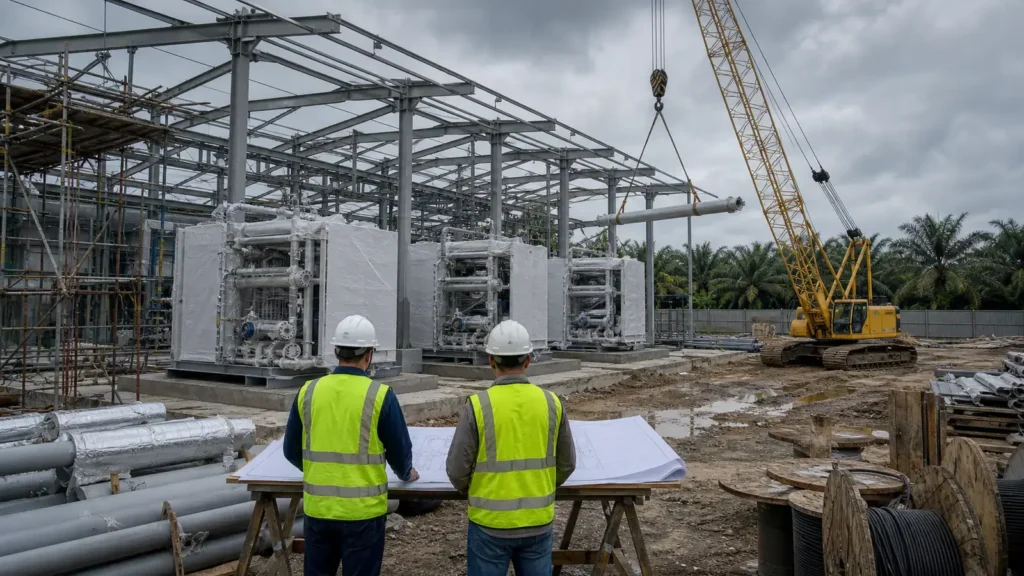
In 2024, engineering, procurement, construction and contingency costs accounted for more than half of the total cost of installing an electrolyser, the unit that turns water and electricity into hydrogen, so the EPC contract, not the equipment order, decides who carries the project. The cost of making and installing an electrolyser outside China was USD 2 000 to USD 2 600 per kilowatt in 2024. In addition, the limited experience of EPC firms in large-scale clean hydrogen projects makes them reluctant to provide comprehensive construction guarantees, which leads to higher costs. Those three facts are the hydrogen EPC risk I read first, and I place them in the hydrogen, power-to-liquid and e-fuels hub.
I take them in order: what the contract is meant to do. What sits inside the price, where the schedule goes, and who guarantees what. Then I set out what the supplier signs up to, how maturity changes the package, the five checks I run. In addition, the construction risk section I would write in a credit paper.
In short
- Price: in 2024 more than half of the installed cost of an electrolyser was engineering, procurement, construction and contingency.
- Schedule: a 2024 installation record puts projects above 10 MW at five or more years from design to commissioning.
- Guarantees: comprehensive construction guarantees are hard to obtain. Also, in addition, a performance guarantee scored only 2.2 against technology performance risk in a 2024 survey.Maturity: in 2025 only 9 percent of the pipeline to 2030 had reached final investment decision.Checks: I test the price basis, the guarantee carve-outs, the delay damages, the deductibles and the schedule assumption.rantee scored only 2.2 against technology performance risk in a 2024 survey.
- Maturity: in 2025 only 9 percent of the pipeline to 2030 had reached final investment decision.
- Checks: I test the price basis, the guarantee carve-outs, the delay damages, the deductibles and the schedule assumption.
In this article
What an EPC contract is supposed to do
An EPC contract is a single contract under which one contractor takes responsibility for the design, engineering, procurement, construction and testing of the plant as a single point of responsibility to the owner. The contractor normally wraps the risk, meaning it accepts the whole exposure, and if anything goes wrong it is liable to the owner; it then normally back-to-backs that risk to its subcontractors, meaning the same obligations flow down to them. Also, the contractor rarely performs all of the actual work itself, because most of it is subcontracted to other firms.
A&O Shearman’s 2023 question and answer on net-zero projects explains that a key facet of an EPC contract is the wrap, with the contractor as the single point of contact to the principal, and that on new or unproven technologies the parties face unknown risks. Therefore, a detailed consideration is needed as to whether the contractor is in a position to wrap the design and performance risk.
What this means for you: on a hydrogen plant I read the wrap clause before the price. That is because a single point of liability is only as strong as the flow-down behind it.
What is inside the price
In 2024 more than half of the total cost of installing an electrolyser corresponded to engineering, procurement, construction. In addition, contingency costs, which depend on the project location. The cost of making and installing a unit outside China was USD 2 000 to USD 2 600 per kilowatt in 2024, against USD 600 to USD 1 200 per kW for units manufactured and installed in China; with transport costs. In addition, tariffs considered, a Chinese unit installed outside China still cost USD 1 500 to USD 2 400 per kW.
A 2024 installation estimate puts the total installed capital cost of a water electrolyzer at about 2 times the capital cost of the equipment: about 15 percent is the stacks, about 35 percent the other equipment, and about 50 percent engineering and construction, a level that continued technology development could bring to about 1.4 times the equipment cost. Front-end engineering design, the early stage that fixes scope before detailed engineering, and balance of plant. The equipment around the stack, sit in those lines. In addition, I carry them into the contracting and risk side of the file.
What this means for you. I ask for the installed cost split in writing, since a competitive equipment quotation can hide an unpriced construction scope.
Where the schedule goes
According to the US Department of Energy’s installation summary published in 2024. Water electrolyzer projects take several years to execute, from project design through commissioning. Projects below 10 MW can take up to three years, while projects above 10 MW can take five or more years.
The same 2024 summary records long lead-times for equipment, not only for electrolyzer stacks but also for pumps, valves and power electronic equipment, and notes that delays in receiving equipment can cause delays in the overall project schedule. Obtaining permits from local authorities can cause significant delays. Therefore, early engagement with authorities and community members is the cheaper path. At the 2023 workshop behind that summary, about 25 percent of participants had some experience installing an electrolyzer and about 25 percent planned to be involved in the future; over 450 people attended. The schedule assumption sits inside my financing plan for the project.
What this means for you. I test the schedule against published installation durations, because a commissioning date that ignores equipment lead-times. In addition, permitting is not a schedule I can rely on.
Who will guarantee what
A fixed-price turnkey EPC contract with a reputable company mitigates the risks of cost and time overruns; in the absence of such a contract. Contractors-all-risks insurance, cover for loss during the works. In addition, delay-in-start-up insurance, cover for losses after a delayed start, may mitigate risks related to design, construction and completion. That is the position recorded in the 2024 OECD and World Bank report on de-risking instruments.
Accurate estimation of construction costs. In addition, equipment at an early stage is hard, because experience of EPC firms in large-scale clean hydrogen projects is limited and established track records are missing. Contractors are consequently reluctant to provide comprehensive construction guarantees, which leads to higher costs. In the 2024 survey 41 respondents took part, and the performance guarantee, a promise that the plant delivers an agreed output, obtained a grade of only 2.2 against technology performance risk.
Delay liquidated damages, a pre-agreed sum for each period of delay, should match the seller’s anticipated liabilities under the sales agreements, a line I test against my project finance work in Southeast Asia.
What this means for you: I do not treat insurance as a substitute for a guarantee. In addition, I read every construction guarantee for technology carve-outs.
What the equipment supplier signs up to
IRENA’s 2020 cost reduction study puts power supply at 20 percent to 30 percent of total electrolyser cost, often a custom design from EPC contractors for small plants, and the stack at about 45 percent of total cost at lower manufacture rates, falling to 30 percent at higher rates.
That 2020 study records that raising the plant from 1 MW, described as typical at the time, to 20 MW could cut costs by over a third. It also identifies strategies to cut investment costs by 40 percent in the short term and up to 80 percent in the long term, and reports that as of November 2020 there were no real projects above 100 MW in water electrolysis.
Beyond the numbers, units installed outside China face efficiency. In addition, underperformance issues, need adaptation to local standards, and carry uncertainties over maintenance and repairs over the plant lifetime. An availability guarantee, cover for downtime of the electrolysers or the entire plant, answers part of that exposure.
What this means for you: I price the scale assumption and the guarantee together, inside the plant economics I model. That is because a commitment without real-condition performance data is a target rather than a warranty.
What maturity does to the contract
The record in the IEA’s Global Hydrogen Review 2025 shows that more than 200 low-emissions hydrogen production projects have received a final investment decision since 2020, and that projects with a final investment decision now represent 9 percent of the total project pipeline to 2030. By 2030, production from operational or decided projects should reach 4.2 Mtpa.
Bankability, the point at which lenders are willing to commit debt, remains the constraint: early-stage technologies struggle with project bankability because of their lack of a proven performance record. Export credit agencies and public finance institutions can expand guarantee programmes for first-of-a-kind projects, meaning the first deployment of a technology at that scale.
Maturity also sits in the permits. The contract must assess who bears responsibility for changes to requirements. That is because a perfectly built plant is only relevant if it can be connected to the grid by the appropriate regulator. I place that test inside the maturity assessment I run.
What this means for you. I do not read a final investment decision as a plant under construction, and I check what public guarantee stands behind a first-of-a-kind scope.
What I would test before I accept the EPC package
These are the five questions I put to a hydrogen EPC package before I accept it, and the same five answers tell me where the risk actually sits. I ask them in the same order every time:
- Price basis: is the price fixed-price turnkey. With the contractor carrying cost and time overruns, or a cost-plus arrangement that passes them back to the sponsor?
- Guarantee scope: are the construction guarantees comprehensive, or carved out for technology risk and left with the equipment?
- Delay damages: do delay liquidated damages match the liabilities expected under the offtake contract?
- Deductibles: do the performance guarantee and the availability guarantee carry a deductible the sponsor can absorb before the insurer pays?
- Schedule: does the schedule assumption match the installation durations published in 2024, up to three years below 10 MW and five or more years above 10 MW?
What this means for you: I write these five answers into the credit paper, because the EPC package either closes them or leaves them for the debt to find.
How I would write the construction risk section in a credit paper
In a credit paper I keep the construction risk section to four dated rows, each one carrying its own date. Therefore, a reader can challenge one fact without reopening the analysis:
- Installation cost, 2025: the 2025 record shows more than half of the total cost of installing an electrolyser is engineering, procurement, construction and contingency. Therefore, the contract carries it rather than the equipment order.
- Schedule, 2024: in 2024 projects above 10 MW were recorded as taking five or more years from project design through commissioning, with long lead-times for pumps, valves and power electronic equipment.
- Guarantees, 2024: a 2024 survey graded a performance guarantee at only 2.2 against technology performance risk, and recorded reluctance among contractors to provide comprehensive construction guarantees.
- Wrap, 2023: under a 2023 review the contractor wraps the risk as the single point of responsibility and back-to-backs it to its subcontractors.
What this means for you: with those four rows in place. The reader can see what is priced, what is guaranteed. In addition, what stays with the sponsor.
Sources
- IEA, Global Hydrogen Review 2025, Executive summary, 2025.
- OECD and The World Bank, Leveraging De-Risking Instruments and International Co-ordination to Catalyse Investment in Clean Hydrogen, 2024.
- IRENA, Green Hydrogen Cost Reduction: Scaling up Electrolysers to Meet the 1.5C Climate Goal, 2020.
- US Department of Energy, Water Electrolyzer Installations Summary Report, 2024.
- A&O Shearman, Q&A: Managing risk in cutting-edge Net Zero projects, 2023.
Frequently asked questions
What is an EPC contract in a hydrogen project?
An EPC contract is a single contract under which one contractor takes responsibility for the design, engineering, procurement, construction and testing of the plant as a single point of responsibility to the owner. The contractor normally wraps the risk, so if anything goes wrong it is liable to the owner, and it then back-to-backs that risk to its subcontractors, passing the same obligations down the chain. The contractor rarely performs all of the actual work itself, because most of it is subcontracted to other firms.
How much of an electrolyser project is engineering and construction?
In the 2024 estimate, engineering, procurement, construction and contingency account for more than half of the total installed cost of an electrolyser. The 2024 estimate puts about 50 percent of the installed cost of a water electrolyzer at engineering and construction, about 35 percent at other equipment and about 15 percent at stacks, with total installed capital cost at about 2 times the capital cost of the equipment and about 1.4 times considered achievable as the technology develops.
Why are contractors reluctant to guarantee hydrogen plants?
Because experience in large-scale clean hydrogen projects is limited and established track records are missing, comprehensive construction guarantees are costly to give, so contractors provide fewer of them. Suppliers of critical equipment have yet to deliver the required quantities, which leaves supply contract terms, warranties and guarantees underdeveloped, and electrolyser manufacturers do not necessarily have a strong enough track record to give certainty on performance in real conditions.
What insurance covers construction risk in a hydrogen project?
Contractors-all-risks insurance covers design, construction and completion, and delay-in-start-up insurance covers the period after a delayed start, and both are used where there is no fixed-price turnkey contract. In the operation phase a performance guarantee and an availability guarantee cover output shortfalls and plant downtime, and the sponsor absorbs the deductible before the insurer starts to pay. Neither layer replaces a construction guarantee.
Not sure your project would survive a credit conversation?
A short call is usually enough to see where your project stands.
If you are structuring the EPC package before a final investment decision. I can review the price basis, the guarantees, the insurance layers. In addition, the schedule assumption with you, and I run that work as part of my contracting and risk management work.
I do not provide investment advice or arrange investments. I act as a strategic advisor and facilitator.

Alex, Founder of WeConnect Asia
I help low-carbon fuel and carbon removal project developers in Southeast Asia secure the commercial. In addition, financial partners needed to reach FID.
Related articles

Pitching a Climate Tech Company to Strategic Investors: What the Corporate Has to Believe Before It Writes a Cheque
How to pitch a climate tech company to strategic investors: the metric cluster, the readiness evidence and the ask that corporates fund.

Biomethane: What It Is, How It Is Made and Who Buys It
Biomethane is biogas cleaned to pipeline quality. I explain how it is made, how it differs from biogas and who buys it in Southeast Asia.

CO2 Sourcing for e-SAF Projects: What the Rules Allow and What the Contract Must Say
Biogenic CO2, direct air capture or industrial flue gas: which sources an e-SAF plant may use, what they cost and which contract terms make the fuel certifiable.

Operating Performance Guarantees for SAF Plants: What Lenders Ask For
Minimum guarantees, performance damages, retesting and who stands behind them: the operating guarantees a SAF plant needs to keep debt and offtake intact.

EPC and Construction Risk in SAF Plants: What a Lender Actually Tests
FEED scope, convertible EPC, performance guarantees and damages caps: the construction risk questions a SAF project must answer before financial close.

Matching Feedstock and Offtake Risk Back-to-Back in a SAF Project: How Lenders Read the Chain
Lenders do not buy a feedstock plan and an offtake plan separately. They buy the link between the two, and the link is where most SAF files break.