
Home » Hydrogen Market Players: Producers, Traders and Buyers You Will Meet
Hydrogen Market Players: Producers, Traders and Buyers You Will Meet
10 min read · Sep 16, 2025 · By Alex
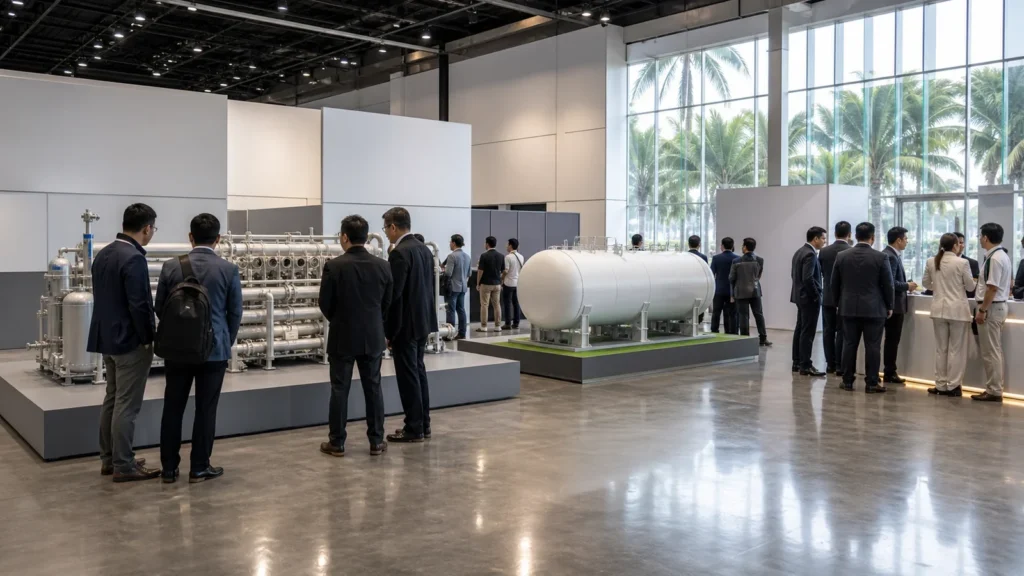
Every commercial conversation about green hydrogen ends with the same four groups of people: the ones who make the molecule, the ones who take it under contract, the ones who move it and finance it, and the ones who certify it. You meet them in that order because each one signs a different document, and none of them substitutes for the next. The hydrogen market players are therefore not a single crowd to be invited into one room. The maker signs a delivery schedule, the buyer signs a volume, the mover signs a route, and the certifier signs a record. What I judge in a first meeting is the paper each of them will put in front of me, and the order in which those papers become real.
I order the field in five moves: where committed capacity sits, who buys and in which form, what the contract layer looks like, who moves and stores the molecule, and who keeps the certificates. Each move answers a different question, and each question belongs to a different meeting.
In short
- Producers: I check whether their capacity is committed or only announced, because the two are never the same number (2024).
- Buyers: The form they sign for decides which contract I prepare (2026).
- Contract layer: Firm offtake volume stays thin against announced production, so I read contracts before capacity (2025).
- Logistics: Pipelines, ammonia conversion and storage each cost differently per kilogram, so distance picks the route (2019).
- Certificates: One party maintains the standard, but no existing system yet fits cross-border trade (2023).
In this article
What the hydrogen market is made of
The market is a chain of signatures rather than a crowd of contacts. A producer is the party that makes the molecule. A developer is the party that carries a project from site to the final investment decision, the point at which the board commits the money. An offtaker is the party that agrees to take a defined volume, and the instrument it signs is a firm offtake agreement, a contract that obliges delivery on stated terms instead of expressing an intention to buy. A trading house is an intermediary that routes volumes it does not hold demand for. Committed investment is money already decided on, not announced. A guarantee of origin records how a given molecule was made.
What this means for you: the same conversation produces a different document with each of them. With the offtaker I ask for volume and term, with the producer for a schedule, with the trading house for a route, with the certificate issuer for a tracking record, and with the lender for committed investment. I never let one answer stand in for another.
The producers and where capacity sits
Capacity does not sit where announcements are loudest. The Asia Pacific region leads low-carbon hydrogen development and holds most of the committed production capacity, which reached 4.2 million tonnes per year in 2024, with state-owned enterprises playing a major role in execution (2024), as the APERC Hydrogen Report 2024 records. China hosts the largest share of renewable energy based hydrogen projects in the region, with a committed capacity of 1.8 million tonnes per year as of 2024 (2024). Roadmaps read differently: the Malaysia roadmap reports production volumes of 2 million tonnes in 2030, 8 million in 2040 and 16 million in 2050 (2023). Before I call anyone I place the project on the map of developers active in Southeast Asia.
What this means for you: I ask which of those two numbers a producer holds, a committed capacity or a roadmap target. Only the first tells me a plant has cleared a hurdle, and only the first belongs in a commercial round.
The buyers and what they buy
Buyers take molecules in a few forms, and the form decides who I call. Long-term bilateral contracts dominate, particularly for ammonia and ammonia-derived fertilisers, while hot briquetted iron, iron ore reduced with hydrogen, gains prominence (2026), a pattern the Global Hydrogen Review 2026 sets out. Around 170 ammonia and 130 methanol port terminals are in operation, and construction has started in Japan on the first commercial-scale terminal for liquefied hydrogen imports (2026). That is why I track the green ammonia market across Southeast Asia. Trade would underpin more than 40 percent of announced volumes by 2030 if all projects materialise, yet less than 8 percent of it, around 1 Mtpa in hydrogen equivalent, comes from projects that are operational, in construction or have committed investments (2026).
What this means for you: I ask a buyer which form it will sign for, because ammonia carries a long-term contract while liquefied hydrogen waits for a terminal that is only now under construction. The form tells me the contract.
The contract layer
The contract layer is thinner than the project pipeline. Cumulative firm offtake agreements account for less than 2 Mtpa, merely 5 percent of the potential production announced projects could achieve by 2030, and uncertain demand remains a critical challenge because producers need reliable off-takers to justify large-scale investments (2025), according to the Global Hydrogen Review 2025. Capital follows the same shape: only 9 percent of announced projects worldwide have secured committed investments, against 0.5 percent in emerging economies, with 80 percent of those projects export-oriented and capital costs reaching 15 percent, three times the level of advanced economies (2025). On the demand side, Japan offers long-term certainty through 15-year contracts (2025). The route from first contact to signature is set out in the steps I take to secure an offtake agreement.
What this means for you: I read the contract file before the capacity file. Three lines decide whether a round is real: the volume actually contracted, the share of the project with committed investment, and the tenor the buyer will sign.
The people who move and store it
Distance decides the carrier, and the carrier decides my meeting list. Moving hydrogen as a gas by pipeline costs around 1 USD per kg of H2 for about 1 500 km, converting it to ammonia costs around 1 USD per kg of H2, and transmitting ammonia over that distance is around 1.5 USD per kg of H2 (2019), as The Future of Hydrogen estimates. Storage splits the same way: salt caverns typically cost less than 0.6 USD per kg of H2 and are likely to be the lowest-cost storage option, while tanks for small and short storage reach discharge efficiencies of around 99 percent (2019). Distribution today usually relies on trucks carrying hydrogen as a gas or a liquid, and that is likely to remain the main mechanism over the next decade (2019).
What this means for you: I ask each logistics player for a cost per kilogram over a stated distance rather than a general claim of competitiveness. A pipeline operator, an ammonia converter and a storage developer answer three different questions, and only one of them matches my route.
The people who keep the certificates
A certificate is only as good as the system behind it. The certification scheme holder develops, updates and maintains the standard, while governance, enforcement, and verification and tracking remain separate parts of the system (2023), a structure set out in Creating a global hydrogen market. The same assessment reviewed eight voluntary schemes and five mandatory schemes and found that none of the existing hydrogen certification systems is suitable for cross-border trade, with gaps in standards, ecolabelling and certification design (2023). Certificates carry compliance with standards and sustainability data such as carbon footprint and renewable energy content (2023). For a buyer booking molecule attributes at distance, I explain the book and claim mechanism first.
What this means for you: I ask who issued the certificate, under which scheme, and what data it carries. If the scheme cannot be compared across a border, the buyer’s claim cannot travel either, and I say so before the commercial round starts.
Who I put in the room first
I do not open with the producer, however strong its announced capacity looks. I start with the offtaker that can carry a credible volume, because demand is what everything else follows. Second comes the producer who can deliver it, then the carrier and the certificate issuer who make the delivery legible, then the lender. I ask each for one item: a draft volume and term, a delivery schedule, a route with a tracking record, and committed investment. The filter is strict: only 9 percent of announced projects worldwide have secured committed investments, against 0.5 percent in emerging economies (2025). The wider sequence sits inside how I structure strategic partnerships.
What this means for you: the order is not a preference, it is a test of commitment. If the offtaker cannot produce a volume, no producer meeting is worth booking, and if no lender sits behind committed investment, the round ends where it started.
The five lines I write for a first meeting
I write five lines before a first meeting and check each against a document rather than a conversation:
- Which document each player signs, and who holds the original.
- Which volume is contracted rather than announced (2025).
- Which form the molecule takes when it moves (2026).
- What the movement costs per kilogram over a stated distance (2019).
- Who issues the certificate the buyer books (2023).
What this means for you: those five lines are the whole preparation, and the meeting order follows from whichever line is still empty. If I cannot fill a line from a document, I do not book the meeting.
Sources
- Asia Pacific Energy Research Centre, APERC Hydrogen Report 2024 https://aperc.or.jp/file/2025/3/18/APERC_Hydrogen_Report_2024_final.pdf, 2025.
- IEA, Global Hydrogen Review 2026, Trade and infrastructure https://www.iea.org/reports/global-hydrogen-review-2026/trade-and-infrastructure, 2026.
- IEA, Global Hydrogen Review 2025, Five key questions about hydrogen https://www.iea.org/reports/global-hydrogen-review-2025/five-key-questions-about-hydrogen, 2025.
- IEA, The Future of Hydrogen https://iea.blob.core.windows.net/assets/9e3a3493-b9a6-4b7d-b499-7ca48e357561/The_Future_of_Hydrogen.pdf, 2019.
- IRENA and RMI, Creating a global hydrogen market: Certification to enable trade https://www.irena.org/-/media/Files/IRENA/Agency/Publication/2023/Jan/IRENA_Creating_a_global_hydrogen_market_2023.pdf, 2023.
Frequently asked questions
Who are the main players in the hydrogen market?
The producers who make the molecule, the offtakers who buy it under contract, the trading houses and carriers that move it, the certificate issuers and verifiers that document it, and the lenders that fund it (2026). The developer, the party that carries a project to the final investment decision, is the side most readers sit on. Each group signs a different paper, so I never let one meeting substitute for another.
What is the difference between a buyer and a trader?
A buyer takes the volume under a contract and carries the demand risk, while a trading house intermediates volumes and routes; in practice long-term bilateral contracts dominate, particularly for ammonia and ammonia-derived fertilisers (2026). A trading house can move a parcel, but it is not a buyer of last resort and I never present it as one.
Which player should a developer approach first?
Start with the offtaker that can carry a credible volume, because cumulative firm offtake agreements stand at less than 2 Mtpa, merely 5 percent of the potential production announced projects could achieve by 2030 (2025). Only then do I bring in the producer, the carrier, the certificate issuer and the lender.
Why do so few announced projects find committed investment?
Because demand and capital are both thin: only 9 percent of announced projects worldwide have secured committed investments against 0.5 percent in emerging economies, and 80 percent of those projects are export-oriented (2025). Capital costs there can reach 15 percent, three times the level of advanced economies (2025), so a signed offtake matters more than a larger announced capacity.
Not sure your project would survive a credit conversation?
A short call is usually enough to see where your project stands.
If you are preparing a first commercial round and want the meeting order, the document list and the wording checked before you dial, I provide strategic partnership support built around this sequence of producers, buyers, carriers, certificate issuers and lenders.
I do not provide investment advice or arrange investments. I act as a strategic advisor and facilitator.

Alex, Founder of WeConnect Asia
I help low-carbon fuel and carbon removal project developers in Southeast Asia secure the commercial and financial partners needed to reach FID.
Related articles

Pitching a Climate Tech Company to Strategic Investors: What the Corporate Has to Believe Before It Writes a Cheque
How to pitch a climate tech company to strategic investors: the metric cluster, the readiness evidence and the ask that corporates fund.

Biomethane: What It Is, How It Is Made and Who Buys It
Biomethane is biogas cleaned to pipeline quality. I explain how it is made, how it differs from biogas and who buys it in Southeast Asia.

CO2 Sourcing for e-SAF Projects: What the Rules Allow and What the Contract Must Say
Biogenic CO2, direct air capture or industrial flue gas: which sources an e-SAF plant may use, what they cost and which contract terms make the fuel certifiable.

Operating Performance Guarantees for SAF Plants: What Lenders Ask For
Minimum guarantees, performance damages, retesting and who stands behind them: the operating guarantees a SAF plant needs to keep debt and offtake intact.

EPC and Construction Risk in SAF Plants: What a Lender Actually Tests
FEED scope, convertible EPC, performance guarantees and damages caps: the construction risk questions a SAF project must answer before financial close.

Matching Feedstock and Offtake Risk Back-to-Back in a SAF Project: How Lenders Read the Chain
Lenders do not buy a feedstock plan and an offtake plan separately. They buy the link between the two, and the link is where most SAF files break.