
Home » Marine Fuel Offtake Structures: Three Contract Layers a Lender Will Read
Marine Fuel Offtake Structures: Three Contract Layers a Lender Will Read
10 min read · Nov 2, 2026 · By Alex
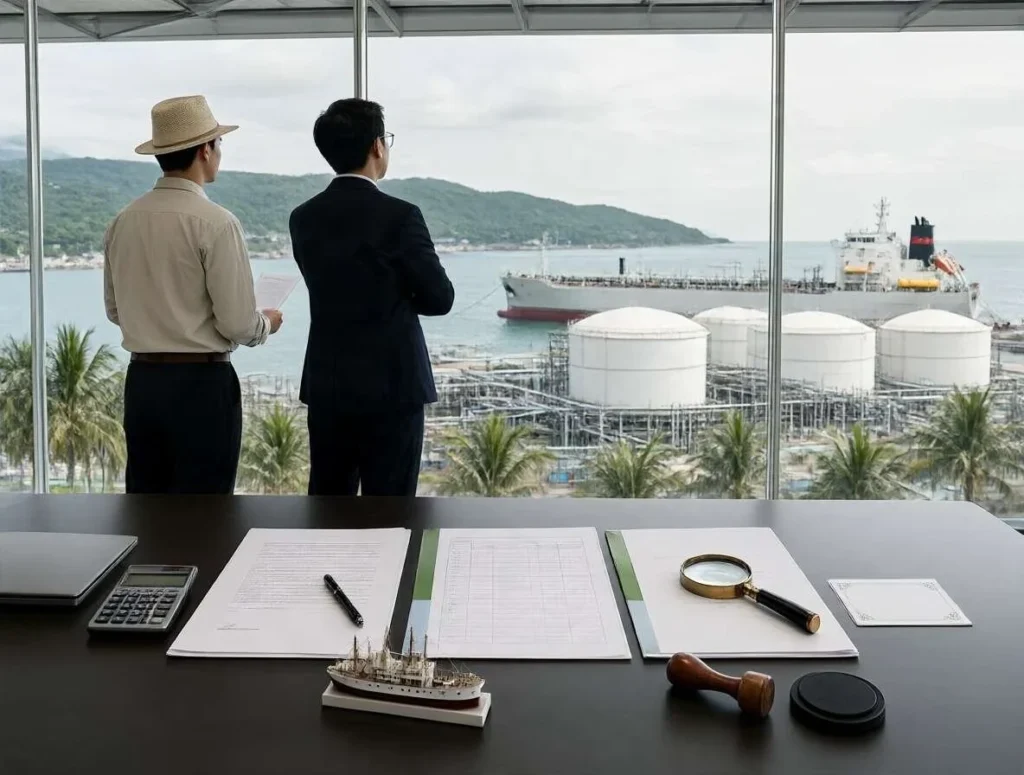
A lender reading a marine fuel file wants to know early whether three layers hold. The first is a long-term commitment to take the fuel. The second is a bunker supply contract, the deal under which a seller delivers fuel to a ship. The third is a certification trail that travels with each parcel. State of Green recorded on 26 June 2025 that without binding offtake agreements, production investment slips. Also, fuel availability can fall short of vessel deployment. Also, BIMCO’s Bunker Terms 2018 carry a methanol annex adopted on 10 October 2025. It updates definitions, sustainability certification requirements and closed or remote sounding during bunkering. In addition, the Maritime and Port Authority of Singapore assessed supply chain reliability, operational readiness, safety systems and sustainability certification. It did so when it awarded three licences on 24 November 2025.
Those three layers are the skeleton of the marine fuel offtake agreement I am asked to read. Also, I judge each one against what the marine fuel market has published.
What the three layers of a marine fuel offtake agreement cover
I describe structure here, not law: I do not price a contract, I do not give legal advice. Also, I do not rank a provider. The order below is the order I would hand a draft to a lender in. Every figure carries the date of the publication that printed it.
In short
- Offtake term: Volume, term, counterparty and a delivery start; State of Green, 26 June 2025.
- Supply terms: BIMCO Bunker Terms 2018 with the methanol annex adopted on 10 October 2025.
- Certification trail: Four tests read by the Maritime and Port Authority of Singapore on 24 November 2025.
- Delivery record: 59 methanol-fuelled ships in 2025 and 38 in the first half of 2026, Maritime Propulsion, 3 November 2026.
- Cost reference: Low-carbon methanol can cost 1.2 to 12 times fossil methanol, BloombergNEF, 18 June 2024.
In this article
Three layers, one file
The lender reads the term first, then the delivery mechanism, then the certification that travels with the parcel. That order is not mine alone: it follows where the money moves. BloombergNEF described on 18 June 2024 the sequence that follows a signature. Once fuel producers secure long-term offtakes or investment from shipping buyers, they approach port infrastructure operators. They seek storage space or even co-invest in the expansion. The same record noted that methanol needs new terminals and new bunkering ports. Meanwhile, the methanol annex BIMCO adopted on 10 October 2025 sits in the middle of that sequence. It turns a term into a measurable delivery. A file that opens with a certificate and buries the volume commitment underneath tells me the seller never secured the volume.
What this means for you: the marine fuel market rewards a file that reads in that order. I file the signed term first, the supply contract second, and the certificates that travel with each parcel third.
The offtake layer
Specifically, an offtake agreement is a contract under which a buyer commits to take an agreed volume of fuel. The commitment runs over a defined term. State of Green recorded on 26 June 2025 that without binding offtake agreements production investments are delayed. Also, fuel availability can fall short of vessel deployment. Also, green methanol costs two to three times more than conventional bunker fuel. It is not available in sufficient volumes, which is why the term matters more than a headline price. The same source records A.P. Moller – Maersk’s November 2023 agreement with Goldwind for 500,000 tonnes a year from 2026. This covers covere the first 12 large methanol-enabled container vessels, and its October 2024 agreement with LONGi.
Meanwhile, in that same record, those two agreements cover more than 50 % of the methanol that fleet needs in 2027. They also carry up to 600,000 tonnes a year from 2026. The lifecycle emissions cut is at least 65 %.
What this means for you: The offtake structure is where a lender starts, so I put volume, term, counterparty and a delivery start on the first page and I leave the price discussion for the second.
The bunker supply layer
A bunker supply contract is the contract under which a seller sells and delivers marine fuel to a ship. BIMCO’s Bunker Terms 2018 are the standard form for it. On 10 October 2025 BIMCO’s Documentary Committee adopted a methanol annex to those terms. This carries carrye updated definitions, sustainability certification requirements and options to set limits on GHG intensity and emissions calculations. GHG intensity here means the greenhouse gas emissions of a fuel measured across its life cycle against a unit of energy. Moreover, the annex also requires closed or remote sounding procedures during methanol bunkering because of the fuel’s toxic nature. It follows the LNG annex of 2023. An ammonia annex and a biofuels clause for time charter parties remain under work. Nicholas Fell, chairperson of the Documentary Committee, said the committee developed the annex with industry stakeholders and technical input, and it reflects current market practices.
What this means for you: The supply terms I attach to a term sheet are the ones a lender already recognises, so I do not draft a private form when this one exists.
The risk allocation layer
Singapore’s licence evaluation is the clearest published template I know for how this layer allocates risk. It covers supply chain reliability, operational readiness, safety systems and the sustainability certification of the methanol. The assessment ran on 24 November 2025, before three licences went to 13 applicants. Those licences run from 1 January 2026 to 31 December 2030. The three licensees are Global Energy Trading, Golden Island and PetroChina International (Singapore). Each of those four tests names a party. Also, a contract that leaves any of them unnamed hands the risk straight back to the lender. The delivery side of the same layer is measurable. Maritime Propulsion reported on 3 November 2026 that yards delivered 59 methanol-fuelled ships in 2025. The first half of 2026 added 38 more. In October 2026 a methanol dual-fuel vessel took on about 5,000 tonnes of certified bioethanol in Singapore.
What this means for you: The risk allocation has to name who carries each of those four tests, because an allocation with no named party is a description of the risk rather than a transfer of it.
What the lender keeps
The lender keeps three dated documents: the signed offtake, the supply contract on recognised terms. Also, a delivery note that can be traced back to a certified parcel. BloombergNEF noted on 18 June 2024 that methanol could take a first-mover advantage over ammonia in locking in port infrastructure. Once producers sign long-term offtakes, they approach port operators for storage space or co-investment. The same note recorded that nearly 70 % of grey methanol supply comes from China. That concentration is a supply question the lender will ask about. Also, I answer it with dates rather than with assurances. I also keep the publisher and the date beside every figure. A structure I cannot re-read against its source I cannot re-check before the first drawdown.
What this means for you: The bankability read is a document, a date and a counterparty, and I hand over exactly those three things in that order.
The specification behind the signature
A signature is only as good as the specification it commits to. BloombergNEF put the cost consequence plainly on 18 June 2024. Low-carbon methanol production costs can be 1.2 to 12 times those of fossil methanol depending on the feedstock. Above 500 USD a tonne, a shipping company may find the carbon price cheaper than green fuels. That holds at least until 2030. The molecule itself is simple to specify. Maritime Propulsion reported on 3 November 2026 that methanol is a liquid at ambient temperature and pressure. Conventional tanks hold it, and dual-fuel engines burn it with a small amount of conventional fuel as ignition. Consequently, the methanol annex adopted on 10 October 2025 attaches sustainability certification requirements and GHG intensity options to the supply contract. The specification and the certification then travel together.
What this means for you: The molecule and the clause have to match, so I write the specification into the term sheet instead of leaving it to be settled at the berth.
What I would ask before I accept the structure
I ask five questions in writing before I accept a structure. Does the offtake commit volume, term and counterparty with a delivery start, or does it only state an intention. Which standard bunker terms and annex govern the stem. This means meane one delivery of fuel to a ship, and where does custody transfer happen. This means meane the point where responsibility for the parcel passes to the buyer. Which certification signs the sustainability claim, and does the delivery note carry it with the parcel. What happens when the certified parcel does not arrive, and who absorbs the difference in cost. In fact, how much of the promised volume has a licensed port behind it. A contract without a berth is only a forecast.
What this means for you: I put those five questions in one message with the draft attached. I do not move to commercial terms until each answer arrives in writing with a date.
How I would structure it if it were my own file
I keep four dated rows. The term row carries the November 2023 agreement of 500,000 tonnes a year from 2026. Also, the October 2024 agreement with LONGi, published by State of Green on 26 June 2025. The terms row carries the BIMCO Bunker Terms 2018 and the methanol annex adopted on 10 October 2025. The licence row carries the three Singapore licences valid from 1 January 2026 to 31 December 2030. Also, the 13 applications behind them, published by the Maritime and Port Authority of Singapore on 24 November 2025. The delivery row carries the 59 methanol-fuelled ships delivered in 2025. Moreover, the 38 ships in the first half of 2026 sit beside 5,000 tonnes of bioethanol lifted in Singapore in October 2026. Maritime Propulsion published both on 3 November 2026. Every row carries its publisher and its date.
What this means for you: when a lender asks where a number came from, I hand over the row and its source line. I never hand over a paragraph I have rewritten.
Sources
- Ship & Bunker, 10 October 2025.
- BloombergNEF, 18 June 2024.
- State of Green, 26 June 2025.
- MPA, 24 November 2025.
- Maritime Propulsion, 3 November 2026.
Frequently asked questions
What makes a marine fuel offtake agreement bankable?
Volume, term, counterparty and a delivery start. State of Green recorded on 26 June 2025 that without binding offtake agreements production investments are delayed and fuel availability can fall short of vessel deployment, against a green methanol price of two to three times conventional bunker fuel. The record I point to is the November 2023 agreement with Goldwind for 500,000 tonnes a year from 2026, alongside the October 2024 agreement with LONGi.
Which standard contract governs methanol bunkering?
The BIMCO Bunker Terms 2018, extended by a methanol annex adopted by the Documentary Committee on 10 October 2025. That annex adds updated definitions, sustainability certification requirements, options to set limits on GHG intensity and emissions calculations, and closed or remote sounding during bunkering because of the fuel’s toxic nature. It follows the LNG annex of 2023, with an ammonia annex and a biofuels clause for time charter parties still under work.
What did the Maritime and Port Authority of Singapore assess?
Four things, on 24 November 2025: supply chain reliability, operational readiness, safety systems and the sustainability certification of the methanol to be supplied, assessed across 13 applicants before three licences were awarded, valid from 1 January 2026 to 31 December 2030.
How much methanol fuelled shipping capacity exists today?
Maritime Propulsion reported on 3 November 2026 that 59 methanol-fuelled ships were delivered in 2025 and 38 in the first half of 2026, and that about 20 methanol-capable container vessels were operating at A.P. Moller – Maersk after it reached its target of 19 in 2026. Because methanol is stored in conventional tanks at ambient temperature and pressure, licensed bunkering capacity, not hull orders alone, sets how fast that fleet can run.
Not sure your project would survive a credit conversation?
A short call is usually enough to see where your project stands.
If you are assembling this file before a first credit committee, I read the draft the way a lender will and I return the three layers in order. The offtake work I do covers the term sheet, the supply contract and the certification trail as one structure.
I do not provide investment advice or arrange investments. I act as a strategic advisor and facilitator.

Alex, Founder of WeConnect Asia
I help low-carbon fuel and carbon removal project developers in Southeast Asia secure the commercial and financial partners needed to reach FID.
Related articles

Pitching a Climate Tech Company to Strategic Investors: What the Corporate Has to Believe Before It Writes a Cheque
How to pitch a climate tech company to strategic investors: the metric cluster, the readiness evidence and the ask that corporates fund.

Biomethane: What It Is, How It Is Made and Who Buys It
Biomethane is biogas cleaned to pipeline quality. I explain how it is made, how it differs from biogas and who buys it in Southeast Asia.

CO2 Sourcing for e-SAF Projects: What the Rules Allow and What the Contract Must Say
Biogenic CO2, direct air capture or industrial flue gas: which sources an e-SAF plant may use, what they cost and which contract terms make the fuel certifiable.

Operating Performance Guarantees for SAF Plants: What Lenders Ask For
Minimum guarantees, performance damages, retesting and who stands behind them: the operating guarantees a SAF plant needs to keep debt and offtake intact.

EPC and Construction Risk in SAF Plants: What a Lender Actually Tests
FEED scope, convertible EPC, performance guarantees and damages caps: the construction risk questions a SAF project must answer before financial close.

Matching Feedstock and Offtake Risk Back-to-Back in a SAF Project: How Lenders Read the Chain
Lenders do not buy a feedstock plan and an offtake plan separately. They buy the link between the two, and the link is where most SAF files break.