
Home » Palm Residues for SAF: POME, EFB and PFAD, and the Rules That Decide Which One You Can Use
Palm Residues for SAF: POME, EFB and PFAD, and the Rules That Decide Which One You Can Use
10 min read · Nov 2, 2026 · By Alex
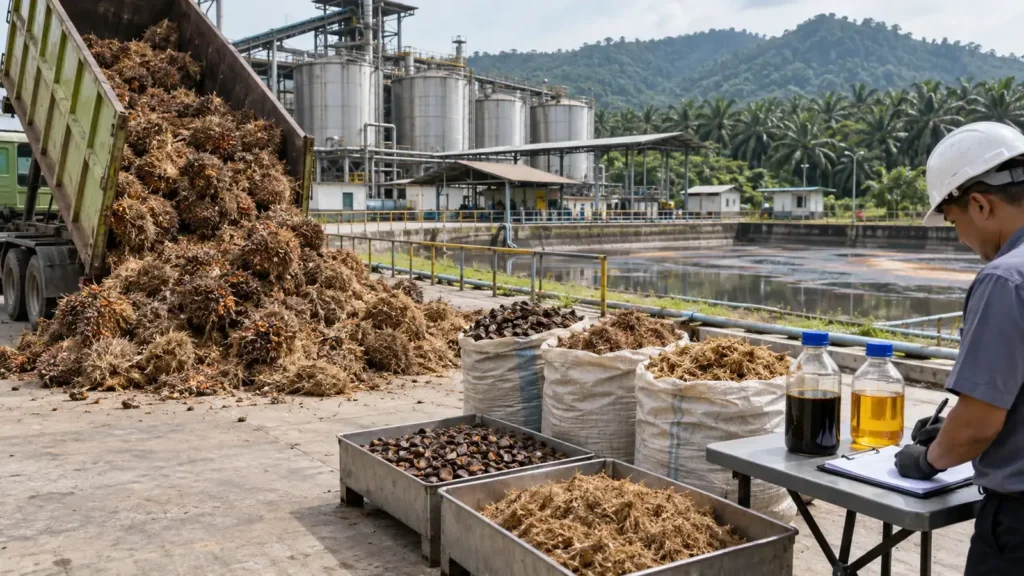
Palm residues can feed sustainable aviation fuel, but they enter through two different doors. Oil-based residues, such as the oil recovered from palm oil mill effluent, run through HEFA, while lignocellulosic residues such as empty fruit bunches run through gasification into Fischer-Tropsch kerosene, and the door you choose decides your cost, your certification route and your eligibility. Feedstock availability across Southeast Asia is where most developers start, but the palm residues SAF feedstock question gets answered at the mill gate, not at the regional total.
What follows is the arithmetic and the rulebook I use when a developer asks which residue to build around.
In short
- Two families: oil-based residues such as POME oil and palm fatty acid distillate go through HEFA; lignocellulosic residues go through gasification and Fischer-Tropsch.
- The rule first: palm oil mill effluent and empty palm fruit bunches sit in Annex IX part A of the renewable energy directive, which brings double counting rather than automatic approval.
- Cost inversion: the oil door is dominated by feedstock price, the residue door by capital and operating cost.
- Life cycle: methane capture and land use change move the emissions number more than anything else, and POME has no established default value yet.
- Evidence: I audit the mill, the sterilisation technology and the binding offtake before I believe a residue volume.
In this article
The short answer: two doors out of the mill
Palm residues can carry a SAF project, but they split into two families with different chemistry. Oil-based residues, the oil recovered from effluent and palm fatty acid distillate, run through HEFA (hydroprocessed esters and fatty acids), while lignocellulosic residues, empty fruit bunches, mesocarp fibres, palm kernel shells, fronds and trunks, run through gasification into Fischer-Tropsch Synthetic Paraffinic Kerosene, or FT-SPK (World Bank, 2025).
The HEFA pathway and FT-SPK are the two most suitable technological pathways by which oil palm and related residues can be used to produce SAF, because of feedstock suitability, a high technology readiness level and cost considerations, and the HEFA route is the most efficient pathway for producing SAF in terms of the rate of energy conversion (World Bank, 2025).
What this means for you: decide the door before you size the plant, because a HEFA unit and a gasification unit cannot be swapped for each other once the engineering has started.
What a mill actually leaves behind
Sustainability criteria start with a physical inventory. The palm milling process runs through sterilising palm fresh fruit bunches, stripping, digestion, and a combination of screening and settling, and these steps generate empty fruit bunches, pressed palm fibres and wastewater (ISCC, 22 August 2025). The effluent is a brownish, viscous liquid with a strong odour and about 90 to 95% water, carrying residual oil, fatty acids, soil particles and suspended solids, and each tonne of it produces approximately 28 m3 of biogas (ISCC).
Solid residues are bigger than they sound: the palm oil industry generates 1.07 ton of empty fruit bunch for every ton of palm oil produced, global production of EFB in 2018 was approximately 80 million tons, and the amount generated in Malaysia is approximately 21.3 million tons per year (MDPI Sustainability, 13 September 2021).
No number in this section is a saleable volume: it is a physical output of the mill.
What this means for you: ask for the mill’s own mass balance, not a national residue statistic, before you model a single tonne of feedstock.
The rule that decides what counts
ReFuelEU Aviation sits downstream of a provision that most feasibility files skip. Annex IX part A of the renewable energy directive lists feedstocks whose contribution towards the minimum shares may be considered to be twice their energy content, and its point (g) reads “Palm oil mill effluent and empty palm fruit bunches” (Directive (EU) 2018/2001).
That listing creates double counting: when biofuels derived from Annex IX feedstocks are used in the transport sector, their energy content may be counted twice toward meeting national renewable energy targets, which is particularly relevant for the EU target of sourcing 29% of transport energy from renewables by 2030 (ISCC). RED III introduced a combined minimum target of advanced biofuels and RFNBOs of 5.5% fuel share in the transport sector in 2030, of which at least 1% must be RFNBOs, and waste and residue materials are regarded as having zero GHG emissions at their origin (ISCC).
Being listed is an accounting advantage for the buyer, not a permit for the seller: you still have to prove the material qualifies as waste or residue rather than as a crop input.
What this means for you: build your documentation around the Annex IX status of each residue, because that status is what the offtaker’s compliance team will price.
What the two doors cost
Sustainable aviation fuel price formation differs sharply between the two routes. The HEFA process has an energy conversion efficiency of 97%, but only 55% of that output meets aviation fuel specifications, giving an overall efficiency of 54% for SAF production from crude palm oil (World Bank, 2025).
In palm oil-based SAF the dominant cost driver is the crude palm oil feedstock, and feedstock cost exerts the greatest influence on the minimum selling price of middle distillates, outweighing fixed operating costs and capital investment (World Bank).
The residue door inverts that trade: gasification-FT routes rely on lower-cost residues such as empty fruit bunches, mesocarp fibres, palm kernel shells, fronds and trunks but incur much higher capital and operating costs than HEFA (World Bank).
What this means for you: sensitivity-test capital cost on the residue case and feedstock price on the oil case, because those are the two variables that will move your minimum selling price.
What CORSIA and the life cycle rules do to residues
CORSIA eligibility is where the palm file gets specific. Under CORSIA and other leading sustainability frameworks, only crude palm oil processed at mills equipped with methane-capture systems qualifies as an eligible SAF feedstock, and methane emissions from POME represent one of the most significant greenhouse gas sources in the palm oil supply chain (World Bank, 2025). Methane capture is the collection and use of the biogas released during anaerobic treatment of mill effluent rather than its release to atmosphere.
Methane capture adoption remains low: 29% of CPO produced in facilities using that technology in the Orinoquia region and 22% nationally in Colombia, while complete biological treatment systems for industrial effluents span from about US$0.5 million for small plants to well over US$5 million for high-capacity plants (World Bank). Residue-based SAF is not constrained by methane capture requirements, unlike CPO, and residues from all harvested fresh fruit bunches can be used for SAF (World Bank).
On the life cycle side, the most favourable scenario reaches 15.5 gCO2e/MJ, an 83% GHG reduction, while the most conservative scenario reaches 40.9 gCO2e/MJ, a 54% reduction, and land use change is the most influential factor in determining life cycle emissions of palm-based SAF (World Bank). POME is recognised as an approved feedstock under CORSIA, but there is currently no established default life cycle emissions value for POME-derived SAF (Asia Pacific Sustainable Aviation Centre, 15 November 2026).
What this means for you: on the oil door you inherit a methane capture obligation you must verify mill by mill; on the residue door you inherit a missing default value that leaves carbon intensity open to negotiation.
Why the volume estimates disagree
POME oil is not one defined product, so estimates diverge. It refers to the oil recovered from any wastewater from the palm oil mill, including oil skimmed off the ponds and oil recovered before discharge through fat traps or centrifuge technology (ISCC).
Plausible yields per tonne of fresh fruit bunches run from 2.1 to 7.6 kg with horizontal sterilisation and from 6.0 to 28.8 kg with vertical sterilisation, only about 10% of palm oil mills use horizontal sterilisation, and the average yield is therefore up to almost 10 kg per tonne of FFB (ISCC).
Translating global CPO production of 76 million tonnes, a typical oil yield of 23.5% for fresh fruit bunches and a 90:10 split between horizontal and vertical sterilisers, ISCC puts the maximal global POME oil potential at up to approximately 3 million tonnes, while Indonesia alone could generate up to almost 2 million tonnes against an Indonesian estimation of only 0.3 million tonnes (ISCC).
Two published estimates of the same market differ: Transport & Environment wrote in April 2025 that about 2 million tonnes of POME oil were used in the European market in 2023, exceeding global production capacity, while Studio Gear Up challenged that conclusion and estimated global capacity at around the current consumption of 2 million tonnes (ISCC, reporting both). Regional POME production in 2020 reached an estimated 1.4 million tonnes, which at typical HEFA conversion yields of 1,200 litres per tonne translates to a potential 1.7 billion litres of SAF production capacity (Asia Pacific Sustainable Aviation Centre).
What this means for you: treat any national residue figure as a range until you have seen the sterilisation technology mix behind it, because that mix decides the yield.
The evidence I ask for before I fund a residue project
Feedstock supply diligence begins at the mill, not at the national statistic. Since April 2023 ISCC EU makes it mandatory for the Points of Origin, that is the palm oil mills, to be individually certified and annually audited, and the auditor checks the annual amount of processed fresh fruit bunches, the mill’s sterilisation technology, the recovery method of POME oil and the annual amounts of generated waste streams (ISCC).
I treat a residue label as a claim to be tested, because labelling or selling other types of oil, such as palm fatty acid distillate or crude palm oil, as POME oil is a serious and fraudulent breach of ISCC EU requirements, with consequences up to withdrawal of the certificate and exclusion from recertification (ISCC).
On the demand side, investors often require at least 70 to 80 percent of annual capacity to be covered by offtake agreements, some lenders require 100 percent of the SAF produced to have reliable offtake covering the full loan tenor, and offtake contracts often start as non-binding memoranda of understanding while contractually binding agreements are needed for a project to reach FID, covering for example 8 to 14 years (World Economic Forum with Kearney).
What this means for you: a signed mill certification audit plus a binding offtake covering the loan tenor is the pair I require before a residue volume enters a bankable model.
How I would run this if it were my file
I benchmark the residue case against the oil-based case with the same two published numbers every time. By 2030 global SAF production capacity is expected to reach around 20 Mt with the project success factor applied, of which HEFA refineries account for about 95% of total volume (IATA, September 2025), and demand for global SAF is expected to reach 17 million tonnes per annum, approximately 4 to 5 percent of total jet fuel consumption (World Economic Forum with Kearney).
Then I look at where the feedstock sits: second generation feedstocks such as used cooking oil, animal fat, industrial grease and residues like palm oil mill effluent have a high emission reduction potential but are relatively limited in availability, and ASEAN, led by Indonesia and Malaysia, contributes over 80% of the world’s palm oil production as of 2023 with further expansion limited by land (IATA, September 2025).
Then I write the file in the order the door dictates: feedstock contract, life cycle evidence, carbon intensity case, offtake, and only then capital structure.
What this means for you: pick the door, prove the mill, fix the carbon intensity number, and only then price the capital, because the market is already over 90% HEFA and a residue case has to earn its way past that default.
Sources
- World Bank, 2025.
- ISCC, 22 August 2025.
- Directive (EU) 2018/2001, 15 November 2026.
- Asia Pacific Sustainable Aviation Centre, 15 November 2026.
- IATA, September 2025.
- MDPI Sustainability, 13 September 2021.
- World Economic Forum with Kearney, February 2025.
Frequently asked questions
Which palm residues can actually be used for SAF?
Two families: oil-based residues such as the oil recovered from mill wastewater and palm fatty acid distillate run through HEFA, while empty fruit bunches, mesocarp fibres, palm kernel shells, fronds and trunks run through gasification-FT, and both routes are considered suitable for oil palm and related residues (World Bank, 2025).
Are palm residues automatically eligible under EU and CORSIA rules?
No. POME and EFB sit in Annex IX part A of the renewable energy directive, which brings double counting and minimum targets rather than automatic approval, and under CORSIA only crude palm oil processed at mills with methane-capture systems qualifies as an eligible feedstock, with no established default life cycle value for POME-derived SAF (Directive (EU) 2018/2001; World Bank; Asia Pacific Sustainable Aviation Centre).
Why do estimates of palm residue volumes disagree so much?
Because the definition drives the number: POME oil includes oil skimmed from ponds and oil recovered before discharge, yields depend on sterilisation technology at 2.1 to 7.6 kg or 6.0 to 28.8 kg per tonne of FFB, and published estimates of the same market range from 0.3 million tonnes to about 3 million tonnes (ISCC).
Is palm residue SAF cheaper than SAF made from crude palm oil?
The residue feedstock is cheaper but the conversion is not: gasification-FT relies on lower-cost residues yet incurs much higher capital and operating costs than HEFA, while in palm oil-based SAF the dominant cost driver is the crude palm oil feedstock itself (World Bank, 2025).
Not sure your project would survive a credit conversation?
A short call is usually enough to see where your project stands.
If you are sizing a palm-based project and need the feedstock contract, the life cycle evidence and the offtake read against each other, investor introductions is where I start.
I do not provide investment advice or arrange investments. I act as a strategic advisor and facilitator.

Alex, Founder of WeConnect Asia
I help low-carbon fuel and carbon removal project developers in Southeast Asia secure the commercial and financial partners needed to reach FID.
Related articles

Pitching a Climate Tech Company to Strategic Investors: What the Corporate Has to Believe Before It Writes a Cheque
How to pitch a climate tech company to strategic investors: the metric cluster, the readiness evidence and the ask that corporates fund.

Biomethane: What It Is, How It Is Made and Who Buys It
Biomethane is biogas cleaned to pipeline quality. I explain how it is made, how it differs from biogas and who buys it in Southeast Asia.

CO2 Sourcing for e-SAF Projects: What the Rules Allow and What the Contract Must Say
Biogenic CO2, direct air capture or industrial flue gas: which sources an e-SAF plant may use, what they cost and which contract terms make the fuel certifiable.

Operating Performance Guarantees for SAF Plants: What Lenders Ask For
Minimum guarantees, performance damages, retesting and who stands behind them: the operating guarantees a SAF plant needs to keep debt and offtake intact.

EPC and Construction Risk in SAF Plants: What a Lender Actually Tests
FEED scope, convertible EPC, performance guarantees and damages caps: the construction risk questions a SAF project must answer before financial close.

Matching Feedstock and Offtake Risk Back-to-Back in a SAF Project: How Lenders Read the Chain
Lenders do not buy a feedstock plan and an offtake plan separately. They buy the link between the two, and the link is where most SAF files break.