
Home » Palm Residues and Sustainability: The Proof a Lender Will Ask For
Palm Residues and Sustainability: The Proof a Lender Will Ask For
10 min read · Nov 2, 2026 · By Alex
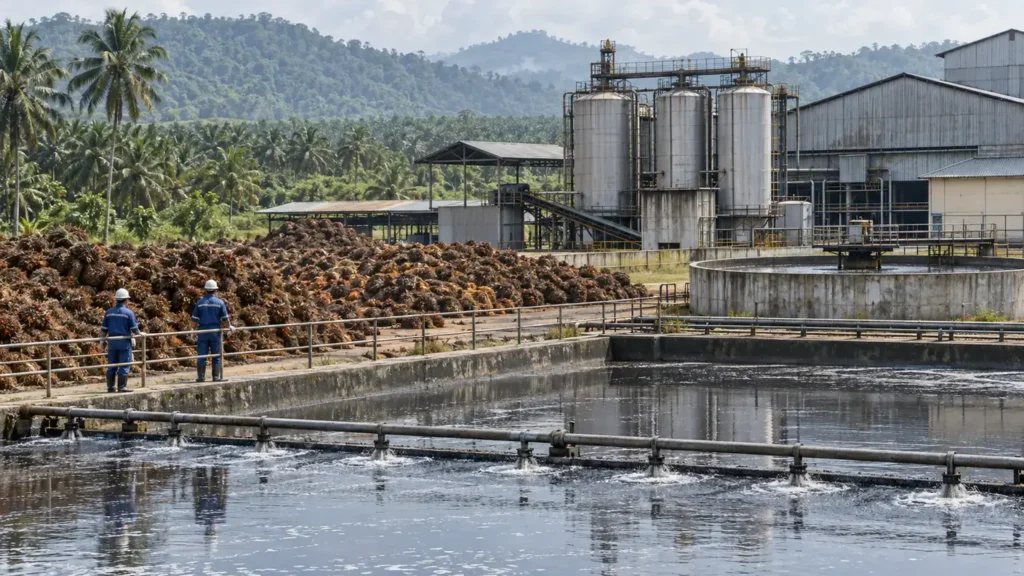
Three checks decide whether your tonnes are real and eligible, and they run in this order: the material must be listed in annex IX of the renewable energy directive, which lists waste and residue feedstocks, where palm oil mill effluent (POME) and empty palm fruit bunches (EFB) sit at point (g) of part A; the chain must run through a scheme recognised by the European Commission, with the mills themselves certified individually since April 2023; and the member state buying the fuel must classify the same material as a waste or residue. Everything else hangs off those gates. The wider regional picture sits at southeast asia feedstock availability. Palm residues sustainability is proved in documents.
I am writing this for a credit officer pre-FID, with a POME or EFB offtake on the table and a spreadsheet full of tonnes. The question is never whether the material sounds responsible. It is whether the tonnes are real, certified and countable in the member state that will use them.
In short
- Listing: palm oil mill effluent and empty palm fruit bunches sit at point (g) of part A of annex IX, the part whose contribution may be counted twice.
- Scheme: points of origin, the palm oil mills themselves, are individually certified under ISCC EU since April 2023.
- National test: the member state must classify the same material as a waste or residue before the tonne counts there.
- Yields: 2.1 to 7.6 kg of POME oil per tonne of fresh fruit bunches with horizontal sterilisation, 6.0 to 28.8 kg with vertical.
- Watch point: reported volumes run at twice what is collectable globally, so expect questions about how your tonnes were verified.
In this article
The short answer: three checks, in this order
The listing comes first. POME and EFB appear at point (g) of part A of annex IX, the part whose contribution towards the minimum shares may be considered twice their energy content (EUR-Lex). PFAD appears in neither part, so I never model it under this silo.
The scheme comes second. Under ISCC EU, points of origin, which are the palm oil mills themselves, must be individually certified, effective from April 2023, and the auditor applies a tailored questionnaire for the mill audit (ISCC, 22 August 2025).
The national classification comes third. The ISCC material list carries a column showing whether a material is classified as a waste or residue in each member state, so the same tonne can pass in one market and fail in the next (ISCC, February 2026).
What this means for you: I would not open a financial model until those three are written down: the annex IX entry, the certified chain of custody, and the classification in the member state that will count the fuel.
What the palm residues are, physically
POME is the voluminous wastewater from the sterilisation and clarification process in milling oil palm fruits: about 90 to 95% water, with residual oil, fatty acids, soil particles and suspended solids, and quite acidic (ISCC, 22 August 2025). Empty palm fruit bunches are the remains of the fresh fruit bunches after the fruit has been removed, and oil recovered from them must be called EFB oil (ISCC, February 2026).
Under ISCC EU, POME oil means oil recovered from any wastewater from the palm oil mill, skimmed from the ponds or recovered before discharge through fat traps or centrifuges, including the sterilisation process. Each tonne of POME produces approximately 28 m3 of biogas (ISCC, 22 August 2025).
I define a point of origin as the palm oil mill itself, and mass balance as the chain of custody where certified volumes are tracked through records while material may be mixed. I check both against sustainability criteria.
What this means for you: the first diligence question is physical: which stream, which recovery method, which mill. If the dossier cannot answer those three, the tonne is a story.
What double counting is worth
Annex IX splits in two: part A covers feedstocks whose contribution towards the minimum shares may be considered twice their energy content, part B covers feedstocks whose contribution is limited (EUR-Lex). In practice, that is double counting: when biofuels derived from annex IX feedstocks are used in transport, their energy content may be counted twice toward national renewable energy targets, against an EU target of 29% of transport energy from renewables by 2030 (ISCC, 22 August 2025). I treat it as an accounting value, not as extra physical fuel.
RED III added a combined minimum target of advanced biofuels and renewable fuels of non-biological origin of 5.5% fuel share in transport in 2030, of which at least 1% must be RFNBOs, and it demands a phasing out of biofuels associated with high indirect land use change risk (ISCC, 22 August 2025).
The arithmetic is in eu compliance and carbon intensity.
What this means for you: the double count is where the value sits, and where a loan is repaid from policy rather than the market. I confirm the target before I size anything.
How a certificate proves the volume
Plausibility is judged against yields, not against a spreadsheet. The ISCC guidance gives 2.1 to 7.6 kg of POME oil per tonne of fresh fruit bunches under horizontal sterilisation and 6.0 to 28.8 kg under vertical sterilisation, with only about 10% of mills using horizontal sterilisation, giving an average of up to almost 10 kg per tonne (ISCC, 22 August 2025).
The auditor checks the annual amount of fresh fruit bunches processed, the sterilisation technology, the recovery method of POME oil and the annual waste streams, and must assess plausibility against those ranges (ISCC, 22 August 2025).
The material list separates the entries: POME, with the note that POME oil cannot be covered under the POME entry; a separate POME oil entry; and empty palm fruit bunches, all marked for ReFuelEU Aviation and FuelEU Maritime (ISCC, February 2026). The mandate behind those marks is at refueleu aviation.
What this means for you: I would ask which sterilisation line sits behind each listed mill, then test your contracted volume against the matching yield range. A certificate without a mill list is a nameplate, not proof.
What buyers are refusing right now
The reported volumes have outrun what the mills can produce: more POME is being consumed than can be collected globally, by a factor of two, and the data indicate that more palm oil residues are being reported than is actually possible, suggesting a high likelihood of fraud (Transport & Environment, 2025).
Some EU member states including Portugal, Germany and Ireland have moved to disincentivise Pome oil usage in their biofuels mandates, and in October the Dutch emissions authority said it will investigate the international Pome oil supply chain with a focus on “fraud risk” (Argus, 15 December 2025).
European Pome oil demand is currently expected to remain stable in the near term at around 1.9mn t per year, and higher demand for annex IX part A feedstocks under RED III may drive other EU countries to absorb diverted volumes (Argus, 15 December 2025). The programme that carries these tonnes into aviation claims is set out at corsia.
What this means for you: I would write the audit questions before the offtake: which mill, which sterilisation line, which certificate. Buyers are refusing documentation, not material.
Three ways the proof chain breaks
First, substitution at the mill: labelling or selling other types of oil, for example palm fatty acid distillate or crude palm oil, as POME oil is a serious and fraudulent breach of ISCC EU requirements, with consequences such as withdrawal of the certificate and exclusion from recertification (ISCC, 22 August 2025). PFAD sits in neither part of annex IX (EUR-Lex).
Second, definition drift: the Malaysian Palm Oil Board has recently required all types of oil produced from palm fruit milling, including steriliser condensate and EFB oil, to be classified as crude palm oil, and ISCC is still awaiting a response (ISCC, 22 August 2025).
Third, scarcity of the certified material itself: second generation feedstock such as used cooking oil, animal fat and POME carries high emission reduction potential but is relatively limited in availability, and ASEAN already contributes over 80% of the world’s palm oil production with further expansion limited by land (IATA, September 2025).
What this means for you: I read the three as one question: does the physical stream still exist at the volume I have been sold, under the definition the buyer will apply.
The order I would run the work in
I would ask for five documents before I model anything: the annex IX entry, the scheme certificate covering the chain of custody, the list of certified points of origin with their sterilisation technology and yield range, the national classification in the member state that will count the tonne, and the offtake against a defined specification.
Two facts anchor the sequence. ReFuelEU aviation requires suppliers to report their SAF volumes through the Union database for biofuels (European Commission, 16 November 2026), and palm oil mill effluent and empty palm fruit bunches are listed at point (g) of part A (EUR-Lex). Sustainable aviation fuel begins as paperwork.
The physical contracting behind those documents sits at feedstock supply. I keep all five in one index so the credit memo and the compliance file read from the same list.
What this means for you: I run the five in that order because each one validates the next; skipping the classification step is how a certified tonne ends up with no home.
How I would run this if it were my file
I would take my dossier to the published record first: point (g) of part A covering palm oil mill effluent and empty palm fruit bunches (EUR-Lex); mill certification effective from April 2023 with yield ranges of 2.1 to 7.6 and 6.0 to 28.8 kg per tonne of fresh fruit bunches (ISCC, 22 August 2025); POME oil kept separate from the POME entry in the eligible materials list (ISCC, February 2026); reported volumes at twice what is collectable globally (Transport & Environment, 2025); and European demand around 1.9mn tonnes a year (Argus, 15 December 2025).
I would then reconcile the model against those five anchors and let any gap decide the structure: smaller volume, shorter tenor, or a certification condition precedent. I would also confirm which member state will count the tonne, since that classification decides the accounting value.
What this means for you: if the dossier survives those published checks, the palm residues sustainability case is documented rather than asserted, and the conversation with a lender becomes one about price and tenor.
Sources
- ISCC, 22 August 2025.
- EUR-Lex, 16 November 2026.
- ISCC, February 2026.
- Transport & Environment, 2025.
- Argus, 15 December 2025.
- European Commission, 16 November 2026.
- IATA, September 2025.
Frequently asked questions
What makes palm residues eligible under EU rules?
Three conditions. The material must be listed in annex IX: palm oil mill effluent and empty palm fruit bunches sit at point (g) of part A, whose contribution may be counted twice toward national targets. It must be covered by a scheme recognised for compliance, and ReFuelEU aviation takes advanced biofuels from part A. The member state that counts the fuel must classify the same material as a waste or residue (EUR-Lex; European Commission).
Which certification should my project use for POME or EFB?
I would use a scheme recognised by the European Commission that certifies the mills themselves. Under ISCC EU, points of origin must be individually certified since April 2023, and the eligible materials list separates the POME, POME oil and EFB oil entries, so the certificate you hold matches the material you buy (ISCC, 22 August 2025; ISCC, February 2026).
How much POME oil can a mill realistically supply?
I would judge the answer against the yield range rather than against the contract: 2.1 to 7.6 kg per tonne of fresh fruit bunches with horizontal sterilisation, and 6.0 to 28.8 kg with vertical sterilisation. Since about 10% of mills use horizontal sterilisation, an average of up to almost 10 kg per tonne is the figure I would test (ISCC, 22 August 2025).
What happens if the country buying my fuel stops recognising POME?
The volume loses its accounting value where it is counted. Portugal, Germany and Ireland have moved to disincentivise Pome oil usage in their biofuels mandates, and the Dutch emissions authority is investigating the international Pome oil supply chain with a focus on fraud risk, while European demand is expected to hold around 1.9mn tonnes a year near term (Argus, 15 December 2025).
Not sure your project would survive a credit conversation?
A short call is usually enough to see where your project stands.
If you are assembling this dossier for a credit committee, I can help you sequence the checks and prepare the file. The introduction work sits at investor introductions, and it runs better when the annex IX entry, the mill list and the classification are already in place.
I do not provide investment advice or arrange investments. I act as a strategic advisor and facilitator.

Alex, Founder of WeConnect Asia
I help low-carbon fuel and carbon removal project developers in Southeast Asia secure the commercial and financial partners needed to reach FID.
Related articles

Pitching a Climate Tech Company to Strategic Investors: What the Corporate Has to Believe Before It Writes a Cheque
How to pitch a climate tech company to strategic investors: the metric cluster, the readiness evidence and the ask that corporates fund.

Biomethane: What It Is, How It Is Made and Who Buys It
Biomethane is biogas cleaned to pipeline quality. I explain how it is made, how it differs from biogas and who buys it in Southeast Asia.

CO2 Sourcing for e-SAF Projects: What the Rules Allow and What the Contract Must Say
Biogenic CO2, direct air capture or industrial flue gas: which sources an e-SAF plant may use, what they cost and which contract terms make the fuel certifiable.

Operating Performance Guarantees for SAF Plants: What Lenders Ask For
Minimum guarantees, performance damages, retesting and who stands behind them: the operating guarantees a SAF plant needs to keep debt and offtake intact.

EPC and Construction Risk in SAF Plants: What a Lender Actually Tests
FEED scope, convertible EPC, performance guarantees and damages caps: the construction risk questions a SAF project must answer before financial close.

Matching Feedstock and Offtake Risk Back-to-Back in a SAF Project: How Lenders Read the Chain
Lenders do not buy a feedstock plan and an offtake plan separately. They buy the link between the two, and the link is where most SAF files break.