
Home » Resource Recovery Facilities: What They Are and How They Are Paid
Resource Recovery Facilities: What They Are and How They Are Paid
10 min read · Mar 18, 2026 · By Alex
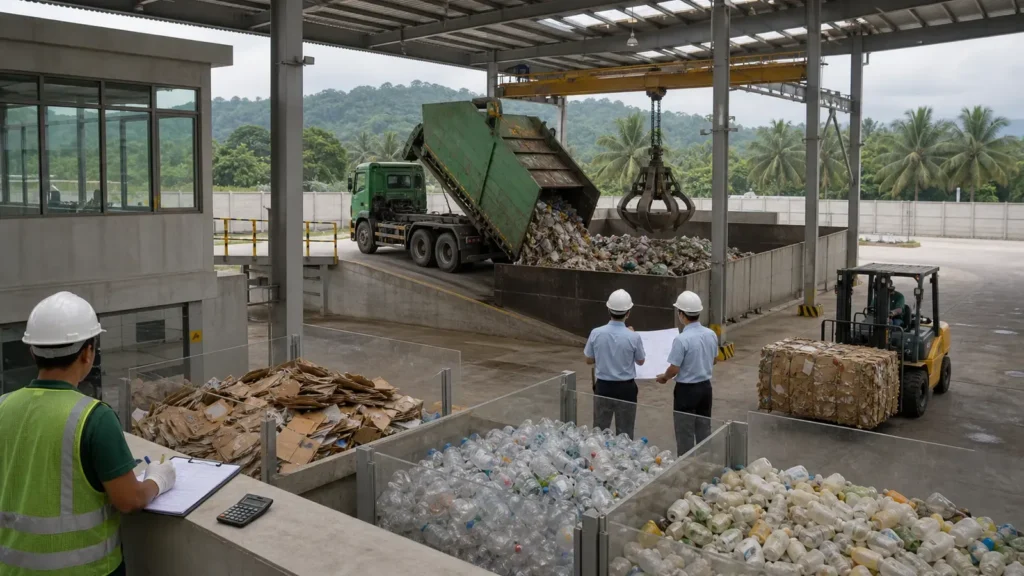
Before a term sheet gets signed, the first question is what this plant does with a truckload of mixed municipal waste. Scoping starts with the plant itself, and I place it inside the waste-to-energy and circular infrastructure branch of my work. A resource recovery facility is the plant that separates usable material out of mixed waste before anything is recycled, burned or landfilled, and its economics turn on three measured things: sorting, transport and collection carry 53.72 percent of the waste services market in 2025, energy sales are generally only 20 to 30 percent of total project revenue in a waste concession, and a 2025 regional brief counts a 250 tonnes per day materials-recovery facility under construction alongside a 2,900 tonnes per day waste-to-energy plant. That matters commercially, because what the plant separates decides what it can sell and who signs for it.
I go in a fixed order: what the facility is, where it sits in the chain, how a concession pays it, what the region already has in the ground, how the money gets assembled, and then how I would stage the decision.
In short
- What it is: a plant that separates usable material out of mixed waste; the sorting line inside it is the materials-recovery facility.
- Where it sits: between collection and the recycling plant, bought through tenders and concessions; traceability is the recurring bottleneck.
- How it is paid: a gate fee or an availability payment, plus material sales; energy is generally only 20 to 30 percent of revenue.
- What exists: Singapore treats about 80 percent of municipal waste in waste-to-energy plants, and started a 250 tonnes per day sorting line in May 2020.
- My test: measured tonnage over a full year, a signed buyer for each fraction, and a payment formula that survives a short year.
In this article
What a resource recovery facility actually is
A resource recovery facility is a plant that separates usable material out of mixed waste, and the sorting line inside it is the materials-recovery facility: the line that turns one mixed stream into paper, plastic, metal and organic fractions. It sits between collection and the recycling plant, and in advanced systems it works alongside segregated collection, coordination and standardisation.
The July 2025 OECD Regional Plastics Outlook for Southeast and East Asia reports 113 Mt of plastic waste in 2022, of which 19 percent was collected for recycling and 12 percent effectively recycled, with effective rates from 6 percent to 14 percent against a global average of 16 percent collected and 10 percent recycled, while mismanaged plastic waste in ASEAN averages 56 percent. At least 15 million people worldwide work in the informal waste sector, taking high-value material at the point of disposal with low process losses, while formal systems take mixed and contaminated streams; the report also calls for urgent investment in formal, safe infrastructure.
What this means for you: scope the sorting line first, because those fractions are what any downstream contract can price.
Where the facility sits in the chain
The chain runs from fragmented, often informal first-mile collection, through aggregation and sorting at materials-recovery facilities, organics segregation and refuse-derived fuel preparation, down to recycling, landfill, energy recovery from municipal solid waste and hazardous treatment. Refuse-derived fuel is solid fuel made from the combustible fraction of municipal waste. In the 2025 Mordor Intelligence market study of ASEAN waste management, collection, transport and sorting carry 53.72 percent of 2025 revenue and municipal solid waste 56.78 percent, while recycling and resource recovery is the fastest service segment at 8.42 percent a year.
Municipalities and state agencies remain the buyers, awarding work through tenders and concessions, and producer responsibility schemes now insert producers and producer responsibility organisations into financing and performance verification. The recurring bottleneck is traceability across informal recovery networks, which limits verification and access to premium markets. The five largest operators hold well under 30 percent of 2025 revenue.
What this means for you: size the line against documented incoming tonnage, because the paid part of this chain is the sorting and transport step, not the recycling story.
How the facility is paid
A gate fee is the tonnage charge paid by whoever delivers waste; an availability payment is a fee for keeping the plant available to standard, not for tonnes processed. In the Global Infrastructure Hub risk allocation matrix for waste-to-energy plants, when the authority takes the whole plant capacity the payments are availability based, with deductions or penalties for missing availability and performance criteria, and when the operator tops up with third-party waste the payments are per tonne, backed by a guaranteed minimum quantity.
Energy sales are generally only 20 to 30 percent of total project revenue, bought per kilowatt-hour produced. Construction passes down through a fixed-price contract with bid, completion and performance bonds, and security has a cost that feeds into pricing. Performance standards are usually lower during early operation, and the risk is higher for a technology that is not proven. An exclusivity granted without a guaranteed minimum quantity reduces the availability of bank debt and pushes the project towards more expensive equity.
What this means for you: I set the gate fee and tipping fee breakdown beside this matrix before I model any revenue.
What the region already has
In the July 2025 ISWA regional brief on waste management in Southeast Asia, Singapore treats about 80 percent of municipal waste in waste-to-energy plants, produced 1,502,487 MWh from incineration in 2023, and in May 2020 started work on a 250 tonnes per day materials-recovery facility with a 2,900 tonnes per day waste-to-energy plant, plus 80 million Singapore dollars for Closing the Resource Loop.
Indonesia produced 35.8 million tonnes of municipal waste in 2022 at 0.67 kg per person: 47.64 percent to sanitary or controlled landfill, 37.38 percent escaping into the environment, 7 percent recycled in 2023, 12 waste-to-energy installations, and refuse-derived fuel units totalling about 1,500 tonnes a day. In that 2025 brief Malaysia counts about 14 million tonnes a year, 165 landfills and a 13.7 percent recycling rate; Thailand counted about 210 MW of waste-to-energy capacity in 2018 and a 17.6 percent recycling rate. The Philippines went from 9.07 million tonnes in 2000 to 16.63 million in 2020 and projects 20.45 million by 2045.
What this means for you: read these as installed and announced capacity, then test the gap against what project finance in Southeast Asia requires.
How the money is assembled
The June 2025 Asian Development Bank brochure on advancing the circular economy frames the opportunity as extending circular economy investment in Asia and the Pacific, and it lays out a chain in three steps: policy measures upstream, public and private investment plus new financing downstream, then knowledge work and capacity development. The work is carried out with partners rather than alone, and the 53068-001 plastic pollution project sits inside that same June 2025 family of operations.
For a recovery facility the practical reading is narrow: sorting capacity gets financed once the material has a route and the public counterparty has set the rules. That is where offtake arrangements for waste-to-energy and biogas enter, since an offtake is the contract that takes the output of the plant. A route can be a recyclable grade with a processor behind it, a fuel specification with a kiln in front of it, or a contracted gate fee.
What this means for you: I do not scope the line until I can name the buyer of each fraction and the rule that obliges the public counterparty to pay.
What the contracts decide
The contract decides whether this plant survives a bad year, and the numbers it is written against are already public. In 2022 the region generated 113 Mt of plastic waste, collected 19 percent for recycling, effectively recycled 12 percent and left 56 percent mismanaged, which is the stream a concession is asked to accept. In 2025 collection, transport and sorting carry 53.72 percent of market revenue, recycling and resource recovery services grow at 8.42 percent a year, and a 34-year concession was signed in June 2025 for 1,056 tonnes per day.
Between 2014 and 2020 exports of plastic waste fell by 58 percent, so domestic sorting capacity stopped being optional. Between 2020 and 2025 one ASEAN market produced 1,502,487 MWh from incineration, added a 250 tonnes per day sorting line and set a 40 percent recycling target, while producer responsibility schemes began asking for documented chain of custody on every tonne they count.
What this means for you: my steps for signing a municipal waste supply agreement matter more here than the equipment specification, because the offtake is what turns sorted material into contracted revenue.
The five checks I run on a recovery facility
- I measure the tonnage and composition of the incoming stream over a full year, because a single season hides the moisture that ruins a refuse-derived fuel line.
- I confirm that each sorted fraction has a buyer under a signed offtake, not an expression of interest.
- I read the payment formula line by line, since availability payments and per-tonne payments behave differently when the plant runs short.
- I trace what arrives, because undocumented material blocks premium buyers and blocks verification of producer fees as well.
- I check the bonds and liabilities that flow down to the construction contractor, since bid, completion and performance bonds are priced into the offer.
What this means for you: any one of these five left open becomes the item that stops financial close, so I clear them before I brief a designer.
How I would stage a recovery facility decision
I hold four dated rows, and each one has to be answered with measured data before I let the next row carry weight.
- 2014-2020: exports of plastic waste fell 58 percent, so domestic sorting capacity became unavoidable.
- 2022: 113 Mt of plastic waste was generated and 12 percent effectively recycled, so the feedstock exists but the processing does not.
- 2025: collection, transport and sorting carry 53.72 percent of market revenue, recycling and resource recovery services grow 8.42 percent a year, and a 34-year concession was signed in June 2025 for 1,056 tonnes per day.
- 2045: the Philippines projects 20.45 million tonnes of municipal waste, which is the demand curve a facility has to be sized against.
What this means for you: I stage the decision in that order, and I do not move to design until the first two rows are measured rather than estimated.
Sources
- OECD, Regional Plastics Outlook for Southeast and East Asia, 2025.
- Mordor Intelligence, ASEAN Waste Management Market, 2026.
- Global Infrastructure Hub, Waste to Energy Plant, PPP Risk Allocation Tool, n.d.
- International Solid Waste Association, Regional Brief: Waste Management Challenges and Opportunities in South East Asia, 2025.
- Asian Development Bank, Advancing the Circular Economy, 2025.
Frequently asked questions
What is the difference between a recovery facility and a recycling plant?
The recovery facility separates usable material out of mixed waste and delivers it as sorted fractions, while the recycling plant takes those fractions and turns them into a secondary raw product. The recovery facility therefore ends where the material is clean, documented and stacked, and the recycling plant begins there. In advanced systems the sorting line works with segregated collection, coordination and standardisation, which is what keeps contamination and process losses down.
How does such a facility earn money?
Three ways. First, a tonnage charge on delivered waste, or an availability payment backed by a guaranteed minimum quantity, depending on who carries the waste risk. Second, the sale of the sorted material itself. Third, energy sales, which in a waste concession are generally only 20 to 30 percent of total project revenue. The first two are contracted with the public counterparty, so their quality decides how the project reads to anyone funding it.
Is sorting capacity bankable on its own?
It is bankable when the material has a route out of the plant. An exclusivity granted without a guaranteed minimum quantity reduces the availability of bank debt and pushes the project towards more expensive equity, which is why a signed buyer for each fraction is worth more to me than a long exclusive term. Sorting capacity without an offtake is a building, not a project.
What should I measure before scoping one?
Measure the incoming tonnage and composition over a full year, the share of it that is documented, and the buyer for each sorted fraction. In 2022 plastic waste mismanaged in the region averaged 56 percent and only 12 percent was effectively recycled, so the delivered stream is where projects fail first. I measure moisture as well, because it decides whether the combustible fraction is worth preparing as fuel.
Not sure your project would survive a credit conversation?
A short call is usually enough to see where your project stands.
If you are at concept stage and want a second read on the sorting line, the payment mode or the buyer for each fraction, strategic partnership work with me is where I take that on. I usually start from the tonnage file, the draft concession terms and the list of material fractions.
I do not provide investment advice or arrange investments. I act as a strategic advisor and facilitator.

Alex, Founder of WeConnect Asia
I help low-carbon fuel and carbon removal project developers in Southeast Asia secure the commercial and financial partners needed to reach FID.
Related articles

Pitching a Climate Tech Company to Strategic Investors: What the Corporate Has to Believe Before It Writes a Cheque
How to pitch a climate tech company to strategic investors: the metric cluster, the readiness evidence and the ask that corporates fund.

Biomethane: What It Is, How It Is Made and Who Buys It
Biomethane is biogas cleaned to pipeline quality. I explain how it is made, how it differs from biogas and who buys it in Southeast Asia.

CO2 Sourcing for e-SAF Projects: What the Rules Allow and What the Contract Must Say
Biogenic CO2, direct air capture or industrial flue gas: which sources an e-SAF plant may use, what they cost and which contract terms make the fuel certifiable.

Operating Performance Guarantees for SAF Plants: What Lenders Ask For
Minimum guarantees, performance damages, retesting and who stands behind them: the operating guarantees a SAF plant needs to keep debt and offtake intact.

EPC and Construction Risk in SAF Plants: What a Lender Actually Tests
FEED scope, convertible EPC, performance guarantees and damages caps: the construction risk questions a SAF project must answer before financial close.

Matching Feedstock and Offtake Risk Back-to-Back in a SAF Project: How Lenders Read the Chain
Lenders do not buy a feedstock plan and an offtake plan separately. They buy the link between the two, and the link is where most SAF files break.