
Home » Rice Straw SAF Feedstock: Availability, Supply Chain, and What It Takes
Rice Straw SAF Feedstock: Availability, Supply Chain, and What It Takes
10 min read · Nov 2, 2026 · By Alex
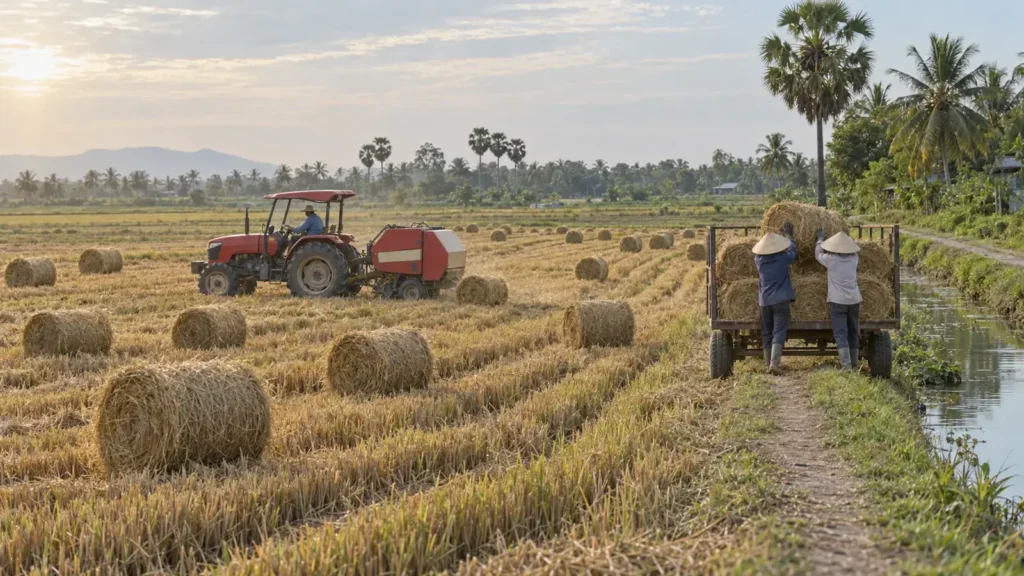
The paddy fields of Southeast Asia leave a vast residue behind after every harvest. Almost none of it reaches a sustainable aviation fuel plant. The tonnage is not the obstacle. Rice straw as a rice straw SAF feedstock clears the volume test and fails the mobilisation test. Southeast Asia holds 138.6 million tonnes a year of rice husks and rice straw. That is 36.9% of all the residues the RSB counted. Also, it converts to a potential 9.7 million tonnes of SAF. The ICAO rates it low on readiness grounds, and IRENA records logistics costs as the largest hurdle. India alone has 77 to 154 million tonnes a year available for alcohol-to-jet. Also, a Viet Nam survey shows over 75% of farmers still open burn or incorporate the residue.
I write this as a feasibility read, not a market forecast. Instead, I separate what the published counts actually measure from what a supplier has to move, convert and certify. Only then can a single tonne sit in a SAF contract. The gap between those two things is where projects stall.
Rice straw SAF feedstock: volume and mobilisation at a glance
In short
- Volume: 138.6 million tonnes a year of rice husks and rice straw in Southeast Asia, worth 9.7 million tonnes of SAF.
- Mobilisation: collection, transport and storage of this bulky material are the largest cost hurdle in the region.
- Conversion: alcohol-to-jet is the route the ICAO describes, with two Indian reference facilities running at modest scale.
- Rules: straw sits in annex IX part A, so its energy counts twice towards minimum shares in the EU.
- Risk: the ICAO rates readiness low on supply chain grounds, and earlier cellulosic ethanol plants closed without reaching capacity.
In this article
The short answer: the volume is real, the mobilisation is not
The RSB counts 138.6 million tonnes a year of rice husks and rice straw in Southeast Asia. That is 36.9% of the 375.3 million tonnes regional residue and waste base it built for a 2025 baseline. The country split is Indonesia at 46.0 million tonnes and Viet Nam at 34.5. Meanwhile, Thailand stands at 23.0, Myanmar at 17.4 and the Philippines at 10.8. Through Fischer-Tropsch that base converts to a potential 9.7 million tonnes of SAF a year.
The ICAO India study gives a parallel figure: 77 to 154 million tonnes a year of rice straw for alcohol-to-jet. Its low case uses 50% of the residue. Its high case assumes the whole residue goes to second generation ethanol and SAF.
Moreover, against both counts, IRENA finds a low mobilisation rate for agricultural residues across the region. It names logistics costs as the largest hurdle. The RSB separately marks Fischer-Tropsch conversion of this residue as in development. This is technology readiness: how close the conversion process is to routine commercial operation.
What this means for you: I can take the tonnage into a committee room. However, I cannot take it as a supply. Before I quote any share of that 138.6 million tonnes I need a district level count. That count has to show what is genuinely free.
What the residue is worth where it sits
In fact, the RSB clusters rice husks and rice straw in the high availability plus low risk group. It ranks them ahead of municipal solid waste and bagasse, which it places in medium availability plus low risk. Two caveats sit on that ranking: the overall variability of its data points is 40%. Moreover, the study considered neither supply chain efficiency nor feedstock competition.
The classification is a claim question before it is a volume question. The sustainability criteria decide whether a tonne counts at all. Country context then moves the number. IRENA records that the Philippines draws 57% of its residue based SAF potential from rice straw and husk. Viet Nam draws 78%. Thailand, relying mainly on those same residues, can barely meet a 70% blend target.
For example, the same study notes that chicken farms may already use rice husks as bedding material. Therefore, recorded availability does not equal delivered availability. I keep one definition precise here. Feedstock readiness means how easily a residue reaches a plant in the form the plant expects. On rice straw, the ICAO rates that readiness low.
What this means for you: a high availability label describes the field, not the loading bay. I would ask for the competing uses in writing before I treat any part of the regional count as reachable.
What it takes to convert it
The ICAO process runs through collection and aggregation, preprocessing, pretreatment, enzyme production and hydrolysis, then fermentation. Pretreatment means breaking open the plant cell structure so enzymes can reach the sugars. The options are acid, steam explosion and alkali. Rice straw carries 28 to 36% cellulose, 23 to 28% hemicellulose and 12 to 14% lignin. Meanwhile, the lignin cannot become ethanol and operators mostly burn it for energy. Therefore, sugar yield rather than gross tonnage sets the economics. Enzymes are costly but critical for that yield.
Two Indian reference points exist. Praj runs a 30,000 m3 a year facility on rice straw. Also, the ICAO notes that feedstock and supply chain challenges limit its scale. IndianOil runs a biorefinery at 100 m3 a day. It processes 200 kt of rice straw into 30,000 m3 of ethanol a year.
Conversion fixes the carbon claim as well. Under CORSIA, general agricultural residues carry a default carbon intensity including indirect land use change of 24 to 39 gCO2/MJ. Meanwhile, that is a floor set before any project specific measurement.
What this means for you: I would ask the offtaker which of these steps it owns and which I supply. Collection and pretreatment are where the two sides of the contract actually meet.
What the rules do with it
Straw sits at point (e) of part A of annex IX of the renewable energy directive. In fact, annex IX part A lists the feedstocks for advanced biofuels whose contribution may count twice their energy content. Analysts call that treatment double counting: a tonne of straw counts as two tonnes of energy towards the minimum shares. Bagasse sits at point (j) of the same list.
ReFuelEU Aviation builds its SAF definition on that annex. It sets a 2% share of SAF at EU airports from 2025 rising to 70% from 2050. Meanwhile, it sets a 1.2% share of synthetic aviation fuels from 2030 rising to 35% from 2050. It also certifies blended aviation fuels up to a 50% SAF blend. Suppliers cover more than 95% of air transport departing from EU airports. They report volumes through the Union database for biofuels.
Also, CORSIA keeps a positive list of wastes, residues and by-products. Feedstocks that are low risk for land use change benefit from an emission factor of zero.
What this means for you: the double counting entry is worth money. In fact, that value holds only if the whole chain from field to blend is certified. I check the certification route before I check the premium.
What demand looks like on the other side
IATA puts global SAF production at just 2 Mt in 2025. By 2030 it expects around 20 million tonnes of capacity with the project success factor applied. About 95% of that capacity is still from HEFA refineries. Feedstock accounts for the lion’s share of HEFA production costs, and second generation feedstock. Meanwhile, it carries high emission reduction potential but remains relatively limited in availability.
The regional prize is real: PR China and ASEAN together hold about 240 million tonnes of biomass feedstock for SAF. That is about 15% of the global total by 2050. That is where low carbon fuel mandates on the demand side meet this residue.
The ICAO reads alcohol-to-jet as the largest opportunity for India for one structural reason. In fact, the ethanol intermediate is chemically identical whatever the feedstock or process. So producers can transport and aggregate ethanol to feed large scale plants instead of hauling straw long distances.
What this means for you: I would sell ethanol logistics rather than straw logistics where the distance works. In addition, I would price against a market where HEFA still sets the benchmark and the feedstock sets the margin.
Three ways the rice straw assumption fails
First, the collection chain. For example, the ICAO rates feedstock readiness low on supply chain grounds. It also records material handling problems in earlier commercial cellulosic ethanol plants. Those problems led to lengthy startups and failure to reach expected capacity.
Second, the conversion record. Moreover, the same study notes that many commercial scale cellulosic ethanol facilities in Europe and the United States closed. They closed because they could not achieve capacity and were not economically viable. It names the Beta Renewables plant at Crescentino, opened in 2013. Also, the Clariant plant in Romania, closed in December 2023.
Third, the alternatives for the same tonne. IRENA records open burning as the quick disposal route. A survey in Viet Nam shows over 75% of farmers burning or incorporating the residue into soil. It also warns of competition from shipping fuel and biochar. Malaysia’s residue based SAF potential stays low at 1.6 million tonnes a year. A high share of its residues already goes to other purposes.
What this means for you: each of these failures is testable before signing. Instead, I would price the collection chain, the plant’s track record and the competing end uses separately. They belong on three separate lines in the model.
The order I would run the work in
I would not price a tonne before I have walked the collection geography. Therefore, I keep the sequence fixed. Confirm the free balance after existing uses in the actual districts, and confirm who takes delivery and in what form. Specifically, confirm which certification route the tonne travels under, and confirm the conversion route and its readiness. Then discuss price and offtake.
Two facts anchor that order. The RSB classifies rice husks and rice straw as high availability with low risk while Fischer-Tropsch stays in development. Meanwhile, IRENA records logistics costs as the largest hurdle in the region.
The feedstock supply work I run starts at the loading bay. It asks what is genuinely free, in what physical form and at what delivered cost. It also asks under which certification route the tonne travels.
What this means for you: reverse that order and you price a tonnage nobody has yet collected. That is the most common way this file stalls at feasibility.
How I would run this if it were my file
I would put my own collection map against the published numbers before I take anything to committee. The comparison set is fixed: 138.6 million tonnes a year in the region and 9.7 million tonnes of potential SAF (RSB). India gives 77 to 154 million tonnes a year (ICAO), with feedstock readiness low on supply chain grounds (ICAO). In addition, annex IX carries straw with double counting (EUR-Lex). The European curve runs from 0.36 million tonnes of lignocellulosic SAF in 2025 to 1.96 million tonnes in 2035 (ICCT). Mobilisation evidence comes from IRENA.
Each of those numbers carries a different boundary. The regional figure is a dry mass potential for a 2025 baseline with 40% variability across data points. India’s figure is a range built on two assumptions. The European curve rests on a deployment rate the ICCT says could be much lower in practice.
What this means for you: I would report the overlap between my districts and those boundaries. By contrast, the union of the published totals would not serve. I would also show the committee which tonnage is counted, which competes and which is merely standing in a field.
Sources
Frequently asked questions
How much rice straw is available for SAF in Southeast Asia?
The RSB counted 138.6 million tonnes a year of rice husks and rice straw, 36.9% of the regional residue and waste base, converting to 9.7 million tonnes of potential SAF through Fischer-Tropsch. Indonesia holds 46.0 million tonnes a year, Viet Nam holds 34.5 million tonnes and Thailand 23.0 million tonnes. Those are field level counts for a 2025 baseline with 40% variability, so I read them as scale rather than as deliverable tonnage.
Can rice straw ethanol be certified as SAF feedstock?
It can enter certified fuel through the conversion route rather than directly. The ethanol intermediate is chemically identical whatever the feedstock, and second generation ethanol from rice straw feeding alcohol-to-jet is the route the ICAO describes. CORSIA keeps a positive list of wastes, residues and by-products, and only the biogenic fraction of a waste counts as a feedstock for certified SAF. The ReFuelEU Aviation definition also draws on advanced biofuels from feedstocks listed in part A of annex IX of the renewable energy directive.
Why is rice straw harder to use than bagasse?
Because the supply chain differs more than the chemistry. Bagasse is produced during crushing at the mill, already size reduced and aggregated, and carries no transport cost from the fields. The residue in the paddy field must be collected, baled, transported, stored, dried and size reduced. The ICAO rates bagasse feedstock readiness as high with alcohol-to-jet as the suitable route, and rates rice straw as low on supply chain grounds, even though its composition carries 28 to 36% cellulose.
What should I check before signing a supply agreement?
Three checks, in order. First, the free balance after existing uses in the districts that will supply you, since animal feed, soil compost and higher value products already take part of the residue. Second, the collection and storage logistics, which IRENA calls the largest hurdle in the region. Third, the certification route plus the conversion readiness of the offtaker’s technology, because a low carbon claim is only as sound as the plant that produces it.
Not sure your project would survive a credit conversation?
A short call is usually enough to see where your project stands.
If you are at feasibility stage and need the collection geography, the certification route and the offtaker conversation run in the right order, that is the introduction work I do. I map the free balance first, then put the file in front of the people who can fund it.
I do not provide investment advice or arrange investments. In addition, I act as a strategic advisor and facilitator.

Alex, Founder of WeConnect Asia
I help low-carbon fuel and carbon removal project developers in Southeast Asia secure the commercial and financial partners needed to reach FID.
Related articles

Pitching a Climate Tech Company to Strategic Investors: What the Corporate Has to Believe Before It Writes a Cheque
How to pitch a climate tech company to strategic investors: the metric cluster, the readiness evidence and the ask that corporates fund.

Biomethane: What It Is, How It Is Made and Who Buys It
Biomethane is biogas cleaned to pipeline quality. I explain how it is made, how it differs from biogas and who buys it in Southeast Asia.

CO2 Sourcing for e-SAF Projects: What the Rules Allow and What the Contract Must Say
Biogenic CO2, direct air capture or industrial flue gas: which sources an e-SAF plant may use, what they cost and which contract terms make the fuel certifiable.

Operating Performance Guarantees for SAF Plants: What Lenders Ask For
Minimum guarantees, performance damages, retesting and who stands behind them: the operating guarantees a SAF plant needs to keep debt and offtake intact.

EPC and Construction Risk in SAF Plants: What a Lender Actually Tests
FEED scope, convertible EPC, performance guarantees and damages caps: the construction risk questions a SAF project must answer before financial close.

Matching Feedstock and Offtake Risk Back-to-Back in a SAF Project: How Lenders Read the Chain
Lenders do not buy a feedstock plan and an offtake plan separately. They buy the link between the two, and the link is where most SAF files break.