
Home » Sustainable Aviation Fuel Grants and Concessional Finance
Sustainable Aviation Fuel Grants and Concessional Finance
10 min read · Sep 5, 2025 · By Alex
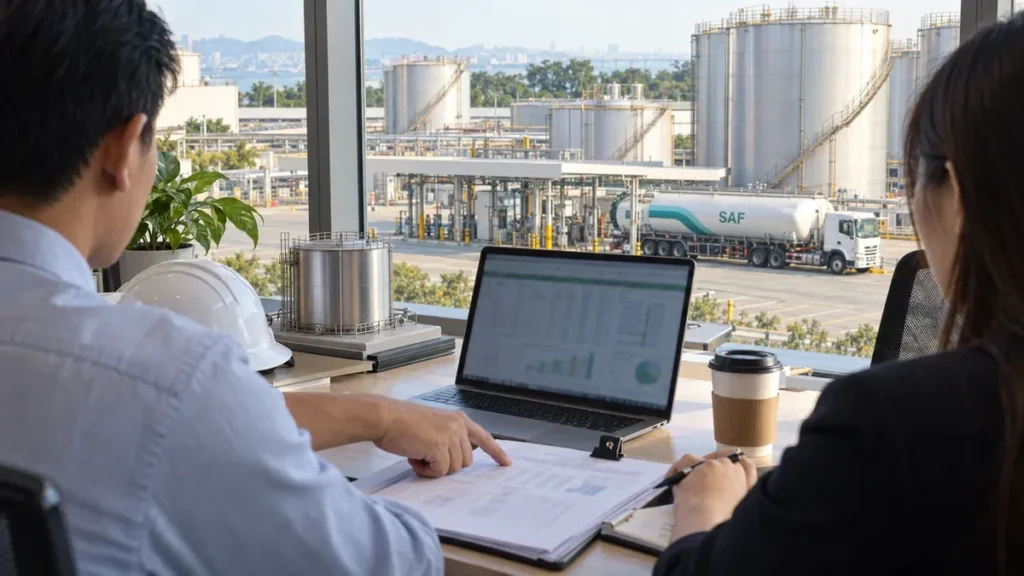
If you are a developer at feasibility stage looking at sustainable aviation fuel in Southeast Asia, the order of public money matters more than the headline size. Chase a non-repayable grant first for the studies and demonstration work equity will not fund, bring in concessional debt or patient equity from a development finance institution second, and take senior debt last, priced against offtake. The full stack sits in how to finance a SAF project.
This article covers the first two layers. A grant is money you do not repay, and it arrives with reporting and performance obligations. Concessional finance is below-market debt or patient equity from a multilateral development bank or a development finance institution. Both are available before final investment decision. Neither is free.
In short
- A grant is non-repayable, and it carries reporting and performance evaluation.
- Concessional finance is below-market debt or patient equity, from a development finance institution or a multilateral development bank.
- The largest grant window here caps at 50 million USD.
- A cost share applies: 25 percent, or 10 percent for small or non-hub airports.
- Order decides outcomes: grant first, concessional layer second, offtake-backed senior debt third.
In this article
What grants and concessional finance do, and what they do not cover
A grant is non-repayable. You spend it on what the programme allows and report on it, with accountability measures such as performance evaluations. It does not repay itself out of plant cash flow, because when you need it the plant has none.
Concessional finance is different money with a different job: debt priced below market, or patient equity, from a multilateral development bank or a development finance institution. It is repaid, and it tolerates a construction and ramp-up period a commercial lender will not price.
A SAF refinery moves through five phases: conceptualisation, pre-feasibility, FID, construction, commissioning. Grants pay for the first two; concessional debt and equity carry the project into construction. Neither layer replaces equity for the money at risk, or a buyer for the fuel.
What this means for you: decide which phase you are funding before you write a page. Studies, engineering and demonstration belong to the grant layer; steel and tanks belong to the concessional or debt layer. A capital cost request in a study window wastes a cycle.
How the largest grant window in the market is actually run
The biggest grant window I know in this market is Fueling Aviation’s Sustainable Transition, or FAST. It sits under the SAF Grand Challenge established under the Inflation Reduction Act of 2022, is administered by the FAA, and runs up to 50 million USD.
Eligible projects are SAF production, transportation, blending and storage. Qualifying fuel must cut emissions by more than 50 percent and come from biomass, waste streams, renewable energy or gaseous carbon oxides. The cost share is 25 percent, or 10 percent for small or non-hub airports, so the award never covers the budget.
Applicants are state and local governments, air carriers, airport sponsors, higher education institutions, research institutions, SAF and low-emission technology developers, and non-profit organisations; the statutory references are Public Law 117-169 and 49 U.S. Code 44504.
None of this is exotic: a cost-shared infrastructure window with an emissions test bolted on, and the test is what applicants fail.
What this means for you: run the eligibility test before you budget staff time on the application. Confirm the emissions reduction, your applicant category and your ability to carry the cost share. If one is missing, another window is the cheaper path.
What the award data tells you about sizing a request
The FAA announced 291 million USD from the Inflation Reduction Act on 16 August 2024: 244.5 million USD for 22 projects producing, transporting, blending or storing SAF plus scoping studies, and 46.5 million USD for 14 low-emission technology projects, with awardees across 23 states against a goal of net-zero aviation emissions by 2050. Named awards ran from 16.8 million USD to Gevo down to 240,000 USD to the City of Atlanta for a supply-chain study.
Trade reporting dated 27 August 2024 gives the channel split. That data is more than two years old, and I read it as a pattern rather than a live programme: 244.5 million USD, 84 percent of the FAST total, across 36 projects in four channels, SAF Tier 1 with 7 supply-chain studies, SAF Tier 2 with 15 infrastructure projects, Low Emission Category 1 with 13 and Category 2 with 1.
The size distribution is the useful part. The largest single grant was 50 million USD to Martinez Renewables, a Marathon Petroleum and Neste joint venture in California expected to produce 100 to 350 million gallons of SAF per year from 2027. Below that came 26.76 million USD to BP Products North America, 24 million USD to Buckeye Terminals, 21.96 million USD to World Energy for pipeline components serving Los Angeles International Airport, and 3 million USD to LanzaJet. The FAA said no further grants or funding opportunities were under consideration.
What this means for you: size the request against the channel, not the plant. Supply-chain and engineering work won in the smaller band, heavy infrastructure at the top. Ask for what you can evidence, and expect that one award will not close your funding gap.
Why a grant is not free money
A grant is non-repayable, which is why it is supervised. Reporting duties, milestone logic and performance evaluations follow the money, and you must show it moved the project rather than the overhead. Grants rarely arrive as a blank cheque: the cost share must be identified before you apply.
Government grants most likely go to SAF producers that have not yet secured large equity investment, and amounts range from a few hundred thousand dollars to multi-million dollar grants. That band contains a study, a test campaign and a demonstration. It does not contain a plant.
The World Economic Forum with Kearney places research and innovation grants for first-of-a-kind facilities first among 10 financial levers, citing the UK Advanced Fuel Fund. That lever pays for the unknown so the next layer can price the known.
What this means for you: request an amount tied to a defined deliverable and date, keep the cost share in cash you can show, and write the milestone schedule before the budget, because the evaluation reads the schedule first.
The concessional layer: MDBs, DFIs and guarantees
The institutions most active in climate blended finance are IFC, FMO, IDB Invest, ADB and EBRD. Their support runs in two stages: technical knowledge early, then debt or equity as projects approach FID. The first stage costs little cash and a lot of calendar, and it is where the structure gets built that stage two will lend against. The mechanics are set out in development finance institutions.
Three of the 10 levers sit here: multilateral development bank support using local knowledge in markets with complex regulation, with EBRD working with KazMunaiGas and Air Astana in Kazakhstan; guarantees and insurance to enhance the credit profile, with the US Department of Energy Loan Programs Office; and long-term offtake, with IAG’s 14-year agreement with the power-to-liquid producer Twelve.
In the stack the grant pays for the work that unlocks the rest. Concessional debt or equity sits above the grant and below senior debt: it funds capital cost on patient terms, guarantees lift the credit profile so the senior tranche can be priced at all, and offtake carries the debt after that.
What this means for you: open the relationship during the study, not after. Enter with a technical scope you want reviewed and leave the financing question for stage two: that conversation tells you which instrument the institution will put behind your pathway.
What the UK path shows about the next instrument
The UK is building the instrument that follows grants. Its Sustainable Aviation Fuel Bill had its first reading on 14 May and legislation is expected by the end of 2026. The centrepiece is a revenue certainty mechanism with a guaranteed strike price, modelled on Contracts for Difference, with the first tranche reserved for non-HEFA pathways.
The demand side sits beside it in SAF mandates: at least 10 percent of jet fuel used on UK departures from 2030, rising to 22 percent by 2040.
Grants continue: the Department for Transport selected 17 SAF projects to share 63 million GBP (84.9 million USD / 72.7 million EUR) in the third round of the Advanced Fuel Fund, plus 400,000 GBP (530,000 USD) for testing through the UK SAF Clearing House.
The cost base explains the mechanism: a first-of-a-kind plant is estimated at 600 million GBP (800 million USD) to 2 billion GBP (2.6 billion USD) each, and such plants lose money in the initial years. The Department names three barriers to FID: no clear market price for advanced non-HEFA SAF, policy and regulatory uncertainty, and competition for finance with other technologies and other countries. Funding comes from a levy estimated at around 1.50 GBP (2 USD) per passenger, carried by around 20 aviation fuel suppliers, and the measure is time limited.
What this means for you: watch for the strike price, because it converts a mandate into bankable revenue. Until it exists, the UK examples show what your own government will be asked to build, and the three named barriers are the ones you must answer.
How to sequence the money in Southeast Asia
My order is fixed. A grant first, for feasibility, engineering, testing and demonstration. Concessional equity and guarantees second, from a development finance institution. Offtake-backed senior debt last. Each layer prices the risk the layer below has already removed, and reversing the order means paying commercial pricing for risk nobody has retired.
The market justifies the sequence. SAF demand in 2030 is put at 17 million tonnes per annum, about 4 to 5 percent of jet fuel consumption. Installed capacity likely reached 4.4 million tonnes by end 2024, with 6.9 million tonnes planned, and a further 5.8 million tonnes would need final investment decisions by 2026. The industry may require between 19 billion USD and 45 billion USD of capital expenditure by 2030.
The equity story has to hold first, which is where low carbon fuels investment belongs in your file. If your pathway is not HEFA, the structure changes and e-SAF project finance is the page to work from. The sequence must converge on a decision point, which is bankability.
What this means for you: put the grant in the file first and let it define the study calendar, because its outcome determines what the concessional lender sees at stage-two entry. Never submit a debt request that predates the grant result it depends on.
What I put in the file before I apply
By the time I contact a programme, the file already holds these items.
An eligibility memo: which scheme, which statutory test, how the project meets it, with the emissions reduction demonstrated rather than asserted.
A cost-share plan: the 25 percent, or the 10 percent for small or non-hub airports, shown as committed cash or committed in-kind.
A milestone schedule: studies, engineering, testing, each with a date.
An accountability plan: who reports, how often, what is measured, so reporting never slows the build.
An offtake draft: a term sheet rather than a letter of intent, which the concessional lender will ask for before stage two.
An equity story: the source of the remaining money, since government grants most likely go to producers that have not yet secured large equity investment.
What this means for you: assemble the file in that order and you will know which window you belong in. The eligibility memo and the cost-share plan decide the answer; the rest is presentation. Apply where the test is already met, and hold the capital cost request until the concessional conversation is open.
Sources
- US Department of Energy, Alternative Fuels Data Center, Sustainable Aviation Fuel (SAF) Grants, page undated, consulted 14 Nov 2026
- US Department of Transportation, Biden Harris Administration Announces Nearly $300 Million in Awards for Sustainable Aviation Fuel and Technologies as part of Investing in America Agenda, 16 August 2024
- Green Air News, US awards $291 million in grants to accelerate low-emission aviation technologies and SAF production and use, 27 August 2024
- World Economic Forum with Kearney, Financing Sustainable Aviation Fuels: Case Studies and Implications for Investment, February 2025
- Green Air News, UK government starts legislative process for a revenue mechanism to support SAF producers, 16 May 2025
- Renewables Now, UK awards GBP 63m in new SAF funding round, opening paragraph only, paywalled
Frequently asked questions
How much grant money can a project realistically ask for?
Government grants most likely go to producers that have not yet secured large equity investment, from a few hundred thousand dollars to multi-million dollar grants. In the FAST data the largest single award was 50 million USD, a supply-chain study took 240,000 USD and a test facility 2.7 million USD. The work you can evidence sets the ceiling, not your plant size.
Do I have to fund part of the project myself?
Yes, in the window I described. FAST attaches a cost share of 25 percent, or 10 percent for small or non-hub airports. Identify it before you apply, as cash or committed in-kind, because an unpriced cost share loses evaluations.
What does a development finance institution want before it commits?
Two stages: technical knowledge early, then debt or equity as the project approaches FID. Support from IFC, FMO, IDB Invest, ADB and EBRD runs in that order, so the first conversation is about scope and structure rather than a cheque.
Does a grant actually move me closer to final investment decision?
It does, when it retires a risk somebody downstream is pricing. Research and innovation grants for first-of-a-kind facilities lead the 10 financial levers for a reason: they fund the unknown, so the guarantees, offtake and senior debt that follow can price what is known.
Want your grant and concessional shortlist narrowed?
A short call is usually enough to see where your project stands.
If you are building a SAF project in Southeast Asia and need to decide which window to approach first, I work with developers on that sequencing through grants and incentives support.
I do not provide investment advice or arrange investments. I act as a strategic advisor and facilitator.

Alex, Founder of WeConnect Asia
I help low-carbon fuel and carbon removal project developers in Southeast Asia secure the commercial and financial partners needed to reach FID.
Related articles

Pitching a Climate Tech Company to Strategic Investors: What the Corporate Has to Believe Before It Writes a Cheque
How to pitch a climate tech company to strategic investors: the metric cluster, the readiness evidence and the ask that corporates fund.

Biomethane: What It Is, How It Is Made and Who Buys It
Biomethane is biogas cleaned to pipeline quality. I explain how it is made, how it differs from biogas and who buys it in Southeast Asia.

CO2 Sourcing for e-SAF Projects: What the Rules Allow and What the Contract Must Say
Biogenic CO2, direct air capture or industrial flue gas: which sources an e-SAF plant may use, what they cost and which contract terms make the fuel certifiable.

Operating Performance Guarantees for SAF Plants: What Lenders Ask For
Minimum guarantees, performance damages, retesting and who stands behind them: the operating guarantees a SAF plant needs to keep debt and offtake intact.

EPC and Construction Risk in SAF Plants: What a Lender Actually Tests
FEED scope, convertible EPC, performance guarantees and damages caps: the construction risk questions a SAF project must answer before financial close.

Matching Feedstock and Offtake Risk Back-to-Back in a SAF Project: How Lenders Read the Chain
Lenders do not buy a feedstock plan and an offtake plan separately. They buy the link between the two, and the link is where most SAF files break.