
Home » The SAF Green Premium: Who Pays It and How to Put It in a Contract
The SAF Green Premium: Who Pays It and How to Put It in a Contract
10 min read · Nov 2, 2026 · By Alex
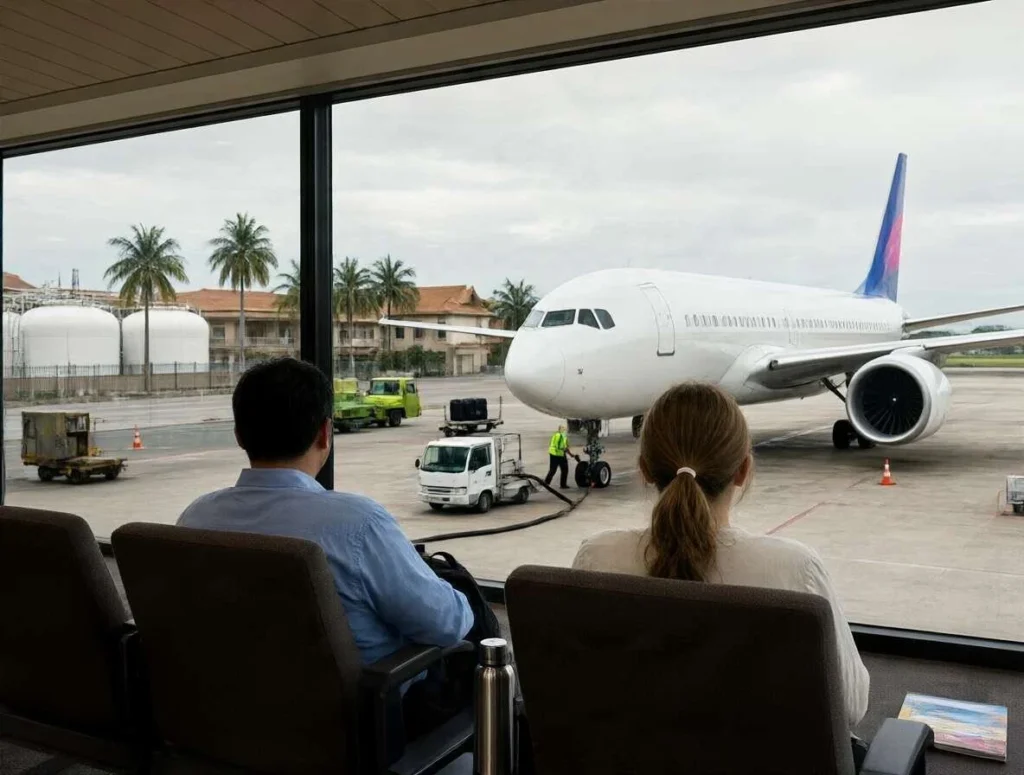
A jet fuel price gap has no single payer. In the published structure of sustainable aviation fuel prices the cost splits four ways. The airline that buys the fuel and passes part of it to its passengers, the State that penalises non-compliance. Also, funds revenue certainty, the corporate buyer that purchases certificates to cover its Scope 3 footprint. In addition, the producer who must show a lender that one of those four channels will still be there through the loan tenor. The contract under which a buyer commits to future volumes, an offtake, decides which channel carries the real cost. Also, the SAF green premium, the extra amount a buyer pays above conventional jet fuel, is a contract question before it is a market question.
Everything below runs on published figures: industry price reporting, a survey of buyer willingness to pay, and the text of the European regulation. I keep the four channels apart because a different party pays each one, on a different calendar, against different evidence.
In short
- No single payer: the cost splits across the airline and its passengers, the State, and the corporate certificate buyer.
- How the model produces the premium: a cost-plus model deducts production costs and rebates, and the remainder forms the premium.
- Size today: SAF generally costs between 2 and 5 times more than fossil jet fuel.
- What lenders ask: at least 70 to 80 percent of annual capacity covered by offtake agreements.
- What counts: only the row the contract makes binding survives a credit review.
In this article
What the green premium actually is
I start with the arithmetic rather than the label. Under a cost-plus model the producer forecasts the total costs needed to produce the fuel. This covers feedstock, hydrogen, variable costs, fixed costs, CAPEX and OPEX, deducts rebates such as tax credits and incentives. In addition, the remaining value is the green premium. The price the buyer then pays carries add-ons beyond production. A market premium, logistics, certification, transaction-related costs, and markups throughout the supply chain. The market lacks transparency in terms of deals and prices paid, so a quoted figure is rarely comparable between suppliers. In 2024 the difference between production cost and market prices, the market premium, in Europe reached as high as around 1000 USD/tonne of HEFA SAF.
Feedstock costs are the largest component for a HEFA producer, and hydrogen is the largest component inside the variable processing costs. Today SAF generally costs between 2 and 5 times more than fossil jet fuel.
What this means for you: I split the production gap from the add-on costs before any number reaches a counterparty. This happens because the part a supplier controls is rarely the part that moves most.
Channel one, the airline and its customers
The first payer is the operator that lifts the fuel. At current price levels the SAF premium translates into an additional USD 3.6 billion in fuel costs for the industry in 2025. Airlines paid a premium of USD 2.9 billion for the 1.9 Mt of SAF available in 2025, of which USD 1.4 billion reflects the standard SAF price premium over conventional fuel. Because airlines usually operate on thin margins, they will likely pass this premium on to customers to maintain financial viability. The UK SAF mandate has triggered price spikes, leaving airlines to absorb the burden. Near-term pricing mirrors conventional aviation fuel with a CAF price index and a SAF premium applied. In addition, the index itself comes from a price reporting agency such as Argus or S&P Global Commodity Insights (Platts). Therefore, the premium stays visible on every uplift.
What this means for you: I ask for the index, the premium and the add-on costs on three separate lines. Therefore, I can see whether an increase sits in the fuel base or in the margin.
Channel two, the passenger and the State
The second payer sits downstream and behind a desk. In Europe, under ReFuelEU Aviation, airlines pay up to five times more than the price of conventional jet fuel and double the market price of SAF, without guarantee of supply or consistent documentation. Suppliers that miss the minimum shares must supply the quantities corresponding to the shortfall in the subsequent reporting period. A penalty, meaning a fine set by a Member State for a missed obligation, falls on an aircraft operator that fails to comply. It is proportionate and dissuasive and not less than twice the amount resulting from the multiplication of the yearly average price of aviation fuel per tonne by the total yearly non-tanked quantity.
A 2022 study found that a levy rising from 0 USD on a passenger’s first flight of the year to 177 USD on their twentieth flight could generate 121 billion USD in annual revenue to pay for developing the SAF market.
What this means for you: I keep the compliance line in a separate row from the fuel line. This happens because the fine and the shortfall obligation follow a regulatory calendar that my fuel budget does not.
Channel three, the public buyer and the revenue guarantee
The third payer is the State, through grants and a price floor. Also, the United Kingdom has offered more than 200 million GBP in upfront grant funding to second-generation SAF projects via its Advanced Fuels Fund, paired with its SAF mandate. Also, a revenue certainty mechanism which will take effect by the end of 2026. That mechanism allows SAF producers to sign a 15-year contract with a counterparty at a fixed guaranteed strike price. Both sides settle against the market: when the price falls below that strike, the government reimburses producers for the losses. When the market price runs higher, producers return the profits above it.
In addition, a levy on aviation fuel suppliers funds it. Governments can ensure the largest financial contributions come from fossil jet fuel suppliers while designing cost-sharing mechanisms, which follows the polluter pays principle. I keep CORSIA in a separate column in my file until it is contracted.
What this means for you: I check whether the guarantee is a signed contract with a named counterparty or a policy intention, and I credit only the first.
Channel four, the corporate buyer of certificates
The fourth payer buys a claim rather than a ticket. Airlines and individuals downstream of the fossil fuel supply chain can share the costs. An airline can sign an offtake with a SAF producer to meet company-level goals, or partner with a business to procure voluntary SAF via Scope 3 certificates, meaning corporate credits tied to a buyer’s own travel emissions. When registries properly track the reductions, they mitigate the cost of procurement for the customer. RMI surveyed 23 companies and found corporate buyers showed an average willingness to pay 300 USD per ton of CO2 emissions abated for SAF certificates, ranging from 298 to 325 USD per ton across sectors.
Assuming a 75 percent carbon intensity reduction, that willingness to pay translates into a green premium of 2.34 to 3.93 USD per gallon, leading to a SAF price range of 9.4 to 10.96 USD per gallon. Meanwhile, the cost of SAF production ranges from 6.4 to 19.01 USD per gallon.
What this means for you: I set this row beside the fuel mandate baseline. This happens because a certificate sells only when the buyer can show what it avoided.
What a lender wants to see before it accepts the premium
Before any of this becomes cash, someone has to underwrite it. Investors often require offtake agreements to cover at least 70 to 80 percent of annual capacity. In addition, some lenders require 100 percent of the SAF produced to have reliable offtake covering the full loan tenor. The offtake contract needs to cover the tenure of debt financing, for example 8 to 14 years. A private equity-backed energy transition fund may want 15 to 20 percent levered equity returns, and such a green premium could generate the revenues needed to entice investors, with potential for bankable projects on the HEFA pathway today. Airlines and logistics service providers showed an average willingness to pay 6 USD per gallon for SAF, almost three times the price of fossil jet fuel which sits at 2.29 USD per gallon.
EASA publishes reference prices each year under Article 13 of the ReFuelEU Aviation Regulation, serving as the reference for EU Member States in their determination of penalties and for the support mechanism under the EU ETS Directive.
What this means for you: I test the bankability of the contracted row only. This happens because a lender counts an offtake it can enforce and an index it can quote.
Where the premium breaks down
The premium fails at the same two points in almost every discussion. Contract length and feedstock type are the top attributes determining purchase decisions in the RMI sample, with respondents preferring shorter offtake contracts and waste-based feedstock over crop-based alternatives. Longer contract durations tend to reduce the probability of a purchasing decision and lower the willingness to pay. This happens because buyers are hesitant to lock in long-term contracts at current prices. A contract could include clauses that let the seller renegotiate pricing mid-contract or yearly. If uncapped, that potential for price adjustment adds another layer of risk to SAF supply. Airlines have criticised the high cost of SAF purchases and called on regulators in the United Kingdom. Also, the European Union to review the timeline and trajectory of mandates amidst rising prices.
What this means for you: I cap renegotiation, I keep the initial term short and I name the feedstock. This happens because those three choices decide whether a buyer signs at all.
How I would allocate it if it were my file
I write four rows, airline, passenger and State, public revenue guarantee, corporate certificate buyer. In addition, I put one number in each row from the published figures rather than a blended average. I mark which row survives a credit review. In addition, I keep the rows apart because different parties pay them on different calendars. Then I test the total against the coverage requirement of at least 70 to 80 percent of annual capacity, and against the production cost band of 6.4 to 19.01 USD per gallon that the premium has to close. I note the rows that are expectations rather than payments, and I do not add them to the total.
My last row is the one the offtake contract makes binding, because that is the only row a lender will count. I keep every figure attached to its source and its date. Therefore, the sheet I hand over stays traceable line by line.
What this means for you: I hand over one sheet with four rows, the source and date of every number. In addition, a single line that states the contracted channel.
Sources
- IATA, 12 May 2024.
- IATA, 9 December 2025.
- ICCT, 6 October 2025.
- World Economic Forum, February 2025.
- RMI, 17 September 2024.
- Regulation (EU) 2023/2405, consulted 15 November 2026.
- EASA, 25 February 2025.
Frequently asked questions
What is the SAF green premium?
It is what remains after total production costs and rebates are taken into account in a cost-plus model, so it sits between the producer’s cost floor and the price a buyer accepts. In market terms it is the gap behind a fuel that costs 2 to 5 times more than fossil jet fuel. I treat it as a number a contract must allocate rather than a single market quote (IATA; ICCT).
Who pays the green premium, the airline or the passenger?
Both, through different channels. The airline pays first and, operating on thin margins, passes part of it to customers, while the State sets penalties and funding mechanisms that move cost onto suppliers and travellers. One 2022 study found that a levy rising from 0 USD on a passenger’s first flight of the year to 177 USD on their twentieth flight could raise 121 billion USD a year to pay for developing the SAF market (RMI; ICCT).
How much are buyers willing to pay for SAF?
RMI surveyed 23 companies with a choice experiment over price, carbon intensity reduction, feedstock type and contract duration. Airlines and logistics service providers showed an average willingness to pay 6 USD per gallon, corporate buyers 300 USD per ton of CO2 abated for certificates, and at a 75 percent carbon intensity reduction that corporate figure becomes a green premium of 2.34 to 3.93 USD per gallon (RMI).
Does a green premium make a project bankable?
Only when one channel is contracted. Investors often require at least 70 to 80 percent of annual capacity to be covered by offtake agreements, and some lenders require 100 percent of the SAF produced to be covered for the full loan tenor. A premium that exists only as an expectation meets neither test (World Economic Forum).
Not sure your project would survive a credit conversation?
A short call is usually enough to see where your project stands.
If you want these four rows turned into a contract schedule, I work through the premium allocation, the index choice. Also, the coverage requirement with you in a single pass: offtake agreements.
I do not provide investment advice or arrange investments. I act as a strategic advisor and facilitator.

Alex, Founder of WeConnect Asia
I help low-carbon fuel and carbon removal project developers in Southeast Asia secure the commercial and financial partners needed to reach FID.
Related articles

Pitching a Climate Tech Company to Strategic Investors: What the Corporate Has to Believe Before It Writes a Cheque
How to pitch a climate tech company to strategic investors: the metric cluster, the readiness evidence and the ask that corporates fund.

Biomethane: What It Is, How It Is Made and Who Buys It
Biomethane is biogas cleaned to pipeline quality. I explain how it is made, how it differs from biogas and who buys it in Southeast Asia.

CO2 Sourcing for e-SAF Projects: What the Rules Allow and What the Contract Must Say
Biogenic CO2, direct air capture or industrial flue gas: which sources an e-SAF plant may use, what they cost and which contract terms make the fuel certifiable.

Operating Performance Guarantees for SAF Plants: What Lenders Ask For
Minimum guarantees, performance damages, retesting and who stands behind them: the operating guarantees a SAF plant needs to keep debt and offtake intact.

EPC and Construction Risk in SAF Plants: What a Lender Actually Tests
FEED scope, convertible EPC, performance guarantees and damages caps: the construction risk questions a SAF project must answer before financial close.

Matching Feedstock and Offtake Risk Back-to-Back in a SAF Project: How Lenders Read the Chain
Lenders do not buy a feedstock plan and an offtake plan separately. They buy the link between the two, and the link is where most SAF files break.