
Home » SAF Mass Balance and Chain of Custody: Proving the Fuel You Claim
SAF Mass Balance and Chain of Custody: Proving the Fuel You Claim
10 min read · Nov 2, 2026 · By Alex
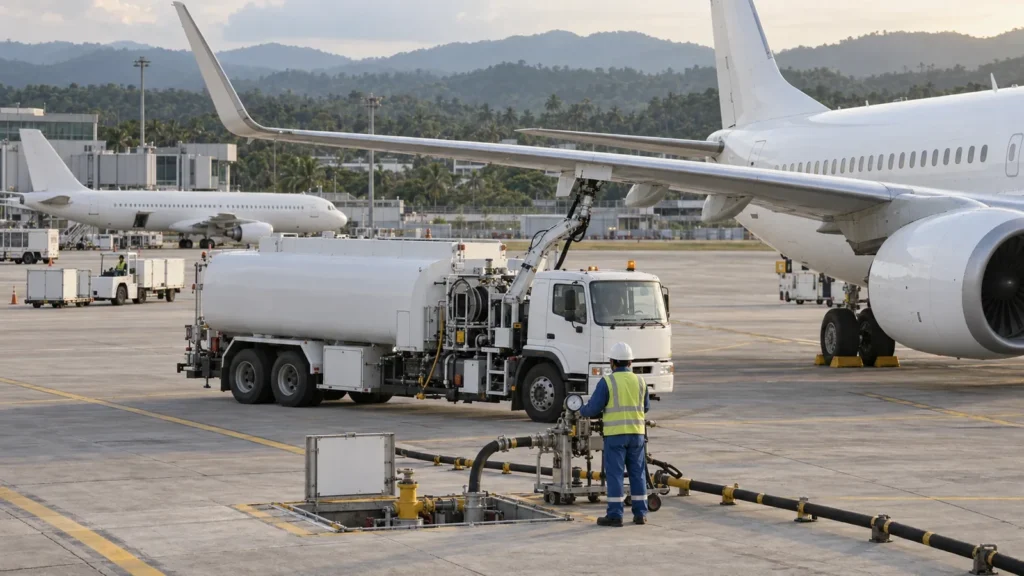
When certified fuel and conventional jet fuel enter one hydrant system, the molecules become indistinguishable within minutes. The environmental claim must nevertheless stay attributable to a named buyer. I write for a developer at pre-FID structuration stage in Southeast Asia asking how to prove sustainable origin once everything is mixed. The direct answer: sustainable aviation fuel accounting permits SAF mass balance, a model that lets certified. In addition, conventional fuel be co-mingled in common infrastructure, on the condition that the party claiming the volume physically withdraws an equivalent mass from that same system. The alternative, book and claim, decouples the attribute from the physical fuel.
This article explains how a sustainable aviation fuel claim survives co-mingling, the certified chain behind it, the documents it produces, and the commercial weight of those documents. I keep to what each model requires instead of judging one scheme against another. Everything below targets pre-FID structuration.
In short
- Mechanism: SAF mass balance lets certified. In addition, conventional fuel mix in shared infrastructure. With the claimed mass matched by an equivalent withdrawal from that same system.
- Chain: Every handover point in the supply chain needs certification so attributes can be documented.
- Documents: Three records carry the claim: origin, compliance and ownership.
- Registry: Certificates are logged one to one against volume uplifted so no reduction is claimed twice.
- Commercial: Paperwork decides which mandated markets you can serve and on what terms.
In this article
The short answer: co-mingled fuel, matched withdrawal
Chain of custody is the set of rules that tracks a material through every hand it passes. In addition, it is the frame for everything below. Under SAF mass balance, co-mingling of SAF and conventional aviation fuel into common infrastructure is allowed. However, users must physically uplift fuel from that infrastructure (IATA). The mass of SAF blended into the fuel system is matched to an equivalent mass of fuel being withdrawn by the fuel purchaser. Even though the original fuel molecules have not been directly traced (ICCT). That match lets a SAF purchaser claim SAF use even if most fuel molecules in shared supply infrastructure are of fossil origin (ICCT). SAF is only approved for use blended with conventional fuel. Therefore, once co-mingled in existing distribution and fueling infrastructure its molecules can no longer be traced independently (IATA).
What this means for you: your claim rests on a documented mass match rather than on tracked molecules. Therefore, the contract must fix where you uplift and how much.
Why an accounting system exists at all
The physical fuel and the environmental claim are two different goods on two different paths. An accounting mechanism lets airlines track and claim the environmental benefit of their purchases and separates those claims from the physical journey of the fuel, while operators. In addition, their customers address a shared emissions responsibility without double counting, where one reduction is claimed twice, through transparent and credible registry systems (IATA). Without such a mechanism, sustainability attributes can only be ascertained if SAF stays segregated from conventional fuel from origin to wing (IATA). When materials move along the supply chain. Their attributes, including sustainability benefits, carry tracking, documentation and verification via the chain of custody (RSB).
That is why the sustainability criteria must be settled before any paper moves. Emissions reductions are then accounted for separately from the physical product while remaining allocated to their rightful owner (IATA).
What this means for you: fix the attribute you intend to claim early. That is because a registry entry only carries what your scheme verified.
The certified chain: who has to be certified
Every entity along the supply chain must hold certification. That is because certification lets that entity issue a traceable document proving the sustainability attributes of the material (IATA). The entities needing certification are those where significant changes to properties. In addition, environmental attributes take place as the material passes through their custody: feedstock producers and providers, feedstock transporters, feedstock traders, SAF producers, SAF blenders and SAF suppliers (IATA). Certification schemes such as RSB and ISCC consider lifecycle greenhouse gas emissions, direct and induced land-use change, water supplies, high conservation value areas and biodiversity, socio-economic conditions of farmers and local population, and food security (IATA). The schemes verify the criteria set by governments and regulations, including the EU Renewable Energy Directive and CORSIA (IATA). I do not rank schemes; I check which one the destination market accepts for the volume I am placing.
What this means for you: list each handover in your chain. In addition, confirm certification status before you sign, because an uncertified custody point breaks the document trail.
The documents that carry the claim
A claim only travels on paper. Three documents belong in a SAF procurement contract. A proof of sustainability is the delivery document issued by a certified supplier for each delivery of sustainable material. Under a CORSIA approved or an EU RED sustainability certification scheme (IATA). A proof of compliance is issued under the EU RED sustainability certification scheme by a certifying organization such as ISCC or RSB (IATA). Also, a product transfer document authenticates the transfer of ownership of the SAF from seller to buyer (IATA). The agreement should also fix fuel specification, sustainability certification and pricing, plus the assignment of renewable energy and minimum emissions reduction requirements via a credible accounting mechanism (IATA).
In some circumstances a proof of sustainability does not reach the buyer, so a product transfer document or proof of compliance may be offered instead; I verify what the destination jurisdiction accepts (IATA).
What this means for you: write the three documents into the offtake template now. That is because a missing proof of sustainability is a missing claim later.
Where book and claim takes over
Book and claim is a chain-of-custody model in which the administrative record flow does not necessarily connect to the physical flow of material (RSB, citing ISO 22095:2020); the customer decouples the attribute from the physical product. In addition, transfers it via a dedicated registry (RSB). Buyer and seller need no physical supply chain link here (RSB). A fuel supplier mixes SAF into shared jet fuel infrastructure at another airport on behalf of the airline making the purchase, while other aircraft receive the molecules and the purchaser gets credit (ICCT). With production in a restricted number of locations, mass balance preserves the current uneven distribution of SAF, while book.
In addition, claim lets production happen where it is most efficient, cuts logistics costs, avoids transport emissions and promotes competition (IATA). CORSIA already recognizes book and claim by allowing SAF use reporting based on purchase records (IATA).
What this means for you: decide per volume whether you uplift from the shared system or book the attribute in a registry. That is because the two paths need different counterparties.
Double counting, registries and the Scope 3 question
The risk is a claim counted twice: double counting, where one reduction credits more than one party. SAF sustainability certificates carry tracking in registries that log purchases, each recording the volume. In addition, type of SAF produced and its life-cycle greenhouse gas emissions intensity (ICCT). A one-to-one ratio between certificates purchased and volume uplifted means no double counting in corporate greenhouse gas reporting (ICCT). End-user certificates are Scope 3 certificates. That is because a business’s air travel emissions sit in the Scope 3 category of the GHG Protocol corporate emissions accounting framework (ICCT). Airlines can only show lower per-seat emissions to customers if those Scope 3 certificates are retired on their behalf; if sold to corporations.
Only the corporation claims the reduced footprint (ICCT). The RSB Book & Claim Manual sets out how attributes are registered, transferred and retired as a Book & Claim Unit, covering certification, data points, claims, double counting and additionality (RSB).
What this means for you: match certificate count to uplifted volume one to one at every reporting date.
What the paperwork is worth commercially
The documents decide which market you can sell into and on what terms. SAF prices range between 2 to 5 times conventional aviation fuel depending on pathway and feedstock (IATA), and exceed fossil jet fuel by a factor of two. In addition, up to five in mandated markets (IATA Press Release No 57). Also, in Europe under ReFuelEU Aviation, airlines pay up to five times more than the price of conventional jet fuel and double the market price of SAF, without guarantee of supply or consistent documentation (IATA). Book and claim is one of the ten financial levers that mobilise investment in SAF production, letting individual.
In addition, corporate travellers fund projects through Scope 3 certificates and diversifying revenue (World Economic Forum and Kearney). In Southeast Asia, countries rich in feedstock but without mandates could still produce SAF and sell sustainability credits to airlines elsewhere, though the system remains under development. In addition, near-term benefit is uncertain (IRENA).
What this means for you: paperwork sets market access, so confirm documentation consistency before pricing any mandated volume.
How I would run this if it were my file
I would map every counterparty before signing, because feedstock producers and providers, transporters, traders, producers, blenders. In addition, suppliers each need certification where attributes change hands (IATA). I would write the three documents into the offtake template from the start: proof of sustainability, proof of compliance and product transfer document, since a missing proof of sustainability is a missing claim (IATA). Also, I would decide early whether my volume is physically uplifted or booked. That is because mass balance requires withdrawal from the same infrastructure while book. In addition, claim does not connect buyer and seller physically (IATA; RSB). I would put a registry check into my closing conditions, so that certificates purchased.
In addition, volume uplifted stay at a one-to-one ratio (ICCT). And I would hand the whole documentation file to the financing plan as a single package, since that is where it has to hold up (how to finance a SAF project).
What this means for you: run these five checks in sequence, because each one protects a different link in the claim.
Sources
- IATA, SAF Handbook, May 2024
- RSB, consulted 16 November 2026
- International Council on Clean Transportation, 6 October 2025
- World Economic Forum and Kearney, February 2025
- IATA Press Release No 57, 9 December 2025
- IRENA, December 2024
Frequently asked questions
What is mass balance in SAF?
It is a chain-of-custody model that allows certified and conventional fuel to be co-mingled in common infrastructure, where the mass of SAF blended in is matched to an equivalent mass withdrawn by the fuel purchaser, even though the original molecules are not traced (IATA; ICCT). The purchaser still has to take physical delivery from that shared system for the claim to hold.
How does mass balance differ from book and claim?
Mass balance requires buyer and seller to be connected through a physical supply chain and the buyer to uplift fuel from the shared infrastructure, while book and claim lets the administrative record flow run separately from the physical flow and transfers the attribute through a dedicated registry (RSB; IATA). The difference is one of mechanics, not of rank.
Which documents prove a SAF claim?
At minimum a proof of sustainability issued by a supplier certified under a relevant scheme, a proof of compliance under the EU RED scheme for mandated volumes, and a product transfer document authenticating the transfer of ownership (IATA). The purchase agreement should also record fuel specification, certification and pricing conditions.
Can a passenger claim the emissions saving from mass balance SAF?
Not automatically: airlines can only represent lower per-seat emissions to customers if the Scope 3 certificates have been retired on their behalf, and where certificates are sold to corporations only the corporation can claim the reduced footprint (ICCT).
Not sure your project would survive a credit conversation?
A short call is usually enough to see where your project stands.
If you are structuring a SAF offtake and need the documentation checked against European requirements. I run that work through EU compliance and carbon intensity: criteria mapping, document review. In addition, claim mechanics for the volume you are placing.
I do not provide investment advice or arrange investments. I act as a strategic advisor and facilitator.

Alex, Founder of WeConnect Asia
I help low-carbon fuel and carbon removal project developers in Southeast Asia secure the commercial. In addition, financial partners needed to reach FID.
Related articles

Pitching a Climate Tech Company to Strategic Investors: What the Corporate Has to Believe Before It Writes a Cheque
How to pitch a climate tech company to strategic investors: the metric cluster, the readiness evidence and the ask that corporates fund.

Biomethane: What It Is, How It Is Made and Who Buys It
Biomethane is biogas cleaned to pipeline quality. I explain how it is made, how it differs from biogas and who buys it in Southeast Asia.

CO2 Sourcing for e-SAF Projects: What the Rules Allow and What the Contract Must Say
Biogenic CO2, direct air capture or industrial flue gas: which sources an e-SAF plant may use, what they cost and which contract terms make the fuel certifiable.

Operating Performance Guarantees for SAF Plants: What Lenders Ask For
Minimum guarantees, performance damages, retesting and who stands behind them: the operating guarantees a SAF plant needs to keep debt and offtake intact.

EPC and Construction Risk in SAF Plants: What a Lender Actually Tests
FEED scope, convertible EPC, performance guarantees and damages caps: the construction risk questions a SAF project must answer before financial close.

Matching Feedstock and Offtake Risk Back-to-Back in a SAF Project: How Lenders Read the Chain
Lenders do not buy a feedstock plan and an offtake plan separately. They buy the link between the two, and the link is where most SAF files break.