
Home » SAF Price Mechanisms: Fixed, Indexed and Cost-Plus, and What Each Does to Risk
SAF Price Mechanisms: Fixed, Indexed and Cost-Plus, and What Each Does to Risk
10 min read · Nov 2, 2026 · By Alex
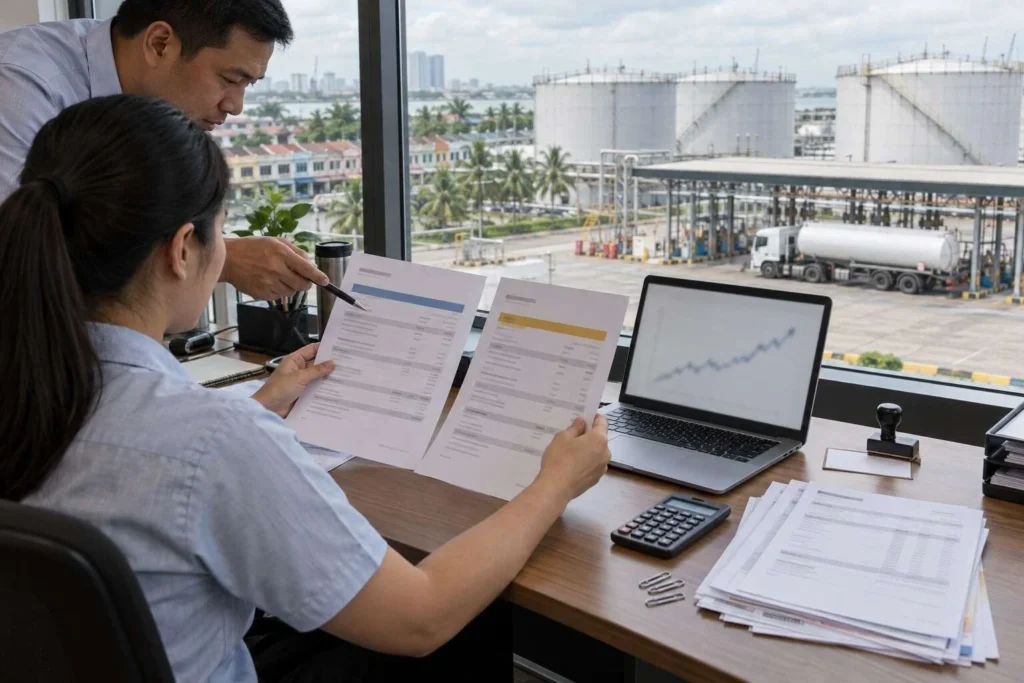
There is no single published price for sustainable aviation fuel, so a contract has to pick a base, an adjustment rule and a party that absorbs the movement. The published options are a fixed contractual price, a conventional aviation fuel or SAF index with an agreed premium, a cost-of-production assessment from a price reporting agency, meaning a firm that publishes price assessments, a cost-plus model that follows the inputs, and at the far end a long-term sales contract with no price set in advance. The one that survives credit review is the mechanism whose price base the lender already understands. That is the test I apply to SAF price mechanisms in offtake structures.
I compare these options side by side, because the pricing choice is made before financial close and is rarely revisited once debt is drawn. Here an index is a published price series for a named trading market, used as the base of a formula. My question is narrow: which base carries a credit review.
In short
- No single price: the contract picks a base, an adjustment rule and a party that absorbs movement.
- The invoice stack: logistics, certification, transaction costs and markups sit between plant gate and invoice.
- Feedstock first: the largest line for a HEFA producer decides who absorbs the swing.
- The menu: index plus premium, cost-of-production, cost-plus, or no price set in advance.
- Credit test: a base the lender already understands, covered for the debt tenor.
In this article
There is no single SAF price
Nothing in this market starts from a quotation. The price that airlines pay for SAF, in addition to the production costs, incorporates add-on costs such as a market premium, logistics, certification, transaction-related costs, and markups throughout the supply chain. A market premium is the gap between what the fuel costs to produce and what the market charges for it. In 2024, that gap in Europe reached as high as around 1000 USD/tonne of HEFA SAF, while SAF prices fluctuated throughout the year and the market lacks transparency in terms of deals and prices paid.
That is the sentence I put on top of the model: the number I am pricing against is a stack, not a quote. Two offers can carry the same production cost and different invoice levels.
What this means for you: I ask for the stack in writing, line by line, and I price a mechanism only after the add-ons are visible.
What the buyer's invoice is made of
The premium is visible at the buyer’s end. Airlines paid a premium of USD 2.9 billion for the 1.9 Mt of SAF available in 2025, of which USD 1.4 billion reflects the standard SAF price premium over conventional fuel. At current price levels, the SAF premium translates into an additional USD 3.6 billion in fuel costs for the industry in 2025, and SAF prices exceed fossil-based jet fuel by a factor of two, and by up to a factor of five in mandated markets.
I keep the published levels in view through published SAF price benchmarks. A mechanism is only as good as the add-ons it names: logistics, certification, transaction costs and supply chain markups all sit between the plant gate and the invoice. A contract that fixes only production cost leaves the buyer carrying the part that moves most.
What this means for you: I name every add-on in the pricing clause, or I treat the fixed base as an incomplete answer.
Feedstock is the line that moves
Feedstock costs are the largest cost component for a HEFA producer, and hydrogen is the largest cost component within the variable processing costs. The cost-plus model forecasts the total costs needed to produce the SAF, covering feedstock, hydrogen, variable cost, fixed costs, CAPEX and OPEX, deducts rebates such as tax credits and incentives, and the remaining value is the green premium: the part of the price the buyer pays for the environmental attribute.
Because that line moves with the market, every SAF price mechanism below is really an argument about who absorbs the movement. I check input supply before I look at the index, and feedstock availability in Southeast Asia is one page I read when the plant sits far from its inputs. A contract that allows a wider mix of feedstocks gives me a narrower swing to price. I write that mix into the formula rather than into a side letter.
What this means for you: I treat feedstock as a risk allocation question first and a cost question second.
The published menu
IATA’s published menu runs from near-term one-off or annual contracts on a conventional aviation fuel or SAF index, to long-term offtake agreements on cost-of-production or cost-plus, to a strategic equity stake at unspecified pricing. Near-term pricing mirrors conventional aviation fuel: a CAF price index with a SAF premium applied, or a SAF price index, both published by a price reporting agency. Argus FOB Singapore and Platts CIF ARA are bases to which logistics costs, fees and a supplier’s margin are added, and I read these SAF price mechanisms against ReFuelEU offtake planning.
Cost-of-production pricing is an estimated ex-refinery cost calculated from assessed feedstock prices and related costs, while cost-plus forecasts the full cost stack and passes feedstock and hydrogen fluctuation from seller to buyer. The far end sets no price in advance: long-term sales contracts priced at delivery by market price or agreed formula with floor prices, and contracts for differences, where the offtaker pays the difference when market prices fall below agreed levels and the reverse when they rise (Global Trade Funding, 13 March 2022).
What this means for you: I pick one row and I write down which movement each row hands to the buyer.
Policy sits inside the price
Mandates change the level an index has to reflect. In Europe, under ReFuelEU Aviation, airlines pay up to five times more than the price of conventional jet fuel and double the market price of SAF, without guarantee of supply or consistent documentation, the UK SAF mandate has triggered price spikes leaving airlines to absorb the burden, and e-SAF faces a much higher cost base, potentially up to 12 times that of conventional jet fuel. Demand the index reflects is policy made. In 2025 SAF output is expected to reach 1.9 million tonnes, double the 1 Mt produced in 2024, representing only 0.6% of total jet fuel consumption, rising to 2.4 Mt and 0.8% in 2026.
I track the mandate side at SAF mandates. Dentons puts it plainly: the long-term valuation of SAF is currently impossible as the premium for SAF is too uncertain to establish a reliable value, and the SAF price will be a function of demand, largely driven by regulatory drivers, and supply which combines feedstock costs and production costs.
What this means for you: I price the mandate as a separate variable rather than baking it into a forecast.
What a lender will actually sign
In the absence of any well-established pricing index for SAF, project finance lenders will likely require offtake to be on a fixed-cost basis or by reference to another commodity index with which lenders are familiar and comfortable (Dentons, 15 April 2025). The advantage of a CAF index as the base price is that airlines can extend their ongoing fuel price hedging practices to SAF, while the SAF premium is often higher than under long-term offtake pricing options. I carry that trade-off into the price case in the financial model.
Offtakers can share pricing risk by tying price to project performance against a benchmark set as of a stated time, so the price adjusts up or down against specified project costs or revenues (Bracewell, 10 September 2026). The credit test is simple: investors often require at least 70 to 80 percent of annual capacity to be covered by offtake agreements, and the offtake contract needs to cover the tenure of debt financing, for example 8 to 14 years (World Economic Forum, February 2025).
What this means for you: I choose the base the lender already knows how to read, then I size coverage to the debt tenor.
What each mechanism gets wrong
Every SAF price mechanism has a failure mode I write down before signature. Clauses that allow the seller to renegotiate pricing mid-contract or even yearly could be introduced, and if uncapped, this potential for price adjustment can add complexity to an airline’s fuel budget and another layer of risk to SAF supply. For cross-border deals, fixed pricing can create currency risk and indexed pricing can create benchmark risk, and sometimes a floor, a ceiling or an adjustment formula works better than either extreme. A clause that reads as flexibility in negotiation becomes a budget line later.
If the formula is complex, the contract should define the source, the timing, the fallback mechanism and who calculates adjustments, and say what happens when no benchmark is published on a given date. Market price is not a pricing mechanism: it is an invitation to fight later (Mayo Law, consulted 15 November 2026).
What this means for you: I cap renegotiation, name a fallback benchmark and treat an undefined market price as unfinished drafting.
How I would run this if it were my file
I write one row per mechanism: price base, who absorbs the feedstock movement, what happens when the benchmark is missing, and what the lender already knows how to read. Then I test the row against the published preference for a fixed-cost basis or a familiar commodity index. Then I close the contract with the two published answers on volatility: any contract should include strong transparency provisions regarding fluctuating costs, and diversifying feedstock usage in contracts could be another way to mitigate the fluctuation risk, with the latest version of the Aviation Fuel Supply Model Agreement setting out SAF clauses to protect buyers.
Nothing in that row depends on a forecast I cannot show; each entry points to a published source or a contract clause. My model then shows one mechanism, one party that absorbs the movement, and one cap.
What this means for you: I walk into review with one row per mechanism, one absorbing party and one cap, and I expect the cap to be challenged first.
Sources
- IATA, 12 May 2024.
- IATA, 9 December 2025.
- Dentons, 15 April 2025.
- Global Trade Funding, 13 March 2022.
- Bracewell, 10 September 2026.
- World Economic Forum, February 2025.
- Mayo Law, consulted 15 November 2026.
Frequently asked questions
Why is there no single SAF price index?
The premium is too uncertain to establish a reliable value, so no long-term number can be pinned down. The price depends on regulatory demand and on supply combining feedstock and production costs, and the market lacks transparency in terms of deals and prices paid. What is published moves during the year instead of settling.
What is the difference between cost-of-production and cost-plus?
Cost-of-production is a price reporting agency assessment based on the estimated ex-refinery cost calculated from assessed feedstock prices and related costs. Cost-plus forecasts feedstock, hydrogen, variable and fixed costs, CAPEX and OPEX, deducts rebates and leaves the green premium, and the cost-plus model is becoming more popular with suppliers because the risk profile favors the seller.
Can the feedstock price risk be passed entirely to the buyer?
Under cost-plus the fluctuation of feedstock and hydrogen is passed from seller to buyer, which could represent a significant shift in pricing if feedstock market price conditions change. The contract therefore needs strong transparency provisions regarding fluctuating costs and a diversified feedstock mix.
Which price base do lenders prefer?
With no well-established pricing index for SAF, lenders will likely require offtake on a fixed-cost basis or by reference to another commodity index with which they are familiar and comfortable, and a conventional aviation fuel index plus an agreed premium lets the buyer extend its existing hedging practice, which keeps the fuel budget on a familiar track.
Not sure your project would survive a credit conversation?
A short call is usually enough to see where your project stands.
When a file is ready for the next conversation, I use the same one-row-per-mechanism sheet to brief counterparties and to frame investor introductions, so the price base, the absorbing party and the cap are visible before anyone asks.
I do not provide investment advice or arrange investments. I act as a strategic advisor and facilitator.

Alex, Founder of WeConnect Asia
I help low-carbon fuel and carbon removal project developers in Southeast Asia secure the commercial and financial partners needed to reach FID.
Related articles

Pitching a Climate Tech Company to Strategic Investors: What the Corporate Has to Believe Before It Writes a Cheque
How to pitch a climate tech company to strategic investors: the metric cluster, the readiness evidence and the ask that corporates fund.

Biomethane: What It Is, How It Is Made and Who Buys It
Biomethane is biogas cleaned to pipeline quality. I explain how it is made, how it differs from biogas and who buys it in Southeast Asia.

CO2 Sourcing for e-SAF Projects: What the Rules Allow and What the Contract Must Say
Biogenic CO2, direct air capture or industrial flue gas: which sources an e-SAF plant may use, what they cost and which contract terms make the fuel certifiable.

Operating Performance Guarantees for SAF Plants: What Lenders Ask For
Minimum guarantees, performance damages, retesting and who stands behind them: the operating guarantees a SAF plant needs to keep debt and offtake intact.

EPC and Construction Risk in SAF Plants: What a Lender Actually Tests
FEED scope, convertible EPC, performance guarantees and damages caps: the construction risk questions a SAF project must answer before financial close.

Matching Feedstock and Offtake Risk Back-to-Back in a SAF Project: How Lenders Read the Chain
Lenders do not buy a feedstock plan and an offtake plan separately. They buy the link between the two, and the link is where most SAF files break.