
Home » SAF Technology Risk: How to Score TRL, Integration and Scale-Up Before FID
SAF Technology Risk: How to Score TRL, Integration and Scale-Up Before FID
10 min read · Mar 2, 2026 · By Alex
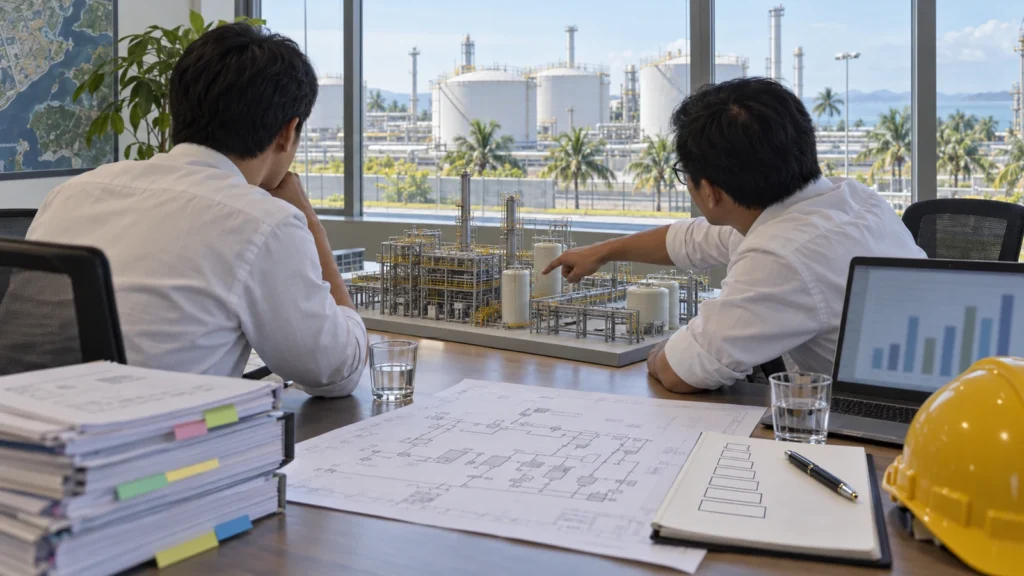
You evaluate a sustainable aviation fuel project before FID (final investment decision) by testing three things: how mature each unit of the plant actually is, whether the integrated plant has ever run as one system, and which contract carries the loss when it underperforms. The financing question sits underneath: how I finance a SAF project only answers once SAF technology risk has been scored, because that score is what a lender prices first.
Three tests, four places where a loss can land, and one contract layer that decides who absorbs it. I work through them in that order, then check what the calendar allows.
In short
- Maturity: Write the readiness level of every block with its evidence, then the configuration’s level.
- Integration: Likelihood and severity concentrate at the interfaces, so price the configuration.
- Contracts: No liquidated damages from a party that cannot pay them, no turnkey price a contractor will not sign.
- Risk transfer: Insurance up to 75 percent of the capital stack for up to 10 years, then temporary public money.
- Calendar: 4 to 5 years of build against mandates that bite in 2030.
In this article
What SAF technology risk actually covers
With no commercial-scale e-SAF facility yet operational as of October 2025, the first deployment of a given pathway is by definition FOAK (first-of-a-kind, the first commercial deployment of a given technology): no operational benchmarks, no serial learnings, no learning-curve effects (Project SkyPower with the Green Finance Institute, October 2025). The risk sits in four places: block maturity, system integration, the delivery partner, and the contract layer.
Project Finance International describes the gridlock plainly: lenders seek performance guarantees, liability coverage and access to operational data; technology providers offer limited guarantees, capped liability and control over intellectual property; and EPC (engineering, procurement and construction contract) contractors avoid an LSTK (lump sum turnkey contract), cap liability and push for rapid acceptance. A SAF SPV (special purpose vehicle) has no balance sheet to absorb it (PFI, 19 December 2025).
IRENA adds the layer on top: compared with conventional renewable energy projects, SAF projects face first-of-a-kind risks, certification requirements and long-term offtake (the contract under which a buyer takes the plant’s output) uncertainty (IRENA, 3 March 2026). So I start from a sequencing question: what has to be true to reach FID, and which of those conditions is a technology condition.
What this means for you: do not ask whether the technology works. Ask which of the four places can absorb a loss, and whether one has the balance sheet for it.
TRL: what the number proves and what it does not
The TRL (technology readiness level, the nine-point scale that grades how far a technology has moved from demonstration to routine operation) is the common language of maturity, and public money gates money with it. In the third window of the UK Advanced Fuels Fund the plant must reach TRL 6 to 8 when operational, TRL 5 pilots and TRL 9 commercial plants are ineligible, and the technology must already be at TRL 5 or above at application (ICAO, May 2025).
The same window requires a total score above 65 percent, against 50 percent in the first two windows, and a main fuel output above 45 percent of the lower heating value meeting ASTM (the body that certifies jet fuel specifications) qualification.
Two limits matter for your file. Institutional investors are sometimes prevented by their own mandates from investing below TRL 8. And blocks commercially mature up to TRL 9 still carry risk outside their traditional applications. A TRL grades a technology, not your configuration, your contractor or your site.
What this means for you: quote your TRL with its evidence, then the TRL of the configuration, because that second figure survives a lender’s review.
Integration is where the risk actually sits
The Green Finance Institute commissioned ERM to apply TRL methodology to individual technology blocks and to the integrated configurations of the two dominant e-SAF routes (October 2025). For reverse water-gas shift plus Fischer-Tropsch synthesis, ERM assigned TRL 7 on demonstrations by Ineratec and Infinium, noted the full pathway has not been demonstrated at commercial scale, and confirmed the route already holds ASTM certification.
For e-methanol to jet, ERM assigned 5 to 7: the full process has not been demonstrated at commercial scale, the fuel is not yet ASTM certified, and qualification is under review by engine and aircraft manufacturers.
The pattern is what matters: proven components have not been demonstrated in an integrated system, and adding less proven units lowers the configuration’s TRL. Likelihood and severity are higher where steps and interfaces sit at lower TRLs. ERM does not see this as a barrier to eventual e-SAF production; the concern is economic performance, meaning capital expenditure, input consumption, yield and utilisation. The number therefore lands in e-SAF project finance files rather than engineering reports.
What this means for you: price the interfaces, not the blocks. Integration risk shows up later as utilisation, yield or input consumption, which is what your debt service coverage depends on.
The contract layer: why nobody signs a turnkey price
Project finance lenders traditionally insist on a lump sum turnkey contract under which a capable, financially strong contractor guarantees completion and operational performance, which lets the SPV and its financiers invoke LD (liquidated damages, the penalty paid for delay or underperformance) for delay or shortfalls.
EPC contractors are unlikely to offer it for e-SAF: multiple new technologies in a FOAK setting make process risks hard to assess, liability becomes unclear, and a turnkey price that exists must cover both the technology and the construction risk premium.
The practical answers are an EPCM structure, or work packages grouped with manageable interfaces, contracts bundled into as few packages as possible, and LDs placed with the most creditworthy supplier in each package.
The licensor layer behaves the same way. Warranties are typically limited and insufficient to cover contractor liabilities, many licensors are small engineering firms with limited credit strength, and their warranties carry little weight in project finance terms. Fronting those obligations with a stronger counterparty such as an OEM (original equipment manufacturer) or a contractor improves accountability.
This is why the FEED (front-end engineering design) matters: it identifies and mitigates the primary risks, sets the execution model with the contractor, and is the basis on which equity and debt price risk-adjusted returns. It is estimated at 1.5 to 3 percent of TIC (total installed cost), which is 15 to 45 million euros on projects of 1 to 1.5 billion euros.
What this means for you: fund the FEED early, refuse any contract that parks liquidated damages with a party that cannot pay them, and read a missing turnkey signature as information.
Insurance and public money: what actually absorbs the loss
The oldest source I use here is a New Energy Risk presentation dated 28 February 2024, more than two years old and flagged as such. It moves technical and operating risk from project capital to insurance markets, on typical terms of up to 300 million USD per project, up to 75 percent of the capital stack and up to 10 years of coverage.
Capacity is the second constraint: a 1.5 billion euro project financed at 60/40 needs 0.9 billion euros of debt, while insurance capacity for technology risk may only reach 0.45 billion euros per policy.
The public response is a menu of public instruments: a cornerstone lender, insurance enhancements, contingent reserve facilities, matched FEED funding and backstopped supplier guarantees. IRENA and ICAO route the same idea through Finvest@ETAF, an ETAF platform of 14 partners and more than 4.15 billion USD pledged. Support must stay targeted and temporary, because extended support creates moral hazard.
What this means for you: underwrite your residual first. Once you know how much debt sits outside insurance capacity, you know how large a public instrument to request.
Feedstock and offtake: two equal pillars around the technology
On the feedstock side, PFI sets out four pathways with very different risk profiles. HEFA is the most commercially mature and the most bankable today, but availability is limited and increasingly contested by other sectors for the same waste oils and fats, including used cooking oil. Gasification is technically proven but capital-intensive and slow to develop; alcohol-to-jet offers flexibility but complex processing and few commercial examples; e-SAF, from green hydrogen and captured carbon dioxide, is the most capital-intensive of the four. HEFA has the clearest precedent for debt, the others need blended finance. Pathway detail sits in my note on SAF feedstock availability.
On the offtake side, the numbers are just as blunt: airlines resist 10 to 15 year contracts because of price volatility and uncertain future demand, while developers report investors asking for 12 to 15 year agreements that are hard to sign today. Many commitments stay short-term or non-binding, short of the certainty project financing needs. The workarounds are blended finance, partnerships and aggregators that pool demand. The drafting test sits in how to secure SAF offtake agreements.
What this means for you: test feedstock and offtake with the evidence standard you apply to the reactor. A weak feedstock case and a non-binding buyer survive no TRL.
What equity and debt ask in return
Debt providers facing stricter assurance requirements under frameworks such as Basel want proof of cash flow before they lend, and equity expects high returns. Without that proof the likely path is full equity, and a higher cost of capital raises the LCOP (levelised cost of production) and the minimum sale price, which makes the long-term offtake you need harder to secure.
Risk allocation is a principle: the SPV is shielded by transferring risk to the parties best able to manage it, sponsors take market and strategic risks, contractors cover construction and integration, and licensors and OEMs provide warranties. In practice sponsors lack balance-sheet depth and licensors cap liabilities, which inflates financing costs.
Your technical review converts that into a number: an evidence-based assessment of technology maturity, process efficiency, scalability and integration risk, which identifies bottlenecks early, improves cost forecasting and informs risk allocation (PFI, 19 December 2025).
Two design levers sit next to it. Overengineering reduces downtime at a higher upfront capital cost. Modular or hub-and-spoke designs cut the upfront requirement and allow phased investment, at the cost of higher unit costs. Green premium aggregation, pooling demand from several airlines or corporate buyers, supports the long-term offtake that technology alone cannot buy. That is my view on equity for sustainable aviation fuel in Southeast Asia.
What this means for you: decide which lever you pull before you set your capital structure, because overengineering, modularity and aggregation move your cost of capital differently.
How I would run this if it were my file
- Write the TRL of every block with its evidence, then the configuration’s TRL separately, because that is the number the lender prices.
- Price the integration, not the blocks: interfaces carry the likelihood and the severity.
- Fund the FEED before debt: 1.5 to 3 percent of TIC is the cheapest risk money in the file.
- Refuse any structure that parks liquidated damages with a party that cannot pay them.
- Buy insurance first, up to 75 percent of the capital stack for up to 10 years, then temporary public money.
- Test feedstock and offtake as strictly as the plant; a perfect reactor with no binding offtake is unfinanceable.
- Read the calendar: 4 to 5 years of build against 2030 mandates leaves an FID window in months.
The real question behind a SAF technology risk assessment is not whether the technology will work. It is who pays while it learns to work at your scale.
What this means for you: run the seven steps in that order and the file stops being an argument about technology and becomes signed risk allocation.
Sources
- ICAO, ACT-SAF series 19, May 2025.
- Project Finance International, 19 December 2025.
- Biobased Diesel Daily, republishing IRENA, 3 March 2026.
- New Energy Risk, 28 February 2024, more than two years old.
- Project SkyPower with the Green Finance Institute, October 2025.
Frequently asked questions
What TRL does a SAF project need to reach financial close?
There is no single universal number. The UK Advanced Fuels Fund third window requires TRL 6 to 8 when operational, rejects TRL 5 pilots and TRL 9 commercial plants, requires TRL 5 or above at application, and a score above 65 percent. Some funds are barred below TRL 8, so the binding constraint is often your investor base.
Is a high TRL enough to satisfy a lender?
No. Blocks that are commercially mature up to TRL 9 still carry risk outside their traditional application, and combining proven blocks in a new configuration lowers that configuration’s TRL. That is why lenders ask for performance guarantees, liability coverage and operational data rather than a maturity label.
Who pays when a first-of-a-kind plant underperforms?
In theory, the party that holds the risk: performance insurance covering up to 75 percent of the capital stack for up to 10 years, then EPC and licensor warranties. In practice warranties are limited and capacity may only reach 0.45 billion euros per policy, so a residual sits with the sponsors.
How much does a FEED study cost?
Between 1.5 and 3 percent of total installed cost, which is 15 to 45 million euros on a project of 1 to 1.5 billion euros. It establishes the basis for allocating integration risk, so parties can underwrite defined performance commitments.
Not sure your project would survive a credit conversation?
A short call is usually enough to see where your project stands.
If you want me to run this scoring against your own file, I offer technology maturity and scale-up assessment as a standalone workstream before FID.
I do not provide investment advice or arrange investments. I act as a strategic advisor and facilitator.

Alex, Founder of WeConnect Asia
I help low-carbon fuel and carbon removal project developers in Southeast Asia secure the commercial and financial partners needed to reach FID.
Related articles

Pitching a Climate Tech Company to Strategic Investors: What the Corporate Has to Believe Before It Writes a Cheque
How to pitch a climate tech company to strategic investors: the metric cluster, the readiness evidence and the ask that corporates fund.

Biomethane: What It Is, How It Is Made and Who Buys It
Biomethane is biogas cleaned to pipeline quality. I explain how it is made, how it differs from biogas and who buys it in Southeast Asia.

CO2 Sourcing for e-SAF Projects: What the Rules Allow and What the Contract Must Say
Biogenic CO2, direct air capture or industrial flue gas: which sources an e-SAF plant may use, what they cost and which contract terms make the fuel certifiable.

Operating Performance Guarantees for SAF Plants: What Lenders Ask For
Minimum guarantees, performance damages, retesting and who stands behind them: the operating guarantees a SAF plant needs to keep debt and offtake intact.

EPC and Construction Risk in SAF Plants: What a Lender Actually Tests
FEED scope, convertible EPC, performance guarantees and damages caps: the construction risk questions a SAF project must answer before financial close.

Matching Feedstock and Offtake Risk Back-to-Back in a SAF Project: How Lenders Read the Chain
Lenders do not buy a feedstock plan and an offtake plan separately. They buy the link between the two, and the link is where most SAF files break.