
Home » Tallow SAF Feedstock: What the Categories and the Volume Really Allow
Tallow SAF Feedstock: What the Categories and the Volume Really Allow
10 min read · Nov 2, 2026 · By Alex
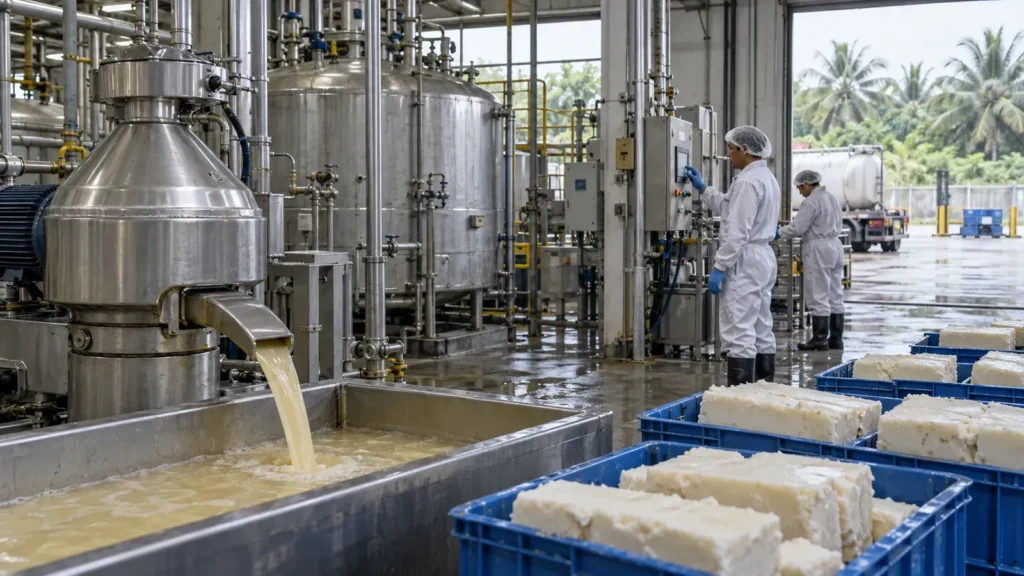
Animal fats are a usable option on eligibility. However, a small one on volume: beef tallow, pork lard and chicken fat, materials obtained from rendering plants. The renewable energy directive lists exactly two entries in part B of annex IX. They are used cooking oil and animal fats classified as categories 1 and 2 under Regulation (EC) No 1069/2009. The ICCT estimates 750,000 tonnes of animal fat feedstocks available in the EU-27 in 2030 for all uses. Also, the industrial sector expects used cooking oil and tallow to supply 40% of all SAF feedstock by 2030. The tallow SAF feedstock question therefore turns on the other users of the same tonnes. This is what I settle first, alongside the wider regional view: feedstock availability across Southeast Asia.
Before I discuss a price I settle three facts in order: grade, competing tonnage and pathway. The grade decides what can legally leave the rendering plant, while the other two set the value of the tonne. Everything below follows that sequence, because a number without its grade and its competitor attached tells me very little.
In short
- Eligibility: Part B of annex IX holds exactly two entries: UCO and animal fats classified as categories 1 and 2.
- Volume: The ICCT puts 750,000 tonnes of animal fat in the EU-27 in 2030, for all uses.
- Pathway: HEFA takes tallow today, at technology readiness level 9 and 2 to 2.5 times jet fuel cost.
- Competition: Pet food, animal feed, soap and heat and power already hold part of the same tonnes.
- Region: One operating plant in Singapore runs on UCO and animal fats, and most regional projects are still planned.
In this article
The short answer: eligible, but only two categories count
By animal fats I mean beef tallow, pork lard and chicken fat, which the ICCT describes as primarily obtained from rendering plants. Rendering is the process that separates and recovers fat from animal byproducts. The renewable energy directive sets the rules in part B of annex IX. That group of feedstocks counts only partly toward the minimum shares and can count twice its energy content. Part B holds exactly two entries: UCO, and animal fats classified as categories 1 and 2 in accordance with Regulation (EC) No 1069/2009. The European trade grades tallow in three categories: category 1 from diseased livestock, category 2 for technical purposes such as specialty chemicals and oleochemical products, and category 3 fit for human consumption, animal and aqua feed and cosmetics.
CAAFI reports that most SAF today comes from lipids such as UCO and inedible animal fats like tallow and lard, converted through the HEFA pathway.
What this means for you: eligibility is a question about grade before it is a question about supply. A load of category 3 material sits outside the file entirely, so the certificate decides whether there is a conversation.
What tallow becomes in a refinery and why HEFA takes it
The feedstocks accepted under ASTM International’s D7566 drop-in specification include fats, oils and greases, along with carbohydrates and sugars, lignocellulosic materials and industrial wastes. Sustainable aviation fuel from lipids travels one dominant road: hydrotreated esters and fatty acids, the hydrogenation of waste and vegetable oils into jet-range hydrocarbons. The ICCT finds that waste fats, oils and greases offer the cheapest and easiest means of producing SAF with current technology. IATA places HEFA above 90% of current or upcoming SAF capabilities, at technology readiness level 9. Its costs run 2 to 2.5 times conventional aviation fuel, and feedstock takes the largest share of production cost. The cost benchmarks point the same way from the other side. Tallow or animal fat forms the basis of IATA’s published production costs for the United States. Meanwhile, UCO forms the basis of the European and North Asian benchmarks.
What this means for you: the market prices a tallow offer against a pathway, not against jet fuel. Feedstock is the largest share of HEFA cost. Therefore, the grade and the index you accept matter more than the plant’s name.
What the categories decide in the file
Category 1 and category 2 under Regulation (EC) No 1069/2009 are the grades that matter here. Category 1 comes from diseased livestock, and plants can use it for biofuels. In addition, category 2 serves technical purposes such as specialty chemicals and oleochemical products. Both sit in part B of annex IX, where they count only partly toward the minimum shares and can count twice their energy content. Category 3 serves human consumption, animal and aqua feed and cosmetics. Also, regulators exclude it from biofuel production, so it never reaches the file. The European Commission’s definition of SAF under ReFuelEU Aviation covers drop-in fuels meeting the sustainability criteria of the renewable energy directive, including biofuels produced from oils and fats listed in part B. Policy risk therefore starts at the grade.
What this means for you: the certificate sets the ceiling on what you can sell into this market, and no commercial term can lift it.
What the volume actually says
The ICCT sets animal fat availability at 750,000 tonnes in the EU-27 in 2030 for all uses. It expects no rise by 2030, because other applications and limited policy support hold the pool flat. In its appendix, waste fats, oils and greases give a maximum SAF production of 1.2 Mt from 2.4 Mt of available feedstock. That equals 1.9% of 2030 jet fuel demand. The industrial sector expects used cooking oil and tallow to supply 40% of all SAF feedstock by 2030. That share assumes tallow holds its place against every other lipid. IATA notes that second generation feedstock carries high emission reduction potential, yet supply stays relatively thin. ReFuelEU Aviation turns that scarcity into a compliance obligation rather than a preference.
What this means for you: the headline number is a ceiling across all uses, not a promise to one plant. So I size the file against the tonnes left after everyone else draws.
What Southeast Asia runs today
IRENA’s table of planned and operating plants lists Neste at Tuas in Singapore, on UCO and animal fats. That line runs 1,000,000 tonnes a year since the third quarter of 2023. Planned projects lean on UCO and palm residues. IATA expects China and ASEAN to hold about 240 Mt of biomass feedstock for SAF by 2050. Singapore targets 1% SAF for all departing flights from 2026, rising to 3 to 5% by 2030. The ICCT’s warning still applies: the road sector already consumes most waste oils, and supply stays highly constrained. Before I count any tonne I run it through CAAFI’s feedstock readiness score. The score grades a material on production status, market status, programme support and regulatory compliance, plus its link to an approved conversion process. Sustainability standing sits alongside that score.
What this means for you: the regional base is real but concentrated in a few operating lines. A new claim on tallow therefore competes with plants already running and with the road sector for the same barrel.
Three ways the tallow assumption fails
First, the grade. Category 3 sits outside the file, and the ICCT notes that EU biofuel policies would accept only a portion of animal fats. The material has other uses and limited policy support. Second, the competing users. Inedible fats go to pet food, animal feed and soap processing. Animal fats also serve heat and power production, and Germany does not support them in its biofuel mandate at all. Third, the market. Stillwater Publications gives a clear bottom line: demand for low carbon fuels points to significant tightness, especially for waste oils like UCO and tallow. Quantities not used as biofuel feedstock go to food, animal feed or oleochemical inputs. Each failure tends to arrive after the parties agree the price.
What this means for you: I treat all three as diligence questions with dates attached, because they move faster than a long supply contract.
The order I would run the work in
I confirm the grade against Regulation (EC) No 1069/2009 before any price discussion, because category 3 ends the conversation. I confirm which users already hold the tonnage, including pet food, animal feed, soap and heat and power. Moreover, I confirm the scheme classification of the material and its standing under part B. Only categories 1 and 2 appear there. In addition, I confirm the pathway and the plant that will take it. HEFA sits at technology readiness level 9, and standalone plants take 3 to 5 years to build and start production. Offtake work only starts once those four points are on paper. Only then do I discuss indexation: IATA’s published cost of production for the United States already uses tallow or animal fat as its basis.
What this means for you: running the sequence in that order saves weeks of negotiation on a number the certificate would have settled first.
How I would run this if it were my file
I put four things on one page before I take anything to committee. The first is the grade certificate from the rendering plant, and the second is the availability left after competing uses. The third is the readiness of the plant that will take it, and the fourth is the numbers behind each. That page carries 750,000 tonnes of EU animal fat for 2030 and the two entries of part B of annex IX. It also shows the 40% share of SAF feedstock expected from used cooking oil and tallow by 2030. Then comes HEFA at 2 to 2.5 times jet fuel cost and the Singapore plant that runs on UCO and animal fats today. Anything missing goes to the bottom of the pile.
What this means for you: a file that carries its grade, its competitors and its pathway on one page gets a straight answer in the first meeting. A file that does not gets a question about the grade instead.
Sources
Frequently asked questions
Is tallow an approved SAF feedstock?
Yes, through HEFA. Most SAF today is produced from lipids such as UCO and inedible animal fats like tallow and lard, HEFA is approved under ASTM D7566 and the resulting fuels can be blended up to 50% by volume with petroleum-based kerosene, and part B of annex IX covers animal fats classified as categories 1 and 2. Approval of the pathway does not by itself give you a buyer or a price.
What is the difference between category 1, category 2 and category 3 tallow?
Category 1 comes from diseased livestock and can be used for biofuels. Category 2 serves technical purposes such as specialty chemicals and oleochemical products. Category 3 is fit for human consumption, animal and aqua feed and cosmetics, and it is excluded from biofuel production. Only categories 1 and 2 appear in part B of annex IX, so the grade on the certificate decides which material can enter the file at all.
How much tallow can a SAF project count on?
The ICCT estimates 750,000 tonnes of animal fat feedstocks available in the EU-27 in 2030 for all uses, set at 2019 consumption rates, and expects no substantial increase by 2030. That pool is shared with pet food, animal feed, soap and heat and power, so the portion that actually reaches a SAF plant is smaller than the headline figure suggests.
Does using tallow lower the carbon intensity of the fuel?
The evidence I have says these feedstocks typically carry a lower carbon intensity and a favourable classification in European rules, while the exact value still depends on the certified life cycle assessment behind the batch. I do not quote a figure until the certificate for that batch is in front of me.
Not sure your project would survive a credit conversation?
A short call is usually enough to see where your project stands.
If you are at feasibility stage and want the grade, the competing uses and the pathway laid out before you approach a buyer or a lender, I can run that review with you: investor introductions and the surrounding file preparation sit on top of this same base.
I do not provide investment advice or arrange investments. In addition, I act as a strategic advisor and facilitator.

Alex, Founder of WeConnect Asia
I help low-carbon fuel and carbon removal project developers in Southeast Asia secure the commercial and financial partners needed to reach FID.
Related articles

Pitching a Climate Tech Company to Strategic Investors: What the Corporate Has to Believe Before It Writes a Cheque
How to pitch a climate tech company to strategic investors: the metric cluster, the readiness evidence and the ask that corporates fund.

Biomethane: What It Is, How It Is Made and Who Buys It
Biomethane is biogas cleaned to pipeline quality. I explain how it is made, how it differs from biogas and who buys it in Southeast Asia.

CO2 Sourcing for e-SAF Projects: What the Rules Allow and What the Contract Must Say
Biogenic CO2, direct air capture or industrial flue gas: which sources an e-SAF plant may use, what they cost and which contract terms make the fuel certifiable.

Operating Performance Guarantees for SAF Plants: What Lenders Ask For
Minimum guarantees, performance damages, retesting and who stands behind them: the operating guarantees a SAF plant needs to keep debt and offtake intact.

EPC and Construction Risk in SAF Plants: What a Lender Actually Tests
FEED scope, convertible EPC, performance guarantees and damages caps: the construction risk questions a SAF project must answer before financial close.

Matching Feedstock and Offtake Risk Back-to-Back in a SAF Project: How Lenders Read the Chain
Lenders do not buy a feedstock plan and an offtake plan separately. They buy the link between the two, and the link is where most SAF files break.