
Home » Ethanol Feedstock for ATJ: Where the Alcohol Would Come From
Ethanol Feedstock for ATJ: Where the Alcohol Would Come From
10 min read · Nov 2, 2026 · By Alex
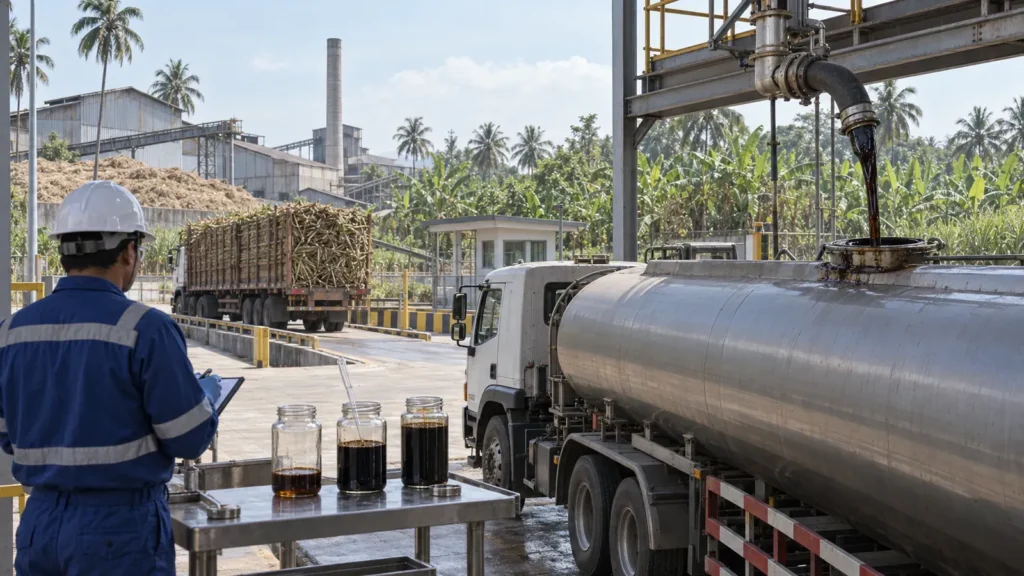
The ethanol for an alcohol-to-jet plant comes from fermenting sugars or starch, and in Southeast Asia the literature splits that into three tiers. Sugar and starch crops give the near-term volume: 7.0 million tonnes a year of sugarcane molasses convert to 0.6 million tonnes of SAF, 35.0 million tonnes of cassava roots and starch to 4.8 million tonnes, and 12.2 million tonnes of cassava residues to 1.7 million tonnes. Residues and woody material sit in a third, harder tier whose advanced ethanol costs more to make than conventional ethanol. That is the shape of the ethanol feedstock ATJ question, and the regional feedstock picture gives the denominators I work from.
I am writing for a supplier who has to pick one source and defend it. So I stay on the published conversion factors, costs and eligibility rules, and I say plainly where each source stops.
In short
- Tier one: sugar and starch crops, cheapest to ferment, available now.
- Tier two: agricultural residues, cheaper as feedstock, much dearer in capital cost.
- Tier three: woody and lignocellulosic material, largest theoretical pool, least ready.
- The chemical point: the ethanol intermediate is identical whatever the feedstock, so it can be aggregated at scale.
- The real constraint: conversion factors, competing uses and eligibility rules, not headline tonnage.
In this article
The short answer: three tiers of alcohol
The RSB conversion table gives me the regional volumes directly. Sugarcane molasses at 7.0 million tonnes a year of dry mass, that is biomass weighed without water content, converts to 0.6 million tonnes of SAF. Sugarcane for ethanol at 5.8 million tonnes converts to 0.8 million tonnes. Corn for ethanol at 6.3 million tonnes converts to 1.0 million tonnes. Cassava roots and starch at 35.0 million tonnes converts to 4.8 million tonnes. Cassava residues at 12.2 million tonnes converts to 1.7 million tonnes. Every one of those goes through ethanol and then alcohol-to-jet, so the ranking of sources by SAF output does not track the ranking by tonnage.
The reason a single plant can draw from several of these feedstocks is chemical. ICAO notes that the ethanol intermediate is chemically identical whatever the feedstock or the process, so ethanol can be transported and aggregated for large-scale ATJ facilities. That is the structural advantage of this route over gasification, where the syngas has to be made on site from a solid.
What this means for you: I would size a plant against the conversion factor, not against the tonnage I can see in a provincial agricultural statistic, because 35.0 million tonnes of cassava and 7.0 million tonnes of molasses are not comparable inputs once the ethanol yield is applied.
What the alcohol has to be made of
The ICAO conversion session lists the carbohydrates that make the alcohol: residual starch, sugar, molasses, agricultural residue or grasses, biogenic municipal solid waste with no plastics or synthetics, bagasse and wood. The same session states that selecting the carbohydrate significantly impacts scalability, capital cost, operating cost, carbon score and sustainability. Fermentation is the conversion itself, the biological process by which microorganisms turn those carbohydrates into alcohol.
The same session notes that carbohydrates as feedstock for alcohol production enable a meaningful solution for sustainable aviation fuel through fermentation of plants and organic waste, while other feedstocks for alcohol are possible but will not reach the same scale and impact. That sentence tells me where the volume sits. The pathway is certified as ATJ-SPK and uses sugar and starch crops or lignocellulosic biomass.
What this means for you: the carbohydrate I choose fixes the carbon score before any conversion technology is selected, so the sustainability screen belongs at feedstock selection, not after the plant design.
The first generation tier, and why it goes first
Molasses is the byproduct of sugar production, the dark liquid left after crystallisation, and the RSB annex applies a conversion of 5 tonnes of sugarcane molasses to 1 tonne of ethanol. First generation means the alcohol comes from food or feed crops; second generation means it comes from residues and wastes.
ICAO calls ethanol from sugar and byproducts such as molasses a cost-effective first generation ethanol that can support SAF through alcohol-to-jet, and recommends using 1G ethanol to establish commercial-scale ATJ facilities until 2G ethanol scales, because establishing ATJ plants based only on 2G ethanol would cause avoidable delays in SAF production. ICAO also records that a large sugarcane industry makes sugar and molasses ethanol cost-effective in that market.
The eligibility side is fixed by the RED. Residues and advanced feedstocks sit in part A of annex IX, where their contribution towards the minimum shares may be considered twice their energy content, a mechanism called double counting. Oils and fats sit in part B, counted once subject to caps.
What this means for you: I would fix the eligibility target of my buyer’s market before I sign a supply term, because the same tonnage earns different treatment under part A and part B.
What the alcohol costs the fuel
Advanced ethanol from agricultural residues is more complex to produce and carries a higher production cost than conventional first generation ethanol, and SAF costs through the ATJ process will be significantly higher with advanced ethanol than with conventional ethanol. Agricultural residues are much cheaper as a feedstock than molasses or maize, but the capital costs for advanced ethanol production are much higher. The cheap input does not survive the capital charge.
On the finished fuel, IRENA puts ATJ using sugarcane as a first generation feedstock in Thailand at around USD 1.6 per litre, similar to HEFA at USD 1.6 to 2.1 per litre and above the fossil Jet A-1 price of USD 0.6 per litre. IATA records that feedstock accounts for the lion’s share of total HEFA production costs and that feedstock prices vary significantly with market supply and demand dynamics.
What this means for you: I would price the tonne twice, once as feedstock cost and once as capital cost carried per litre, because the residue that looks cheap on the first line is dear on the second.
Where the regional ATJ volume actually sits
The RSB pathway projection puts ATJ at 12.3 million tonnes a year in 2025, 12.9 in 2030 and 13.7 in 2050, against FT at 22.3 rising to 24.9 and HEFA at 6.3 rising to 7.1. Total available feedstock converts to 40.9 million tonnes of SAF in 2025, 43.1 in 2030 and 45.7 in 2050.
On readiness, HEFA is the only technology currently proven through successful operations and operated at market scale, at Technology Readiness Level 9, while ATJ is not yet commercialised even though it shows low specific capital cost. FT carries high specific capital cost and high production costs. IATA puts global SAF production in 2025 at just 2 million tonnes against capacity expected to reach around 20 million tonnes by 2030 with the project success factor applied, HEFA still at about 95% of total volume. On the commercial record, the first small-scale commercial ATJ facility, LanzaJet’s Freedom Pines facility in Georgia, was expected to be completed and commissioned in early 2024. Cassava root starch is rated a medium risk feedstock that requires careful soil and water management.
What this means for you: the ATJ volume is a projection, not a queue of operating plants, so my contract has to survive a gap between the projected 12.3 million tonnes and the commissioned capacity that actually exists.
Three ways the ethanol assumption fails
First, the schedule risk. ICAO reports that many commercial-scale cellulosic ethanol facilities in Europe and the United States closed because they could not achieve capacity and were not economically viable, and that harvesting, collection, storage and handling were among the major challenges of previous commercial cellulosic ethanol efforts, with material handling problems leading to lengthy startups and failure to reach expected capacity. Raizen continues with two operating facilities in Brazil.
Second, the eligibility risk. The RED demands a phase-out of biofuels associated with high indirect land use change risk, and the annex IX treatment decides what counts as advanced. A feedstock I can source is not automatically a feedstock that counts.
Third, the competition risk. RSB rates palm oil, sugarcane and corn as higher risk food and feed crops because of intensive cultivation and direct and indirect land use change, and rates sugarcane bagasse and rice husks and straw as low risk. IRENA warns that it will be risky to rely solely on residues and wastes to meet SAF demand in many Southeast Asian countries, given existing utilisation and future competition from other end uses such as shipping fuels and biochar, as well as logistics and conversion costs.
What this means for you: I would assume the ethanol assumption fails at one of those three points and ask my offtaker which failure they are priced for.
The order I would run the work in
I would pick the tier before I pick the supplier. Fix the carbon and eligibility target first, then the sugar or starch balance sheet inside the catchment, then the conversion readiness of the route the offtaker will accept, then price the tonne against the alcohol it yields. The two anchors are the RSB conversion factors from molasses and cassava to SAF, and the ICAO point that selecting the carbohydrate drives scalability, capital cost, operating cost, carbon score and sustainability.
I would then check competing uses inside that same catchment, because IRENA records that oil palm residues are returned to soil or burned at the mill, that rice straw and husk are partly used as animal feed, soil compost and higher value products, and that a survey in Vietnam shows over 75% of farmers resort to open burning or incorporation of residues into soil. What is counted as available is often already spoken for.
What this means for you: the competing uses matter more than the spreadsheet, because a supply plan built before the eligibility target is fixed gets rebuilt anyway.
How I would run this if it were my file
I would test my own feedstock plan against the published conversions before taking it to committee: 7.0 million tonnes of molasses for 0.6 million tonnes of SAF and 35.0 million tonnes of cassava roots and starch for 4.8 million tonnes, 5 tonnes of molasses yielding 1 tonne of ethanol, the cost gap between advanced and conventional ethanol, the Thailand ATJ figure of around USD 1.6 per litre, and the regional ATJ projection of 13.7 million tonnes a year by 2050.
Then I would write the three failure modes into the memo as named risks with named mitigations, and I would carry the conversion factor as an assumption with its source attached rather than as a plant parameter.
What this means for you: if the plan cannot survive those six numbers written out in a single table, it is not ready for committee, and no additional tonnage will save it.
Sources
Frequently asked questions
Which ethanol feedstock gives the most SAF in Southeast Asia?
On the RSB conversion table, cassava roots and starch lead: 35.0 million tonnes a year of dry mass for 4.8 million tonnes of SAF, ahead of corn for ethanol at 6.3 million tonnes for 1.0, sugarcane for ethanol at 5.8 for 0.8, sugarcane molasses at 7.0 for 0.6, and cassava residues at 12.2 for 1.7, all through ethanol and ATJ. The lead follows from the conversion factor, not from a larger raw tonnage than every other family in the region.
Is first generation ethanol acceptable for SAF?
Yes. Ethanol from sugar and byproducts such as molasses is a cost-effective first generation feedstock that can support SAF through ATJ, and ICAO recommends using it to establish commercial-scale ATJ facilities until 2G ethanol scales, provided the eligibility rules for the market I sell into are met.
Why does advanced ethanol cost more?
Advanced ethanol from agricultural residues is more complex to produce than conventional ethanol, and while residues are cheaper than molasses or maize, the capital cost of advanced ethanol production is much higher, which pushes SAF costs through ATJ up accordingly. The input saving is real and the capital charge is larger.
What should my feasibility study check first?
Three checks in order: the carbon and eligibility target of the buyer’s market, the local sugar or starch balance sheet and its competing uses, and the conversion readiness of the route plus the conversion factor I am assuming from feedstock to ethanol.
Not sure your project would survive a credit conversation?
A short call is usually enough to see where your project stands.
If you want a second pair of eyes on a feedstock plan built in this order, I run that review as part of my introductions work, where the conversion table and the offtaker’s eligibility screen are read together before anyone is put in the room.
I do not provide investment advice or arrange investments. I act as a strategic advisor and facilitator.

Alex, Founder of WeConnect Asia
I help low-carbon fuel and carbon removal project developers in Southeast Asia secure the commercial and financial partners needed to reach FID.
Related articles

Pitching a Climate Tech Company to Strategic Investors: What the Corporate Has to Believe Before It Writes a Cheque
How to pitch a climate tech company to strategic investors: the metric cluster, the readiness evidence and the ask that corporates fund.

Biomethane: What It Is, How It Is Made and Who Buys It
Biomethane is biogas cleaned to pipeline quality. I explain how it is made, how it differs from biogas and who buys it in Southeast Asia.

CO2 Sourcing for e-SAF Projects: What the Rules Allow and What the Contract Must Say
Biogenic CO2, direct air capture or industrial flue gas: which sources an e-SAF plant may use, what they cost and which contract terms make the fuel certifiable.

Operating Performance Guarantees for SAF Plants: What Lenders Ask For
Minimum guarantees, performance damages, retesting and who stands behind them: the operating guarantees a SAF plant needs to keep debt and offtake intact.

EPC and Construction Risk in SAF Plants: What a Lender Actually Tests
FEED scope, convertible EPC, performance guarantees and damages caps: the construction risk questions a SAF project must answer before financial close.

Matching Feedstock and Offtake Risk Back-to-Back in a SAF Project: How Lenders Read the Chain
Lenders do not buy a feedstock plan and an offtake plan separately. They buy the link between the two, and the link is where most SAF files break.