
Home » Land Use Change and ILUC in SAF: Where the Certification Weight Sits
Land Use Change and ILUC in SAF: Where the Certification Weight Sits
10 min read · Nov 2, 2026 · By Alex
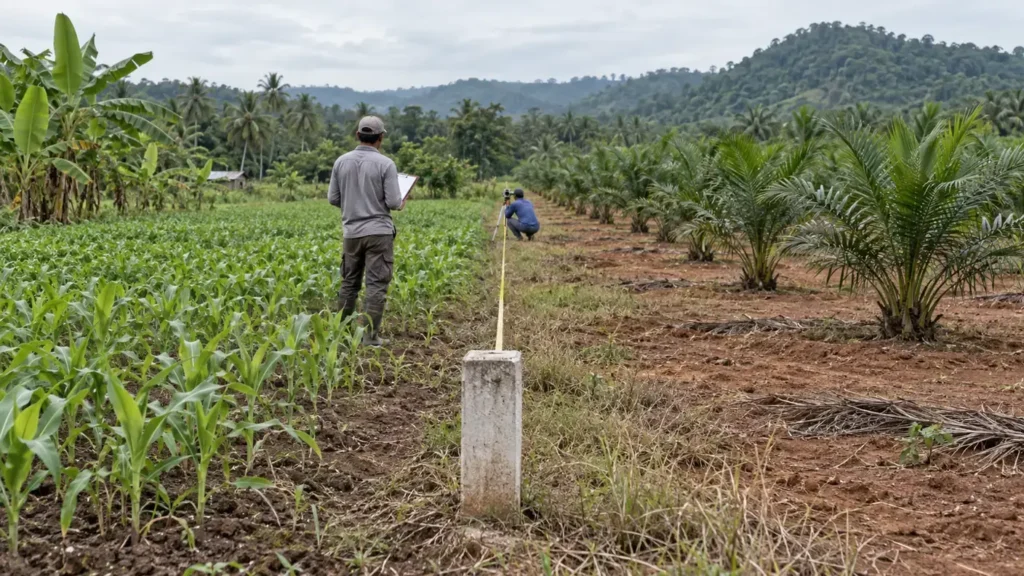
The land question in a fuel certification file has a simple root. You cannot observe part of the clearing behind a feedstock on the plot. The file therefore has to model it. Indirect land use change expands agricultural land through the market. It occurs when farmers divert cropland to biofuel feedstocks. It can release stored carbon that offsets some or all of the climate benefit of the fuel.
Regulators therefore cap rather than score. RED III caps conventional biofuels from food and feed crops at 7 percent of transport energy. It phases palm oil-based fuels out by 2030 unless certified as low ILUC-risk. ReFuelEU Aviation does not count food or feed crop fuels toward the sustainable aviation fuel mandate. CORSIA folds land-use effects into its life-cycle assessment. Since July 2025, the United States has excluded ILUC from the calculation used to set 45Z credit values. That is the answer I give when a lender asks why land use change keeps appearing in an iluc saf feedstock file, and the regional feedstock availability view is where I begin.
I write this for the reader at pre-FID structuration. That reader needs to know what land use change does to the numbers rather than to the narrative. The short version: the debate over the number continues. Europe caps volume instead, and my file must show which treatment applies.
In short
- The split: direct land use change is observed on the plot, ILUC is market-mediated and therefore modelled.
- The European cap: 7 percent of transport energy. It is also one percentage point above the member state’s 2020 share, whichever is lower.
- The phase-out: palm oil-based fuels leave by 2030 unless certified as low ILUC-risk.
- The mandate test: food or feed crop fuels and high ILUC-risk feedstocks do not count under ReFuelEU Aviation.
- The accounting: CORSIA puts ILUC inside the life-cycle assessment, so modelled land-use effects raise emissions values.
In this article
The short answer: a modelled number that regulators cap instead of score
I split the land question in two before anything else. Direct land use change expands cropland for feedstock production. You can observe and account for it directly, for instance a forest cleared for a palm oil plantation. Indirect land use change happens through market-mediated responses. Increased demand for crops as feedstocks raises crop prices. It creates incentives to convert non-crop land to cropland. The mechanism runs through global markets. If US fuel use diverts soybean oil, higher vegetable oil prices follow. Those higher prices may induce palm oil expansion in Southeast Asia to replace it in food markets. Land conversion can therefore occur far from the production site (Resources for the Future).
Faced with that distance, EU policymakers accepted that land-use change risks matter. They found available ILUC projections too uncertain to incorporate directly into life-cycle carbon intensity scores. Quantity-based limits therefore serve as guardrails instead (Resources for the Future).
What this means for you: I do not defend a single ILUC figure in committee. I show the mechanism, the acknowledged uncertainty and the quantity limit that replaces a scored value.
Why the number moves
Model results are highly sensitive to contested assumptions and modelling choices. Also, the past predictive performance of ILUC models has been difficult to validate empirically (Resources for the Future). The founding projection put corn ethanol at nearly doubling greenhouse gas emissions over the first 30 years. The break-even point came only after about 167 years. Subsequent critiques questioned the assumptions behind those large projections. Policymakers have since relied on lower ILUC emission values (Resources for the Future).
A life-cycle assessment follows a fuel from feedstock production through conversion and use to an emissions value. Also, the carbon intensity score it assigns then drives credits, mandates or compliance. Certification schemes carry the same question: RSB and ISCC list direct and induced land-use change among their sustainability principles (IATA). I keep the certification and fuel quality page open beside the model assumptions whenever I compare two schemes.
What this means for you: the number moves because analysts choose its inputs rather than measure them. I document the choices. I treat any single figure as a range with stated assumptions rather than as a settled fact.
What Europe does with it
The renewable energy directive, known as RED III, caps conventional biofuels made from food and feed crops. The cap is 7 percent of transport energy. Alternatively it sits one percentage point above the member state’s 2020 share, whichever is lower. It also requires the phase-out of high ILUC-risk biofuels. Palm oil-based fuels carry a high ILUC-risk designation. They must exit by 2030 unless certified as low ILUC-risk (Resources for the Future).
ReFuelEU Aviation sets minimum shares of SAF that suppliers at EU airports must deliver. Fuels made from food or feed crops do not count toward the mandate. Neither do feedstocks categorized as high ILUC-risk, even when they are eligible under RED accounting (Resources for the Future). Under the EU emissions trading system, the biogenic portion of fuels counts as zero-emission. That treatment applies only if the fuels meet RED sustainability and greenhouse gas-saving criteria. RED’s ILUC screening therefore carries through to aviation. The mechanics of that chain sit on the SAF mandates page.
What this means for you: eligibility under one instrument does not imply recognition under the next. I check the mandate, the emissions trading test and the maritime rule separately. A feedstock can pass one and fail another.
What goes in the file
Annex IX part A of RED lists feedstocks for the production of advanced biofuels. Rules may count their contribution towards the minimum shares twice their energy content, the double counting mechanism. The list includes palm oil mill effluent and empty palm fruit bunches at point (g). Annex IX part B lists oils and fats from crop production. Rules may count their contribution once, subject to caps. The list includes used cooking oil and animal fats. The directive also demands a phase-out of biofuels associated with high ILUC risk. Palm oil from high ILUC-risk areas falls in that group (EUR-Lex).
The renewable energy directive definition of sustainable aviation fuel covers synthetic aviation fuels from renewable hydrogen and captured carbon, advanced biofuels from feedstock listed in part A of annex IX, biofuels produced from oils and fats listed in part B, and recycled carbon aviation fuels (European Commission). ReFuelEU aviation sets a 2% share of SAF at EU airports from 2025. This rises rise to 70% from 2050 (European Commission), and the ReFuelEU Aviation page shows how the volume share and the feedstock rules lock together.
What this means for you: I confirm the annex standing before I model anything. Part A and part B change both the counted energy and the market that accepts the fuel.
What the regional record says
The Roundtable on Sustainable Biomaterials bands sustainability risk across the Southeast Asian feedstock pool: low risk for municipal solid waste, sugarcane bagasse and rice husks and straw; higher risk for food and feed crops such as palm oil, sugarcane and corn because of intensive cultivation, direct land use change and ILUC (RSB). It records deforestation as the most significant regional risk, driven by agricultural expansion, logging and infrastructure, and requires palm oil residues to show plantation-level sustainability compliance (RSB).
The ICCT finds that lignocellulosic residues are more abundant than waste fats and, converted to SAF, generally carry higher greenhouse gas savings than food-based pathways (ICCT). EUCASS records that vegetable oils and animal oils face strict EU RED III sustainability criteria to limit indirect land use change and deforestation risks, which is why used cooking oil has become an important feedstock (EUCASS). The same screening question reaches aviation’s offset framework, where CORSIA incorporates ILUC into life-cycle assessments so that fuels with higher modelled land-use effects receive higher emissions values and smaller compliance benefits (Resources for the Future).
What this means for you: the feedstock’s risk band decides the file, not the project’s brand. It sets how much of the file goes to land-use defence. I start by classifying the feedstock.
Three ways the assumption fails in a file
First, the model itself: contested assumptions move the result and empirical validation is hard. Two teams can therefore price the same feedstock differently, and both can defend their inputs (Resources for the Future).
Second, the jurisdiction split: California’s Low Carbon Fuel Standard penalises the same project for ILUC. It accounts for ILUC in each fuel’s carbon intensity score, and credits are tradable. A fuel assigned higher ILUC emissions may therefore stop generating credits or begin generating deficits. From 2025 the 45Z credit replaced 40B. The July 2025 legislation extended 45Z through 2029. It directed Treasury to exclude ILUC from the calculation used to set its values (Resources for the Future). Europe keeps caps and phase-outs.
Third, the feedstock’s standing: palm oil-based fuels leave the European market by 2030. They escape only when certified as low ILUC-risk (Resources for the Future). The United States does not use virgin palm oil as a biofuel feedstock. Europe and the United Kingdom use it minimally.
What this means for you: I record which jurisdiction governs the buyer’s compliance before any emissions assumption. Each jurisdiction scores the same feedstock differently.
The order I would run the work in
No commercial conversation opens before the file fixes the regulatory treatment. This is the order I keep.
- Scheme treatment: get the certifier’s ILUC treatment in writing. Ask for its sustainability principles and its documentation of direct and induced land-use change (IATA).
- Annex standing: confirm whether my feedstock sits in annex IX part A, counted twice its energy content, or part B, counted once subject to caps (EUR-Lex).
- Model output: confirm which life-cycle values the model produces and on what assumptions, with contested inputs named (Resources for the Future).
- Market access: confirm the rules my buyer works under, whether the mandate counts the fuel, and which chain of custody applies (IATA).
- Price: only then discuss price with the counterparties who fund and offtake this kind of supply, once the SAF price mechanisms are settled.
What this means for you: the sequence protects the file from a changing number. The number would change once the price conversation has started.
How I would run this if it were my file
I put one page in front of committee before any financial model discussion. That page carries: the 7 percent cap. Also, note the one percentage point alternative above the member state’s 2020 share. That alternative sits with the 2030 palm phase-out unless certified low ILUC-risk (Resources for the Future). Note the ReFuelEU Aviation exclusion of food or feed crop fuels and high ILUC-risk feedstocks from the mandate. Those fuels stay excluded even when they are eligible under RED accounting (Resources for the Future). The annex IX part A and part B split also matters (EUR-Lex). The certification principles carry direct and induced land-use change (IATA). Residues also save more greenhouse gas than food-based pathways (ICCT). Finally, the strict RED III criteria made used cooking oil important (EUCASS).
I then state the assumption I rely on and name the modelling risk beside it. I also note which jurisdiction governs the buyer’s compliance. Nothing on that page promises offtake or price.
What this means for you: write a one-page land-use annex before the model. It stops the ILUC question from arriving as a surprise at committee. It keeps the discussion on the limits the regulator has already chosen.
Sources
Frequently asked questions
What is ILUC in a SAF certification file?
It is the market-mediated part of land clearing: increased demand for crops as feedstocks raises crop prices and creates incentives to convert non-crop land to cropland, so the emissions are modelled rather than observed (Resources for the Future). Certification schemes such as RSB and ISCC list direct and induced land-use change among their sustainability principles, alongside lifecycle greenhouse gas emissions, water supplies, high conservation value areas and biodiversity (IATA).
Which feedstocks are treated as high ILUC risk?
Palm oil-based fuels are designated high ILUC-risk and must be phased out by 2030 unless certified as low ILUC-risk (Resources for the Future). Conventional biofuels from food and feed crops, such as corn ethanol or biodiesel from soybean or rapeseed oil, are capped at 7 percent of transport energy or one percentage point above the member state’s 2020 share, whichever is lower. Other fuels could be designated in future if the evidence base supports it.
Does ILUC change the carbon intensity number my lender sees?
CORSIA incorporates ILUC into life-cycle assessments, so fuels with higher modelled land-use effects receive higher emissions values and smaller compliance benefits (Resources for the Future). Under California’s Low Carbon Fuel Standard, ILUC is accounted for in each fuel’s carbon intensity score, and because credits are tradable a fuel assigned higher ILUC emissions may eventually stop generating credits or begin generating deficits.
How do CORSIA and ReFuelEU treat ILUC differently?
CORSIA folds ILUC into the life-cycle value used for compliance, so the modelled land-use effect changes the emissions value the fuel earns. Europe caps and excludes instead: ReFuelEU Aviation does not count fuels made from food or feed crops or from high ILUC-risk feedstocks toward the mandate even when they are eligible under RED accounting (Resources for the Future). I check which treatment governs the buyer before I compare obligations.
Not sure your project would survive a credit conversation?
A short call is usually enough to see where your project stands.
If you are structuring this file and want the regulatory standing, the model assumptions and the buyer’s market access rules on one page, I open conversations with the counterparties who fund and offtake this kind of supply.
I do not provide investment advice or arrange investments. I act as a strategic advisor and facilitator.

Alex, Founder of WeConnect Asia
I help low-carbon fuel and carbon removal project developers in Southeast Asia secure the commercial and financial partners needed to reach FID.
Related articles

Pitching a Climate Tech Company to Strategic Investors: What the Corporate Has to Believe Before It Writes a Cheque
How to pitch a climate tech company to strategic investors: the metric cluster, the readiness evidence and the ask that corporates fund.

Biomethane: What It Is, How It Is Made and Who Buys It
Biomethane is biogas cleaned to pipeline quality. I explain how it is made, how it differs from biogas and who buys it in Southeast Asia.

CO2 Sourcing for e-SAF Projects: What the Rules Allow and What the Contract Must Say
Biogenic CO2, direct air capture or industrial flue gas: which sources an e-SAF plant may use, what they cost and which contract terms make the fuel certifiable.

Operating Performance Guarantees for SAF Plants: What Lenders Ask For
Minimum guarantees, performance damages, retesting and who stands behind them: the operating guarantees a SAF plant needs to keep debt and offtake intact.

EPC and Construction Risk in SAF Plants: What a Lender Actually Tests
FEED scope, convertible EPC, performance guarantees and damages caps: the construction risk questions a SAF project must answer before financial close.

Matching Feedstock and Offtake Risk Back-to-Back in a SAF Project: How Lenders Read the Chain
Lenders do not buy a feedstock plan and an offtake plan separately. They buy the link between the two, and the link is where most SAF files break.