
Home » EU ETS for Shipping: The Allowance Calendar, the Cost and the Contract Clause
EU ETS for Shipping: The Allowance Calendar, the Cost and the Contract Clause
10 min read · Nov 2, 2026 · By Alex
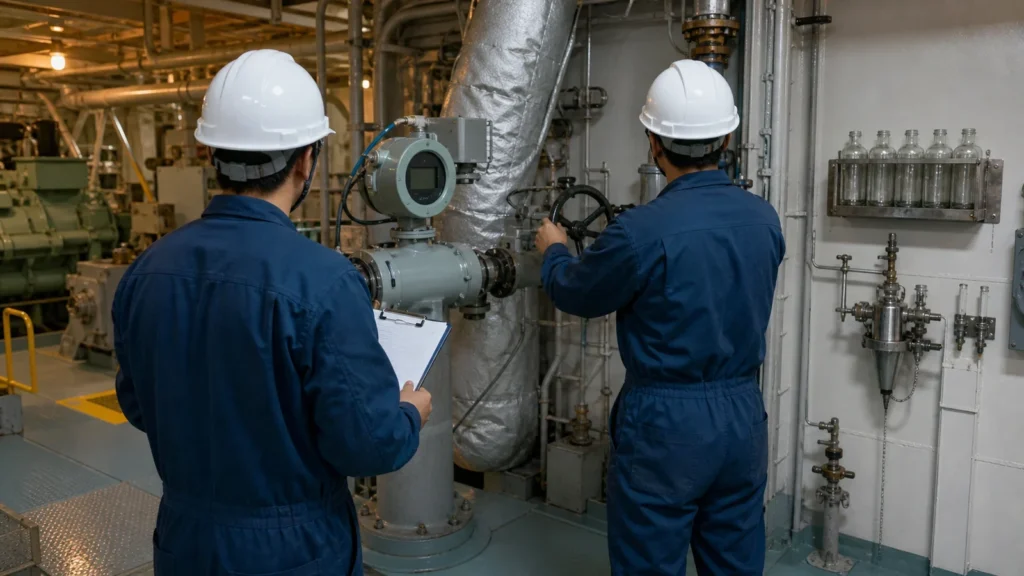
The shipping calendar is three lines: allowances covering 40 percent of verified 2024 emissions are surrendered in 2025, 70 percent of 2025 emissions in 2026, and 100 percent of 2026 emissions in 2027, with methane and nitrous oxide added from 2026, all recorded by the European Commission report of 18 March 2025. That same report puts the cost at 3.7 percent on average of total shipping costs in 2024 if no measure is taken, with surcharges of 1 percent to 5 percent on deep sea container freight in that year. The money follows the company that controls the ship, not the party that ordered the cargo, and I read the EU ETS as a compliance obligation sitting inside the sustainable maritime fuels page.
I write for an offtaker or charterer at concept stage who has found an emissions line in a draft and needs to know what it is before it is priced. Everything below is dated to the source that carries it.
In short
- The calendar: 40 percent of verified 2024 emissions are surrendered in 2025, 70 percent of 2025 emissions in 2026, 100 percent of 2026 emissions in 2027, per the report of 18 March 2025.
- The scope: 100 percent of voyages between EU or EEA ports, 50 percent of voyages in or out, for cargo and passenger ships above 5,000 gross tonnes from 2024.
- The cost effect: an average 3.7 percent increase on total shipping costs in 2024, and container surcharges of 1 percent to 5 percent observed that year, per the report of 18 March 2025.
- The counterweight: FuelEU Maritime caps the greenhouse gas intensity of energy at 91.16 gCO2e/MJ against the 2020 baseline, with a 2 percent reduction in 2025 and 6 percent in 2030.
- The clause: allowance procurement and surrender must be written into the charter party, per the club’s note of 21 January 2026.
In this article
1. The three-line calendar
The obligation attaches to the shipping company that controls the ship. It is settled in emissions allowances, which are permits to emit the global warming equivalent of one tonne of carbon dioxide, bought and surrendered once a year. Surrender means handing the allowances to the administering authority against verified emissions for the preceding year, not against a forecast. The phase-in is the ramp from partial to full coverage: 40 percent in 2024, 70 percent in 2025, 100 percent in 2026, as recorded on 18 March 2025. The observed effect of that first year was a 3.7 percent average increase in total shipping costs where no efficiency measure was taken.
What this means for you: I date the obligation before I date the price, because the surrender date is fixed and the price is not.
2. What FuelEU Maritime adds beside it
The DNV FuelEU page, consulted on 16 November 2026, records that the two regimes count different things. The allowance system prices a tonne of carbon dioxide equivalent actually emitted; FuelEU Maritime caps the annual average greenhouse gas intensity of energy used by ships, measured in gCO2e per megajoule on a well-to-wake basis, against the 2020 fleet baseline of 91.16 gCO2e/MJ, with reductions of 2 percent in 2025, 6 percent in 2030, then an acceleration from 2035 to 80 percent by 2050. It applies to 100 percent of energy on voyages and port calls inside the EU or the EEA and 50 percent on voyages into or out of it. The same source, consulted on 16 November 2026, records that passenger and container ships must use shore power at relevant ports from 2030 when berthed more than two hours, and from 1 January 2035 in all ports where shore power is available. The FuelEU Maritime page details that second obligation.
What this means for you: I read the two obligations as one contract line only after I have separated their measurement bases.
3. What is being prepared at global scale
The report of 18 March 2025 records that the extension of the system to maritime transport took effect in January 2024, and that the European Union leaves the remaining 50 percent of emissions from voyages between an EU port and a port outside the EU jurisdiction to third countries to address as they see fit, in the absence of an equivalent pricing measure at global level. The same report records that in 2018 global shipping emissions reached 1,076 million tonnes of carbon dioxide, around 2.9 percent of human caused global emissions, and that projections show an increase of up to 130 percent relative to 2008 by 2050. The news item of the International Carbon Action Partnership, consulted on 17 November 2026, records that the regulations were adopted on 16 May 2023 and entered into force on 5 June 2023, and that revenues from allowance sales will be channelled into the Innovation Fund. The IMO net zero framework page sets out the global instrument being negotiated beside this one.
What this means for you: I treat the missing global measure as the reason the 50 percent share is a policy choice rather than a settled international rule.
4. What a lender puts in the file
DNV’s topic page on the system, consulted on 17 November 2026, records that a limited number of allowances is released each year and reduced each year in line with the EU target of a 55 percent greenhouse gas reduction by 2030 relative to 1990 and net zero by 2050, and that one allowance gives the right to emit the global warming equivalent of one tonne of carbon dioxide. The same source records the three year phase-in of 40 percent in 2024, 70 percent in 2025 and 100 percent in 2026, the scope covering cargo and passenger ships above 5,000 gross tonnes from 2024 and offshore ships above 5,000 gross tonnes from 2027, the widening to methane and nitrous oxide from 2026, and the anti avoidance rule for container ships calling at transshipment ports outside the EU less than 300 nm from an EU port, which pulls 50 percent of the emissions of the voyage to that port into scope. The same source records that companies monitor, report and verify their emissions every year under the EU MRV regulation and use that information to determine the allowances they must surrender. The bankability page shows how that evidence is read at credit time.
What this means for you: I put the monitoring plan, the verified figure and the surrender date in the file before I put a price in it.
5. The system is wider than one sector
The transport page of the European Commission, updated on 6 May 2026, records that on 17 July 2026 the Commission proposed a targeted revision of the system that strengthens the existing scheme for aviation and maritime transport and gradually extends emissions trading to municipal waste incineration, and that the proposal also updates free allocation and the carbon border adjustment mechanism. The same page records two official question and answer documents, one on maritime transport in the emissions trading system and one on monitoring, reporting and verification of maritime transport emissions, and that both guidance documents for shipping companies date from July 2024. A proposal is not adopted law, and I mark it as such in every file. The partnership’s news item records that the sector represents 3 to 4 percent of the European Union’s total carbon dioxide emissions. The aviation side of the same system shows how the same instrument reads in a neighbouring sector.
What this means for you: I keep the adopted obligation and the proposed revision on separate lines so no budget rests on the second.
6. Who pays under the charter
The UK P&I Club note of 21 January 2026 records that from 1 January 2026 companies must surrender allowances for 100 percent of verified emissions in scope, covering 100 percent of voyages between EU or EEA ports, 50 percent of voyages between an EU or EEA port and a port outside them, and 100 percent of emissions at berth in EU or EEA ports, and that from 2026 the scope also covers methane and nitrous oxide, which matters most for ships running on LNG or with high methane slip. The same note records that cost components embedded in marine fuels delivered in the European Union rose sharply at the start of 2026, and it recommends strengthening monitoring and reporting systems, reviewing charter parties for gaps in cost allocation, writing responsibility for allowance procurement and surrender into new fixtures, spreading purchases over time and using hedging, and acting on voyage and speed optimisation, hull and propeller performance and weather routing. The Methanol Institute paper of September 2024 records an allowance price range between 50.45 EUR and 104.81 EUR from May 2021 to May 2024, an assumed 100 EUR a tonne of carbon dioxide, an extra cost of 321 EUR a tonne for very low sulphur fuel oil at that price, and an impact of the system on price constant from 2030 at 150 EUR a tonne for bio-methanol and e-methanol alike. Those are projected costs under stated assumptions, not bills received. The marine fuel offtake page covers where that cost is allocated.
What this means for you: I allocate the cost in the fixture, because a surcharge observed in one year is not a permanent rate and silence leaves the dispute to the next arbitration.
7. What I would test before I sign
I check five clauses. Which party is the shipping company under the directive, since that party owes the allowances. Which emissions share the voyage triggers, 100 percent or 50 percent. Whether the charter names the allowance price mechanism and the settlement date. Whether methane and nitrous oxide are in scope for this vessel from 2026. And whether the monitoring plan and the verifier are already agreed, since the surrender date does not move for a late file.
What this means for you: I write these five answers into the draft before the commercial terms are agreed, because the cost clause is easier to fix at concept stage than after fixture.
8. How I would keep the exposure
I keep four dated rows. The emissions row carries the verified tonnes for the year. The allowance row carries the quantity to surrender and the date of the purchase. The cost row carries the price paid and the clause that lets it pass through. The hedge row carries whatever part of the volume is fixed in advance. Every row carries its date, because the obligation is settled once a year against last year’s emissions.
What this means for you: I update the four rows at each surrender and at each fixture, so the exposure on my desk is always a dated figure rather than a remembered one.
Sources
- European Commission, Monitoring of the implementation of the ETS extension to maritime transport, 18 March 2025.
- DNV, EU ETS, consulted 17 November 2026.
- International Carbon Action Partnership, EU extends its ETS to the maritime sector, consulted 17 November 2026.
- European Commission, Reducing emissions from the shipping sector, updated 6 May 2026.
- UK P&I Club, EU ETS and Shipping from 1 January 2026, 21 January 2026.
- Methanol Institute, Economic value of methanol for shipping under FuelEU Maritime and EU ETS, September 2024.
- DNV, FuelEU Maritime, consulted 16 November 2026.
Frequently asked questions
When does a shipping company surrender allowances?
Once a year, against the previous year’s verified emissions: 40 percent of 2024 emissions are covered by a surrender in 2025, 70 percent of 2025 emissions in 2026, and from 2027 onwards 100 percent of the emissions reported for the previous year.
Which voyages does the EU ETS cover?
100 percent of voyages and port calls between EU or EEA ports, and 50 percent of voyages between an EU or EEA port and a port outside them, for cargo and passenger ships above 5,000 gross tonnes from 2024, with offshore ships above 5,000 gross tonnes added from 2027 and a rule pulling part of the voyage to a nearby transshipment port into scope.
What does the EU ETS add on top of FuelEU Maritime?
They price different things: the allowance system charges each tonne of carbon dioxide equivalent actually emitted, while FuelEU Maritime caps the greenhouse gas intensity of the energy used on board against the 2020 baseline of 91.16 gCO2e/MJ and lets a ship trade a compliance balance, so a vessel can owe money under one and hold a surplus under the other.
How do I pass the cost through a charter party?
By naming it: the club’s note of 21 January 2026 recommends reviewing charter parties for gaps in cost allocation, writing the responsibility for allowance procurement and surrender into new fixtures, and setting a procurement strategy with purchases spread over time and hedging where appropriate.
Not sure your project would survive a credit conversation?
A short call is usually enough to see where your project stands.
If you want the emissions line drafted into a charter party or an offtake term sheet at concept stage, I work on that at contracting and risk management.
I do not provide investment advice or arrange investments. I act as a strategic advisor and facilitator.

Alex, Founder of WeConnect Asia
I help low-carbon fuel and carbon removal project developers in Southeast Asia secure the commercial and financial partners needed to reach FID.
Related articles

Pitching a Climate Tech Company to Strategic Investors: What the Corporate Has to Believe Before It Writes a Cheque
How to pitch a climate tech company to strategic investors: the metric cluster, the readiness evidence and the ask that corporates fund.

Biomethane: What It Is, How It Is Made and Who Buys It
Biomethane is biogas cleaned to pipeline quality. I explain how it is made, how it differs from biogas and who buys it in Southeast Asia.

CO2 Sourcing for e-SAF Projects: What the Rules Allow and What the Contract Must Say
Biogenic CO2, direct air capture or industrial flue gas: which sources an e-SAF plant may use, what they cost and which contract terms make the fuel certifiable.

Operating Performance Guarantees for SAF Plants: What Lenders Ask For
Minimum guarantees, performance damages, retesting and who stands behind them: the operating guarantees a SAF plant needs to keep debt and offtake intact.

EPC and Construction Risk in SAF Plants: What a Lender Actually Tests
FEED scope, convertible EPC, performance guarantees and damages caps: the construction risk questions a SAF project must answer before financial close.

Matching Feedstock and Offtake Risk Back-to-Back in a SAF Project: How Lenders Read the Chain
Lenders do not buy a feedstock plan and an offtake plan separately. They buy the link between the two, and the link is where most SAF files break.