
Home » Municipal Waste to Methanol: What the Operating Plants Actually Prove
Municipal Waste to Methanol: What the Operating Plants Actually Prove
10 min read · Oct 8, 2025 · By Alex
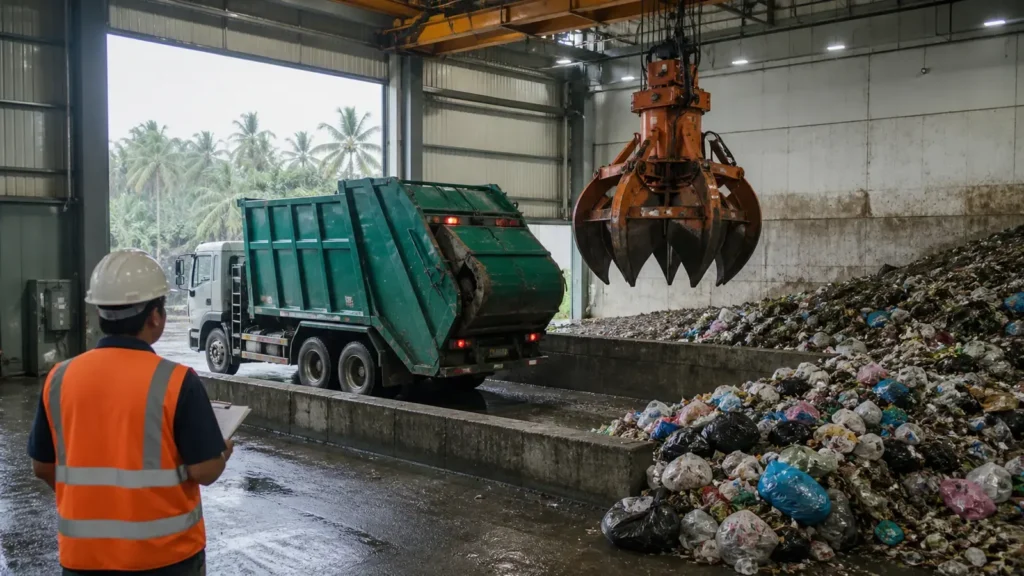
The conversion of a city’s everyday rubbish into a fuel-grade alcohol is real, but it rests on very few installations. Also, the 2023 review, published 17 December 2022, lists one municipal solid waste plant, the rubbish a city collects and weighs, at technology readiness level 8. The rating of how far a system has moved from laboratory to operating plant, and a demonstration at level 6 to 7. What has to be proven is not the reaction but the disposition around it: the syngas ratio, meaning the hydrogen content of the raw gas leaving the gasifier, the gate fee. Meaning the payment per tonne delivered, and the offtake agreement, meaning the contract that buys the finished fuel. I would treat waste to methanol as a logistics contract first and a chemistry second. In addition, I hold that view alongside the green methanol industries page.
Before I commit a feasibility budget I want three proofs: a plant that runs on municipal waste, a syngas ratio that holds through the synthesis loop, and a contract that pays for the waste at the gate and for the fuel at the berth. The record behind those proofs is real, and thinner than the announcement cycle suggests.
In short
- Operating record: one municipal solid waste plant at readiness level 8 and one demonstration at level 6 to 7, per the review, 17 December 2022.
- Chemistry: a stoichiometric number, the ratio the feed gas must hold, near 2 after hydrogen enrichment, per the task study, December 2021.
- Feedstock cost: 0 to 17 dollars per megajoule for biomass and municipal waste, per the renewable methanol outlook, 2021.
- Bio-methanol cost: 320 to 770 dollars a tonne, 220 to 560 with process improvements, per the 2021 outlook.
- Sold volume: 400,000 to 500,000 tonnes of renewable methanol sold in 2024 against 94 million tonnes of total supply, per the 2025 milestones report.
In this article
Three proofs, not one
I sort the evidence into three proofs and I do not let one stand in for another. The first is a plant that runs on municipal solid waste at a scale a buyer can visit, with a mass balance, the accounting of tonnes entering against tonnes leaving, that closes without a hidden subsidy. Also, the second is a syngas ratio that holds through the synthesis loop, the raw gas meeting the specification the reactor needs on the day I test it. The third is a contract that pays twice: the gate fee for each tonne delivered. In addition, the offtake agreement for the finished molecule.
The first proof is partly satisfied, the second is documented, the third is largely open. In addition, I date every figure I take from them rather than quoting a round number.
What this means for you: I would give the three proofs separate line items and separate owners. A confident chemistry slide cannot replace an unsigned delivery obligation. In addition, a signed supply contract cannot replace a gas analysis that fails the synthesis specification.
What the operating plants show
The review of waste gasification technologies, heating waste without oxygen into a combustible gas, published 17 December 2022, is my inventory:
- Edmonton: Enerkem takes 100,000 tonnes of municipal solid waste a year for 38,000 tonnes of biofuels at technology readiness level 8, 17 December 2022.
- United States: Fulcrum’s Sierra plant takes 175,000 tonnes a year for 30,000 tonnes of Fischer-Tropsch liquids plus 11 million gallons of sustainable aviation fuel, also at level 8.
- Westbury: 48 tonnes a day of municipal waste and wood for 4,000 tonnes of cellulosic ethanol and 1,000 tonnes of methanol a year at level 6 to 7, plus a Sherbrooke synthesis unit at level 4 to 5 making 475 cubic metres a year.
- Scale: plasma gasification needs roughly 1,200 to 2,500 megajoules per tonne of municipal waste. In addition, a downdraft unit runs from 96 kilowatts for 3.35 tonnes a day to 35,000 kilowatts for 2,665 tonnes a day over a 20-year project life.
The waste to energy plant guide covers the wider family of thermal routes.
What this means for you. I read those tonnes as a floor, not a forecast, and I ask which of them are methanol rather than ethanol or aviation fuel. Size drives the energy bill, so my plant must match a catchment that can actually deliver.
What the chemistry demands
The IEA Bioenergy task study of December 2021 models two routes, and both end at the same constraint. In the first, biomass gasification supplies the raw gas and steam reforming of digested biogas supplies the hydrogen for enrichment. Also, in the second, anaerobic digestion, the breakdown of organic matter by bacteria without oxygen, takes the organic fraction of municipal waste. In addition, the digestate, the solid residue left behind, is then gasified. Either way the gasifier output has too low a hydrogen to carbon oxide ratio for direct conversion, so enrichment is required, and methanol synthesis wants a stoichiometric number. The ratio the feed gas must hold for the reaction to balance, near 2 in that December 2021 study.
Anaerobic digestion leaves up to 50 percent of the organic matter unconverted. That is where the digestate comes from, and the study records European biomethane sites rising from 483 in 2018 to 729 in 2020 across 19 countries, citing the European Biogas Association. The rest of the plant’s job sits on the green methanol production page.
What this means for you: I would not sign a waste supply before a syngas test on the actual stream. In addition, What I need from that test, with its date, is the hydrogen ratio delivered. In addition, the cost of lifting it to 2.
Waste is a contract before it is a feedstock
The IRENA renewable methanol outlook of 2021 makes the point I use constantly: waste streams such as municipal solid waste and black liquor simplify feedstock logistics. In addition, improve plant economics, because the material is already collected and weighed. The same 2021 outlook prices biomass and municipal waste feedstock at 0 to 17 dollars per megajoule and puts bio-methanol at 320 to 770 dollars a tonne with feedstock up to 6 dollars per megajoule, falling to 220 to 560 dollars a tonne with process improvements. It records less than 0.2 million tonnes of renewable methanol produced a year in 2021, and confirms that the renewable molecule is chemically identical to the fossil one.
Therefore, it is a drop-in, meaning the fuel system needs no change. My reading: the gate fee and the delivery obligation are what a lender reads first. Therefore, the supply contract carries this section. That work starts at the waste-to-energy project finance page, where the tipping fee. In addition, the guaranteed waste delivery are treated as contracts rather than assumptions.
What this means for you. I would write the gate fee into the model as revenue before I model a single tonne of methanol. If the payment per tonne delivered is not fixed and dated. The plant is exposed to a waste market that will not wait for construction.
The route that shares the plant
However, the same 2021 outlook records that co-production of fossil and green methanol is possible, and that in the short term biomass can be co-fed into a coal-based gasifier or biogas fed into a natural gas methanol plant.cords that co-production of fossil and green methanol is possible, and that in the short term biomass can be co-fed into a coal-based gasifier or biogas fed into a natural gas methanol plant. It also puts the optimal hydrogen to carbon monoxide ratio for synthesis close to 2 in 2021, the same target the raw gas has to hit after adjustment. The task study of December 2021 adds that upgrading systems for biogas already exist at commercial scale, that anaerobic digestion already treats several feedstocks including the organic fraction of municipal waste, and that digestate disposal is an agronomic. In addition, environmental constraint pushing operators toward energy use.
A shared plant therefore buys a hydrogen route from existing infrastructure and a destination for a residue that already carries a disposal problem. The two streams I would take from it, biogas and digestate, are explained in how a biogas plant works.
What this means for you: If a biogas plant or an existing methanol site sits nearby. I cost that co-location before I cost a standalone gasifier. Both streams reduce obligations I would otherwise carry alone, and that changes the feasibility case more than any claim about catalysts.
What I would not count as proof
I exclude four things from my evidence base. First, a study at simulation level read as an operating plant: the December 2021 study models two routes. In addition, a model is not a run. Second, a readiness level read as a yield: level 8 in the review of 17 December 2022 says the system works in its environment. It does not say how many tonnes came out. Third, an announced capacity read as production: the Methanol Institute 2025 milestones report puts total methanol supply at 94 million tonnes in 2024 against only 400,000 to 500,000 tonnes of renewable product sold that year. Fourth, a low feedstock cost read as a low delivered cost once sorting, drying.
In addition, tar handling are paid for, and a levelised cost of 960 euros a tonne against 450 for fossil methanol. From the assessment of 2022, is a calculation nobody has signed.
What this means for you: I put these four exclusions on the first page of my feasibility report. A figure without a date, a scale and a counterparty goes in an annex as an announcement. In addition, it stays out of the mass balance and the revenue case.
What it changes for a Southeast Asian project
The renewable methanol outlook of 2021 records that municipal solid waste among the feedstocks improves plant economics where logistics are simple, and that is the argument I would make in this region. Also, the 2025 milestones report gives the counterweight: about 4 million tonnes of low-carbon, blue, bio. In addition, e-methanol capacity was operational or under construction in February 2025. The same 2025 report counts more than 200 announced projects for 45.8 million tonnes a year by 2030, of which only 20 to 40 percent may proceed, giving 7 to 14 million tonnes in five years. Announced capacity is not sold tonnes, and that report shows 400,000 to 500,000 tonnes of renewable product sold in 2024. My reading is narrower: the case rests on a waste stream that is collected and weighed, not on a global pipeline number. Regional context sits in waste to energy.
What this means for you. I would build the case on three local documents: the collection contract that says who delivers, the weighing record that says how many arrive, and the gate fee that says what they are worth. Without them, a pipeline figure is not a project.
The three lines I would keep
Line one: tonnes of municipal solid waste delivered per year under a signed contract. With the gate fee per tonne, dated, set against the 100,000 tonnes a year the review records for a Canadian installation. Line two: the ratio the syngas test achieved, with the date of the test. In addition, the enrichment needed to reach a stoichiometric number near 2. The target set in the study of December 2021. Line three: tonnes of methanol contracted for sale, with the buyer named. In addition, the signature dated, measured against the 400,000 to 500,000 tonnes of renewable product sold in 2024, per the 2025 milestones report. Each line carries a number, a date. In addition, a name; if one of the three is empty I do not proceed.
What this means for you: If those three lines are blank, I stop. If they carry a date. In addition, a counterparty, I move to the next stage of diligence. That is because a waste project is judged on delivery, specification and sale, in that order.
Sources
- Santos et al., Waste Gasification Technologies: A Brief Overview, 17 December 2022.
- IEA Bioenergy Task 33, Gasification for production of biomethanol by coupling with anaerobic digestion, December 2021.
- IRENA and Methanol Institute, Innovation Outlook: Renewable Methanol, 2021.
- Renewable methanol production from green hydrogen and captured CO2: A techno-economic assessment, Journal of CO2 Utilization, 2022.
- Methanol Institute, 2025 Milestones, 2025.
Frequently asked questions
Is waste to methanol a proven technology?
Partly. The review of waste gasification technologies, published 17 December 2022, lists one municipal waste installation at readiness level 8 and a demonstration at level 6 to 7, so the route runs but on very few plants. A readiness level tells me a system has been demonstrated in its environment; it does not tell me tonnes produced or a price anyone agreed to pay.
What is the hardest part of running a waste-to-methanol plant?
The syngas. It leaves the gasifier with too low a hydrogen ratio for methanol synthesis, so it must be enriched until the stoichiometric number is near 2. The study of December 2021 sets out two ways to reach that target, steam reforming of digested biogas, or gasification of the digestate left after anaerobic digestion of the organic fraction of municipal waste. Both move the constraint into the balance of plant, where budgets slip.
How much methanol can waste produce at commercial scale?
The documented installations are specific: 1,000 tonnes of methanol a year from 48 tonnes of waste a day at demonstration scale, and 38,000 tonnes of biofuels a year from 100,000 tonnes of municipal waste at readiness level 8, both recorded on 17 December 2022. The larger figure is not methanol, the smaller is not full scale, so I read them as proven throughput, not guaranteed yield.
Should a project bet on waste as its feedstock?
Only with a signed waste supply and a signed fuel offtake. The 2025 milestones report shows 400,000 to 500,000 tonnes of renewable methanol sold in 2024 against 94 million tonnes of total supply, so the market does not absorb an uncontracted plant. Waste is credible for me when the gate fee is agreed before the front-end design, and not otherwise.
Not sure your project would survive a credit conversation?
A short call is usually enough to see where your project stands.
If you are at feasibility stage, my offtake agreements service pairs the fuel sale terms with the waste supply terms, so the mass balance. In addition, the revenue case in your study use the same tonnes.
I do not provide investment advice or arrange investments. I act as a strategic advisor and facilitator.

Alex, Founder of WeConnect Asia
I help low-carbon fuel and carbon removal project developers in Southeast Asia secure the commercial. In addition, financial partners needed to reach FID.
Related articles

Pitching a Climate Tech Company to Strategic Investors: What the Corporate Has to Believe Before It Writes a Cheque
How to pitch a climate tech company to strategic investors: the metric cluster, the readiness evidence and the ask that corporates fund.

Biomethane: What It Is, How It Is Made and Who Buys It
Biomethane is biogas cleaned to pipeline quality. I explain how it is made, how it differs from biogas and who buys it in Southeast Asia.

CO2 Sourcing for e-SAF Projects: What the Rules Allow and What the Contract Must Say
Biogenic CO2, direct air capture or industrial flue gas: which sources an e-SAF plant may use, what they cost and which contract terms make the fuel certifiable.

Operating Performance Guarantees for SAF Plants: What Lenders Ask For
Minimum guarantees, performance damages, retesting and who stands behind them: the operating guarantees a SAF plant needs to keep debt and offtake intact.

EPC and Construction Risk in SAF Plants: What a Lender Actually Tests
FEED scope, convertible EPC, performance guarantees and damages caps: the construction risk questions a SAF project must answer before financial close.

Matching Feedstock and Offtake Risk Back-to-Back in a SAF Project: How Lenders Read the Chain
Lenders do not buy a feedstock plan and an offtake plan separately. They buy the link between the two, and the link is where most SAF files break.