
Home » Bio-Methanol Project Finance: What a Lender Wants on Top of the Plant
Bio-Methanol Project Finance: What a Lender Wants on Top of the Plant
10 min read · Jan 2, 2026 · By Alex
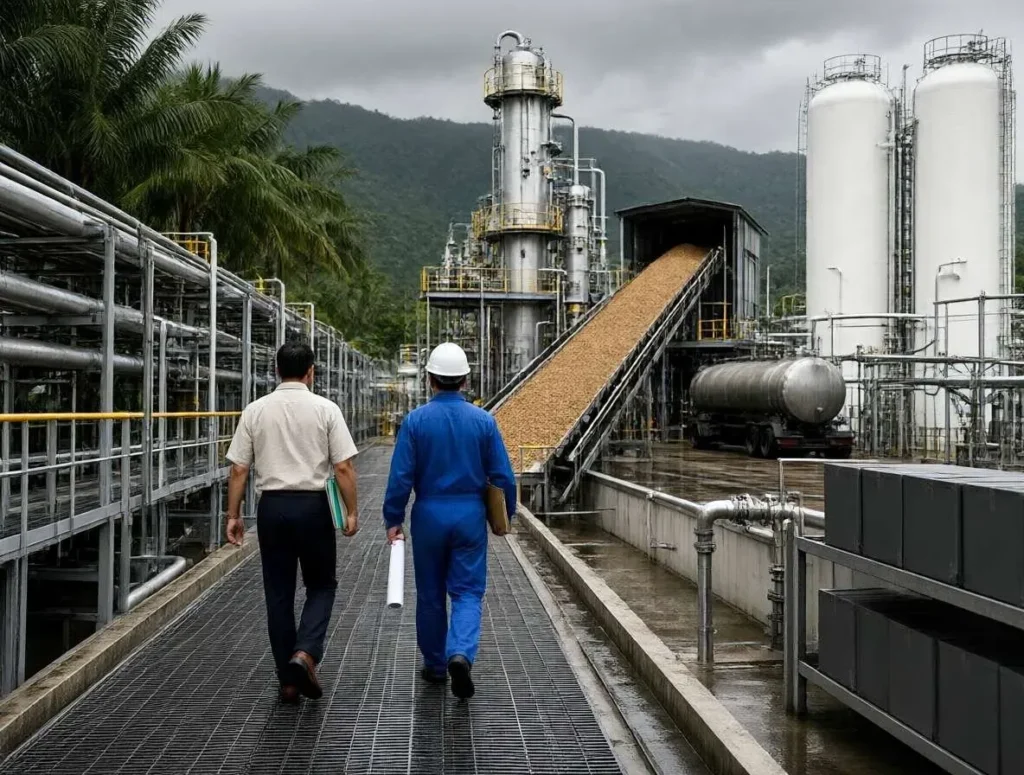
Few lenders open a bio-methanol file at the reactor. I read the capital stack, the debt tenor and the public cover first. Those items, not the engineering, decide the next step. For bio methanol project finance, three asks sit above the plant: a thicker equity buffer and shorter debt tenor while revenue risk is not covered by policy, which the Global Biofuels Alliance recorded as the standard lender ask in January 2026; an offtake reaching past the loan. That is because the European Investment Bank recorded in May 2024 that buyers hesitate beyond two to three years while the construction loan is considerably longer. In addition, public or concessional cover for the first-of-a-kind tranche. That is because bio-methanol is named among the pathways with a structural financing gap in January 2026. The green methanol industry overview carries the same picture.
I read a bio-methanol file against published evidence rather than against the sponsor’s model. By bio-methanol I mean methanol produced from biomass or waste rather than from fossil feedstock. In addition, every figure below carries its publisher and date.
In short
- Equity buffer: thicker sponsor money paid in before the first draw, per the Global Biofuels Alliance in January 2026.
- Debt tenor: shorter while revenue risk is uncovered by policy, same source and date.
- Offtake: volume, price and duration fixed with a creditworthy buyer, and the contract must outlive the loan.
- Public cover: guarantees or concessional capital for the first-of-a-kind tranche, per the Global Biofuels Alliance in January 2026.
- Evidence: 400,000 to 500,000 tons of renewable product sold in 2024 against 94 million metric tons of supply, Methanol Institute 2025.
In this article
Three asks on top of the plant
Three asks sit above the plant, and I test each one before I test the technology. The first is an equity buffer, the sponsor money beneath the debt. In addition, a debt tenor, the repayment period, both set while revenue risk is uncovered by policy. The second is an offtake, the contract under which a buyer commits volume, price and duration. In addition, it must reach past the loan. The third is cover for the first-of-a-kind tranche, the capital for the first industrial-scale unit of an unproven route.
Also, the Global Biofuels Alliance recorded in January 2026 that biofuels account for under 2 percent of global fuel consumption at nearly 198 Mtpa, that all of them are policy-anchored assets whose mandates, incentives. In addition, sustainability frameworks provide the revenue visibility required for bankability, and that mature pathways have repeatable financing structures while bio-methanol does not yet.
What this means for you: I do not price a file whose revenue rests on goodwill; I want a mandate. A price floor or a signed contract behind every tonne before the buffer. In addition, the tenor become the question.
The cost the debt has to cover
A loan is repaid out of a margin over production cost, so I start with the spread. IRENA and the Methanol Institute recorded in 2021 that bio-methanol costs 320 to 770 USD a tonne with feedstock at up to 6 USD per gigajoule, falling to 220 to 560 USD a tonne with process improvements, against 100 to 250 USD a tonne for fossil methanol. The same 2021 review recorded feedstock costs for biomass and municipal solid waste between 0 and 17 USD per gigajoule; black liquor.
A pulping residue used as biomass, sits in that feedstock question. BloombergNEF and the Climate Technology Coalition recorded on 18 June 2024 that low-carbon methanol production costs run 1.2 to 12 times those of fossil methanol depending on the feedstock, and that above 500 USD a tonne shipping companies may find it cheaper to pay the carbon price on their emissions until 2030. The e-methanol project finance page reads the same spread from the other route.
What this means for you. I price the debt against the high end of that band rather than the model’s midpoint, and I ask which feedstock contract holds the low end.
How the loan is actually built
Project finance means senior debt, the main loan ranking ahead of equity, repaid from the project’s own contracted revenue. It is drawn by a special purpose vehicle, the project company that owns the assets, above an equity buffer, the sponsor money beneath it. The Global Biofuels Alliance recorded in January 2026 that lenders. In addition, investors require higher equity buffers, shorter debt tenors. In addition, stronger downside protection unless policy-driven revenue risk is mitigated by bankable long-term offtake agreements, price floors, contracts for difference, which pay the gap between agreed. Also, in addition, market price, or equivalent public support.equivalent public support. Long-term contracts with creditworthy counterparties fix volume, price and duration and form the foundation of bankability.
GIZ and NIRAS recorded in 2024 that a pre-feasibility structure recommends around 30 percent equity upfront in the special purpose vehicle to help secure loan guarantees. In addition, investment funds, with the weighted average cost of capital held at 11 percent. The infrastructure project finance page shows the shape of that stack.
What this means for you: I read the equity line first. That is because the buffer shows whether the sponsor expects the loan to carry what it cannot price.
The same test, applied next door
I compare a bio-methanol file against its closest sibling because the lenders are the same. In addition, the questions do not change. The Global Biofuels Alliance recorded in January 2026 that emerging pathways, including bio-methanol, face structural financing gaps driven by technology risk, limited operating history and immature infrastructure and supply chains. That is why concessional capital, guarantees and risk-sharing platforms are needed to cross from demonstration to bankable scale. It recorded that mature pathways such as bioethanol, biodiesel, biomethane and HEFA-based sustainable aviation fuel already reach project finance in supportive markets, and that biofuels demand grows 2 to 2.5 times by 2035 for cumulative investment of 420 to 500 billion USD in a base case. The sustainable aviation fuel financing page answers the same three questions.
What this means for you. I use the mature route as the yardstick; if the file cannot show what separates bio-methanol from a pathway that already finances itself. The gap stays open. I look for the demonstration record or the public cover that closes it.
The tenor mismatch lenders actually price
The European Investment Bank recorded in May 2024, after a consultation of 34 companies drawn from a longlist of more than 100 with information updated to February 2024, that promoters struggle to secure offtake volumes at prices that reassure lenders about repayment. Also, the same report recorded that buyers hesitate to commit beyond two to three years while the construction loan is considerably longer, that buyers are accustomed to trading on standardized markets and expect marked cost declines from scale, and that some early-generation buyers such as airlines are not considered sufficiently creditworthy.
It also recorded that inflation, higher interest rates. In addition, higher electricity prices had reduced project returns, that the cost gap with conventional fuels should persist, and that including transport in the emissions trading system is unlikely to close it in the medium term. The marine fuel offtake page is where the tenor question is settled.
What this means for you. I do not accept a two to three year contract against a considerably longer loan unless a written rollover case sits beside it in the model.
What public and strategic capital does in the stack
The European Investment Bank recommended in May 2024 that selected first-of-a-kind projects be de-risked with new public risk mitigation instruments. Therefore, private lenders can participate, and that its financing products could be tailored to them. A guarantee is a third party’s promise to cover part of a loss. Review Energy reported on 20 January 2026 that a green bridge financing facility for a solar park. In addition, e-methanol plant in Denmark, e-methanol being methanol made from renewable electricity, was provided by Nordea and SMBC as bookrunners and mandated lead arrangers with a partial guarantee from EIFO, while long-term project financing is being secured. Construction began in 2023, first production came in May 2025.
The inaugural batch was delivered on 13 May 2025, offtakes are signed with LEGO Group and Novo Nordisk. In addition, capacity reaches 42,000 tonnes a year. The Global Biofuels Alliance recorded in January 2026 that corporate offtakers increasingly take equity linked to long-term purchase agreements. Also, the development finance institutions page lists who provides that cover.
What this means for you: I treat that bridge as liquidity rather than a closed transaction, and I ask what converts it.
What I would test before recommending the file
I ask five questions in writing before I recommend a bio-methanol file. First: is the equity buffer thicker than the around 30 percent equity that GIZ. In addition, NIRAS recommended in 2024, and is it paid in before the debt draws? Second: does the offtake outlive the loan, when the European Investment Bank recorded in May 2024 that buyers stop at two to three years? Third: is the offtaker creditworthy, since that same report does not consider early-generation buyers such as airlines so? Fourth: which public instrument or guarantee covers the first-of-a-kind tranche, per the Global Biofuels Alliance in January 2026? Fifth: is the revenue case separated from announced volume, since the Methanol Institute recorded in 2025 that 400,000 to 500,000 tons of renewable product were sold against 94 million metric tons of total supply?
What this means for you: a file that answers all five in writing is a file I can put in front of a lender; a file that answers two is a project plan.
How I would structure it if it were my own file
If it were my own file, I would keep four dated rows on one page. The cost row carries 320 to 770 USD a tonne for bio-methanol from IRENA and the Methanol Institute in 2021, next to the 1.2 to 12 times multiple recorded by BloombergNEF on 18 June 2024. Also, the capital row carries the around 30 percent upfront equity recommended by GIZ and NIRAS in 2024. Next to the higher buffers required by the Global Biofuels Alliance in January 2026. The tenor row carries the two to three year buyer horizon against a considerably longer construction loan. From the European Investment Bank in May 2024.
The public row carries the partial guarantee attached to the bridge financing reported on 20 January 2026, next to the 420 to 500 billion USD of cumulative biofuel investment by 2035. Every row carries its publisher and its date.
What this means for you: I would hand that one page to the lender before the model. That is because each row can be checked against a published source without a meeting.
Sources
- Global Biofuels Alliance, January 2026.
- European Investment Bank, May 2024.
- Review Energy, 20 January 2026.
- GIZ and NIRAS, Pre-feasibility summary of the e-methanol production from Biogas and Green Hydrogen in Parana, Brazil, 2024.
- IRENA and Methanol Institute, 2021.
- BloombergNEF, 18 June 2024.
- Methanol Institute, 2025.
Frequently asked questions
What is project finance for bio-methanol?
It is debt raised against the project’s own contracted revenue rather than against the sponsors, and repaid from that revenue. The Global Biofuels Alliance recorded in January 2026 that long-term offtake contracts with creditworthy counterparties provide the volume, pricing and tenor certainty that forms the foundation of project bankability.
How much equity does a bio-methanol project need?
Around 30 percent available upfront in the special purpose vehicle is the published recommendation from GIZ and NIRAS in 2024, because it helps secure loan guarantees and investment funds, with the final percentage set later against lenders’ requirements, financial models and covenants.
Why do lenders care so much about the offtake?
Because it is the only repayment source a lender can test. The European Investment Bank recorded in May 2024 that buyers hesitate beyond two to three years while the construction loan is considerably longer, that some early-generation buyers such as airlines are not considered sufficiently creditworthy, and that promoters struggle to secure volumes at prices that reassure lenders.
Can public institutions take part of the risk?
Yes, and it is expected to. The European Investment Bank recommended in May 2024 that selected first-of-a-kind large-scale projects be de-risked with new public risk mitigation instruments so private lenders can enter, and Review Energy reported on 20 January 2026 a partial public guarantee supporting a green bridge financing facility for an e-methanol plant.
Not sure your project would survive a credit conversation?
A short call is usually enough to see where your project stands.
If you are structuring bio methanol project finance before final investment decision and need the right capital counterpart in the room. I work through investor introductions, with the file built around the five tests above. Also, I prepare the introduction and the paper that follows it.
I do not provide investment advice or arrange investments. I act as a strategic advisor and facilitator.

Alex, Founder of WeConnect Asia
I help low-carbon fuel and carbon removal project developers in Southeast Asia secure the commercial. In addition, financial partners needed to reach FID.
Related articles

Pitching a Climate Tech Company to Strategic Investors: What the Corporate Has to Believe Before It Writes a Cheque
How to pitch a climate tech company to strategic investors: the metric cluster, the readiness evidence and the ask that corporates fund.

Biomethane: What It Is, How It Is Made and Who Buys It
Biomethane is biogas cleaned to pipeline quality. I explain how it is made, how it differs from biogas and who buys it in Southeast Asia.

CO2 Sourcing for e-SAF Projects: What the Rules Allow and What the Contract Must Say
Biogenic CO2, direct air capture or industrial flue gas: which sources an e-SAF plant may use, what they cost and which contract terms make the fuel certifiable.

Operating Performance Guarantees for SAF Plants: What Lenders Ask For
Minimum guarantees, performance damages, retesting and who stands behind them: the operating guarantees a SAF plant needs to keep debt and offtake intact.

EPC and Construction Risk in SAF Plants: What a Lender Actually Tests
FEED scope, convertible EPC, performance guarantees and damages caps: the construction risk questions a SAF project must answer before financial close.

Matching Feedstock and Offtake Risk Back-to-Back in a SAF Project: How Lenders Read the Chain
Lenders do not buy a feedstock plan and an offtake plan separately. They buy the link between the two, and the link is where most SAF files break.