
Home » Biogenic CO2 Sourcing for Methanol: Where the Carbon Actually Comes From
Biogenic CO2 Sourcing for Methanol: Where the Carbon Actually Comes From
10 min read · Sep 11, 2025 · By Alex
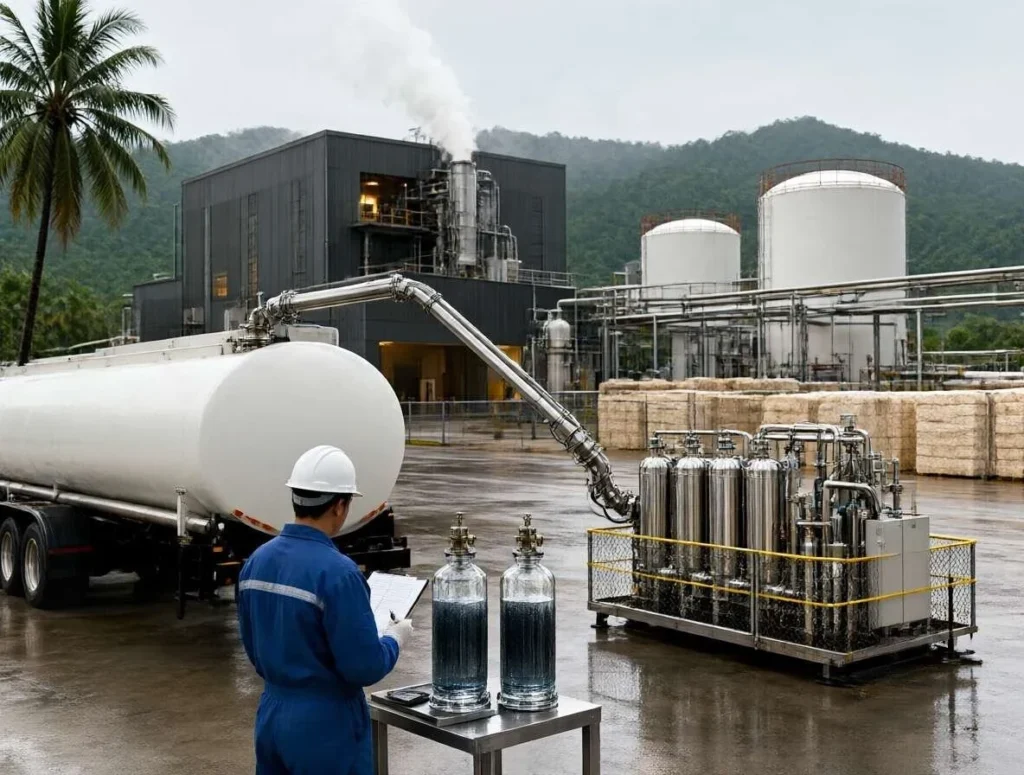
Where the carbon in a green methanol project comes from, at what cost, and for how long is the first sourcing question at pre-FID stage. I answer it with three families of source: CO2 separated during biogas upgrading, the cleaning step that splits raw biogas into biomethane, methane fit for injection into the gas grid, and a CO2 stream; CO2 captured at pulp and paper mills; CO2 pulled from ambient air. Each family sits at a different tier of cost and carries a different contract length. For the biogenic CO2 methanol trade, Zero Carbon Shipping 2024 puts global supply at 320 to 370 million tonnes a year across 360 clustered sites, most of the low-cost volume from pulp and paper, while the European Biogas Association recorded in September 2025 that Europe’s conventional CO2 demand was 13.9 million tonnes a year in 2024 and that emerging markets are projected to need 344 million tonnes by 2040. The industry page carries the same picture.
These three families come from published documents only, and I keep every figure attached to its publisher and its date. The supply estimate above describes the whole market, not a volume offered to any one project.
In short
- Three sources: CO2 from biogas upgrading, CO2 from pulp and paper point sources, CO2 from direct air capture, each at a different cost tier and with a different contract length.
- Supply: Zero Carbon Shipping 2024 estimates 320 to 370 million tonnes a year across 360 clustered sites, a global estimate rather than a volume allocated to any project.
- Demand: The European Biogas Association recorded in September 2025 that Europe consumed 13.9 million tonnes of conventional CO2 in 2024, merchant market at 56 percent, and projects 344 million tonnes a year for emerging markets by 2040.
- Cost: IRENA 2021 puts BECCS CO2 at 10 to 50 USD a tonne against DAC at 300 to 600 USD a tonne.
- Contract: The model agreement published by NAESB, effective December 2006, offers delivery terms of 10, 15 or 20 years and a termination test of 25 percent for 120 days.
In this article
Three sources, one molecule
The chemistry does not change with the source: a methanol molecule needs a carbon atom and an oxygen atom, so the CO2 decision changes the price, the paperwork and the term of supply rather than the product. IRENA and the Methanol Institute recorded in 2021 that close to 98 million tonnes of methanol are produced each year, nearly all of it from fossil fuels, and that less than 0.2 Mt of renewable methanol is produced annually. The renewable fraction is small enough that every new project competes for the same new streams, whether they come from upgrading, from mills or from air. I therefore treat the carbon in a biogenic CO2 methanol project as a new purchase negotiated from scratch, not a residual input inherited from an existing process that already emits it, and I write it as a feedstock contract with its own volume, price, duration and delivery point.
What this means for you: I put the carbon line into the procurement schedule before the engineering budget, with a volume, a start date and a named delivery point, because no existing methanol plant hands over a free CO2 stream.
What the plant actually buys
I define e-methanol as methanol synthesised from CO2 captured at a renewable source, such as DAC, direct air capture which pulls CO2 out of ambient air, or BECCS, bioenergy with carbon capture and storage where the carbon came from biomass, reacted with green hydrogen. IRENA and the Methanol Institute recorded in 2021 exactly that composition, and IRENA 2021 adds that the sourcing of renewable CO2 is key for sustainability and also affects the cost structure and production efficiency of the plant. The European Biogas Association recorded in September 2025 that CO2 hydrogenation is one of the conversion routes that yields e-methanol, sitting next to the Sabatier reaction for e-methane and the reverse water gas shift followed by Fischer-Tropsch synthesis. The production page shows the route.
What this means for you: I write the CO2 specification into the offtake before I discuss its price, because the synthesis route fixes the purity, pressure and continuity that the loop will accept.
Where the cheap tonnes are
Zero Carbon Shipping 2024 estimates the global supply of biogenic CO2 suitable for e-fuel production between 320 and 370 million tonnes a year, mostly in Europe and the Americas, across 360 geographically clustered sites, each of which could in theory host a plant of 1,000 metric tonnes a day of e-methanol. Zero Carbon Shipping 2024 also records that the largest part of the low-cost CO2 comes from the pulp and paper industry, that even 20 percent of the total would produce around 1 EJ of e-fuel a year, enough to decarbonise 8 percent of the current global fleet, and that the whole economically accessible supply would yield about 5.4 EJ of methanol against roughly 12.6 EJ consumed by shipping, so at most 43 percent of the fleet. The European Biogas Association recorded in September 2025 that Europe’s conventional CO2 demand was 13.9 million tonnes a year in 2024 with a merchant market accounting for 56 percent, and that the European Commission impact assessment projects 344 million tonnes a year for emerging markets by 2040, e-fuels alone needing more than 13 times today’s merchant volumes within 15 years. The power-to-liquid page frames these numbers.
What this means for you: I never book the 320 to 370 million tonnes estimate as my own supply; I turn it into a site list, a distance and a delivery schedule for one plant.
The hydrogen side of the same contract
One tonne of e-methanol sits at the meeting point of a carbon contract and a power contract. IRENA 2021 gives e-methanol at 800 to 1600 USD a tonne when the CO2 comes from BECCS at 10 to 50 USD a tonne, and at 1200 to 2400 USD a tonne when it comes from DAC at 300 to 600 USD a tonne. The European Biogas Association recorded in September 2025 that direct air capture is estimated at 300 to 500 EUR a tonne by 2050, and on that basis it points at the low-cost bioCO2 released when biogas is upgraded into biomethane, the methane produced for the gas grid. The same association recorded in September 2025 that the levelised cost of capture, or LCOC, is read in EUR per tonne of CO2 by capacity band, below 5,000, from 5,000 to 10,000, and above 10,000 tonnes a year, split between capital and operating cost, with new greenfield plants sitting below brownfield retrofits. The hydrogen process sets the other half of the bill.
What this means for you: I ask for an LCOC in the same units as my carbon offtake, by capacity band and by plant type, so the power side and the carbon side of one tonne can be compared line by line.
What qualifies as renewable carbon
The rules decide which CO2 may be called renewable, so I read the certificate before the price. IRENA 2021 separates e-methanol made from biogenic or air-captured CO2 from bio-methanol made from biomass, and the label on the product follows that split. The European Biogas Association recorded in September 2025 that a Guarantee of Origin certifies a given quantity of renewable energy, generally a MWh, while further documentation carries the feedstock used and the carbon intensity. Ecohz wrote in its Biomethane Purchase Agreement explainer, published in 2024 and last updated in January 2026, that guarantees of origin and proofs of sustainability are what document provenance once molecules are mixed into a grid, because injected gas is no longer traceable on its own. GIZ and NIRAS recorded in 2024 that the pre-feasibility case assumes biogas at 60 percent biomethane and 40 percent carbon dioxide, with that CO2 used as the carbon source. The renewable fuels page is where the qualification test sits.
What this means for you: I ask for the certificate and the carbon intensity in the same file as the volume, because a quantity without provenance does not support a product claim.
What the source does to the product claim
The carbon intensity of the molecule follows the source, and so does the price line I put in the model. IRENA and the Methanol Institute recorded in 2021 that current e-methanol costs 800 to 1600 USD a tonne with BECCS CO2. The same authors recorded in 2021 that bio-methanol costs 320 to 770 USD a tonne with a feedstock cost up to 6 USD per gigajoule, and 220 to 560 USD a tonne once process improvements are made. They also recorded in 2021 that biomass and municipal solid waste feedstock costs run between 0 and 17 USD per gigajoule, and that waste streams of other industrial processes, such as black liquor from paper mills, simplify feedstock logistics and improve plant economics. That is the argument a pulp and paper mill hears from both sides at once, the carbon storage side and the e-fuel side. The definition page holds the labels.
What this means for you: I keep the source and the claim in the same row of the model, because the feedstock cost, the process route and the label on the certificate move together.
What I would ask before signing anything
I ask five questions in writing before I discuss price. How many tonnes a year, for how many years, and from which physical site. What happens to the title if that same site signs a storage contract first: Zero Carbon Shipping 2024 identifies competition with carbon storage as a major barrier and records that some pulp mill owners are reluctant to commit an offtake for e-fuel production. Whether the certificate carries feedstock and carbon intensity, not only a quantity. What the levelised cost of capture looks like by capacity band, and whether the plant is greenfield or a retrofit, because the European Biogas Association recorded in September 2025 that greenfield projects sit below brownfield retrofits. What the contract says about a site that delivers less than 25 percent of the maximum quantity for 120 consecutive days, a termination trigger written into the public biogas model agreement published by NAESB, effective December 2006.
I also ask whether a book and claim mechanism is offered for the CO2, which lets me claim the attribute without taking the molecule, and whether the SPV, the special purpose vehicle that holds the project, carries the infrastructure agreements that GIZ and NIRAS recorded in 2024.
What this means for you: I put those five answers on one page with the publisher and date beside each figure, because the file that survives diligence is the one where every volume, price and trigger can be traced to a published document.
How I would structure it if it were my own file
I keep four dated rows, and every row carries its publisher and its date. The volume row carries 320 to 370 million tonnes a year of global biogenic CO2 and the 360 clustered sites behind that estimate (Zero Carbon Shipping 2024), next to the 13.9 million tonnes of conventional CO2 demand recorded in Europe for 2024 by the European Biogas Association in September 2025. The cost row carries BECCS at 10 to 50 USD a tonne against DAC at 300 to 600 USD a tonne (IRENA 2021), with direct air capture estimated at 300 to 500 EUR a tonne by 2050 (European Biogas Association, September 2025). The contract row carries the delivery term options of 10, 15 or 20 years, the 8,000 MMBtu a day ceiling, where MMBtu is a million British thermal units, and the 25 percent for 120 days termination test, all from the model agreement published by NAESB, effective December 2006. The claim row carries the guarantee of origin and proof of sustainability language of Ecohz, last updated in January 2026, alongside the 60 percent and 40 percent biogas split recorded by GIZ and NIRAS in 2024.
What this means for you: I build those four rows before the financial model, because a volume I cannot date, a price I cannot source, a term I cannot quote and a claim I cannot document will all be asked for again by a lender.
Sources
- IRENA and Methanol Institute, 2021.
- European Biogas Association, September 2025.
- Zero Carbon Shipping, 2024.
- IRENA, 2021.
- GIZ and NIRAS, 2024.
- Ecohz, 2026.
Frequently asked questions
What is biogenic CO2?
Biogenic CO2 is carbon dioxide released from carbon that recently passed through living matter, captured at an industrial point source instead of being emitted. The European Biogas Association recorded in September 2025 that it is separated during biogas upgrading, the step that also yields biomethane, and that it can be turned into e-methanol by CO2 hydrogenation. IRENA 2021 describes e-methanol as made from biogenic or air-captured CO2 reacted with green hydrogen. (European Biogas Association, September 2025; IRENA 2021.)
How much biogenic CO2 is available?
Between 320 and 370 million tonnes a year suitable for e-fuel production, across 360 geographically clustered sites, most of the low-cost volume from pulp and paper (Zero Carbon Shipping 2024). Zero Carbon Shipping 2024 also records that even 20 percent of that total would cover around 1 EJ of e-fuel a year, while the whole economically accessible supply would cover at most 43 percent of the global fleet, because shipping consumes about 12.6 EJ a year. I read it as a market estimate, never as a volume available to one project.
Is direct air capture cheaper?
No, not at these volumes. Direct air capture is estimated at 300 to 500 EUR a tonne by 2050, and that cost keeps capture from dilute streams expensive, which is why the European Biogas Association points to the low-cost bioCO2 already produced with biomethane in September 2025 (European Biogas Association, September 2025). IRENA 2021 prices the same gap by giving e-methanol at 1200 to 2400 USD a tonne from DAC CO2 against 800 to 1600 USD a tonne from BECCS CO2.
Can a methanol plant use CO2 from a biogas plant?
Yes, and the CO2 is the point. GIZ and NIRAS recorded in 2024 that the pre-feasibility case uses biogas at 60 percent biomethane and 40 percent carbon dioxide, with the CO2 used as the carbon source for green fuels once green hydrogen is added. IRENA and the Methanol Institute recorded in 2021 that biogas can also be fed into a methanol plant based on natural gas. (GIZ and NIRAS 2024; IRENA and Methanol Institute 2021.)
Not sure your project would survive a credit conversation?
A short call is usually enough to see where your project stands.
If you are at pre-FID stage and need one file that ties the carbon volume, the certificate and the contract term to published sources, that is the work I do with you. The feedstock supply service is where this conversation starts.
I do not provide investment advice or arrange investments. I act as a strategic advisor and facilitator.

Alex, Founder of WeConnect Asia
I help low-carbon fuel and carbon removal project developers in Southeast Asia secure the commercial and financial partners needed to reach FID.
Related articles

Pitching a Climate Tech Company to Strategic Investors: What the Corporate Has to Believe Before It Writes a Cheque
How to pitch a climate tech company to strategic investors: the metric cluster, the readiness evidence and the ask that corporates fund.

Biomethane: What It Is, How It Is Made and Who Buys It
Biomethane is biogas cleaned to pipeline quality. I explain how it is made, how it differs from biogas and who buys it in Southeast Asia.

CO2 Sourcing for e-SAF Projects: What the Rules Allow and What the Contract Must Say
Biogenic CO2, direct air capture or industrial flue gas: which sources an e-SAF plant may use, what they cost and which contract terms make the fuel certifiable.

Operating Performance Guarantees for SAF Plants: What Lenders Ask For
Minimum guarantees, performance damages, retesting and who stands behind them: the operating guarantees a SAF plant needs to keep debt and offtake intact.

EPC and Construction Risk in SAF Plants: What a Lender Actually Tests
FEED scope, convertible EPC, performance guarantees and damages caps: the construction risk questions a SAF project must answer before financial close.

Matching Feedstock and Offtake Risk Back-to-Back in a SAF Project: How Lenders Read the Chain
Lenders do not buy a feedstock plan and an offtake plan separately. They buy the link between the two, and the link is where most SAF files break.