
Home » Biomass-to-Biofuels Pathways: What Is Bankable?
Biomass-to-Biofuels Pathways: What Is Bankable?
9 min read · Sep 18, 2025 · By Alex
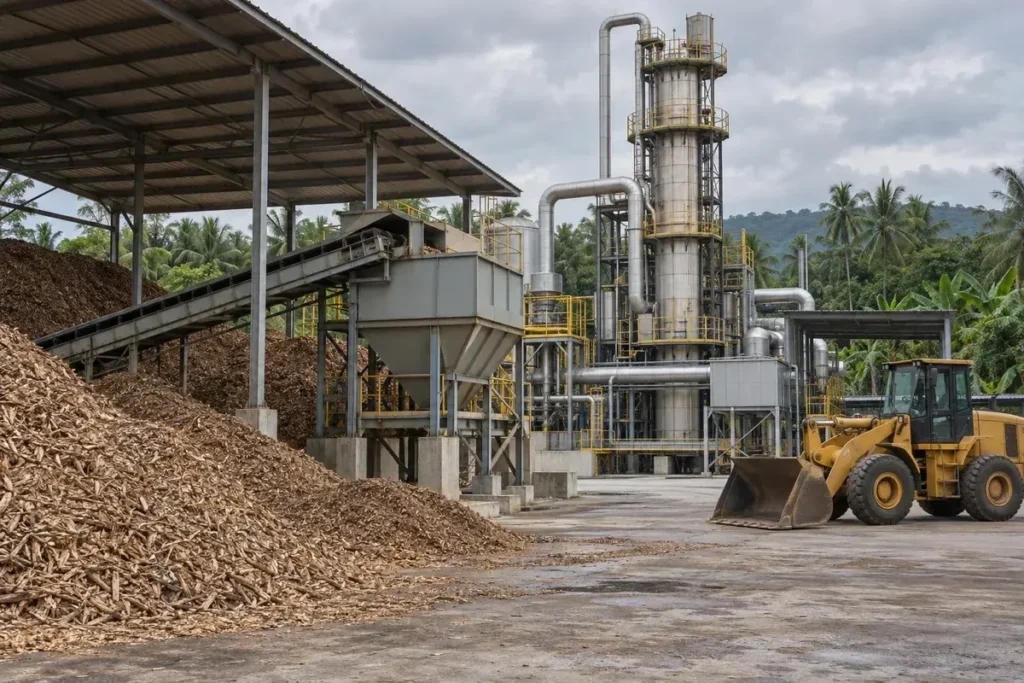
A conversion route earns credit only when the whole chain behind it has run at reference commercial scale. Four links decide it: a contracted feedstock (the raw biomass a plant takes in), a conversion step proven on that same feedstock, a product that meets a specification a buyer accepts, and demand that rests on a written rule or a signed offtake (a contract to buy the output). Four of those are the pathway, the full chain from field to tank; one reactor is not. That is what a lender is really reading when a biomass to biofuels route lands on the desk, and I apply the test in the biogas, biomass and biofuels industry page and in every feasibility memo I write.
I start with what the credit paper actually asks for, then with the two families of conversion and what each puts at risk, then with the product, the demand rule and the feedstock logistics that decide the gate. I close with the proofs I ask for and the row I write into the paper.
In short
- Four links: contracted feedstock, proven conversion, accepted specification, written demand.
- Tracked record: 119 facilities followed in 2024, 31 plans canceled, 880 000 t of promised capacity never built.
- Thermochemical limit: straight-run jet fraction capped near 40 percent by the product distribution model.
- Growth: the biofuel share of transport fuel moves from 5.6 percent in 2023 to 6.4 percent in 2030.
- Maturity: the lipid pathway is fully commercial, gasification and alcohol-to-jet are nearing it.
In this article
What a pathway is in a credit paper
I use pathway for the whole chain from field to tank, in this order: contracted feedstock, proven conversion, accepted specification, written demand. Feedstock means the raw biomass a plant takes in: agricultural residues, wood waste, dedicated energy crops. Bankable means the chain has already run at reference plant scale, and a reference plant is a commercial installation of the same design, on the same feedstock, whose output appears in a document I can read.
A credit committee does not judge a conversion step, it judges the chain. If the feedstock is not contracted, a proven reactor proves nothing about next year’s tonnage, and if no buyer has accepted the specification, a high yield is a laboratory result. The pathway is what sits between those two failure points.
What this means for you: write the four links as four rows before you write a process description, and treat any link without a document as an open item rather than an assumption.
Two families, and what each puts at risk
The record in the IEA Bioenergy Task 39 tracking review published in 2025 is blunt: 50 facilities were operational worldwide up to 2015, and the database counted 119 facilities in 2024, made of 41 operational, 10 under construction, 16 planned, 21 idle and 31 canceled plans.
The biochemical route starts from lignocellulose, the structural part of plants: cellulose 35 percent to 50 percent, hemicellulose 20 percent to 35 percent and lignin 10 percent to 25 percent, as the 2025 review records it. It needs four steps: pretreatment (opening the fibre so enzymes can reach it), hydrolysis (splitting the chains into sugars), fermentation (turning those sugars into alcohol) and product recovery (separating the alcohol from the broth).
In advanced biofuels in multi-product plants I look for a configuration where one feedstock feeds more than one revenue line, because that is what turns a conversion step into a plant with a case behind it.
The same review records an earlier wave of planned facilities that promised 880 000 t per year of additional capacity and none of it materialized, against 605 000 t per year still planned in 2024, with no way to know how much will come online.
What this means for you: before you defend a biochemical route, count how many plants on your feedstock are idle or canceled, and ask whether your configuration earns a second revenue line.
The thermochemical route and its ceiling
Gasification heats biomass without burning it fully and leaves a syngas, a mixture of carbon monoxide and hydrogen; Fischer-Tropsch synthesis, a set of reactions that rebuilds those molecules into liquid fuels, turns that gas into waxes and distillates, while the same gas can also go through a methanol intermediate or through fermentation to ethanol for the alcohol-to-jet route.
That ceiling is a chemistry fact recorded in the IEA Bioenergy Task 39 report on sustainable aviation fuel published in 2024: in the conventional Fischer-Tropsch process the product distribution follows the Anderson-Schulz-Flory statistical model, and the maximum straight-run jet fraction is limited to about 40 percent.
The same 2024 report puts the first small-scale commercial facility using gasification with Fischer-Tropsch synthesis into operation in 2022 on municipal solid waste, and it records that Fischer-Tropsch liquids are approved for co-processing at a maximum of 5 percent blends.
Read power-to-liquid explained next, because power-to-liquid sits at a lower technology readiness level, the scale that runs from first demonstration to commercial operation, with components such as the reverse water gas shift reaction still needing to be resolved. The electric route answers the same transport need by storing energy in a battery instead of making a liquid molecule that has to satisfy a fuel specification.
What this means for you: carry the 40 percent ceiling recorded in 2024 into the offtake conversation, because the specification a buyer writes, not your reactor, decides how much jet-range product you can sell.
The product has to meet a specification someone buys
Renewable fuel demand in industry, buildings and transport stood at 22 EJ in 2023, with liquid biofuels at 20 percent of that figure, in the IEA renewables report published in 2024.
That 2024 report has the biofuel share of total liquid fuel transport demand moving from 5.6 percent in 2023 to 6.4 percent in 2030, reaching 215 billion liters a year by 2030, and it has aviation and shipping responsible for more than 75 percent of new biofuel demand by 2030.
In the same 2024 outlook, more than 80 countries have liquid biofuel policies, while only the European Union and the United Kingdom set e-fuel requirements, so a buyer’s acceptance sits behind a written specification rather than behind a yield figure.
This is where sustainable aviation fuel matters to a pathway: a product that fails a test method has no buyer, and a product that passes it has an offtake only when someone signs for it.
What this means for you: write the specification and its test method into the pathway row before you quote a yield, because acceptance is what converts liters into contracted demand.
The demand rule decides before the engineering does
A mandate is a written rule that forces someone to buy or blend a fuel. Indonesia maintained a 35 percent biodiesel blending rate in 2024, after B35 became nationwide in August 2023, as the USDA Foreign Agricultural Service biofuels annual for Indonesia published in 2024 records.
That same 2024 document shows where the rule stops: hydrogenation derived renewable diesel and sustainable aviation fuel are not supported by the mandate, strong support for biodiesel has not become support for an advanced biofuels programme, and no incentives exist to lower the carbon intensity of the biodiesel supplied.
Installed and planned capacity in that 2024 document covers 477 kilolitres per day of renewable diesel and sustainable aviation fuel at a refinery that is operational with a second phase by 2026, 3 180 kilolitres per day under development to be completed in 2027, and 159 kilolitres per day in trial. Fuel-grade ethanol stayed small in the same period: E5 stations increased from 15 in 2023 to 65 as of April 2024.
This is the risk that sits behind low-carbon fuel mandates: a rule that stops at the first generation leaves an advanced pathway without a compelled buyer, and that is a document risk rather than a technical one.
What this means for you: read the mandate text before the flowsheet, and check whether your product is named as eligible, because an unnamed product has no obliged buyer.
Residues are cheap to find and expensive to move
Palm residues such as palm trunk and empty fruit bunch are currently wasted and could support dozens of commercial-scale plants, in the ICCT techno-economic analysis of cellulosic ethanol in Indonesia published in 2020.
In that 2020 analysis, 30 commercial facilities over 10 years would produce 2 billion liters of cellulosic ethanol annually, replacing a conservative estimate of 4 percent of gasoline consumption, and the subsidy needed could be as low as IDR 6,720 (US$0.46) per liter, almost 60 percent lower than the subsidy needed in European countries.
The same analysis recommends special economic zones around the industry and its supplying plantations to cut feedstock transport costs, because biomass yield, seasonal availability and low density push transport, storage and handling costs up whatever the conversion step does.
The economics sit the same way behind waste to energy projects: the gate is collection logistics, and collection logistics is a credit question.
What this means for you: put the collection radius, the season and the handling loss in the feedstock cell, because a pathway that cannot move its feedstock has no conversion step to defend.
The five proofs I ask for before I believe a pathway
I ask for five proofs, in this order:
- 1. A feedstock contract with tonnage and season.
- 2. A reference plant on the same feedstock that has run at commercial scale.
- 3. A product specification with a test method.
- 4. A written mandate or signed offtake with tenor.
- 5. A policy frame with no waiver history.
The fifth is the cheapest to check in public documents. By 2015, large-scale cellulosic production had failed to develop as anticipated and the United States Renewable Fuel Standard cellulosic mandates had been repeatedly waived, so repeated waiver of obligations is the earliest warning a document set can give you.
What this means for you: hold a route at screening until all five proofs exist as documents, because a story that fills a gap is not a proof.
How I would write the pathway row into the credit paper
I write one row per pathway with four cells: feedstock and logistics, conversion step and reference plant, product and specification, demand rule and offtake. The row is finished only when each cell cites a document: a contract with tonnage, a plant record on that feedstock, a specification with a test method, and a mandate or signed offtake with tenor.
A pathway with three of those four cells is a screening result, not a financeable project, and it does not reach the final investment decision (FID), the point where committed capital follows a completed document set.
What this means for you: fill the four cells with citations before you book the meeting, and leave the row open rather than close it with an assumption.
Sources
- IEA Bioenergy, 2025.
- IEA Bioenergy, 2024.
- IEA, 2024.
- USDA Foreign Agricultural Service, 2024.
- ICCT, 2020.
Frequently asked questions
Which biomass-to-biofuels route is closest to bankable today?
The lipid route, where fats and oils are hydrotreated into jet and diesel, is fully commercial in 2024 and is set to supply the majority of sustainable aviation fuel volumes up to 2030, while gasification with Fischer-Tropsch synthesis and alcohol-to-jet were nearing commercial status in the same 2024 record. Power-to-liquids sat at a lower technology readiness level in 2024.
Does a higher yield make a pathway financeable?
No. The 2024 limits show why: in the conventional Fischer-Tropsch process the maximum straight-run jet fraction is about 40 percent, only about 15 percent of hydrotreated fats and oils falls in the jet range, and that share can be raised only at higher cost and with a loss of overall liquid yield. What is missing is the demand rule, and that is what a lender prices.
What usually kills a planned pathway?
The published findings from 2025 list technological complexity, limited feedstock availability, high production costs, modest commercial outcomes, inconsistent policy support and competition from lower-cost biofuels. The same record counted 119 facilities in 2024, with 31 plans canceled, and an earlier promise of 880 000 t per year of capacity that never materialized.
How do I compare a biochemical plant with a thermochemical one?
On the same four proofs: a feedstock contract with tonnage and season, a reference plant on that feedstock at commercial scale, a product specification with a test method, and a demand rule that compels a buyer. I do not compare them on cost figures, because the public record does not print comparable ones.
1
A short call is usually enough to see where your project stands.
Before a route goes to a credit committee, I test it against reference plants on the same feedstock, using my technology maturity and scale-up work to decide whether the conversion step has earned its row.
I do not provide investment advice or arrange investments. I act as a strategic advisor and facilitator.

Alex, Founder of WeConnect Asia
I help low-carbon fuel and carbon removal project developers in Southeast Asia secure the commercial and financial partners needed to reach FID.
Related articles

Pitching a Climate Tech Company to Strategic Investors: What the Corporate Has to Believe Before It Writes a Cheque
How to pitch a climate tech company to strategic investors: the metric cluster, the readiness evidence and the ask that corporates fund.

Biomethane: What It Is, How It Is Made and Who Buys It
Biomethane is biogas cleaned to pipeline quality. I explain how it is made, how it differs from biogas and who buys it in Southeast Asia.

CO2 Sourcing for e-SAF Projects: What the Rules Allow and What the Contract Must Say
Biogenic CO2, direct air capture or industrial flue gas: which sources an e-SAF plant may use, what they cost and which contract terms make the fuel certifiable.

Operating Performance Guarantees for SAF Plants: What Lenders Ask For
Minimum guarantees, performance damages, retesting and who stands behind them: the operating guarantees a SAF plant needs to keep debt and offtake intact.

EPC and Construction Risk in SAF Plants: What a Lender Actually Tests
FEED scope, convertible EPC, performance guarantees and damages caps: the construction risk questions a SAF project must answer before financial close.

Matching Feedstock and Offtake Risk Back-to-Back in a SAF Project: How Lenders Read the Chain
Lenders do not buy a feedstock plan and an offtake plan separately. They buy the link between the two, and the link is where most SAF files break.