
Home » Emerging SAF Pathways: HTL, Pyrolysis and What a Lender Will Finance
Emerging SAF Pathways: HTL, Pyrolysis and What a Lender Will Finance
9 min read · Sep 13, 2025 · By Alex
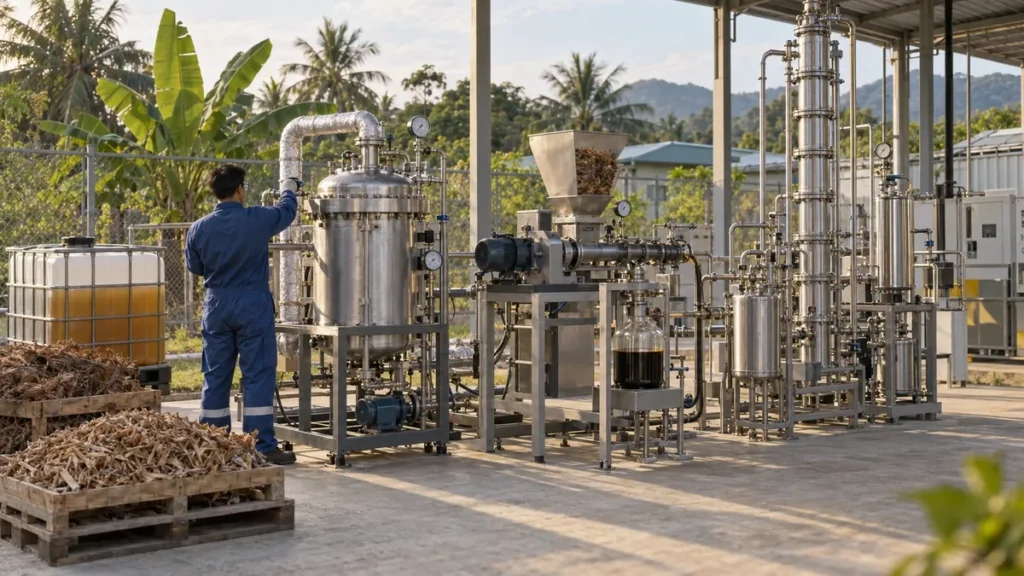
Which production route will a lender fund right now? Hydrothermal liquefaction, fast pyrolysis, gasification-Fischer Tropsch at scale, alcohol-to-jet variants and the two e-SAF routes are the emerging set, and what decides whether they get financed is proof at scale, feedstock access and policy cover, not the chemistry. That is the logic I bring to SAF project risk allocation before I read any process scheme. My view of these emerging SAF pathways is a bankability view: a route earns a place in my model only when those three tests are met in a specific market.
Sustainable aviation fuel is a drop-in jet fuel produced from renewable or waste resources such as cooking oil, municipal waste and agricultural residues (Akin Gump, undated source). The route I choose at feasibility stage fixes most of the cost, the risk and the debt tenor that follow, so route selection and financing structure are one decision.
In short
- Route set: hydrothermal liquefaction, fast pyrolysis, gasification-Fischer Tropsch, alcohol-to-jet and the two e-SAF routes.
- Dominant route: HEFA covers all SAF production today and over 80 percent of announced capacity by 2030, limited by waste lipid supply.
- Cost gap: e-SAF at 4 to 10 times conventional jet fuel, bio-SAF at 2 to 5 times.
- Policy cover: ReFuelEU Aviation ramps to 70 percent by 2050 with an e-SAF sub-mandate at 35 percent, while the United States targets 35 billion gallons by 2050.
- Debt test: contracted revenue covering 8 to 14 years, plus a first-of-a-kind timeline of up to 8 years.
In this article
Which pathways count as emerging, and why the real question is bankability
HEFA accounts for all SAF production today and over 80 percent of announced SAF capacity by 2030, but its scalability is constrained by limited availability of waste lipid feedstocks and by competition with renewable diesel production (Renewable Carbon News, November 2024, older than two years). That constraint is the reason the next routes exist at all: agricultural residues, forestry waste, municipal waste and captured CO2 are simply more abundant than used cooking oil.
The emerging set I track has five members: hydrothermal liquefaction, fast pyrolysis, gasification-Fischer Tropsch, alcohol-to-jet and the e-SAF pair. None of them is a silver bullet (Renewable Carbon News, November 2024).
What this means for you: I pick the route from the feedstock I can contract and the policy that pays for the output, then test whether the scale-up claim survives a lender’s technology review.
Hydrothermal liquefaction and fast pyrolysis
Hydrothermal liquefaction (HTL) and fast pyrolysis both avoid gas intermediates by producing a liquid biocrude (Renewable Carbon News, November 2024). Fast pyrolysis breaks feedstocks down at high temperature and pressure without oxygen, and the bio-oil it yields has high oxygen content, acidity and thermal instability that make downstream upgrading to aviation fuel specification challenging and energy-intensive, which is why pyrolysis players have found greater commercial traction in plastic waste recycling and biochar production rather than in fuels (Renewable Carbon News, November 2024).
HTL runs in a high-temperature, high-pressure water environment and yields a higher quality biocrude with lower oxygen content, higher energy density and superior stability. Its advantage is processing wet feedstocks such as sewage sludge, algae and organic waste without energy-intensive drying, with high carbon efficiency and reduced hydrogen requirements in upgrading (Renewable Carbon News, November 2024). The same source is clear that the technology still needs to scale up to industrial scales, with several demonstration projects, especially when integrated with assets such as wastewater treatment plants.
What this means for you: I treat HTL as a feedstock story carrying a scale-up condition, and pyrolysis as a route that must first prove it can hit fuel specification at a price a lender will underwrite.
Gasification-Fischer Tropsch and alcohol-to-jet
Gasification-Fischer Tropsch converts solid biomass and waste feedstocks into syngas that is catalytically upgraded into liquid hydrocarbons, with extensive commercial experience from coal-to-liquids plants. The remaining obstacles are high capital costs, large-scale requirements and technical complexity in handling mixed feedstocks; the advances cited are novel gasifier designs that reduce tar formation, microchannel FT reactors and improved catalysts (Renewable Carbon News, November 2024).
Alcohol-to-jet uses existing bioethanol infrastructure, with ethanol-to-jet the most developed route and methanol-to-jet gaining attention as biomethanol production scales. These are technologies mature at commercial scale but never combined for SAF production, and the challenges are process complexity and energy intensity (Renewable Carbon News, November 2024).
Capital profile drives the financing question: alcohol-to-jet carries higher capital costs from on-site ethanol processing, gasification-Fischer Tropsch is capital-intensive and needs solid feedstock handling, while HEFA is the most mature and cost-effective but feedstock constrained (World Economic Forum with Kearney, February 2025). Route choice therefore changes the debt story before it changes the fuel, and my sequencing note sits in how to finance a SAF project.
What this means for you: I ask which of these two routes already holds the solid feedstock contract and the process licence arrangement, because that pair decides whether offtake (the contract under which a buyer takes the plant’s output) revenue can cover the capital cost.
e-SAF: the cost and the CO2 problem
Two main pathways are emerging in commercial projects: methanol-to-jet, where green hydrogen and CO2 first become e-methanol and are then converted to jet fuel, and reverse water gas shift followed by Fischer-Tropsch synthesis (Renewable Carbon News, November 2024). The theoretical advantages are unlimited feedstock availability and excellent product quality, but the economics are largely prohibitive. Current e-SAF production costs can be 4 to 10 times that of conventional jet fuel, against 2 to 5 times for bio-SAF, which necessitates substantial government support (Renewable Carbon News, November 2024).
Many e-fuel projects plan to use CO2 from industrial flue gas, and that use will be more restricted in the EU after 2030, so CO2 sourcing is a design decision with a shelf life (Renewable Carbon News, November 2024). Power-to-Liquid (PtL) also carries the highest capital requirements of all routes because it depends on renewable electricity, electrolysis and CO2 capture (World Economic Forum with Kearney, February 2025). The mechanics behind that capital requirement are set out in power-to-liquid explained.
What this means for you: I do not underwrite an e-SAF file on unlimited feedstock claims; I underwrite it on a dated power price, a revisable CO2 source and a mandate that pays the premium.
Policy cover decides which pathway is financeable
ReFuelEU Aviation requires a 2 percent SAF blend by 2025, rising to 6 percent by 2030, 34 percent by 2040 and 70 percent by 2050, with a separate e-SAF sub-mandate starting at 1.2 percent in 2030 and rising to 35 percent by 2050; the United States targets 3 billion gallons by 2030 and 35 billion gallons by 2050, and other nations have proposed mandates ranging from 2 to 10 percent SAF use by 2030 (Renewable Carbon News, November 2024).
Government mandates create a market and stimulate investment, but more support from regulators is needed to advance projects to final investment decision (FID), and costs are likely to stay at several times those of jet fuel (Renewable Carbon News, November 2024).
Policy cuts the other way too. Political commitments to SAF can change or wane, mandate deadlines can be extended, and evolving standards can require expensive retrofitting or even render a facility obsolete (Akin Gump, undated source). I keep the mandate trajectory and the pathway on the same sheet, which is what ReFuelEU Aviation forces any European-bound file to do.
What this means for you: I treat pathway choice and policy geography as one decision, because a route with no cover in my target market stays an unfinanced idea however attractive the yield looks.
What a lender tests before financing an emerging pathway
Technology risk is one of the four categories the World Economic Forum tracks alongside policy, market and feedstock risk, and first-of-a-kind (FOAK) facilities can take up to 8 years from inception to becoming operational (World Economic Forum with Kearney, February 2025).
Demand has to be there as well. Global SAF demand is expected to reach 17 million tonnes per annum by 2030, approximately 4 to 5 percent of total jet fuel consumption, while an additional 5.8 million tonnes would need final investment decisions by 2026 to meet it, and industry capital expenditure is put at between 19 billion and 45 billion USD by 2030 depending on the technology mix (World Economic Forum with Kearney, February 2025).
On the sponsor side, technology obsolescence is a live risk because several certified methods exist today and one or more dominant solutions may emerge and render others uneconomic (Akin Gump, undated source), For a Southeast Asian file, my reading sits in sustainable aviation fuel Southeast Asia equity.
What this means for you: I write the four risk categories on one page and show how each is allocated, because a lender funds allocation, not optimism.
De-risking an emerging pathway: the levers that exist
The World Economic Forum lists ten financial levers, and the ones that matter here are strategic investments by airlines, airports, OEMs and energy players that provide demand assurance; long-term binding offtake that reduces demand uncertainty and is a critical step for reaching FID; infrastructure investors with lower capital costs and a long-term horizon; a tolling model under which the facility provides refinery capacity for a fixed fee while the toller supplies feedstocks and retains risk and title; and green bonds to attract impact investors (World Economic Forum with Kearney, February 2025).
On delivery, a FEED (front-end engineering design) study can take 9 to 15 months, and where technology is novel a single lump sum EPC (engineering, procurement and construction contract) is hard to obtain (Clifford Chance, July 2024, older than two years), with guarantees enforced through PLD (performance liquidated damages) against a minimum performance guarantee (Husch Blackwell, May 2025). Akin Gump’s point stands: novel technology risk is likely to need novel solutions so that the base case economics of the borrower SPV (special purpose vehicle) hold in credible downside sensitivity scenarios (Akin Gump, undated source). My scale-up work sits at technology maturity and scale up.
What this means for you: I would rather hold one binding offtake, one clear guarantee package and one investor with a long horizon than five soft expressions of interest.
How I would run this if it were my file
I start from the feedstock I can actually contract, not from the pathway with the best presentation. HEFA’s constraint is waste lipid availability and competition with renewable diesel, and the alternative routes trade that constraint for capital cost and scale-up risk (Renewable Carbon News, November 2024).
Then I ask three questions in order: is the conversion proven at commercial scale, does the policy framework in my target market pay for the resulting fuel, and can I lock the offtake long enough to cover a debt tenor of 8 to 14 years (World Economic Forum with Kearney, February 2025). Investors often require at least 70 to 80 percent of annual capacity to be covered by offtake agreements, and some lenders require 100 percent of the SAF produced to have reliable offtake covering the full loan tenor (World Economic Forum with Kearney, February 2025).
I price the FOAK clock of up to 8 years into the equity story rather than around it, keep the CO2 source decision revisable, and treat a pathway with no policy cover in my market as an unfinanced idea until support appears.
What this means for you: I carry one page into the lender meeting: feedstock contracted, route proven, policy paid for, offtake tenor matched to debt.
Sources
- Akin Gump, undated, no publication date printed on the document, flagged as an undated page.
- Clifford Chance, July 2024, older than two years.
- World Economic Forum with Kearney, February 2025.
- Renewable Carbon News, November 2024, older than two years.
- Husch Blackwell, May 2025.
Frequently asked questions
Which emerging SAF pathway is closest to bankability today?
Gasification-Fischer Tropsch and alcohol-to-jet sit closest, because both build on established industrial experience: gasification on coal-to-liquids plants and alcohol-to-jet on the bioethanol industry. HEFA remains the only route in full commercial production today, held back by waste lipid availability and competition with renewable diesel (Renewable Carbon News, November 2024). The choice still depends on the feedstock I can contract and on policy cover in the target market.
Why does hydrothermal liquefaction attract attention when it is not proven at industrial scale?
Because it solves the feedstock problem the other routes have. It processes wet feedstocks such as sewage sludge, algae and organic waste without energy-intensive drying, in a high-temperature, high-pressure water environment that gives a biocrude with lower oxygen content, higher energy density and superior stability, and it needs less hydrogen in upgrading (Renewable Carbon News, November 2024). The trade-off is that it still has to scale up to industrial scales and is demonstrated rather than commercial.
Does an e-SAF project need a subsidy to reach FID?
On current economics, yes. e-SAF production costs can be 4 to 10 times conventional jet fuel against 2 to 5 times for bio-SAF, which is why substantial government support is needed, and demand is created by mandates such as the e-SAF sub-mandate that starts at 1.2 percent in 2030 and rises to 35 percent by 2050 (Renewable Carbon News, November 2024). Without that cover, projects struggle to move to FID.
How do I judge whether a new pathway will still be certified in ten years?
By testing certification risk rather than reading the chemistry. Several certified production methods exist today and the market is expected to consolidate, with one or more dominant solutions emerging and possibly rendering others uneconomic, while evolving legal and standard requirements can force expensive retrofits (Akin Gump, undated source). I test the pathway against current standards, against the mandate trajectory in the target market, and against a first-of-a-kind timeline of up to 8 years.
Want this route shortlist run against your own feedstock?
A short call is usually enough to see where your project stands.
If you are at feasibility stage and want a clear read on which of these routes fits your feedstock, your market and your debt tenor, investor introductions is where I open the conversation with capital that already understands this fuel.
I do not provide investment advice or arrange investments. I act as a strategic advisor and facilitator.

Alex, Founder of WeConnect Asia
I help low-carbon fuel and carbon removal project developers in Southeast Asia secure the commercial and financial partners needed to reach FID.
Related articles

Pitching a Climate Tech Company to Strategic Investors: What the Corporate Has to Believe Before It Writes a Cheque
How to pitch a climate tech company to strategic investors: the metric cluster, the readiness evidence and the ask that corporates fund.

Biomethane: What It Is, How It Is Made and Who Buys It
Biomethane is biogas cleaned to pipeline quality. I explain how it is made, how it differs from biogas and who buys it in Southeast Asia.

CO2 Sourcing for e-SAF Projects: What the Rules Allow and What the Contract Must Say
Biogenic CO2, direct air capture or industrial flue gas: which sources an e-SAF plant may use, what they cost and which contract terms make the fuel certifiable.

Operating Performance Guarantees for SAF Plants: What Lenders Ask For
Minimum guarantees, performance damages, retesting and who stands behind them: the operating guarantees a SAF plant needs to keep debt and offtake intact.

EPC and Construction Risk in SAF Plants: What a Lender Actually Tests
FEED scope, convertible EPC, performance guarantees and damages caps: the construction risk questions a SAF project must answer before financial close.

Matching Feedstock and Offtake Risk Back-to-Back in a SAF Project: How Lenders Read the Chain
Lenders do not buy a feedstock plan and an offtake plan separately. They buy the link between the two, and the link is where most SAF files break.