
Home » Green Fertilisers: Who Pays the Premium and How It Gets Signed
Green Fertilisers: Who Pays the Premium and How It Gets Signed
10 min read · Dec 2, 2025 · By Alex
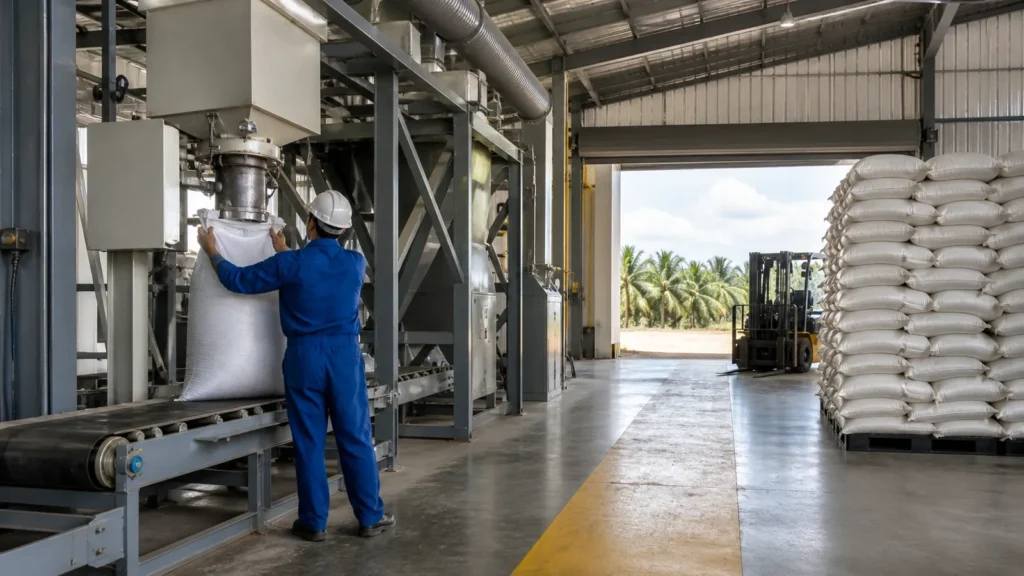
Yes, this product carries a premium, the extra price over the conventional product, and the premium is paid by the buyer who needs the emission claim, meaning a food or drink group working to a scope 3 target, the emissions in its own value chain, rather than a farmer on thin margins, and it survives only when written as a contract with volume, tenor and a certificate somebody can verify, because the physical bag is chemically the same either way. I build the argument on the green ammonia guide, the parent page that sets out where ammonia sits in the chain. The green fertiliser question, as I write it, is a contracting question first and an agronomy question second, because the bag does not change and the claim does.
In this piece I order five things: what changes inside the product, where the emissions sit, what the border rule adds to the price, where the regional demand is, and the contract I would ask for. I keep each one short, because the open question is the signature, not the chemistry.
In short
- The claim: Made with renewable hydrogen instead of fossil hydrogen, a green fertiliser keeps the same chemical composition, so what changes is the emission on the tonne (2025).
- The gap: Low-emission ammonia adds 1 to 3 percent to the finished product and cuts product emissions by up to 30 percent (2025).
- The rule: Since 1 January 2026 the carbon border adjustment applies under its definitive regime and covers fertilisers among six sectors (2026).
- The demand: Ammonia takes 49 percent of Southeast Asian hydrogen demand in 2024, against 31 percent for refining (2024).
- The contract: Less than 2 Mtpa of firm offtake agreements exist cumulatively, about 5 percent of potential 2030 output (2025).
In this article
The bag is the same, the claim is not
A fertiliser is the nutrient spread on a field; urea is the solid nitrogen fertiliser made from ammonia, and a nitrogen fertiliser delivers nitrogen to the soil. A green fertiliser is made with renewable hydrogen instead of fossil hydrogen, with the same chemical composition. A premium is the extra price over the conventional product. Scope 3 covers emissions in a buyer’s value chain. Book-and-claim lets a claim travel without moving the molecule, and a certificate is the document that proves the reduction. An offtaker is the party bound to buy; take-or-pay makes it pay the contracted volume anyway. A carbon border adjustment charges imports for their embedded emissions.
More than half of all food grown relies on ammonia fertilisers made in more than 60 countries, and 40 to 50 percent of the world’s population depends directly on manufactured nitrogen fertiliser at about 20 kg per person (2025), while fertiliser production accounts for about 1 percent of global emissions (2025).
What this means for you: the contract has to describe the claim as precisely as it describes the tonne.
What changes inside the molecule
Nothing in the bag changes. What changes is the hydrogen step: renewable hydrogen replaces fossil hydrogen in ammonia synthesis, and the same ammonia still feeds the same urea. I put that step in the production process explained, because that is where extra cost and the whole reduction are created.
Switching to low-emission ammonia raises the cost of the finished product by 1 to 3 percent while cutting product emissions by up to 30 percent, against organic premiums of 20 to 40 percent, per the Hydrogen Council and McKinsey roadmap of November 2025. The roadmap also notes technologies that abate more than 80 percent of this footprint, new low-carbon plants with capture rates above 95 percent, and certification and book-and-claim that let the reduction travel through a global supply chain (2025).
A buyer can justify 1 to 3 percent when it has a public target to defend; that is not the buyer at the farm gate (2025).
What this means for you: the premium is approved by the party that publishes the target, not the party that spreads it.
Where the emissions actually sit
The premium does not buy a cleaner bag, it buys a different hydrogen molecule, and that molecule sits far upstream of the field. The step I point buyers to is how renewable hydrogen is made, because it is the one the premium pays to remove.
Ammonia production and use account for 2 percent of the world’s carbon dioxide emissions, and 99 percent of production depends on fossil feedstock: 72 percent natural gas, 26 percent coal, 1 percent oil and less than 1 percent electricity, per the BloombergNEF and Climate Technology Coalition paper of January 2024. In 2021, 77 percent of ammonia demand went to fertilisers against 23 percent for industrial uses, and 54 percent of all fertilisers are made with ammonia (2021). The ammonia market is worth 76 billion USD (January 2024). The sector consumes 33 million tonnes of hydrogen a year out of 94 million tonnes of global hydrogen demand (2021).
What this means for you: the footprint sits in the feedstock, so a premium must name the feedstock change it buys.
What the border rule adds to the price
The carbon border adjustment turns an emission into a number, and I read it beside the low-carbon fuel mandates that push volume. Since 1 January 2026 it has applied under its definitive regime through the European Commission across six sectors including fertilisers and hydrogen, and importers above a 50 tonnes mass threshold must hold authorised declarant status.
The certificate price follows the average EU emissions trading auction price, published quarterly in 2026 and weekly from 2027. Published: 75.36 EUR for the first quarter of 2026 (7 April 2026), 75.28 EUR for the second (6 July 2026) and 82.32 EUR for the third (5 October 2026), with the fourth due on 4 January 2027.
A carbon price already paid during production can be deducted, and the guidance of 14 August 2026 includes a sectoral document for fertilisers. This is the first time a fertiliser exporter can price an emission rather than describe it (2026).
What this means for you: I quote the certificate price next to the product price, because from 2026 the border rule is a cash line.
Where the demand is today
The buying centre is regional before it is global, and I map it on the Southeast Asia and Singapore market page.
The December 2025 Southeast Asia briefing sets out the shape of that demand: regional hydrogen demand reached 4 Mt in 2024, with ammonia at 49 percent against refining at 31 percent and methanol at 20 percent, and the country split was Indonesia 35 percent, Malaysia 22 percent, Viet Nam 15 percent and Singapore 12 percent (2024).
Only Indonesia and Malaysia export, with Malaysia at 73 percent of regional exports and the region at 17 percent of world ammonia exports (2023). Announced regional projects equal 12 percent of current demand, while only 6 percent of announced capacity has reached final investment decision (2025). The region holds nearly 11 Mtpa of potential below 6 USD/kg by 2030 (2025). No certification scheme is in place yet, with work under way in three countries (2025).
What this means for you: I will not sell a claim into a region that cannot certify it, so certification timing belongs in my contract.
Who actually pays
The payment does not come from the field. I read the 2025 review’s five key questions for the arithmetic: less than 2 Mtpa of firm offtake agreements exist cumulatively, about 5 percent of potential 2030 output, and only 9 percent of announced projects worldwide have secured committed investment against 0.5 percent in emerging economies (2025). 80 percent of projects in emerging economies are export oriented, and the cost of capital can reach 15 percent there, three times the level of advanced economies (2025).
Nearly half of the 20 largest food and drink groups, with 850 billion USD of annual revenue, have set scope 3 targets (2025), and that is the balance sheet I look at before I ask a farmer for anything. Between those two sits the whole negotiation: the buyer wants the claim, the producer wants the tenor, and the farmer is not in that room.
What this means for you: the premium is paid where the claim is filed, so I price the contract against a buyer’s published target rather than a farm margin.
How I write the premium into a contract
Low-carbon ammonia is scarce, so the clause has to say where it goes. The E3G briefing of April 2023 argues that scarce low-carbon ammonia should be prioritised where the climate benefit is proven, names decarbonising fertiliser production first ahead of co-firing, and calls for carbon intensity standards that cover the full life cycle.
- The clause I ask for first: volume, tenor, price formula, certificate delivered with each parcel.
- The proof I refuse to sell before a registry can verify it.
More than 300 Mtpa of low-carbon ammonia projects were announced by May 2025 against 200 Mtpa of the conventional market, while only 48 projects and 15 Mtpa had reached final investment decision (2025). I set the same volume and tenor questions against the Southeast Asia offtake page, where the gap shows up first.
What this means for you: I price the certificate into the contract and the registry into the closing condition, because an announced capacity is not a parcel I can buy.
The four checks before I call it bankable
I apply four checks in order before I call any premium bankable, and each one is a question a lender will ask anyway.
An announcement is not an order: of 185 tracked low-carbon ammonia projects, 45 hold offtake agreements and 15 are under construction or financed (2024). A firm agreement is not a delivery: 1.3 Mtpa was online in May 2025 out of 15 Mtpa at final investment decision (2025). A regional pipeline is not a plant: only 6 percent of announced regional capacity has reached final investment decision (2025). A certificate nobody can verify is marketing, which is why I check the registry before I price the claim (2026).
The gap between announcement and parcel is where the negotiation actually lives.
What this means for you: four checks, four signatures, and I do not call the premium bankable until all four are cleared.
Sources
- Hydrogen Council with McKinsey & Company, Fertilizing the future: A roadmap to scale low-emission ammonia fertilizers https://hydrogencouncil.com/wp-content/uploads/2025/11/Fertilizing-the-future-FINAL.pdf, November 2025.
- BloombergNEF and Climate Technology Coalition, Scaling Up Hydrogen: The Case for Low-Carbon Ammonia https://assets.bbhub.io/professional/sites/24/CTC-whitepaper_Ammonia_Final.pdf, January 2024.
- European Commission, CBAM definitive regime https://taxation-customs.ec.europa.eu/carbon-border-adjustment-mechanism/cbam-definitive-regime_en, 2026.
- European Commission, Price of CBAM certificates https://taxation-customs.ec.europa.eu/carbon-border-adjustment-mechanism/price-cbam-certificates_en, 2026.
- IEA, Global Hydrogen Review 2025, Southeast Asia, 9 December 2025 https://iea.blob.core.windows.net/assets/745a259b-9cb7-4e1d-9ba1-a8b63d1eaae8/GHR2025_SEA_Webinar.pdf, 2025.
- IEA, Global Hydrogen Review 2025, Five key questions about hydrogen https://www.iea.org/reports/global-hydrogen-review-2025/five-key-questions-about-hydrogen, 2025.
- E3G, Challenging Japan’s promotion of ammonia co-firing for coal power generation, briefing paper https://www.e3g.org/wp-content/uploads/E3G-Briefing-Challenging-Japans-promotion-of-ammonia-co-firing-for-coal-power-generation.pdf, April 2023.
Frequently asked questions
What makes a fertiliser green?
The hydrogen step: the fertiliser is made with renewable hydrogen instead of fossil hydrogen, and the product keeps the same chemical composition, so what changes is the emission embedded in the tonne (2025). The reduction is then carried by a certificate rather than by the product itself.
Who pays the green premium?
The buyer who needs the claim: raising the finished product cost by 1 to 3 percent while cutting product emissions by up to 30 percent is easy to justify against organic premiums of 20 to 40 percent, and it lands on the party with a scope 3 target rather than on the farmer (2025).
What did the EU border rule change for fertiliser exporters?
Since 1 January 2026 imports into the EU of fertilisers among six sectors carry a certificate priced on the emissions trading auction average, with quarterly prices published in 2026 and weekly prices from 2027, and a 50 tonnes threshold for authorised status (2026). A carbon price already paid during production can be deducted from the certificates handed over each year.
How is a green fertiliser offtake different from a conventional one?
I ask for volume, tenor, a price formula and a certificate delivered with each parcel, because less than 2 Mtpa of firm offtake agreements exist cumulatively against the potential output of 2030 (2025).
Not sure your project would survive a credit conversation?
A short call is usually enough to see where your project stands.
If you want the clause set out rather than described, offtake agreements work is where I take a volume, a tenor and a certificate schedule and turn them into a signature, with the registry check written into the closing condition.
I do not provide investment advice or arrange investments. I act as a strategic advisor and facilitator.
Alex, Founder of WeConnect Asia
I help low-carbon fuel and carbon removal project developers in Southeast Asia secure the commercial and financial partners needed to reach FID.
Related articles

Pitching a Climate Tech Company to Strategic Investors: What the Corporate Has to Believe Before It Writes a Cheque
How to pitch a climate tech company to strategic investors: the metric cluster, the readiness evidence and the ask that corporates fund.

Biomethane: What It Is, How It Is Made and Who Buys It
Biomethane is biogas cleaned to pipeline quality. I explain how it is made, how it differs from biogas and who buys it in Southeast Asia.

CO2 Sourcing for e-SAF Projects: What the Rules Allow and What the Contract Must Say
Biogenic CO2, direct air capture or industrial flue gas: which sources an e-SAF plant may use, what they cost and which contract terms make the fuel certifiable.

Operating Performance Guarantees for SAF Plants: What Lenders Ask For
Minimum guarantees, performance damages, retesting and who stands behind them: the operating guarantees a SAF plant needs to keep debt and offtake intact.

EPC and Construction Risk in SAF Plants: What a Lender Actually Tests
FEED scope, convertible EPC, performance guarantees and damages caps: the construction risk questions a SAF project must answer before financial close.

Matching Feedstock and Offtake Risk Back-to-Back in a SAF Project: How Lenders Read the Chain
Lenders do not buy a feedstock plan and an offtake plan separately. They buy the link between the two, and the link is where most SAF files break.