
Home » Hydrogen Carbon Intensity Thresholds: Where the Number Comes From
Hydrogen Carbon Intensity Thresholds: Where the Number Comes From
10 min read · Nov 2, 2026 · By Alex
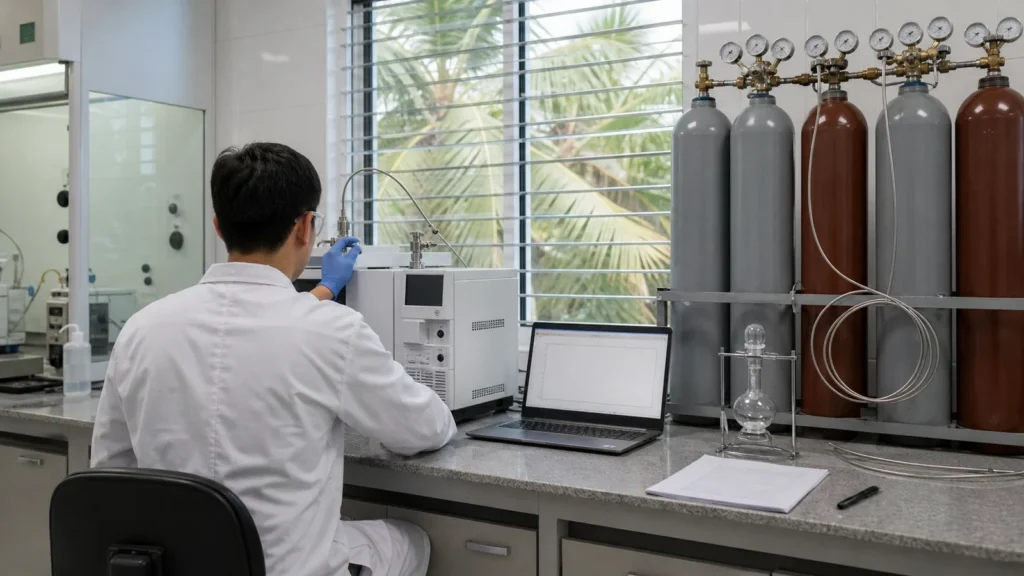
Ask a buyer, a certification scheme and a regulator what emissions limit your green hydrogen must respect. You will then get three different answers. No single number governs the molecule: whoever controls the destination market sets the limit. Also, it typically sits between 1 and 4.9 kilograms of CO2-equivalent per kilogram of hydrogen. Moreover, voluntary schemes write that as kg CO2eq per kg for renewable pathways. A body writes those schemes, and producers choose to join them. One national definition sets 2 kg CO2eq per kg, and European rules ask for 70 percent greenhouse gas savings. Savings measure the emissions avoided against a fossil reference. That is why I read a hydrogen carbon intensity threshold as a design input rather than a compliance afterthought.
A threshold is the maximum emissions intensity a molecule may carry to enter a market. Specifically, it measures the mass of greenhouse gases released per unit of product.
I order this article in three moves: where the number comes from, and who writes it. The third move is what it does to a feasibility model. I also set out what I refuse to accept as a threshold. Every figure below carries its year.
The short answer
In short
- No single number: the buyer, the scheme or the regulator of the destination market writes the ceiling the molecule must respect.
- Route decides the score: in April 2023 the same product gave 0 kg with renewable electricity and 24 kg on a grid averaging 460 g CO2-eq/kWh.
- European rule: at least 70 percent greenhouse gas savings under two delegated acts adopted in June 2023, for producers inside and outside the Union.
- Schemes disagree: in 2023 two of eight voluntary schemes set no threshold, the others set 1 to 4.9 kg CO2eq per kg, and one national definition uses 2 kg at the site of production.
- Model impact: the threshold fixes the power contract, the accounting boundary and the certification route before anything else.
In this article
The number a buyer asks for
A threshold is a ceiling, not a target. Before a molecule sells into a market, someone states the maximum emissions intensity it may carry. The figure comes in kilograms of CO2-equivalent per kilogram of hydrogen. As a result, the buyer checks the certificate against that ceiling. The author can be the buyer in an offtake contract, the body running a voluntary scheme, or the regulator of the destination country.
In 2023, a study of certification schemes found that two of eight voluntary mechanisms set no emissions threshold and simply compare one carbon footprint with another. The number usually arrives late in a conversation and early in a design. A buyer states it after the site, the power supply and the offtake structure take shape. As a result, it decides operating hours, the renewable build, the metering and the certification budget.
What this means for you: ask for the number in the first technical call and record who wrote it. In fact, a ceiling with no author carries no weight. One discovered at contract stage forces a redesign.
What a threshold is measured against
A threshold means nothing until I know what sits under it. The IEA report of April 2023 gives intensity by production route, and the spread explains the disagreement.
- Unabated fossil, 2023: up to 27 kg CO2-eq/kg H2, against 12 to 13 kg for production in 2023.
- Natural gas without capture, 2023: 10 to 14 kg; coal gasification without capture, 2023: 22 to 26 kg.
- Steam methane reforming, the reaction of natural gas with steam, with 93 percent capture, April 2023: 0.7 kg direct and 1.5 to 6.2 kg total.
- Electrolysis, the splitting of water with electric current, April 2023: 24 kg on a grid averaging 460 g CO2-eq/kWh. Specifically, it drops to 0 kg on renewable electricity and 0.1 to 0.3 kg on nuclear under the IPHE methodology. Solar photovoltaic gives 0.9 to 2.5 kg, and onshore wind 0.4 to 0.8 kg.
The report gives no generic upper acceptable threshold, because each government sets its own level while a common methodology keeps the definitions interoperable.
What this means for you: I compare the buyer’s ceiling with the same route and boundary. That check runs through an EU compliance route and settles before any design freeze.
The rule the European Union writes
Hydrogen made by electrolysis with renewable electricity is a renewable fuel of non-biological origin. The European Commission page of 17 November 2026 sets what that fuel must prove. It must show at least 70 percent greenhouse gas savings. Two delegated acts adopted in June 2023 apply to producers inside the Union and outside it. Two criteria carry the rule: additionality. This means meane power purchase agreements with new and unsupported renewable capacity, and temporal and geographic correlation between the electricity and the hydrogen. To ease the start, producers may sign long-term power purchase agreements with existing installations until 1 January 2028. Also, the delegated act comes up for review in July 2028. Certification runs through voluntary schemes recognised by the Commission, which Union countries must accept.
The Renewable Energy Directive adds volumes: at least 1 percent of the energy supplied to transport by 2030 and at least 42 percent of the hydrogen used in industry by 2030, rising to 60 percent in 2035.
What this means for you: if your buyer sits in this market, the 70 percent ceiling and the correlation criteria decide your power contract, so I source the electricity before I size the plant.
Which market sets which number
Five markets write five rules, and the Global Hydrogen Review 2025 page lists them. For example, the European Union acts through delegated acts for renewable and low-carbon hydrogen. The United States uses a Clean Hydrogen Protection Standard. China follows clean and low-carbon hydrogen energy evaluation standards. Japan has the Hydrogen Society Promotion Act, and India a Green Hydrogen Standard. The same page presents standardised certification schemes as the way to tell low-emissions hydrogen apart across global markets.
The practical reading is that one project can face several definitions at once. Also, the tightest one governs whenever the molecule can move. I check the fuel mandates of the destination market before I freeze the route.
What this means for you: write the destination and its rule in the header of the model, not in an appendix. As a result, every scenario answers to the market that will take the molecule.
What the threshold changes in a model
The IRENA and RMI study of 2023 assessed eight voluntary schemes and five mandatory schemes in 2023 and found none of the existing certification systems suitable for cross-border trade. Two of the eight voluntary mechanisms set no emissions threshold and compare carbon footprints instead. Meanwhile, the others set a threshold between 1 and 4.9 kg CO2eq per kg for renewable pathways in 2023. One national definition requires a carbon intensity equal to or below 2 kg CO2eq per kg at the site of production in 2023.
Boundaries do not match: some stop at the point of production, others reach the point of consumption, others add full upstream methane. The study recommends a modular approach by supply chain stage and a single calculation methodology.
So a model needs the number, the boundary and the method together, and I check all three against the regional cost picture for the destination.
What this means for you: a threshold copied without its boundary and its method is not a threshold, it is a slogan, and I never carry it into a base case.
What I refuse to accept as a threshold
I refuse three things. A corporate target is not a regulatory threshold, because no authority enforces it. A scenario value is not a limit, because it describes a modelled future rather than a rule in force. And without its boundary and accounting method, a number cannot compare with another.
Two facts from 2023 show the cost of that confusion. In fact, only 4 percent of announced low-emissions projects were under construction or had reached a final investment decision. Lack of clarity in regulation and certification keeps developers from taking firm decisions.
Three questions come first: who wrote the number, in which document and from which date; where the boundary sits, at the point of production, at the point of consumption or through upstream methane; and which calculation method produced it.
What this means for you: if any answer is missing, I keep the number out of the model and mark the case unresolved rather than pretend precision.
What this means for a Southeast Asian project
At least 60 countries had published or were drafting a hydrogen strategy in 2022. Yet in 2025 low-emissions hydrogen still accounts for less than 1 percent of global production. Meanwhile, the cost gap with unabated fossil production widened in 2025, and modellers expect it to narrow by 2030. For a project in Southeast Asia this means the destination writes the number, not the region.
So I start from demand: hydrogen used for power to X and e-fuels buyers apply their own fuel rules, and the export contract will quote a threshold that came from somewhere else. I then ask which certification route can serve that market without rebuilding the evidence for every customer.
What this means for you: fix the export market and its threshold before you fix the plant, and treat any threshold quoted without a market as incomplete.
How I set the threshold in a feasibility
The IEA executive summary of 2025 records three points. Low-emissions production grew by 10 percent in 2024 and was on track to reach 1 Mt in 2025. That is still below 1 percent of global production. In addition, more than 200 low-emissions projects have received a final investment decision since 2020. Renewable hydrogen could become cost competitive in China by the end of the decade. The gap widens elsewhere.
I fix the threshold in three moves. First, I read the rule of the market that will take the molecule, with its boundary and method. I test the route against that rule with one calculation method. The result becomes the base case, and the threshold becomes a sensitivity. As a result, the model shows what must change if the buyer tightens it.
What this means for you: carry a dated threshold with its boundary into every scenario, and change it only when the buyer, the scheme or the regulator changes it in writing.
Sources
- IEA, Towards hydrogen definitions based on their emissions intensity, April 2023 https://iea.blob.core.windows.net/assets/acc7a642-e42b-4972-8893-2f03bf0bfa03/Towardshydrogendefinitionsbasedontheiremissionsintensity.pdf, 2023.
- European Commission, Renewable hydrogen https://energy.ec.europa.eu/topics/eus-energy-system/hydrogen/renewable-hydrogen_en, consulted 17 November 2026.
- IEA, Global Hydrogen Review 2025, Five key questions about hydrogen https://www.iea.org/reports/global-hydrogen-review-2025/five-key-questions-about-hydrogen, 2025.
- IRENA and RMI, Creating a global hydrogen market: Certification to enable trade https://www.irena.org/-/media/Files/IRENA/Agency/Publication/2023/Jan/IRENA_Creating_a_global_hydrogen_market_2023.pdf, 2023.
- IEA, Global Hydrogen Review 2025, Executive summary https://www.iea.org/reports/global-hydrogen-review-2025/executive-summary, 2025.
Frequently asked questions
What is a hydrogen carbon intensity threshold?
A maximum emissions intensity, expressed in kilograms of CO2-equivalent per kilogram of hydrogen, below which a molecule qualifies in a given market in 2023. It is a ceiling rather than a target. A buyer, a certification scheme or a regulator writes it, and the producer must show a certificate measured against it before the molecule is sold. The number is checked before the sale, not after it.
Is there a single accepted threshold?
No. In 2023, among eight voluntary schemes, two set no threshold at all and compare carbon footprints instead, while the others set one between 1 and 4.9 kg CO2eq per kg for renewable pathways. One national definition uses 2 kg CO2eq per kg at the site of production in 2023, so the same plant can pass one rule and fail another.
What threshold does the European Union require?
At least 70 percent greenhouse gas savings under two delegated acts adopted in June 2023, with additionality and temporal and geographic correlation as criteria, applying to producers inside and outside the Union in 2026. Certification runs through schemes recognised under those acts, and long-term power purchase agreements with existing installations are allowed until 1 January 2028.
Which threshold should I design against?
The threshold of the market that will take the molecule, read together with its boundary and its accounting method, because the same production route scored 0 kg with renewable electricity and 24 kg on a global average grid of 460 g CO2-eq/kWh in 2023. I design against the tightest rule that the buyer and the destination can apply.
Not sure your project would survive a credit conversation?
A short call is usually enough to see where your project stands.
If you want the number fixed before the design is frozen, I run a carbon intensity and compliance review that reads the buyer’s rule, the boundary and the accounting method together and returns the threshold your model should carry.
I do not provide investment advice or arrange investments. I act as a strategic advisor and facilitator.
Alex, Founder of WeConnect Asia
I help low-carbon fuel and carbon removal project developers in Southeast Asia secure the commercial and financial partners needed to reach FID.
Related articles

Pitching a Climate Tech Company to Strategic Investors: What the Corporate Has to Believe Before It Writes a Cheque
How to pitch a climate tech company to strategic investors: the metric cluster, the readiness evidence and the ask that corporates fund.
Biomethane: What It Is, How It Is Made and Who Buys It
Biomethane is biogas cleaned to pipeline quality. I explain how it is made, how it differs from biogas and who buys it in Southeast Asia.
CO2 Sourcing for e-SAF Projects: What the Rules Allow and What the Contract Must Say
Biogenic CO2, direct air capture or industrial flue gas: which sources an e-SAF plant may use, what they cost and which contract terms make the fuel certifiable.
Operating Performance Guarantees for SAF Plants: What Lenders Ask For
Minimum guarantees, performance damages, retesting and who stands behind them: the operating guarantees a SAF plant needs to keep debt and offtake intact.

EPC and Construction Risk in SAF Plants: What a Lender Actually Tests
FEED scope, convertible EPC, performance guarantees and damages caps: the construction risk questions a SAF project must answer before financial close.

Matching Feedstock and Offtake Risk Back-to-Back in a SAF Project: How Lenders Read the Chain
Lenders do not buy a feedstock plan and an offtake plan separately. They buy the link between the two, and the link is where most SAF files break.