
Home » Islamic Finance for SAF Projects: Sukuk, Shariah-Compliant Debt and Banks
Islamic Finance for SAF Projects: Sukuk, Shariah-Compliant Debt and Banks
9 min read · Jun 2, 2026 · By Alex
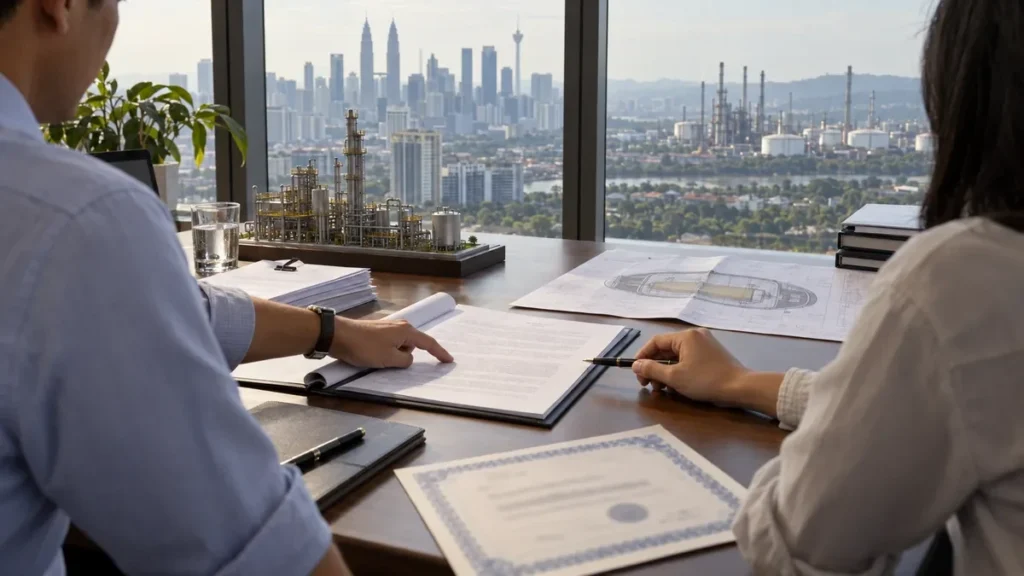
You can raise money for a sustainable aviation fuel project before final investment decision (FID) with Shariah-compliant capital in four forms. The first is use-of-proceeds certificates for the capital markets slice. Then come asset-based leasing and cost-plus sale, plus Shariah-compliant lending from an Islamic bank or its window. Takaful covers risk transfer. Start with how to finance a SAF project; these instruments sit on top of it. Sukuk (Islamic investment certificates) carry the capital markets slice, Shariah rules decide what sits in the asset pool, and sustainable aviation fuel is the sector both screens reward.
I have written this for the pre-FID file: what the instruments are, what the Shariah board will ask for, and where the precedent sits in aviation and in the two regional home markets. The sequence matters more than the label, and the asset pool decides which door you walk through.
In short
- Instrument menu: sukuk for capital markets, ijara and murabaha for the plant, bank lending, takaful for risk.
- Structure before label: build the asset pool first, choose the label after.
- Shariah board gate: documentation needs board approval and enough compliant assets.
- Regional precedent: Malaysia and Indonesia set the frameworks, Etihad the aviation case.
- Demand side: mandates and a firm offtake decide whether either instrument prices.
In this article
What Islamic finance can put into a SAF project
Four routes carry money into a plant like yours: use-of-proceeds sukuk for the capital markets slice, ijara and murabaha for the plant, Shariah-compliant lending from an Islamic bank or its Islamic window, and takaful for risk transfer.
ICAO has adopted a collective long-term global aspirational goal of net-zero carbon emissions by 2050. IATA has committed its member airlines to net-zero emissions by 2050, aligned with the Paris Agreement’s 1.5 degree target. That assumes most of aviation’s decarbonisation comes from SAF (Dentons, 30 June 2026). The Air Transport Action Group’s Waypoint 2050 analysis puts the cost of transitioning to net-zero carbon by 2050 at USD 4.7 trillion (Dentons). Meeting it requires new technology, accessible SAF and a reshaping of how aviation is financed. Project finance and capital markets are the instruments named for that reshaping (Dentons). Global Islamic financial assets passed USD 5 trillion in 2025 (Dentons). Either way, the route to FID turns on contracts, permits and risk allocation.
What this means for you: the structure changes paperwork and screening, not diligence, so a file ready for a conventional lender is ready for a Shariah-compliant one.
The discipline the structure adds to your file
Islamic finance is principally asset-based, and the lender bears some of the risks of ownership. The relationship is not the conventional creditor and debtor one. It involves shared risks and rewards (Norton Rose Fulbright, 2016, older than two years).
Charging or receiving riba (interest) is prohibited. Therefore, the return to an investor must be linked to the profits of an enterprise and derived from commercial risk. The underlying assets must be Shariah-compliant and cannot relate to gambling, the production or sale of alcohol or pork. Gharar (excessive uncertainty) is prohibited. AAOIFI defines sukuk as certificates of equal value representing undivided shares in ownership of tangible assets, usufruct and services (ICMA, IsDB, LSEG, April 2024). Board approval also requires the obligor’s business and assets to align with maqasid al-Shariah (the higher objectives of Islamic law): safeguarding life, faith, intellect, posterity and property.
Your book of contracts, permits and asset titles becomes the security package, read earlier and harder than a conventional file.
What this means for you: treat the asset documents as the credit story, because the Shariah screen and the lender’s security test read the same papers.
Sukuk as the capital markets route
Sukuk are the primary capital market instruments in Islamic finance. Shariah-compliant certificates sharing underlying profits or income streams and offering fixed income characteristics similar to bonds (ICMA, IsDB, LSEG). Global issuance rose to USD 264.8 billion in 2025, the fastest growing segment of Islamic finance (Dentons).
Sukuk are often governed by English law as trust certificates, usually replicate the financial performance and investment risk of a senior unsecured Eurobond, and carry periodic distribution payments with bullet redemption (ICMA, IsDB, LSEG). The documentation needs Shariah board approval, and enough Shariah-compliant assets must underpin the structure (ICMA, IsDB, LSEG).
The most prevalent form is asset-based: the investor takes the primary credit risk of the sukuk obligor. Also, the issuer must pay irrespective of performance. In some hybrid structures tangible assets must be at least 51 percent of the total portfolio value (ICMA, IsDB, LSEG). Sustainable sukuk issuance reached USD 13.4 billion in 2023 against USD 9.4 billion in 2022, the seventh consecutive record year since inception in 2017 (ICMA, IsDB, LSEG).
What this means for you: you are selling familiar bond economics to an investor base that also wants a compliant asset pool, so plan around it.
Where the aviation precedent sits in your capital stack
In aviation, Shariah-compliant financing has relied on ijara, ijara wa iqtina, murabaha and sukuk al-ijara structures, mapping onto the economics of aircraft ownership, leasing and securitisation (Dentons).
The clearest precedent is Etihad Airways: in 2020 it launched a USD 600 million transition sukuk. That was the world’s first sustainability-linked sukuk and the first transition-labelled financing in global aviation. Its terms link to a 20 percent cut in passenger fleet emissions intensity by 2025. They also tie to a 50 percent cut in net emissions by 2035 and net-zero carbon by 2050 (Dentons).
The same menu applies to your file: green loans or bonds for fuel-efficient aircraft, sustainability-linked facilities whose margins step up or down on emissions-intensity or SAF-uptake key performance indicators (KPIs), and project finance and capital markets solutions for SAF plants (Dentons). Your plant and its contracts sit in a special purpose vehicle (SPV), which the Shariah board and security trustee examine. For the equity side of your stack, how equity investors read a SAF file covers what comes before debt.
What this means for you: pick the structure from what you own or build, letting the aviation label follow economics.
Malaysia and Indonesia are the two home markets
Malaysia’s Securities Commission introduced the Sustainable and Responsible Investment Sukuk framework in 2014. Also, the world’s first green sukuk followed in 2017 when Tadau Energy issued MYR 250 million for a 50 MW solar photovoltaic plant certified by CICERO (UNDP and Kuwait Finance House, 2024). Issuers can align with national standards or ICMA’s Green Bond Principles, and eligible green projects cover renewable energy, energy efficiency, clean transportation and green buildings (UNDP and Kuwait Finance House).
Indonesia has pioneered sovereign green sukuk since 2018. The first came in March 2018: USD 1,250 million at 3.75 percent over 5 years, on a wakala structure. It listed in Singapore and Nasdaq Dubai. A 30-year issuance followed in 2021 and a 10-year tranche in June 2022 (UNDP and Kuwait Finance House). Malaysia, Indonesia, the UAE and Saudi Arabia raised 83.3 percent of cumulative sustainable sukuk issuance by the first quarter of 2024 (ICMA, IsDB, LSEG). SAF mandates and fuel policy are the demand side of your file.
What this means for you: an issuer from Malaysia or Indonesia faces a deeper buyer base and a tested framework, shortening documentation.
Policy demand and offtake decide whether either instrument works
A Shariah-compliant instrument does not fix a weak project. The same demand drivers apply: mandates and compliance obligations pulling airline and corporate buyers toward SAF. Also, an offtake agreement (the contract under which a buyer takes the output) firm enough to size debt against. Securing offtake comes before pricing anything.
This is not only a technology challenge but a financing challenge: lenders. Also, investors scrutinise aviation exposure through an ESG lens, and borrowers with credible decarbonisation strategies access green or sustainability-linked products on better terms (Dentons, 30 June 2026). SAF prices remain linked to conventional fuel and energy input costs. Therefore, higher crude prices and supply shocks strengthen the case for scaling capacity, diversifying feedstocks and more efficient production (Dentons).
Reporting is what issuers underestimate. Green or sustainability-linked sukuk issuers must publish periodic reports on allocation of proceeds and on environmental or social impact. For aviation that covers fuel-efficiency data, SAF usage metrics and emissions-intensity performance (Dentons).
What this means for you: budget for annual reporting in the base case, because the margin discount you chase is paid for with data produced yearly.
Islamic windows, Islamic banks or a full sukuk: choosing the door
Much Islamic finance for project financings in the Gulf Cooperation Council has come through Islamic windows of conventional banks. Islamic finance institutions themselves played a smaller role (Norton Rose Fulbright, 2016, older than two years). It is usually the cheapest and fastest door, and rarely right when your tenor is long and your asset is new.
A bilateral Islamic facility gets you ijara or murabaha without a rating, a roadshow or a programme. Also, it is the natural answer while the plant is an EPC contract. A public sukuk programme needs a portfolio of Shariah-compliant assets. It also needs a use-of-proceeds framework where the instrument is labelled, plus Shariah board approval. An external review and reporting after closing come with them (ICMA, IsDB, LSEG). Sukuk investors hold certificates to maturity and the secondary market has been more stable, which matters when cash flows start at commissioning (Latham and Watkins, 2015, older than two years). If you want the facility sized before you commit to a programme, project finance gets it done.
What this means for you: choose the door from the asset you have today, not the instrument you would like to announce.
How I would run this if it were my file
Sequence before product. First I would put the Shariah board question at the front, not after the term sheet. The documentation needs board approval, and the asset pool must exist first (ICMA, IsDB, LSEG). Second I would build the asset side deliberately. Contracts, permits, land rights and titles are what the structure takes security over. They are also what a conventional lender tests (Norton Rose Fulbright). Third I would choose the structure from the asset, not the label. Use ijara and murabaha for what you own, istisna’a for what is built. Wakala suits a managed pool, not a sold one (Latham and Watkins; ICMA, IsDB, LSEG). Fourth, if the instrument is labelled, I would treat the external review, allocation tracking and impact report as costs of the ticket, since issuance expenses rise with certification (UNDP and Kuwait Finance House).
Fifth I would keep the aviation KPIs measurable and auditable, as Etihad’s transition sukuk did with emissions intensity (Dentons).
What this means for you: get the board and the asset pool in the same room early, and every later decision, from pricing to label to tenor, gets easier to defend.
Sources
- Dentons, 30 June 2026.
- ICMA, Islamic Development Bank and LSEG, April 2024.
- UNDP and Kuwait Finance House, 2024.
- Norton Rose Fulbright, 2016, republished article whose original dates from February 2010, older than two years.
- Latham and Watkins, 2015, older than two years.
Frequently asked questions
Is sukuk the same thing as a bond?
Sukuk share many features with conventional bonds: they have periodic distribution payments and most have bullet redemption. The difference is that sukuk certificates evidence ownership of the underlying asset and a share of the income, while a bond evidences a debt the issuer owes (ICMA, IsDB, LSEG; Latham and Watkins).
Do I need a Shariah board just to borrow from an Islamic bank?
A Shariah board approval is what the documentation needs for a sukuk. For a bilateral Islamic facility the transaction is still documented under Shariah contracts and a Shariah adviser reviews it, while capital markets instruments need board approval plus confirmation that enough Shariah-compliant assets underpin it (ICMA, IsDB, LSEG).
Can a SAF project that is not yet operational issue a sukuk?
A use-of-proceeds sukuk does not require an operating asset. What must exist is a portfolio of eligible Shariah-compliant assets and projects for the proceeds; a construction phase can be financed with an istisna’a contract for building assets, described as project-backed (ICMA, IsDB, LSEG; Latham and Watkins).
Which document takes longest to prepare, the framework or the asset pool?
The asset pool comes first. The assets put forward to support the sukuk must be worth at least the principal raised, or in some hybrid structures tangible assets must be at least 51 percent of the total portfolio value; a labelled issuance then adds a framework, an external review and reporting (ICMA, IsDB, LSEG).
Want a Shariah-compliant structure sketched for your project?
A short call is usually enough to see where your project stands.
If you want to discuss how this maps onto your own file, investor introductions is where I start the conversation with buyers who already hold this kind of instrument, so you learn what the market will price before you commit to a structure or a label.
I do not provide investment advice or arrange investments. I act as a strategic advisor and facilitator.

Alex, Founder of WeConnect Asia
I help low-carbon fuel and carbon removal project developers in Southeast Asia secure the commercial and financial partners needed to reach FID.
Related articles

Pitching a Climate Tech Company to Strategic Investors: What the Corporate Has to Believe Before It Writes a Cheque
How to pitch a climate tech company to strategic investors: the metric cluster, the readiness evidence and the ask that corporates fund.

Biomethane: What It Is, How It Is Made and Who Buys It
Biomethane is biogas cleaned to pipeline quality. I explain how it is made, how it differs from biogas and who buys it in Southeast Asia.

CO2 Sourcing for e-SAF Projects: What the Rules Allow and What the Contract Must Say
Biogenic CO2, direct air capture or industrial flue gas: which sources an e-SAF plant may use, what they cost and which contract terms make the fuel certifiable.

Operating Performance Guarantees for SAF Plants: What Lenders Ask For
Minimum guarantees, performance damages, retesting and who stands behind them: the operating guarantees a SAF plant needs to keep debt and offtake intact.

EPC and Construction Risk in SAF Plants: What a Lender Actually Tests
FEED scope, convertible EPC, performance guarantees and damages caps: the construction risk questions a SAF project must answer before financial close.

Matching Feedstock and Offtake Risk Back-to-Back in a SAF Project: How Lenders Read the Chain
Lenders do not buy a feedstock plan and an offtake plan separately. They buy the link between the two, and the link is where most SAF files break.