
Home » Marine Fuel Offtake and Bunkering: Turning a Contracted Volume into a Delivered Stem
Marine Fuel Offtake and Bunkering: Turning a Contracted Volume into a Delivered Stem
10 min read · Nov 2, 2026 · By Alex
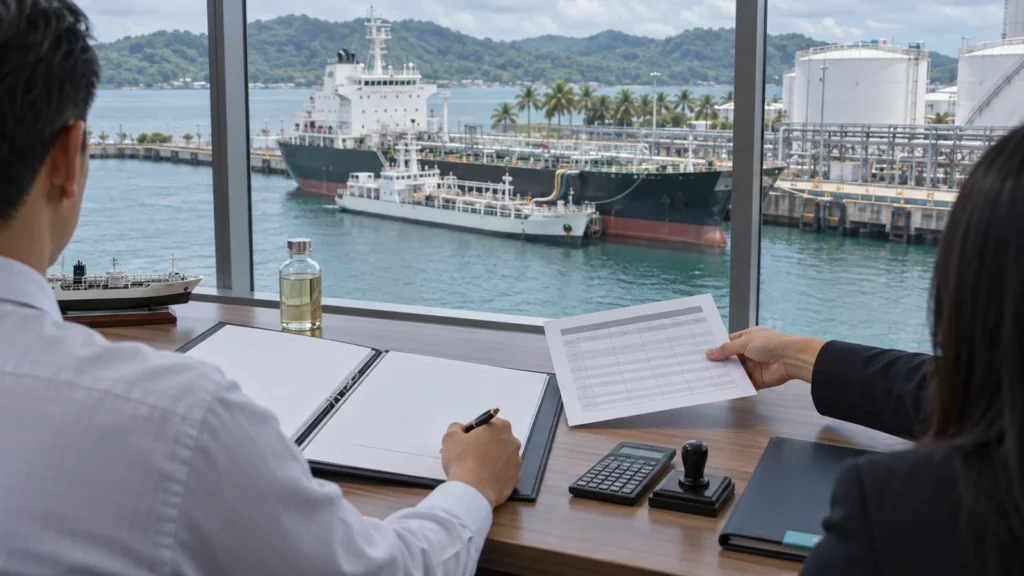
A marine fuel project sells only when three links hold: a binding offtake agreement, a licensed bunker port and a delivered stem, the parcel of fuel that goes aboard for a voyage. Maersk’s November 2023 agreement with Goldwind for 500,000 tonnes of green methanol a year from 2026, widened by its October 2024 bio-methanol agreement with LONGi, covers more than 50% of what its 24 dual-fuel vessels, ships with two fuel systems, need in 2027 (State of Green 2025). Singapore supplies the regulated end: three methanol bunkering licences take effect on 1 January 2026 (MPA 2025). For me, the sustainable marine fuels market only reads clearly once marine fuel offtake and bunkering, the contract and the physical supply to a ship, are treated as one chain.
I write for a developer at pre-FID stage who has a production route and now needs a buyer, a berth and a first parcel. I stay with published contracts, published licence decisions and published delivery counts, because those are the figures a lender can check.
In short
- Contract: A binding offtake fixes volume and term; the agreements Maersk signed in 2023 and 2024 cover more than 50% of its 2027 requirement.
- Port: Three Singapore methanol bunkering licences run from 1 January 2026 to 31 December 2030.
- Stem: The parcel arrives only when a berth, a licensed supplier and certified volume line up.
- Scarcity: Renewable methanol sold in 2024 was 400,000 to 500,000 tons against 94 million metric tons of supply.
- Method: I date every figure and put the publisher next to it.
In this article
Three links, one chain
An offtake agreement is a contract under which a buyer commits to take an agreed volume of fuel over a defined term, and State of Green recorded on 26 June 2025 that without binding offtake agreements production investments are delayed and fuel availability can fall short of vessel deployment. The second link is the port: the Maritime and Port Authority of Singapore issues licences to supply methanol as marine fuel, and on 24 November 2025 it selected Global Energy Trading, Golden Island and PetroChina International (Singapore) from 13 applicants, valid from 1 January 2026 to 31 December 2030. The third link is the stem, the parcel of fuel delivered to a vessel for a voyage, and bunkering is the operation that puts that fuel aboard. The fuel market only clears when all three links hold.
What this means for you: I do not separate production capacity, a port licence and a delivery schedule into three workstreams. I ask for evidence of all three, because a contract without a berth is a forecast and a berth without a contract is a stranded terminal.
The contract link
In November 2023 A.P. Moller – Maersk signed a green methanol offtake with Goldwind for 500,000 tonnes a year from 2026, covering the first 12 large methanol-enabled container vessels. In October 2024 it added a long-term bio-methanol agreement with LONGi, using agricultural residues such as straw and forestry by-products. State of Green reported on 26 June 2025 that the two agreements together cover more than 50% of the green methanol Maersk needs for its dual-fuel fleet in 2027 and support up to 600,000 tonnes of green methanol a year from 2026, with at least 65% lifecycle greenhouse gas reduction against conventional fossil fuels. The Methanol Institute recorded in 2025 that the first large methanol-enabled containership entered service in 2024 and that shipowners signed landmark methanol offtake agreements for their dual-fuel fleets that year. The offtake structure behind those numbers is what a lender will underwrite.
What this means for you: I read an offtake as a dated obligation rather than an intention, with volume, start date and counterparty each named, each checkable and each tied to a delivery point.
The port link
The Maritime and Port Authority of Singapore awarded three licences on 24 November 2025 after a call for applications launched in March 2025, evaluating supply chain reliability, operational readiness, safety systems and the sustainability of the methanol supplied, with five-year validity from 1 January 2026 to 31 December 2030. The authority stated that it will keep evolving the licensing framework against operational experience, technological change and international standards. Maritime Propulsion reported on 3 November 2026 that Singapore began awarding commercial methanol bunkering licences on 1 January 2026, and that in October 2026 a methanol dual-fuel vessel took on about 5,000 tonnes of certified bioethanol in Singapore, ethanol acting as a drop-in fuel for methanol engines. So the licence list is the first thing I check before I promise delivery.
What this means for you: I want the licensee name, the validity dates and the certified product specification in front of me before any volume goes into a delivery schedule I sign.
The delivery link
On the demand side, Hapag-Lloyd ordered eight dual-fuel methanol ships of 4,500 TEU in December 2025 for delivery from 2028 to 2029. Maritime Propulsion reported on 3 November 2026 that 59 methanol-fuelled ships were delivered in 2025 and 38 in the first half of 2026, against only two methanol orders counted by DNV and four by Clarksons in the first half of 2026, equal to 0.37% of all newbuild orders by count. Methanol is a liquid at ambient temperature and pressure, stored in conventional tanks. On the supply side, the Methanol Institute recorded in 2025 that total methanol supply was 94 million metric tons in 2024 with just 400,000 to 500,000 tons of renewable product sold. The commercial terms decide whether the stem arrives.
What this means for you: I count delivered ships, orders and renewable tons as three separate lines, because a hull without a certified parcel still has nothing to lift at the berth.
What the lender asks for
BloombergNEF described the sequence on 18 June 2024: once fuel producers secure long-term offtakes or investment from shipping buyers, they approach port infrastructure operators to secure storage space or co-invest in an expansion, and it noted that new terminals and new bunkering ports are needed for methanol. The Methanol Institute’s project tracking explains why I discount announcements: of more than 200 renewable and low-carbon methanol projects announced by February 2025, totalling 45.8 million metric tons of potential capacity by 2030, only 20 to 40% may move forward, which is still 7 to 14 million metric tons. I ask for the signed offtake, the port licence and the berth reservation as three separate documents. The bankability test is a contract, a licence and a berth, not a pipeline number.
What this means for you: I would rather show a lender a small volume with a name on it than a large announced volume with no berth, because announced capacity never clears a voyage.
The scarcity on both sides
State of Green reported on 26 June 2025 that green methanol is not available in sufficient volumes and costs two to three times more than conventional bunker fuel, which is why the term of an offtake matters more than a headline price. Against 94 million metric tons of total supply in 2024, only 400,000 to 500,000 tons of renewable product were sold, while the announced pipeline of 45.8 million metric tons by 2030 carries an expectation that only 20 to 40% of those projects will be built. BloombergNEF noted on 18 June 2024 that methanol could take a first-mover advantage over ammonia in locking in port infrastructure, because the first batch of low-carbon methanol projects is signing offtakes now. So the molecule itself sets the pace of both the contract and the berth.
What this means for you: I price the term, not the tonne, because a long commitment is what buys access to a scarce molecule and a scarce tank in the same negotiation.
What I would ask before I sign
I ask five questions in writing before I sign anything. Which port on my delivery list holds a licence for this fuel, and until when. How much of my contracted volume already has a berth and a licensed supplier behind it. Whether the counterparty commits under a take-or-pay obligation, meaning it pays for the committed volume whether or not it lifts it, or buys only what it lifts. What share of announced supply my volume is counted against, because an announced pipeline is never available supply. Which certification scheme signs the sustainability claim, since Singapore’s licence evaluation assessed exactly that.
What this means for you: I write the answers into the term sheet, because every one of them can be verified against a licence register, a published delivery count or a signed contract.
How I would structure it if it were my own file
I keep four dated rows. The contract row carries the 500,000 tonnes a year agreement of November 2023 and the bio-methanol agreement of October 2024, each with its delivery start. The port row carries the three licences valid from 1 January 2026 to 31 December 2030 and the 13 applications behind them. The delivery row carries 59 methanol-fuelled ships delivered in 2025 and 38 in the first half of 2026, next to the two orders counted by DNV and the four counted by Clarksons in the same period. My last row is certified volume actually delivered to a berth, because that is the only row a lender counts.
What this means for you: I build the file so that a reader can move from contract to licence to berth without asking me a follow-up question, and so that every figure already carries its date and its publisher.
Sources
- Maritime and Port Authority of Singapore, 24 November 2025.
- State of Green, 26 June 2025.
- Methanol Institute, 2025.
- BloombergNEF, June 2024.
- Maritime Propulsion, 3 November 2026.
Frequently asked questions
What is a marine fuel offtake agreement?
It is a contract under which a buyer commits to take an agreed volume of fuel over a defined term, and shipowners use it to lock supply for dual-fuel fleets before the fuel exists. State of Green recorded on 26 June 2025 that the two agreements Maersk signed in November 2023 and October 2024 together cover more than 50% of the green methanol its fleet needs in 2027, which is the level of commitment a producer can build a plant against.
Who can supply methanol as a bunker fuel in Singapore?
Three licensees were selected from 13 applicants by the Maritime and Port Authority of Singapore: Global Energy Trading, Golden Island and PetroChina International (Singapore). The decision was announced on 24 November 2025, followed a call for applications launched in March 2025, and the licences run from 1 January 2026 to 31 December 2030 subject to the conditions attached to them.
Why is green methanol hard to buy at scale?
It comes down to volume and cost. State of Green reported on 26 June 2025 that green methanol costs two to three times more than conventional bunker fuel. The Methanol Institute recorded in 2025 that 400,000 to 500,000 tons of renewable product were sold in 2024 against 94 million metric tons of total supply, so the renewable share of the market remains small beside the fossil volume.
How many methanol ships are actually being delivered?
Maritime Propulsion reported on 3 November 2026 that 59 methanol-fuelled ships were delivered in 2025 and 38 in the first half of 2026, while DNV counted two methanol orders and Clarksons four in the same period of 2026. Deliveries and orders are different counts and I keep them apart, because a delivered ship creates demand for a stem while an order only creates expectation.
Not sure your project would survive a credit conversation?
A short call is usually enough to see where your project stands.
If you are at pre-FID and want the contract tested before you commit a single tonne, I read an offtake draft against your port list, your delivery evidence and the questions your lender will ask. See how I work on offtake agreements and what I need from you before I start.
I do not provide investment advice or arrange investments. I act as a strategic advisor and facilitator.

Alex, Founder of WeConnect Asia
I help low-carbon fuel and carbon removal project developers in Southeast Asia secure the commercial and financial partners needed to reach FID.
Related articles

Pitching a Climate Tech Company to Strategic Investors: What the Corporate Has to Believe Before It Writes a Cheque
How to pitch a climate tech company to strategic investors: the metric cluster, the readiness evidence and the ask that corporates fund.

Biomethane: What It Is, How It Is Made and Who Buys It
Biomethane is biogas cleaned to pipeline quality. I explain how it is made, how it differs from biogas and who buys it in Southeast Asia.

CO2 Sourcing for e-SAF Projects: What the Rules Allow and What the Contract Must Say
Biogenic CO2, direct air capture or industrial flue gas: which sources an e-SAF plant may use, what they cost and which contract terms make the fuel certifiable.

Operating Performance Guarantees for SAF Plants: What Lenders Ask For
Minimum guarantees, performance damages, retesting and who stands behind them: the operating guarantees a SAF plant needs to keep debt and offtake intact.

EPC and Construction Risk in SAF Plants: What a Lender Actually Tests
FEED scope, convertible EPC, performance guarantees and damages caps: the construction risk questions a SAF project must answer before financial close.

Matching Feedstock and Offtake Risk Back-to-Back in a SAF Project: How Lenders Read the Chain
Lenders do not buy a feedstock plan and an offtake plan separately. They buy the link between the two, and the link is where most SAF files break.