
Home » Methanol vs Biofuel Blends for Ships: What Each Option Forces You to Sign
Methanol vs Biofuel Blends for Ships: What Each Option Forces You to Sign
10 min read · Nov 2, 2026 · By Alex
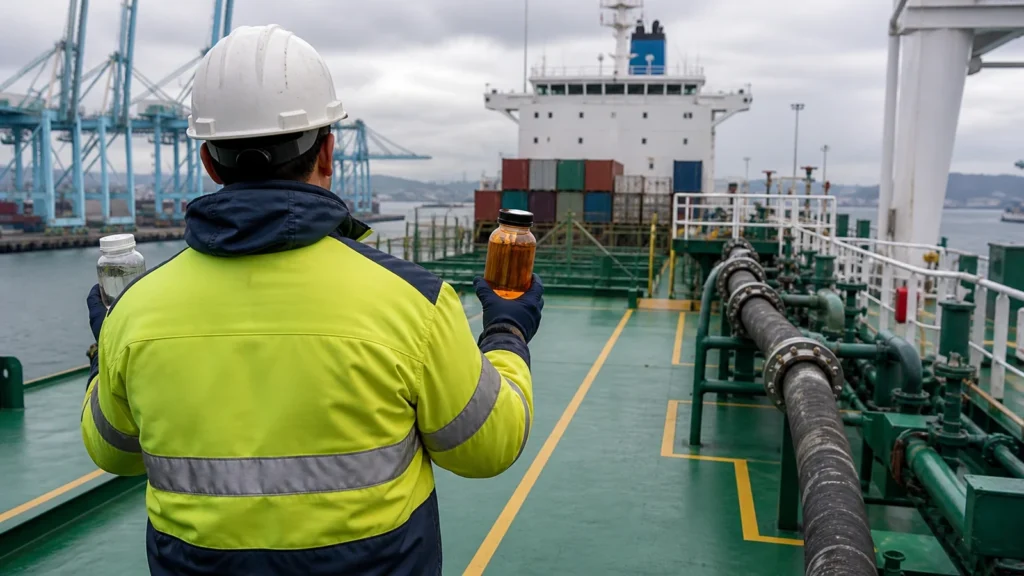
A biofuel blend asks for no new ship and no cryogenic tank. However, it rests on a specification with no international marine standard and no test method above 7 percent FAME in ISO 8217:2017. In fact, Methanol asks for a converted engine and, on May 2023 figures, about 2.4 times the tank volume of a marine gas oil ship. However, it is metered, licensed and priced on published sheets. Furthermore, Four documents decide it: the fuel specification, the maintenance interval, the price sheet and the carbon accounting. Moreover, I date every figure to the document that prints it. By contrast, That is how I answer an owner, a developer or a lender who puts the methanol vs biofuel question in front of me at concept stage, and I set it out inside the sustainable maritime fuels hub.
Both answers arrive as paperwork rather than as a verdict. Consequently, I work from published specifications, published maintenance guidance, posted price sheets and published carbon rules, and nothing here is a sustainability label. However, Every figure below keeps the date of its document.
In short
- Specification: no international marine biofuel standard, and no test above 7 percent FAME in ISO 8217:2017, fatty acid methyl ester, the biodiesel of the bunker trade.
- Tank: about 2.4 times the space of a marine gas oil ship at 20 degrees Celsius, on May 2023 figures.
- Engine: FAME at 100 percent holds injector inspection at 500 to 700 hours against 1,300 hours on HVO, in the 2025 study.
- Price: a posted Asia-Pacific contract price of about 700 USD a tonne in November 2026.
- Carbon: a carbon factor only above a 65 percent cut against 94 gCO2e/MJ well-to-wake, from 1 October 2023.
In this article
What the comparison has to decide
The decision is which document set I will underwrite at concept stage, not which fuel sounds cleaner. Also, it is taken once, because every later contract inherits it. For example, A biofuel blend is a fossil marine fuel carrying a share of bio-component, accepted by existing two-stroke engines and bunkered as a liquid. Meanwhile, Methanol is a liquid alcohol that stays fluid at ambient temperature and pressure. In fact, It needs an engine built to burn it and tanks sized for its lower energy density.
Neither option is green by label: a label reports what burns, not where the carbon came from. Meanwhile, Each one is a different contract with a supplier, a maintenance plan. Also, a port, and a lender reads four documents in order: the fuel specification, the maintenance interval, the price sheet and the carbon accounting.
What this means for you: bring those four documents to the first meeting and judge the fuel by them, since that is how the credit decision will judge it too.
The specification each option rests on
MAN Energy Solutions accepts FAME, HVO, similar FAME-type fuels and blends with ISO 8217 fossil fuel for MAN B&W two-stroke engines, in a July 2023 service letter. In that July 2023 letter, HVO is hydrotreated vegetable oil, also sold as renewable diesel or HEFA, inside the scope of ISO 8217:2017 at the DMA grade, close to diesel in heating value, low in sulphur, at 2 to 3 cSt at 40 degrees Celsius.
In that July 2023 letter, FAME properties follow EN 14214 or ASTM D6751. Also, a B30 holds about 30 percent FAME, with supplier naming that varies. Furthermore, Inside ISO 8217:2017, HVO appears up to 100 percent and FAME up to 7 percent in certain distillate grades, FAME mixed into residual fuel does not appear, and no test method exists above 7 percent. Therefore, In July 2023 no international marine fuel standard for biofuels existed. In addition, Similar FAME-type fuels stay under 15 mg/kg of phosphorus and clear of free fatty acids, methanol, glycerol and chlorides; other bio-components sit outside the letter, at the operator’s own risk.
The July 2023 handling rules follow. By contrast, Strip and clean tanks before bunkering, hold the fuel at least 10 degrees Celsius above its pour point, drain water to limit microbial growth, check compatibility when fuels mix, and keep inlet viscosity between 2 cSt and 20 cSt. In addition, The marine fuel offtake page is where those rules become supplier obligations.
What this means for you: name the standard, the grade and the test method in the supply agreement, because an unnamed specification cannot be claimed against.
What arrives in the tank, and what it does to the engine
The December 2025 study in the Journal of Marine Science and Engineering reads. Moreover, Heat values 40.5, 42.7, 37.4 and 44.2 MJ/kg for heavy fuel oil, marine diesel oil, FAME and HVO; viscosity at 40 degrees Celsius 180 to 380, 2 to 6, 2 to 6 and 2 to 4 cSt for the same four; sulphur 3.23, 0.069, 0.45 and 0.35 percent.
The same 2025 study rates oxidative stability good for heavy fuel oil, good for marine diesel oil, low for FAME and excellent for HVO, and FAME alone is hygroscopic. Instead, It estimates 400, 650, 850 and 900 USD a tonne for the same four fuels, figures for comparison rather than prices paid at the bunker. Consequently, In that 2025 study, FAME at 100 percent brings injector deposits and corrosion, exhaust valve deposits and possible incomplete combustion, while HVO stays clean.
Physical properties decide what a tank and an injector do. Specifically, They do not decide where the carbon came from, and that is the second half of the comparison.
The Methanol Institute’s May 2023 marine fuel report sets methanol at 19.9 MJ/kg and 15.8 GJ/m3 against 42.7 MJ/kg and 36.6 GJ/m3 for marine gas oil, both stored at 20 degrees Celsius, with fuel and storage tanks taking about 2.4 times the space of a marine gas oil ship. Instead, In that May 2023 report, methanol engines are commercially available at high technological maturity, and combustion cuts particulates and black carbon by 95 percent. By contrast, The green methanol explained page covers which methanol reaches the tank.
What this means for you: ask for heat value and tank volume of each candidate in one table, because that trade-off is the one you sign.
What the maintenance plan and the manifold pay
The 2025 study sets injector and nozzle inspection at 500 to 700 hours on FAME at 100 percent against 1,300 hours on HVO and 900 to 1,000 hours on heavy fuel oil, exhaust valve cleaning at 1,000 to 1,500 hours against 1,900 hours on HVO, cylinder oil change at 1,000 to 1,200 hours against 2,400 hours on HVO, and fuel system inspection at 500 hours against 300 to 400 hours on heavy fuel oil. Therefore, In that 2025 study, at 75 percent load, specific fuel consumption reads 220 g/kWh on FAME, 210 on HVO and 205 on heavy fuel oil, combustion stability is medium-low on FAME against good on HVO, and B30 bunkering needs recirculation and extra tank heating.
MAN Energy Solutions adds that component life may shorten for lack of long-term experience, especially on injection equipment, that cylinder liner temperatures can rise slightly with a longer injection duration, and that the cylinder oil already used for 0.50 percent sulphur fuel is only a starting point.
Maritime Propulsion reports 59 methanol vessels delivered in 2025 and 38 in the first half of 2026, a posted contract price of about 700 USD a tonne in Asia-Pacific in November 2026, and 5,000 tonnes of certified bioethanol bunkered by a dual-fuel methanol ship in Singapore in October 2026 as a direct substitute fuel. For example, The methanol bunkering page is where the two manifolds differ.
What this means for you: price the interval and the tonne, because a shortened inspection cycle lands in the dry-docking budget either way.
What neither specification tells you about the carbon
The July 2023 interim guidance, applicable from 1 October 2023, gives a biofuel a carbon factor only if it cuts greenhouse gases by at least 65 percent against a fossil marine gas oil reference of 94 gCO2e/MJ well-to-wake, the span from production to funnel, and only if a scheme recognised by the International Civil Aviation Organization certifies it; blends are averaged by energy. In fact, That factor feeds the Carbon Intensity Indicator, the annual grade a ship earns on its emissions intensity.
No international marine fuel standard for biofuels exists, so a specification proves mechanical compatibility and nothing about origin. In fact, A blend can satisfy every clause of ISO 8217:2017 and still carry fossil carbon, because the base fuel inside it is fossil and no clause records where the bio-component grew or how it was processed.
A book and claim chain of custody is the mechanism that reserves the attributes of a fuel from the physical flow. Also, The buyer takes the profile while the molecule serves another voyage. Also, The book and claim page documents that chain.
What this means for you: ask for the certificate behind the factor, because the specification in front of you cannot supply it.
What the regulator counts
The International Maritime Organization framework measures greenhouse gas intensity in gCO2eq/MJ across carbon dioxide, methane and nitrous oxide well-to-wake, holds zero and near-zero fuels to a threshold well below the current fleet average, requires independent verification by a certification scheme recognised by the Marine Environment Protection Committee, keeps a digital registry of compliance state, and applies by flag, port and coastal states. It is not a carbon tax.
The Maritime and Port Authority of Singapore reports 56.77 million tonnes of marine fuel sold in 2025, up 3.4 percent on 2024, with alternative fuels at 1.95 million tonnes against 1.35 million tonnes in 2024 and three methanol bunkering licences awarded in November 2025. Singapore began issuing commercial methanol bunkering licences on 1 January 2026.
The intensity rule runs on reported fuel data while the bunkering licence runs on port administration, and the IMO GHG fuel standard page carries the first document.
What this means for you: review the reporting chain and the port licence together, since a fuel that cannot be verified cannot be counted.
The five questions I ask before I accept a fuel case
Five questions go into writing before I accept a fuel case at concept stage, and I put the same five to the supplier and to the operator in the same meeting, because a difference between the two answers is itself the finding.
- Which fuel specification will the supplier warrant, and against which standard and test method?
- What does the maintenance interval do to the dry-docking plan and to the survey schedule?
- Which published price sheet is the fuel cost built on, and on what date?
- What carbon factor will this blend or this methanol carry, once certified?
- Which port can serve the vessel on the required schedule?
I write the answers onto one page and I keep the document behind each answer next to it.
What this means for you: if one of the five comes back without a document. Also, a date, the case is not ready for my signature.
How I would write the fuel comparison appendix for my own file
Four rows, each one tied to the document behind it:
- Specification row: no international marine biofuel standard, and no test above 7 percent FAME in ISO 8217:2017.
- Tank row: about 2.4 times the marine gas oil volume, stored at 20 degrees Celsius, on May 2023 figures.
- Interval row: 500 to 700 hours on FAME at 100 percent against 1,300 hours on HVO, in the 2025 study.
- Price row: about 700 USD a tonne posted in Asia-Pacific in November 2026.
I write them as rows rather than as prose so that the date sits beside the figure, and every row carries the date of the document that prints it.
What this means for you: any row I cannot date does not go in the file, because an undated figure is an argument rather than evidence.
Sources
- MAN Energy Solutions, July 2023.
- Journal of Marine Science and Engineering, 17 December 2025.
- Methanol Institute, May 2023.
- Maritime Propulsion, 3 November 2026.
- Maritime and Port Authority of Singapore, 13 January 2026.
Frequently asked questions
Which option needs no new ship?
The biofuel blend. FAME, HVO and their blends are accepted for existing two-stroke engines and are handled as liquids, so the ship stays as it is. Methanol needs an engine able to burn it and, on May 2023 figures, about 2.4 times the tank volume of a marine gas oil ship.
Why is there no marine standard for biofuel?
Because at the time of writing no international marine fuel standard for biofuels exists, so ISO 8217 and supplementary test methods are used together. ISO 8217:2017 covers HVO up to 100 percent and FAME up to 7 percent in certain distillate grades, carries no test above 7 percent, and does not cover FAME mixed into residual fuel.
What does methanol cost the ship in tank space?
Fuel and storage tanks take about 2.4 times the space of a marine gas oil ship, on May 2023 figures. In exchange, methanol is stored at 20 degrees Celsius in conventional tanks, ballast tanks included, with no cryogenics.
What does the regulator do with a blend?
A blend earns a carbon factor only from 1 October 2023, and only if it cuts greenhouse gases by at least 65 percent against a fossil marine gas oil reference of 94 gCO2e/MJ well-to-wake and is certified by a scheme recognised by the International Civil Aviation Organization. Blends are averaged by energy.
Not sure your project would survive a credit conversation?
A short call is usually enough to see where your project stands.
If you are at concept stage and you need the specification, the interval, the price sheet and the carbon factor set side by side before a decision, that is the work I do with owners, developers and lenders. The strategic partnerships engagement is where that conversation starts.
I do not provide investment advice or arrange investments. I act as a strategic advisor and facilitator.

Alex, Founder of WeConnect Asia
I help low-carbon fuel and carbon removal project developers in Southeast Asia secure the commercial and financial partners needed to reach FID.
Related articles

Pitching a Climate Tech Company to Strategic Investors: What the Corporate Has to Believe Before It Writes a Cheque
How to pitch a climate tech company to strategic investors: the metric cluster, the readiness evidence and the ask that corporates fund.
Biomethane: What It Is, How It Is Made and Who Buys It
Biomethane is biogas cleaned to pipeline quality. I explain how it is made, how it differs from biogas and who buys it in Southeast Asia.
CO2 Sourcing for e-SAF Projects: What the Rules Allow and What the Contract Must Say
Biogenic CO2, direct air capture or industrial flue gas: which sources an e-SAF plant may use, what they cost and which contract terms make the fuel certifiable.

Operating Performance Guarantees for SAF Plants: What Lenders Ask For
Minimum guarantees, performance damages, retesting and who stands behind them: the operating guarantees a SAF plant needs to keep debt and offtake intact.

EPC and Construction Risk in SAF Plants: What a Lender Actually Tests
FEED scope, convertible EPC, performance guarantees and damages caps: the construction risk questions a SAF project must answer before financial close.

Matching Feedstock and Offtake Risk Back-to-Back in a SAF Project: How Lenders Read the Chain
Lenders do not buy a feedstock plan and an offtake plan separately. They buy the link between the two, and the link is where most SAF files break.