
Home » CO2 Sourcing for PtL Projects: What a Lender Will Accept
CO2 Sourcing for PtL Projects: What a Lender Will Accept
10 min read · Feb 2, 2026 · By Alex
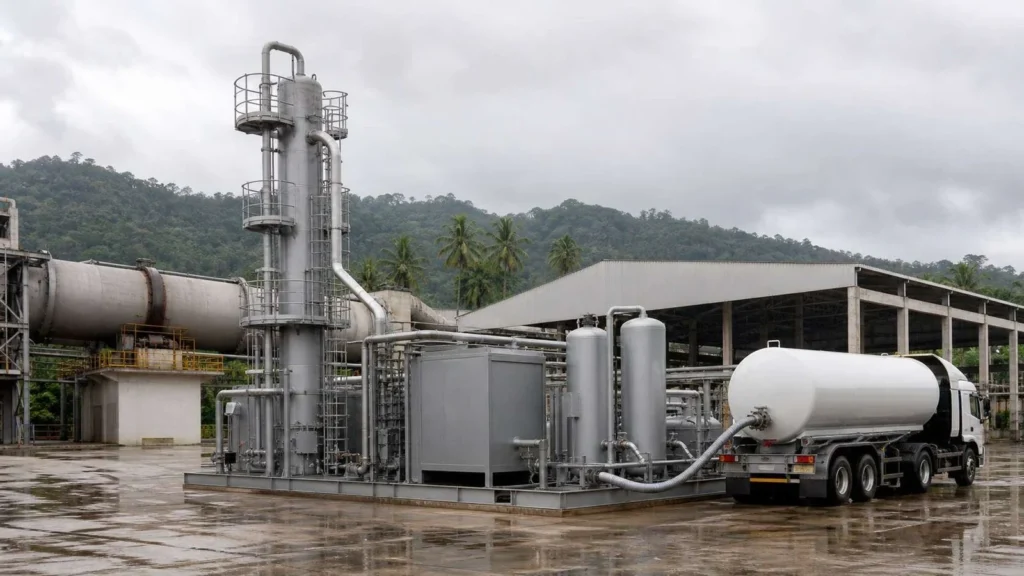
A power-to-liquid plant needs its carbon in the form of CO2, and where you source it is a contract question before it is a chemistry question. For the process basics, start with the power-to-liquid explainer. For CO2 sourcing in a power-to-liquid file, carry three figures into your file: in December 2023 modelling, a near-pure fermentation stream can be captured at around 20 to 30 USD per tonne, biomass combustion flue gas at 10 to 20 volume percent costs 60 to 80 USD per tonne, and direct air capture is estimated at 400 to 670 USD per tonne. Those are three different contracts, and a lender reads them as one document.
This article prices three things in order: the source and the concentration it carries, the purity your synthesis loop will accept, and the contract proof a lender will read as secured carbon. A price without concentration is not a price, and a concentration without a signed delivery obligation is not supply.
In short
- Source: In December 2023 modelling, capture runs at around 20 to 30 USD per tonne for fermentation, 60 to 80 USD per tonne for biomass flue gas and 400 to 670 USD per tonne for direct air capture.
- Purity: The same December 2023 modelling puts fermentation near 100 percent purity against 10 to 20 volume percent for flue gas.
- Context: At 50 USD per MWh in December 2023 modelling, electricity alone contributes 25 to 35 USD per gigajoule of finished fuel.
- Maturity: Reverse water-gas shift reactors and new synthesis routes beyond Fischer-Tropsch still have to be demonstrated at scale, in December 2023 modelling.
- Proof: Firm purchase agreements cumulate to less than 2 Mtpa in 2025, which is 5 percent of the production announced for 2030.
In this article
What a power-to-liquid plant buys from a carbon supplier
The direct answer first: you are buying a stream at a stated concentration, under a signed contract, and a lender reads that contract before it reads any process diagram. Power-to-liquid is the route that makes liquid fuel from hydrogen and captured carbon dioxide, and the carbon you purchase is your CO2 feedstock. Concentration, not volume, decides most of its price.
Fermentation is the biological conversion of sugars that vents a concentrated CO2 stream. Flue gas is the exhaust of a combustion unit, carrying CO2 diluted in nitrogen. Direct air capture pulls CO2 out of ambient air, where it is scarce by definition. Biogenic carbon is carbon that plants absorbed and that is released again when the biomass is converted, which is why it pairs so naturally with biofuel production.
The synthesis loop behind your Fischer-Tropsch reactor wants a clean feed, and reverse water-gas shift reactors that would free CO2 from dirtier streams still have to be demonstrated at scale.
What this means for you: put source, concentration and delivery obligation in one schedule, because every later cost line in your file inherits from those three fields.
Three sources, three prices
Concentration sets the capture bill, which is why carbon capture and storage work is quoted by stream and not by tonne alone. In the 2023 e-fuels report, a high-concentration source such as fermentation gives a stream of near 100 percent purity that can be captured at around 20 to 30 USD per tonne. Biomass combustion flue gases sit at 10 to 20 volume percent, and that dilution pushes the cost to 60 to 80 USD per tonne. Direct air capture is estimated at 400 to 670 USD per tonne.
The same 2023 modelling simplifies this into three assumptions: 30 USD per tonne for the high-concentration source, 80 USD per tonne for flue gas and 400 USD per tonne for direct air capture, with water at 2 USD per cubic metre, a 5 percent cost of capital and a 25 year economic life. Those assumptions target 2030, so they are not quotations for a delivery next year.
What this means for you: model your carbon at three dated price points, because the levelised cost, meaning cost per unit of fuel over the plant’s economic life, inherits from that spread before it inherits from anything else.
The maturity question behind the cheap options
The cheap end of the ladder carries a technology question. Biogenic CO2 is identified as the natural pairing with biofuel production, because the carbon was absorbed by biomass and is released again in the same conversion plant. For a file that must show a closed carbon cycle, that is the source I would look at first.
The December 2023 work is blunt about what is not ready: reverse water-gas shift reactors have to be demonstrated at scale, and new synthesis routes from CO2 beyond Fischer-Tropsch remain to be explored. Neither point kills the source, but both argue for phasing it in.
Maturity in a credit file means a clear read on technology maturity and scale up: which unit is reference, which supplier has run it, and what evidence you will put in front of the lender.
What this means for you: separate the carbon you can contract today from the conversion route that still needs demonstration, and never let the second carry the price of the first.
Carbon is the third lever, not the first
Before you negotiate carbon, know where carbon sits in your cost stack. IRENA’s 2020 cost reduction study puts electricity at a large share of production cost and the electrolyser as the second cost item, which makes carbon the third lever. The same 2020 study puts its reduction levers at 40 percent short term and up to 80 percent long term, with renewable hydrogen potentially under 2 USD per kilogram during the decade, on a path from 53 to 20 USD per megawatt hour of electricity, from 3,200 to 4,200 full load hours and from a 10 percent to a 6 percent cost of capital. Those full load hours are what set your load factor, the share of the year the plant actually runs.
The World Bank’s February 2026 survey of electrolyzers says the same thing from the operating side: electricity is the most significant operating cost and its price is highly site dependent. Its answer is flexibility, hybrid designs and battery storage, and the practical consequence for you is siting, because your carbon source and your power source have to be sited together.
What this means for you: price your carbon third, after electricity and after the hydrogen that feeds your reactor, because a cheaper carbon line cannot repair an expensive electricity line.
What the carbon has to survive in the fuel market
Your carbon ends up in a fuel that has to find a buyer. The ambition on the table is a 10 percent share of e-fuels in aviation and shipping by 2030, and it is the same December 2023 modelling that assumes those volumes. An offtake, meaning a signed agreement to take the finished fuel, is what converts that ambition into a file.
From the 2026 review, the market you sell into looks like this: global hydrogen demand passed 100 Mt in 2025, low-emissions production grew 20 percent in 2025 to almost 1 Mt, and the announced pipeline has shrunk to 27 Mt by 2030. The barriers it lists are high costs, uncertain demand, complex regulation and missing infrastructure, and its infrastructure recommendation points at industrial and port clusters where production and users sit together.
That is also where the aviation fuel outlet concentrates its demand, and where your offtake will be negotiated.
What this means for you: tie your carbon contract to a named offtake path, because a 27 Mt pipeline announced for 2030 tells a lender that buyers are the scarce side of this market.
What I will not accept as secured carbon
Four exclusions, each dated.
- Intent is not contract: A letter of intent is not a supply contract, and the price moves with concentration: in December 2023 figures, 20 to 30 USD per tonne for near-pure fermentation against 60 to 80 USD per tonne for flue gas at 10 to 20 volume percent.
- Announcement is not delivery: A capture announcement is not delivered CO2, and the gap between 30 USD per tonne in December 2023 modelling and 400 to 670 USD per tonne from direct air capture is exactly where optimistic files break.
- Price is not cost: A carbon price without the power context is not a cost. At 50 USD per MWh in December 2023 modelling, power alone adds 25 to 35 USD per gigajoule of fuel, or 1,000 to 1,500 USD per tonne of oil equivalent, before any investment or consumable.
- Source is not market: A source without a demand test is not a market. In 2025 figures, firm purchase agreements cumulate to less than 2 Mtpa, only 5 percent of announced production for 2030.
What this means for you: bring four documents, not four slides: a signed supply contract, a delivered tonnage record, an evidenced power price and a signed demand test.
What this changes for a Southeast Asian project
The clusters answer is geographic: sit your carbon source where production and users are co-located. The 2026 review recommends exactly that for infrastructure, and it also warns that 22 Mt of announced production risks losing its 2030 slot without an investment decision by early 2027.
The cost of capital answer is financial. In 2025 figures, only 0.5 percent of announced projects in emerging economies have secured committed investment against 9 percent worldwide, and capital can reach 15 percent, three times the level of advanced economies. That is a poor place to discover that your carbon contract was mispriced.
Which rule your carbon counts under is a separate exercise: EU compliance and carbon intensity work tells you the accounting answer before you sign anything.
What this means for you: co-locate the source, price the capital at 15 percent if that is your market, and treat the compliance route as a design input rather than a certification afterthought.
The four lines I would put in front of a lender
Line one, the price by source: around 20 to 30 USD per tonne for fermentation, 60 to 80 USD per tonne for flue gas and 400 to 670 USD per tonne for direct air capture, all dated December 2023.
Line two, the purity: near 100 percent purity for the fermentation stream against 10 to 20 volume percent for flue gas, same December 2023 date.
Line three, the context: electricity is the most significant operating cost and its price is highly site dependent, dated February 2026, and the stack is only 15 to 20 percent of the installed investment of an electrolyser, from the five key questions section of the 2025 review.
Line four, the commitment: less than 2 Mtpa of firm purchase agreements, 5 percent of announced production for 2030, in 2025 figures.
What this means for you: put those four lines on one page with their dates, because a lender who can see the source, the purity, the power context and the market test can price the file.
Sources
- IEA, The Role of E-fuels in Decarbonising Transport https://iea.blob.core.windows.net/assets/9e0c82d4-06d2-496b-9542-f184ba803645/TheRoleofE-fuelsinDecarbonisingTransport.pdf, December 2023.
- IEA, Global Hydrogen Review 2026, Executive summary https://www.iea.org/reports/global-hydrogen-review-2026/executive-summary, 2026.
- World Bank, ESMAP, Electrolyzers for Hydrogen Production: Technical and Economic Characteristics https://documents1.worldbank.org/curated/en/099022326123011297/pdf/P506220-b45b0865-8706-4862-8792-d8cc71f84569.pdf, February 2026.
- IRENA, Green hydrogen cost reduction: Scaling up electrolysers to meet the 1.5 C climate goal https://www.irena.org/-/media/Files/IRENA/Agency/Publication/2020/Dec/IRENA_Green_hydrogen_cost_2020.pdf, 2020.
- IEA, Global Hydrogen Review 2025, Five key questions about hydrogen https://www.iea.org/reports/global-hydrogen-review-2025/five-key-questions-about-hydrogen, 2025.
Frequently asked questions
What is the cheapest source of CO2 for a power-to-liquid plant?
Fermentation. In December 2023 figures, the stream is near 100 percent pure and capture costs around 20 to 30 USD per tonne, against 60 to 80 USD per tonne for biomass flue gas and 400 to 670 USD per tonne from direct air capture. The cheap source is the concentrated one, and concentration is the field you contract on.
Why does the concentration of the stream change the price?
Because separation energy scales with dilution. In December 2023 figures, a stream at 10 to 20 volume percent costs 60 to 80 USD per tonne while a near-pure stream costs 20 to 30 USD per tonne, and CO2 in ambient air sits at 400 to 670 USD per tonne. The molecule is identical in all three cases, the work of separating it is not.
How much does the carbon move the cost of the fuel?
On the modelled ranges of December 2023, capture is put at 30, 80 and 400 USD per tonne by source, with water at 2 USD per cubic metre, at a 5 percent cost of capital over 25 years. In the same modelling, at 50 USD per MWh the power price alone contributes 25 to 35 USD per gigajoule, which is the larger term in the stack.
Where should a project in Southeast Asia look for carbon?
Near industrial and port clusters where production and users are co-located, and from biogenic streams that pair naturally with biofuel production. In 2025 figures, capital in emerging economies can reach 15 percent, three times the level of advanced economies, so the source you pick has to be cheap to capture and close to where the fuel is sold.
Not sure your project would survive a credit conversation?
A short call is usually enough to see where your project stands.
If you want the carbon contract structured before the file goes to credit, contracting and risk management support is where I take a source, a concentration and a delivery obligation and turn them into terms a lender can read.
I do not provide investment advice or arrange investments. I act as a strategic advisor and facilitator.

Alex, Founder of WeConnect Asia
I help low-carbon fuel and carbon removal project developers in Southeast Asia secure the commercial and financial partners needed to reach FID.
Related articles

Pitching a Climate Tech Company to Strategic Investors: What the Corporate Has to Believe Before It Writes a Cheque
How to pitch a climate tech company to strategic investors: the metric cluster, the readiness evidence and the ask that corporates fund.

Biomethane: What It Is, How It Is Made and Who Buys It
Biomethane is biogas cleaned to pipeline quality. I explain how it is made, how it differs from biogas and who buys it in Southeast Asia.

CO2 Sourcing for e-SAF Projects: What the Rules Allow and What the Contract Must Say
Biogenic CO2, direct air capture or industrial flue gas: which sources an e-SAF plant may use, what they cost and which contract terms make the fuel certifiable.

Operating Performance Guarantees for SAF Plants: What Lenders Ask For
Minimum guarantees, performance damages, retesting and who stands behind them: the operating guarantees a SAF plant needs to keep debt and offtake intact.

EPC and Construction Risk in SAF Plants: What a Lender Actually Tests
FEED scope, convertible EPC, performance guarantees and damages caps: the construction risk questions a SAF project must answer before financial close.

Matching Feedstock and Offtake Risk Back-to-Back in a SAF Project: How Lenders Read the Chain
Lenders do not buy a feedstock plan and an offtake plan separately. They buy the link between the two, and the link is where most SAF files break.