
Home » Refuse-Derived Fuel Projects: What Makes an RDF Line Bankable in Southeast Asia
Refuse-Derived Fuel Projects: What Makes an RDF Line Bankable in Southeast Asia
10 min read · Jan 21, 2026 · By Alex
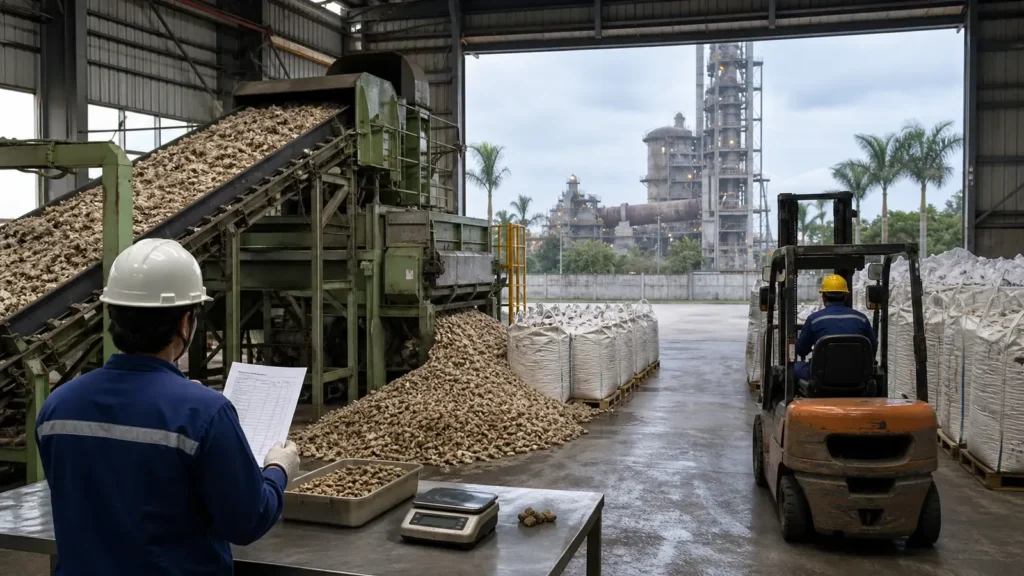
Yes, a project that turns sorted municipal waste into an industrial fuel is financeable when the plant can prove a stable dry combustible fraction at the specification the buyer signs for. The buyers are industrial, and the number they sign for is a calorific value, also called lower heating value. Also, the energy released per kilogram when the fuel burns. An undated overview records a cement plant demanding at least 14 MJ/kg. Refuse-derived fuel is the sorted and shredded dry combustible fraction of municipal solid waste, compressed into homogeneous pellets. In addition, it goes straight into a cement kiln, the furnace in which cement clinker is made.
In addition, in 2025, Indonesia’s RDF plants at Jakarta, Cilacap and Sidoarjo already produced about 1,500 tonnes a day in total. I test that against published thresholds below, starting from waste-to-energy.
In order: what the fuel is. That buys it and against which specification, what the feedstock has to look like, and what the landscape holds today. Then what a lender checks, where projects stall, the five checks I run on an offtake, the contract under which a buyer takes the plant’s output. In addition, how I would test your case.
In short
- Product: Dry combustible fraction of municipal solid waste, sorted, shredded and compressed into pellets, sold to industrial buyers.
- Specification: A cement plant demands at least 14 MJ/kg (undated overview); grate combustion needs about 6 MJ/kg.
- Feedstock: Moisture and composition decide the outcome; Southeast Asian municipal solid waste is often below 6 MJ/kg (undated overview).
- Scale: RDF plants at three Indonesian cities produced about 1,500 tonnes a day in total in 2025.
- Lender test: At least 100 000 tonnes a year of combustible waste and a lower heating value averaging at least 7 MJ/kg (2013).
In this article
What refuse-derived fuel actually is
The International Energy Agency, in the November 2026 IEA input to COP31 on waste, resource efficiency and energy system decarbonisation, puts the world’s municipal solid waste at around 2.6 billion tonnes a year, and disposal, treatment and incineration alone account for about 4 percent of global greenhouse gas emissions, including nearly 20 percent of global anthropogenic methane.
Before energy recovery, waste can be converted into refuse-derived fuel by sorting and shredding the dry combustible fraction and compressing it into homogeneous pellets. In addition, those pellets go straight into a cement kiln. Incineration with energy recovery is the most widely deployed waste-to-energy pathway today. In addition, several pathways require sorting and pre-treatment of the intake. That adds to costs and limits economic viability.
The cement sector could go from about 6 percent of thermal energy requirements today to about 18 percent in 2035. In addition, the three action areas together could cut more than 1.5 Gt CO2-eq annually by 2035.
What this means for you: I read the fuel as a specification before I read the equipment. That is because the number the buyer signs is what the line must hit.
Who buys RDF, and against which specification
The buyers are industrial, and their condition is set upstream: the IEA analysis of energy from waste in Asia states that sufficient collection. In addition, source-segregation infrastructure is needed so that refuse-derived fuel with suitable energy. In addition, moisture content can be provided to facilities. Source segregation means separating the combustible and recyclable fractions where the waste is created.
The same analysis treats energy from waste as primarily a waste management rather than energy solution: it can process a high share of municipal waste but supplies a relatively low share of city energy demand, and it belongs inside the wider waste management hierarchy.
Also, the feedstock pool is rising: annual municipal solid waste in China, Thailand, Viet Nam, India. In addition, Pakistan combined grew by an estimated 60 Mt over 2010-15 to over 300 Mt, while urban populations grew over 2010-16, adding 160 million city-dwellers. Public opposition on air quality and health grounds is noted in China.
What this means for you: I look for a buyer whose process accepts the moisture. In addition, energy content I can deliver, mapped inside the circular industries that consume waste-derived fuel.
What the feedstock has to look like
The thresholds come from the Infrastructure Asia overview of waste management in Asia. That is published without a date: about 6 MJ/kg as a rule of thumb to consider combustion on a grate. In addition, at least 14 MJ/kg for refuse-derived fuel sent to cement plants.
Municipal solid waste in Southeast Asia is often moist and sits below 6 MJ/kg. Therefore, the undated overview points to pre-treatment, hopper storage to drain free water, or biological treatment. It puts at least 500 tonnes per day at the level where incineration makes economic sense, while plants as small as 50 tonnes per day exist but are harder to bank.
In that same undated overview, the Nambo project in West Java treats 1,500 tonnes a day over a 25-year concession under a build-own-operate-transfer scheme. In addition, produces refuse-derived fuel for a cement buyer requiring at least 14 MJ/kg. Infrastructure Asia projects regional waste from 802 million tonnes in 2016 to 1.1 trillion tonnes in 2030.
What this means for you: I size the line against the tonnage I can guarantee. In addition, the calorific value I can hold in every season. That is the logic behind my guide to waste-to-energy plants.
The Southeast Asian RDF landscape today
The July 2025 ISWA regional brief on Southeast Asia, the first regional review from the International Solid Waste Association, counts 12 waste-to-energy installations in Indonesia, and RDF plants at Jakarta, Cilacap and Sidoarjo produce about 1,500 tonnes a day in total. Indonesia generated 35.8 million tonnes of municipal solid waste in 2022, or 0.67 kg per person: 47.64 percent went to sanitary or controlled landfill and 37.38 percent escaped into the environment.
Thailand had about 210 MW of installed waste-to-energy capacity from municipal solid waste in 2018, running incineration, RDF, anaerobic digestion and landfill gas recovery. Malaysia produced close to 14 million tonnes of municipal solid waste a year as reported in 2025, Singapore treats about 80 percent of its municipal solid waste in waste-to-energy installations. In addition, the Philippines produced 16.63 million tonnes in 2020.
What this means for you: I choose the market by the tonnage that is already collected and treated. In addition, I read those figures against my project finance view of Southeast Asia.
What a lender checks before it funds an RDF line
The 2013 ISWA guidelines for low and middle income countries start from the installed base. More than 1 200 waste-to-energy plants run in over 40 countries. In addition, more than 1 000 apply no pre-treatment of municipal solid waste before mass burn. Meaning direct combustion of unsorted waste on a moving grate.
Their entry test: at least 100 000 tonnes a year of combustible municipal solid waste, a lower heating value averaging at least 7 MJ/kg and never below 6 MJ/kg, a community able to pay the higher treatment cost, skilled staff, and planning stable beyond 15 years (2013).
The same guidelines give approximate lower heating values: paper 16 MJ/kg, organic matter 4 MJ/kg, plastics 35 MJ/kg, textiles 19 MJ/kg, glass 0, metals 0, other 11. They also require binding long-term agreements on tipping fees, the gate fee paid per tonne of waste accepted, on waste supply. In addition, on energy sales, because revenue depends on the energy sold and its unit price (2013).
The risks they list in a weak system are variable delivered tonnage. Too low a calorific value, insufficient financial support, a wrong technology choice and an inadequate institutional framework; combustion leaves about 10 percent of the volume and about 20 percent of the weight, against about 2 MWh of heat or 2/3 MWh of electricity per tonne (2013).
What this means for you: I test tonnage, calorific value. In addition, the payment mechanism together, and I read them through the offtake. In addition, energy sale contracts before any equipment is chosen.
Where RDF projects stall in practice
Three stalls recur in the published record. Sorting and pre-treatment of the intake adds to costs and can limit economic viability (November 2026). In addition, long-term waste supply contracts should not be used as a substitute for prevention and recycling (November 2026).
Source segregation is what delivers the right energy. In addition, moisture content (2018 analysis), yet the thresholds stay unforgiving: about 6 MJ/kg for grate combustion and at least 14 MJ/kg for a cement buyer (undated overview), at least 500 tonnes per day for economic sense, and plants of 50 tonnes per day that are harder to bank (undated overview).
About 1,500 tonnes a day already come out of RDF plants across three Indonesian cities (2025). That is where I start the technical review: my technical review service.
What this means for you: I look for the stall in the chain, usually the sorting step or the tonnage guarantee, before I look at the machine.
The five checks I run on an RDF offtake
An offtake is the contract under which a buyer takes the plant’s output. In addition, I run five checks in this order.
- Calorific value floor: the guaranteed minimum. In addition, how it is measured. Against at least 14 MJ/kg demanded by a cement buyer (undated overview) and a lower heating value averaging at least 7 MJ/kg that never falls below 6 MJ/kg (2013 guidelines).
- Moisture ceiling: the maximum water content allowed, and which party carries the drying cost.
- Volume: the tonnage guaranteed, at least 100 000 tonnes a year of combustible waste (2013 guidelines), and the party that guarantees it.
- Term: how long the contract runs, and whether it runs past the debt.
- Failure compensation: what is paid when a batch misses the specification.
What this means for you: I want all five written into one document before I let a technology choice lock them in.
How I would test your RDF case
I bring four dated tests to your site data, in this order:<\/p>
- 2013:<\/strong> the 100 000 tonnes a year and 7 MJ\/kg entry tests, so tonnage and lower heating value come first.<\/li>
- 2018:<\/strong> source segregation as the condition for suitable energy and moisture, so the collection chain gets audited.<\/li>
- 2025:<\/strong> about 1,500 tonnes a day already produced by RDF plants in three Indonesian cities. Therefore, I benchmark against operating output, never against announced capacity.<\/li>
- 2026:<\/strong> pre-treatment cost, and the cement sector going from about 6 percent to about 18 percent of thermal energy by 2035. Therefore, the sorting step is priced against the buyer’s demand.<\/li><\/ul>
What this means for you: I return a written view on whether your line clears all four. In addition, what has to change if it does not.<\/p>
Sources<\/strong><\/p>\n
- \n
- International Energy Agency, Synergies Between Waste Reduction, Resource Efficiency and Energy Systems Decarbonisation<\/a>, 2026.<\/li>\n
- Also, International Energy Agency, Will energy from waste become the key form of bioenergy in Asia?<\/a>, 2018.<\/li>\n
- Infrastructure Asia, Trashing it Out: Waste Management in Asia<\/a>, n.d.<\/li>\n
- International Solid Waste Association, Regional Brief: Waste Management Challenges and Opportunities in South East Asia<\/a>, 2025.<\/li>\n
- International Solid Waste Association, Guidelines: Waste to Energy in Low and Middle Income Countries<\/a>, 2013.<\/li>\n<\/ul>
- Also, International Energy Agency, Will energy from waste become the key form of bioenergy in Asia?<\/a>, 2018.<\/li>\n
- 2018:<\/strong> source segregation as the condition for suitable energy and moisture, so the collection chain gets audited.<\/li>
Frequently asked questions
What is refuse-derived fuel?
It is the dry combustible fraction of municipal solid waste: the material is sorted, shredded and compressed into homogeneous pellets before energy recovery. The pellets can be used directly in industrial processes such as a cement kiln, the furnace in which cement clinker is made, which is why the product is sold to industry rather than to a power buyer alone.
What calorific value does RDF need to be sold?
A cement plant is recorded as demanding at least 14 MJ/kg (undated overview). Grate combustion of unsorted municipal solid waste needs about 6 MJ/kg as a rule of thumb (undated overview), and the 2013 guidelines ask for an average of at least 7 MJ/kg that never falls below 6 MJ/kg.
Who buys refuse-derived fuel in Southeast Asia?
Cement plants first, because they can take the pellets straight into the kiln, plus energy-from-waste facilities that need a feedstock with suitable energy and moisture content. About 1,500 tonnes a day already came out of RDF plants at three Indonesian cities in 2025, so there is an operating base to contract against.
Is an RDF project easier to finance than a mass-burn plant?
It depends on the buyer. Mass burn means direct combustion of unsorted municipal solid waste on a moving grate, and an RDF line adds sorting and pre-treatment cost on top of it. What the RDF route buys is a specification you can contract against, while at least 100 000 tonnes a year of combustible waste and a stable lower heating value are what both routes require (2013).
Not sure your project would survive a credit conversation?
A short call is usually enough to see where your project stands.
If you are at feasibility stage and need the specification, the guaranteed volume. In addition, the failure compensation read together before you commit to a line. I run that work as a contract review: offtake agreement support for waste-to-energy projects.
I do not provide investment advice or arrange investments. Also, I act as a strategic advisor and facilitator.nd facilitator.

Alex, Founder of WeConnect Asia
I help low-carbon fuel and carbon removal project developers in Southeast Asia secure the commercial. In addition, financial partners needed to reach FID.
Related articles

Pitching a Climate Tech Company to Strategic Investors: What the Corporate Has to Believe Before It Writes a Cheque
How to pitch a climate tech company to strategic investors: the metric cluster, the readiness evidence and the ask that corporates fund.

Biomethane: What It Is, How It Is Made and Who Buys It
Biomethane is biogas cleaned to pipeline quality. I explain how it is made, how it differs from biogas and who buys it in Southeast Asia.

CO2 Sourcing for e-SAF Projects: What the Rules Allow and What the Contract Must Say
Biogenic CO2, direct air capture or industrial flue gas: which sources an e-SAF plant may use, what they cost and which contract terms make the fuel certifiable.

Operating Performance Guarantees for SAF Plants: What Lenders Ask For
Minimum guarantees, performance damages, retesting and who stands behind them: the operating guarantees a SAF plant needs to keep debt and offtake intact.

EPC and Construction Risk in SAF Plants: What a Lender Actually Tests
FEED scope, convertible EPC, performance guarantees and damages caps: the construction risk questions a SAF project must answer before financial close.

Matching Feedstock and Offtake Risk Back-to-Back in a SAF Project: How Lenders Read the Chain
Lenders do not buy a feedstock plan and an offtake plan separately. They buy the link between the two, and the link is where most SAF files break.