Home » SAF Project Timeline: From Concept to FID and First Fuel
SAF Project Timeline: From Concept to FID and First Fuel
9 min read · Nov 2, 2026 · By Alex
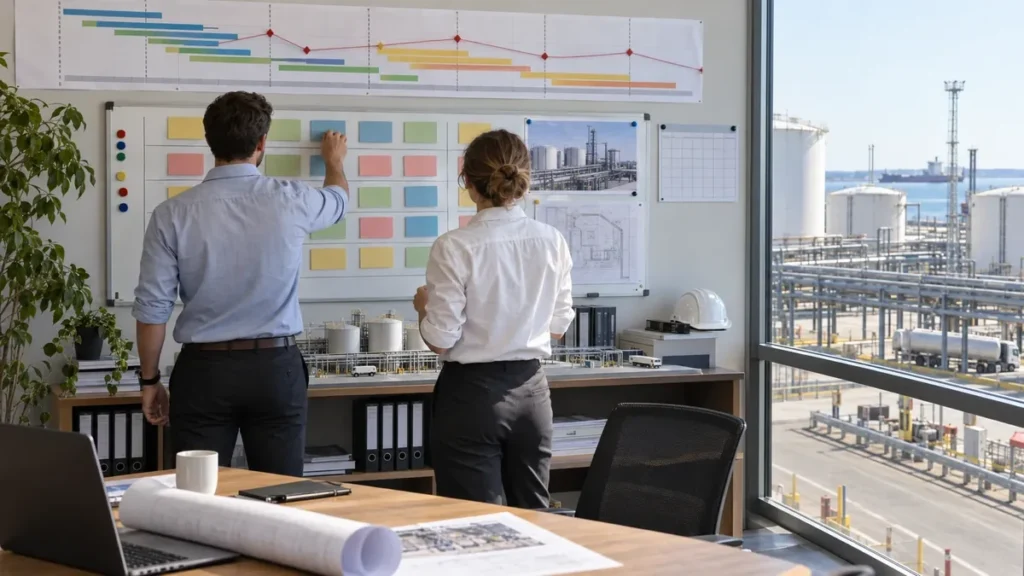
A plant announcement is not a schedule, it is a claim about a date that still has to survive several gates. A greenfield sustainable aviation fuel plant takes about 5 to 7 years from concept to first fuel, and on average four to six years before a greenfield facility reaches full capacity. Of that journey, the 2 to 3 years before the final investment decision (FID) decide whether the project exists at all, because 88 percent of the announced pipeline sits before that gate. So the SAF project timeline I work from is a sequence of proofs rather than a construction plan.
I am writing this for a developer at concept stage who wants to know why schedules slip. The honest answer is that almost nothing slips in construction; the slippage accumulates in the years of evidence that come before it.
In short
- Total: About 5 to 7 years from concept to first fuel on a greenfield plant, with four to six years on average before it reaches full capacity.
- Before FID: 2 to 3 years of development carrying 88 percent of the announced pipeline.
- Core phases: Conceptualization, feasibility and design, financing and FID, construction, commissioning and operation.
- Binding gates: The buyer agreement and feedstock must be in place at FID, not after it.
- Dates you do not control: Permits and policy, which is why contingency belongs in the plan from the start.
In this article
What a SAF project timeline actually measures
The question I hear most often at concept stage is how long this will really take. For a greenfield sustainable aviation fuel plant the answer is about 5 to 7 years from concept to first fuel, with four to six years on average before a greenfield facility reaches full capacity. The part that decides whether the project exists at all is the 2 to 3 years before FID, because 88 percent of the announced pipeline sits before that gate.
So I read a timeline as a sequence of proof rather than a construction schedule. Each phase has to produce evidence a lender will accept: a site, a technology choice, a cost estimate, permits, a signed offtake (the contract under which a buyer takes the plant’s output), committed debt and closed equity. When one item is late, every date after it moves.
The finance question follows the same order, so I write the finance plan and the schedule together: project finance comes down to which proof I can show at which moment.
What this means for you: I would not put a single completion date in front of a lender. I would put the gate sequence there instead and let the date fall out of it, because that is the version I can defend.
The phases, and how long each one takes
The World Economic Forum, with Kearney, sets out five phases for a greenfield SAF facility: conceptualization and pre-feasibility; feasibility and FEED (front-end engineering design); project financing and FID; construction and implementation; commissioning and operation. The durations attached to them are 6 to 12 months for conceptualization and pre-feasibility on HEFA (hydroprocessed esters and fatty acids) and 12 to 24 months on FOAK (first-of-a-kind), then 12 to 18 months for feasibility and FEED, 12 to 18 months for financing and FID, and 24 to 36 months for construction.
The e-fuels.com timeline for the same journey breaks it down further:
- Feasibility, 6 to 12 months: site selection, technology choice, preliminary economics.
- Pre-FEED, 6 to 12 months: process design, cost estimate of plus or minus 30 percent, environmental assessment.
- FEED, 12 to 18 months: detailed engineering, cost estimate of plus or minus 15 percent, permitting.
- FID and financial close, 6 to 12 months: offtake signed, debt committed, equity closed.
- Construction, 24 to 36 months: EPC (engineering, procurement and construction contract) execution, commissioning prep.
- Commissioning, 3 to 6 months: first fuel, ramp-up to nameplate capacity.
The total is 5 to 7 years, and every line buys something checkable: a site, a technology, a cost number, permits, a signed offtake, committed debt, closed equity.
What this means for you: I would date a phase by the output it delivers rather than the week it starts, because a phase with a missing output is not finished.
The years before FID, where schedules actually break
88 percent of the announced SAF pipeline sits before FID, and the bottleneck is the 2 to 3 years of development that come before it, not the construction that follows.
Sustainable Aviation Futures shows how many projects stop there: nearly 190 companies have evaluated SAF production across 330 facilities over the past decade, only about 10 percent are currently producing, which leaves 90 percent stuck between a feasibility study, full funding and facility start-up. That page is undated; it cites a June 2024 report and a February 2025 presentation, and I read it in November 2026.
ICAO Finvest Hub draws the same run, from concept development through feasibility, pre-FEED, FEED, FID and EPC to operations, with indicative spans of about 12 months, about 24 months and about 18 to 48 months. Its chart axis runs from 0 to 96 months since the start of the development cycle, and the deck states that most announced SAF projects globally sit at the early end of it.
What this means for you: I would assume that most of the delay risk in my plan sits in the pre-FID years, and I would staff and fund that part accordingly.
The four factors that move your FID date
WEF/Kearney name four factors that move the overall timeline: technology readiness level of the chosen pathway, location of the facility, experience of the operator, and external capital requirements.
Pathway comes first. HEFA is proven at commercial scale, while gasification-Fischer Tropsch and power-to-liquid facilities are likely to take substantially longer to be built, so FOAK conceptualization alone runs 12 to 24 months against 6 to 12 months for HEFA. Location comes next, because the site sets access to renewable power, feedstock and distribution, and immature infrastructure around it causes delays. Operator experience matters third: a sponsor on its third or fourth plant streamlines the early phases. Capital matters last, since raising money from several investors and development institutions takes time unless the sponsor can fund substantial equity itself, which is what venture capital in low-carbon fuels is built around.
HEFA co-processing is the one route that is fast: 2 to 3 years, because it uses existing refinery infrastructure.
What this means for you: I would score my own project on these four factors before I set a date, because the date is a function of them, not a preference.
Two gates of equal weight: feedstock and offtake
I treat feedstock and offtake as two pillars of the same gate, never as one being the real constraint while the other waits its turn.
On offtake: contracts in this market are still often non-binding memoranda of understanding, and a project needs contractually binding agreements to reach FID. That is why the offtake negotiation sits inside the FID phase rather than after it. When a schedule starts construction before binding offtake exists, that date has an unknown inside it. The mechanics are set out in how to secure SAF offtake agreements.
On feedstock: the WEF/Kearney matrix attaches feedstock risk to every phase, naming availability, high and volatile price levels and sustainability concerns. For HEFA the feedstock is used cooking oil, contested by biodiesel, renewable diesel and SAF itself, so HEFA maturity is a competition risk as much as a speed advantage.
What this means for you: I would run both tracks from concept stage in parallel, treating a signed offtake and a secured feedstock supply as conditions of the same gate rather than milestones to be ticked off in turn.
What happened to the projects that announced and never arrived
The February 2026 global capacity database is the clearest picture of what announcement is worth. Only 31 percent of announced capacity out to 2030 has reached at least FID, 48 percent remains at an early development stage, and 21 percent has been paused, cancelled or not updated.
The cohort due to be operational by the end of 2025 breaks down further: 29 percent realized, 30 percent failed or cancelled, 25 percent delayed to 2026 or later after advanced development, and 16 percent delayed to 2026 or later from early development. The realization gap grew from 7.0 million tonnes in 2024 to 11.6 million tonnes in 2025, while actual production moved from 1 million tonnes in 2024 to 1.9 million tonnes in 2025.
WEF/Kearney adds the pressure on the gate itself: 5.8 million tonnes of capacity would still need to pass FID by the end of 2026. As of August 2024, around 60 refineries had passed FID and were under construction while more than 200 sat between conceptualization and preparing for FID.
Announcement to operation is usually a capital distance, so I watch the two routes that close it as closely as the schedule: the bankability that unlocks debt and development finance institutions.
What this means for you: I would plan your own gates around whether you join the 31 percent that reaches FID or the 21 percent that stalls.
How I read a developer's schedule before I believe it
I do not read dates first, I read gates: what is signed, what is permitted, what is funded, what is proved. A schedule that shows construction starting while offtake is still a memorandum or permits are not secured contains an unknown date.
I test a schedule against two checklists. The WEF/Kearney matrix attaches policy, market, technology and feedstock risk to each phase, so I ask which risk is live in the phase the date depends on. The ICAO Finvest Hub bankability checklist covers project narrative, technology readiness, delivery capability, construction risk, infrastructure and permits, feedstock security, policy support, contracted revenue, creditworthy counterparties and capital structure. Anything on that list that is not yet true is a date that is not yet real.
I also check the regulatory line: policy risk in that matrix includes permits not secured on time, and regulatory timelines rarely align with project lifecycles, so a permit date is rarely yours to set.
What this means for you: I would hand a schedule to a lender only when every gate on those two lists has an owner and a date, because that is the version someone else can underwrite.
How I would plan backward from the FID date
I start from the FID date I need and subtract: FEED at 12 to 18 months, the financing and FID phase at 12 to 18 months, construction at 24 to 36 months, and commissioning at 3 to 6 months. The concept date then appears on its own.
Four moves make that arithmetic hold. Fix the pathway and the site early, because they set technology readiness and location risk. Put offtake and feedstock work at the front of the sequence, because both are binding conditions for FID rather than work that follows it. Keep real contingency, because permits and policy are the two dates you do not control. And treat the FOAK premium in time as a budget item rather than a delay, since conceptualization runs 12 to 24 months instead of 6 to 12 months.
What this means for you: I would publish the FID date last, once offtake, feedstock, site, pathway and contingency all have names against them, and I would let the concept date be the consequence of that chain rather than a promise made at the start.
Sources
- e-fuels.com, 12 February 2026.
- World Economic Forum, February 2025.
- ICAO Finvest Hub, October 2026.
- Sustainable Aviation Futures, undated, read November 2026.
- impact-on-sustainable-aviation.org, February 2026 update.
Frequently asked questions
How long does a SAF project take from concept to first fuel?
About 5 to 7 years from concept to first fuel for a greenfield plant, with construction of 24 to 36 months and commissioning of 3 to 6 months at the end. On average, four to six years pass before a greenfield facility reaches full capacity.
How long does the FEED phase take?
12 to 18 months in both the e-fuels.com table and the WEF/Kearney lifecycle figure, preceded by feasibility and pre-FEED work of 6 to 12 months each.
Why do two projects on the same pathway get different FID dates?
Because technology readiness, location, operator experience and external capital requirements all change the date. Conceptualization and pre-feasibility run 6 to 12 months for HEFA and 12 to 24 months for FOAK, and an inexperienced operator or a site with immature infrastructure adds time.
Does a first-of-a-kind plant take longer than a HEFA retrofit?
Yes. FOAK conceptualization alone runs 12 to 24 months against 6 to 12 months for HEFA, and advanced pathways such as gasification-Fischer Tropsch and power-to-liquid take substantially longer to be built, whereas HEFA co-processing can reach fuel in 2 to 3 years because it uses existing refinery infrastructure.
Want a second pair of eyes on your schedule?
A short call is usually enough to see where your project stands.
If you want a second pair of eyes on your own dates, I run that review as part of my project finance services, working gate by gate against the sequence above.
I do not provide investment advice or arrange investments. I act as a strategic advisor and facilitator.
Alex, Founder of WeConnect Asia
I help low-carbon fuel and carbon removal project developers in Southeast Asia secure the commercial and financial partners needed to reach FID.
Related articles

Pitching a Climate Tech Company to Strategic Investors: What the Corporate Has to Believe Before It Writes a Cheque
How to pitch a climate tech company to strategic investors: the metric cluster, the readiness evidence and the ask that corporates fund.
Biomethane: What It Is, How It Is Made and Who Buys It
Biomethane is biogas cleaned to pipeline quality. I explain how it is made, how it differs from biogas and who buys it in Southeast Asia.
CO2 Sourcing for e-SAF Projects: What the Rules Allow and What the Contract Must Say
Biogenic CO2, direct air capture or industrial flue gas: which sources an e-SAF plant may use, what they cost and which contract terms make the fuel certifiable.
Operating Performance Guarantees for SAF Plants: What Lenders Ask For
Minimum guarantees, performance damages, retesting and who stands behind them: the operating guarantees a SAF plant needs to keep debt and offtake intact.
EPC and Construction Risk in SAF Plants: What a Lender Actually Tests
FEED scope, convertible EPC, performance guarantees and damages caps: the construction risk questions a SAF project must answer before financial close.

Matching Feedstock and Offtake Risk Back-to-Back in a SAF Project: How Lenders Read the Chain
Lenders do not buy a feedstock plan and an offtake plan separately. They buy the link between the two, and the link is where most SAF files break.