
Home » Shipowner Credit Risk in Fuel Offtake: What a Lender Can Actually Check
Shipowner Credit Risk in Fuel Offtake: What a Lender Can Actually Check
10 min read · Nov 2, 2026 · By Alex
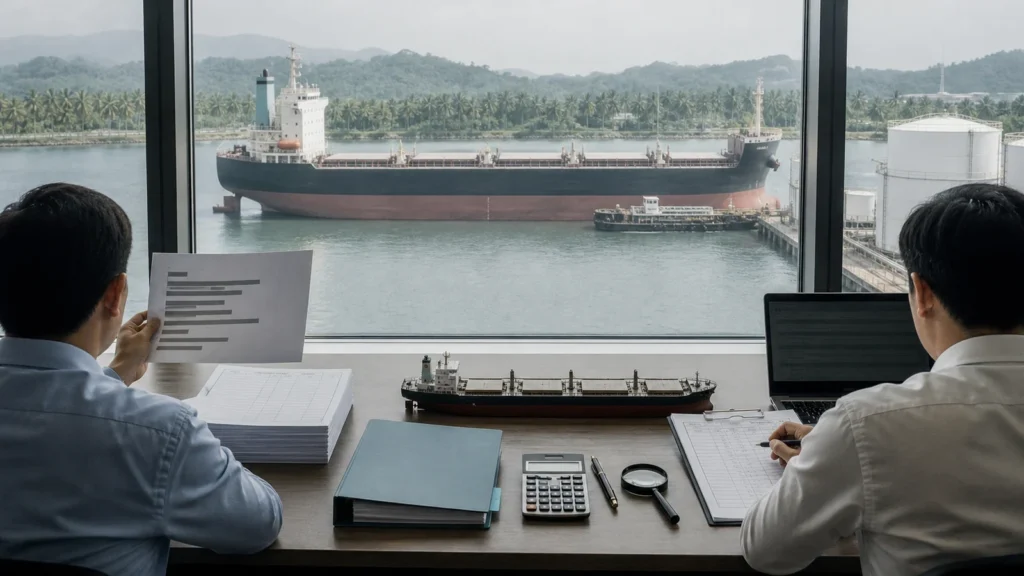
A shipowner’s credit standing is not a reputation question. It is three checks I can run on documents that exist. First, how much of the owner’s finance book is published: 95 percent of eligible portfolio activity was disclosed in the 2025 reporting round. Second, what the contract obliges the owner to hand over, and third, who carries the fuel cost when the contract price exceeds the model. The second is a covenant clause covering the same data the owner already gives to the regulator. Also, the third is a long-term offtake, often above 1 million dollars over 10 years or more. That is shipowner credit risk in practice, and I start from the published sub-hub for this branch.
None of these three checks needs a new disclosure exercise, a new model or a new relationship with the owner. Each sits in a document I can request, date and file. I keep them apart in the credit note, because merging them is how a measurement turns into an assumption.
In short
- Disclosure: 95.1 percent of reported activity on average across the 35 signatories that reported in 2025.
- Alignment score: 11.7 percent above the minimum trajectory on average in 2025, a measurement rather than a decision.
- Contract data: a standard covenant clause obliges the owner to hand over the operational data filed each year.
- Cost exposure: a long-term offtake often runs above 1 million dollars over 10 years or more.
- Commitment horizon: buyers hesitate beyond 2 to 3 years while a construction loan runs much longer.
In this article
What the credit question has to decide
A lender, a development finance institution or an export credit agency, the state body that insures or finances a buyer’s purchase in support of exports, is asked to accept a fuel offtake signed with a shipowner. An offtake agreement is the contract by which a buyer commits to take a stated volume of fuel over a stated period. In addition, the question in front of me is whether that owner is still paying at the end of it. I reduce the decision to three checks: how much of the owner’s finance book is published, what the loan documents oblige the owner to hand over, and who absorbs the fuel cost when the contract price runs above the model.
Each check already sits in a document I can request, date and file. In addition, none of them is a test of reputation or of relationship length. An owner can clear all three and still be declined for reasons outside them.
What this means for you: treat the offtake as a credit question with three dated answers. In addition, send back any answer that arrives as an assurance rather than as a document.
What the lender already has in the file
The 2025 Annual Disclosure Report of the Poseidon Principles gives the whole file in one table. In the 2025 round, 35 out of 36 signatories reported, averaging 95.1 percent of activity, with 29 signatories at 90 percent or above and nine at 100 percent. The average score against the minimum trajectory of the 2023 greenhouse gas strategy was 11.7 percent misaligned, from minus 12.7 percent to plus 44.0 percent, with 16 out of 35 at plus 10 percent or lower. In addition, three aligned at zero or below. The average improved by 7.7 percentage points in one year; against the striving trajectory it stood at 18 percent; the cargo-only average was 6.2 percent, from minus 5.2 percent to plus 21.0 percent.
A climate alignment score compares the emissions intensity of a portfolio with a published decarbonisation trajectory. In addition, a positive score means the portfolio sits above it. A reporting percentage is the share of eligible activity actually disclosed. In lending tied to ships of 5,000 gross tonnage, a measure of total internal volume. In addition, above. The maritime fuel bankability page is where that measurement enters my file.
What this means for you: ask for the disclosure rate and the score, both with their dates, before you ask anything about the fuel. That is because both already sit in a published report. In addition, neither is a refusal of credit.
What the contract makes the owner hand over
The framework briefing slides describe the instrument that turns disclosure into an obligation. A signatory includes a standard covenant clause, a binding agreement written into the financing, in all new shipping business activities, so that high quality data can be accessed. The data requested is the same information the client already submits to the Data Collection System of the International Maritime Organization. Therefore, the administrative burden does not grow. Scores are due to the secretariat no later than 15 November each year and are then published in the signatory’s own reports. Intensity counts in grams of CO2 equivalent per tonne-nautical mile through the Annual Efficiency Ratio, built from fuel consumption, distance travelled and deadweight at maximum summer draught against a well-to-wake factor, that is, production through combustion. Entry cost 12,000 euros in 2025 and the annual fee was 10,000 euros.
The data path runs from the shipowner through the recognised organisations to the lender, and the owner who cannot produce it on demand is the owner who delays the drawdown. The page on securing offtake agreements covers the clause itself.
What this means for you: read the covenant clause before you read the offtake, because the fuel contract only performs if the reporting obligation behind it survives the first reporting cycle.
What happens when the fuel costs more than the model
The Global Maritime Forum analysis of compliance pooling states the blocker plainly. Most planned fuel production facilities have not reached final investment decision. In addition, the key obstacle is the lack of long-term offtake agreements generally required to secure financing. For shipowners, a long-term offtake contract often runs above 1 million dollars over 10 years or more, a level of financial and operational risk that only a limited number of owners are willing or able to take.
The compliance fee under FuelEU Maritime is 2,400 euros a tonne of very low sulphur fuel oil equivalent, and 2026 was the first compliance year for ships sailing with or inside the European Union. Compliance pooling balances compliant and deficit ships in one fleet and works as demand aggregation: multi-year commitments, more stable price structures and stronger commercial entities, while the cost gap. In addition, the supply constraints stay where they are. The marine fuel offtake page is where that gap sits between the two parties.
What this means for you: price the compliance fee into the model and write in the contract which party absorbs it when the contract price runs above the model you both signed up to.
What the mandate does to the counterparty
The 2024 Annual Disclosure Report of the Poseidon Principles shows the weight behind the counterparty. Bank lending represents approximately 62 percent of all types of financing for the global shipping industry and is often the lowest cost source of capital for shipowners. The framework represented approximately 240 billion dollars, or nearly 80 percent of global shipping finance, with about 70 percent from Europe and North America and 30 percent from Asia-Pacific, and 35 signatories from 14 countries at that date. Also, the same four principles inspired the Sea Cargo Charter, the marine insurance version of the framework and the disclosure principles written for steel, aluminium and aviation.
A mandate converts an optional disclosure into a condition of doing business. The 15 December 2025 announcement records 95 percent of eligible portfolio activity disclosed against 93 percent in 2024, the average score against the minimum trajectory moving from over 19 percent to just under 12 percent, cargo segments from 14 percent to 6 percent and passenger segments from 38 percent to 26 percent, with the methodology accepted inside the net-zero standard of the Science Based Targets initiative. The low carbon fuel mandates page sets out the obligations that follow.
What this means for you: check which mandate applies to this owner and since when. That is because a disclosure that has become a condition changes what you can refuse. In addition, what you can only price.
Where the public lender fits
The European Investment Bank and Roland Berger study, based on a consultation of 34 companies drawn from a long list of more than 100, explains the hesitation. Promoters struggle to secure offtake volumes at prices that reassure lenders about repayment capacity; buyers hesitate to commit beyond 2 to 3 years while the construction loan runs much longer. In addition, even with long-term offtakes, some first-generation buyers are not judged sufficiently solvent by lenders. That mismatch between the commitment horizon and the funding horizon is the position I am usually asked to sit in.
Investors in that same study worry about weak returns and high initial capital for first-of-a-kind industrial deployments, the most expensive stage, and about obsolescence: the marine fuel that ships will burn is still undecided between ammonia, methanol and bio-based liquefied natural gas. Therefore, a plant built for one route can lose its buyer. The infrastructure project finance page is where a public lender prices that risk.
What this means for you: when the public lender is the one absorbing the tenor mismatch, ask which buyer, which fuel route and which price the offtake actually fixes, and date every answer.
The five questions I ask before I accept an owner's credit
I put these five questions in writing before I open the file on a fuel offtake. None of them asks for a new disclosure; each asks for a document, a date and a named owner of the risk. This is where shipowner credit risk becomes a checklist instead of a judgement.
- How much of this owner’s finance book is published, and since when?
- What does the covenant clause oblige the owner to hand over, and how often?
- Also, What is the offtake worth over its tenor against the owner’s own balance sheet?
- Who takes the fuel cost when the contract price exceeds the model?
- Which mandate turns the disclosure into a condition of doing business?
What this means for you: five dated answers give you a file you can defend. In addition, any question left open here will reappear as a condition precedent later, at a worse moment.
The credit note I would write for my own file
Four rows, each carrying its own date, and nothing else goes in unless I can date it as well. A row without a source does not get a conclusion, and a conclusion without a row does not get signed.
- Disclosure row: 95 percent of eligible portfolio activity reported in 2025.
- Score row: 11.7 percent misaligned against the minimum trajectory in 2025.
- Contract row: a long-term offtake often above 1 million dollars over 10 years or more, recorded on 17 November 2026.
- Tenor row: buyers committing 2 to 3 years against a construction loan that runs longer. From a study dated May 2024.
What this means for you: write your own four rows before you write the memo, and let the gaps in the rows tell you which questions to put to the owner next.
Sources
- Poseidon Principles Annual Disclosure Report 2025, December 2025.
- Also, Poseidon Principles framework briefing slides, 2025.
- Poseidon Principles Annual Disclosure Report 2024, December 2024.
- European Investment Bank and Roland Berger, May 2024.
- Global Maritime Forum compliance pooling, consulted 17 November 2026.
Frequently asked questions
Is a good climate alignment score a guarantee of finance?
No. A climate alignment score is a measurement of a portfolio against a decarbonisation trajectory, where a positive score means the portfolio sits above that trajectory, and it informs credit decisions without replacing them. The average in 2025 was still 11.7 percent above the minimum trajectory, so even a favourable score describes a position rather than an approval, and no score has ever been a lending decision on its own.
What does a covenant clause actually require?
That the signatory includes a standard covenant clause, a binding agreement written into the financing, in all new shipping business activities so that high quality data can be accessed, using the same information the client already submits to the Data Collection System of the International Maritime Organization. In practice the clause fixes the data path, the cadence and the consequence of a missing report.
Why do owners refuse long-term fuel offtakes?
Because a long-term offtake often runs above 1 million dollars over 10 years or more, a level of financial and operational risk that only a limited number of owners are willing or able to carry, while buyers in the market hesitate to commit beyond 2 to 3 years. The owner is asked to hold a commitment that the other side of the market will not match.
What can a lender verify without asking for new data?
The reporting already published: the share of eligible portfolio activity disclosed each year, the alignment score and the trajectory it is measured against, and the data the owner already gives to the recognised organisations under the mandatory reporting rules. All three are dated, repeatable and independent of anything the owner chooses to tell me in a meeting.
Not sure your project would survive a credit conversation?
A short call is usually enough to see where your project stands.
If you are drafting the offtake side of this file. I take the clause language, the counterparty checks and the cost-gap wording through to a version a lender can price. the offtake agreements service is where I do that work.
I do not provide investment advice or arrange investments. Also, I act as a strategic advisor and facilitator.nd facilitator.

Alex, Founder of WeConnect Asia
I help low-carbon fuel and carbon removal project developers in Southeast Asia secure the commercial. In addition, financial partners needed to reach FID.
Related articles

Pitching a Climate Tech Company to Strategic Investors: What the Corporate Has to Believe Before It Writes a Cheque
How to pitch a climate tech company to strategic investors: the metric cluster, the readiness evidence and the ask that corporates fund.

Biomethane: What It Is, How It Is Made and Who Buys It
Biomethane is biogas cleaned to pipeline quality. I explain how it is made, how it differs from biogas and who buys it in Southeast Asia.

CO2 Sourcing for e-SAF Projects: What the Rules Allow and What the Contract Must Say
Biogenic CO2, direct air capture or industrial flue gas: which sources an e-SAF plant may use, what they cost and which contract terms make the fuel certifiable.

Operating Performance Guarantees for SAF Plants: What Lenders Ask For
Minimum guarantees, performance damages, retesting and who stands behind them: the operating guarantees a SAF plant needs to keep debt and offtake intact.

EPC and Construction Risk in SAF Plants: What a Lender Actually Tests
FEED scope, convertible EPC, performance guarantees and damages caps: the construction risk questions a SAF project must answer before financial close.

Matching Feedstock and Offtake Risk Back-to-Back in a SAF Project: How Lenders Read the Chain
Lenders do not buy a feedstock plan and an offtake plan separately. They buy the link between the two, and the link is where most SAF files break.